ResQLink AI – Smart Emergency Response Network
Bridging Witnesses, Drivers, and Hospitals for Real-Time, Life-Saving Actions
Inspiration
Every second matters in a life-threatening accident. We realized:
- 50% of trauma-related deaths occur within the golden hour.
- 40% of witnesses hesitate or fail to report accidents effectively.
- 30% of ER resources are misallocated due to unstructured pre-arrival data.
ResQLink AI empowers witnesses, first responders, and hospitals with AI-powered tools for real-time, structured, and intelligent emergency response.
What It Does
ResQLink AI is an end-to-end, AI-powered accident response enhancement system that:
- Allows witnesses to report accidents via voice, text, or image using a SOS-enabled interface.
- Uses NLP to extract injury-related keywords from descriptions.
- Applies Computer Vision to detect injury severity and affected body parts from images.
- Integrates Google Gemini AI to:
- Suggest nearest hospitals
- Recommend real-time first aid
- Notifies hospitals in advance with AI-generated triage to prepare appropriate care.
- Driver Assignment System:
- Assigns the nearest available driver using a min-heap queue.
- Displays shortest route to the accident and to hospitals using Dijkstra's Algorithm.
- Sends first-aid guidelines and injury insights to the assigned ambulance driver.
System Architecture
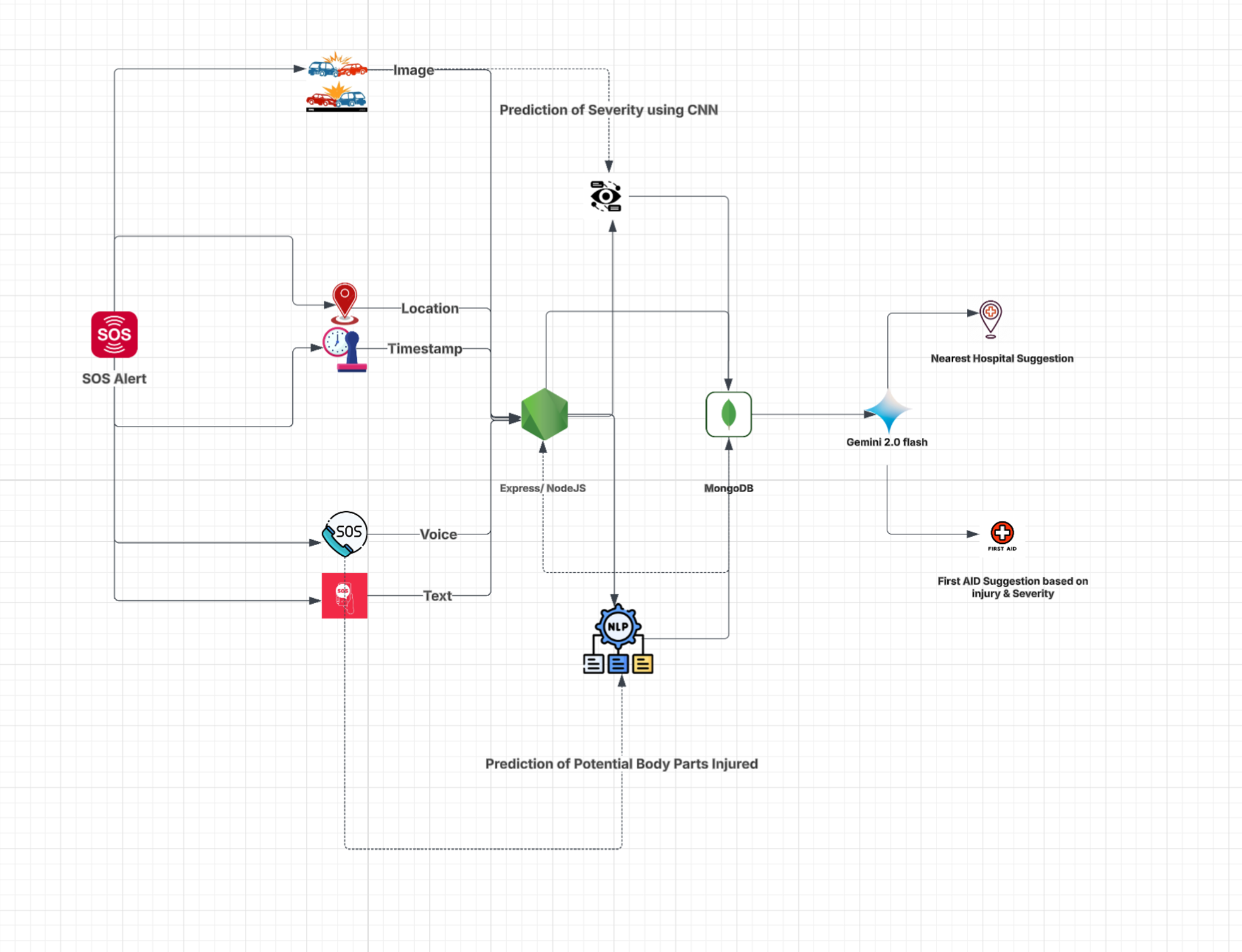
Base Architecture Diagram
Description
The diagram above illustrates the end-to-end architecture of the ResQLink AI system:
- SOS Alert Trigger: A user initiates an alert via voice, text, or image.
- Timestamp and Location are captured immediately and routed to the backend.
- Image Processing: If an image is submitted, it is passed through a CNN-based Computer Vision model to assess the severity of the accident.
- Text/Voice Processing: Textual or voice input is analyzed using NLP models to predict the potential body parts injured.
- Backend API: All inputs are processed by a backend system built using Express/Node.js.
- Data Handling: All relevant data is stored and managed in MongoDB.
- Google Gemini AI Integration:
- Suggests the nearest hospital based on injury severity and geolocation.
- Provides first-aid recommendations tailored to the reported injuries and severity.
Key AI Features
| Capability | Technology Used |
|---|---|
| Injury NLP Extraction | Custom NLP Pipelines |
| Image-based Diagnosis | Computer Vision (CNN) |
| Hospital/First Aid | Google Gemini AI |
| Route Optimization | Dijkstra’s Algorithm |
| Driver Assignment | Min-Heap Priority Queue |
Tech Stack
| Component | Tools & Technologies |
|---|---|
| Frontend | React.js, Tailwind CSS |
| Backend | Flask (AI), Node.js + Express.js (API) |
| AI & ML | NLP, Computer Vision, Google Gemini AI |
| Infrastructure | Docker, GitHub, Cloud Deployment |
How We Built It
- Developed frontend using React and Tailwind CSS for a clean UX/UI.
- Built modular backend using Flask (Python) and Node.js/Express.
- Trained and deployed NLP and Vision AI models.
- Integrated Google Gemini AI for hospital and first-aid recommendations.
- Dockerized microservices for scalable cloud deployment.
- Designed ambulance driver interface using Dijkstra’s algorithm for route optimization.
Challenges Faced
- Processing inconsistent or incomplete witness reports.
- Training accurate image classifiers for injury severity detection.
- Reducing latency in AI processing and Google Gemini integration.
- Handling high traffic and ensuring real-time scalability.
- Lack of time to design a fully interactive UI.
Accomplishments
- Created a full-stack AI-powered emergency response system.
- Integrated NLP, Computer Vision, and Google Gemini AI.
- Implemented AI-based hospital alerting and triage.
- Used Dijkstra’s Algorithm and min-heap queue for driver routing.
- Built scalable, cloud-deployable microservices using Docker.
What We Learned
- The importance of structured reporting in emergency response.
- The role of AI in transforming hospital coordination and triage.
- The potential of NLP and Computer Vision in real-world accident detection.
- Scalability challenges when handling real-time emergency data.
- How Google Gemini AI can enhance emergency recommendations.
What’s Next for ResQLink AI
- Add live video analysis using extended Computer Vision models.
- Enable multi-language support for NLP pipelines.
- Integrate IoT data from vehicles and wearables for automated accident detection.
- Use blockchain to secure and track emergency incident records.
- Implement predictive AI models to identify accident-prone areas.
Scalability Vision
- Use cloud services (AWS, Azure, GCP) for global deployment.
- Integrate Kafka and the ELK Stack for real-time data streaming and monitoring.
- Deploy containerized microservices using Docker and Kubernetes.
- Incorporate Edge AI for low-latency, on-site accident analysis.
Final Vision
A global, AI-driven emergency response network that empowers witnesses, drivers, and hospitals with real-time, life-saving decision support.

Log in or sign up for Devpost to join the conversation.