-
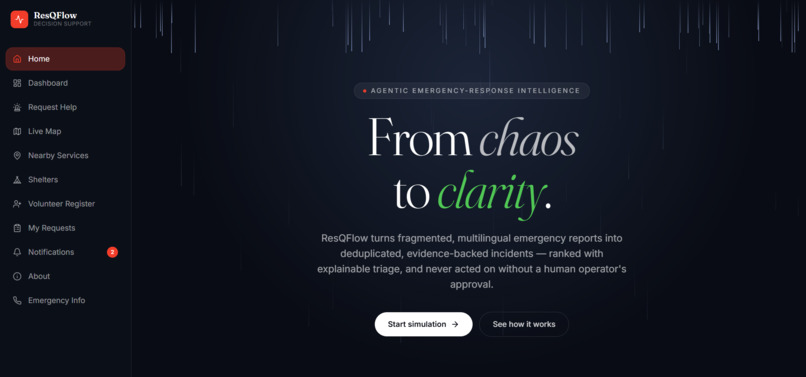
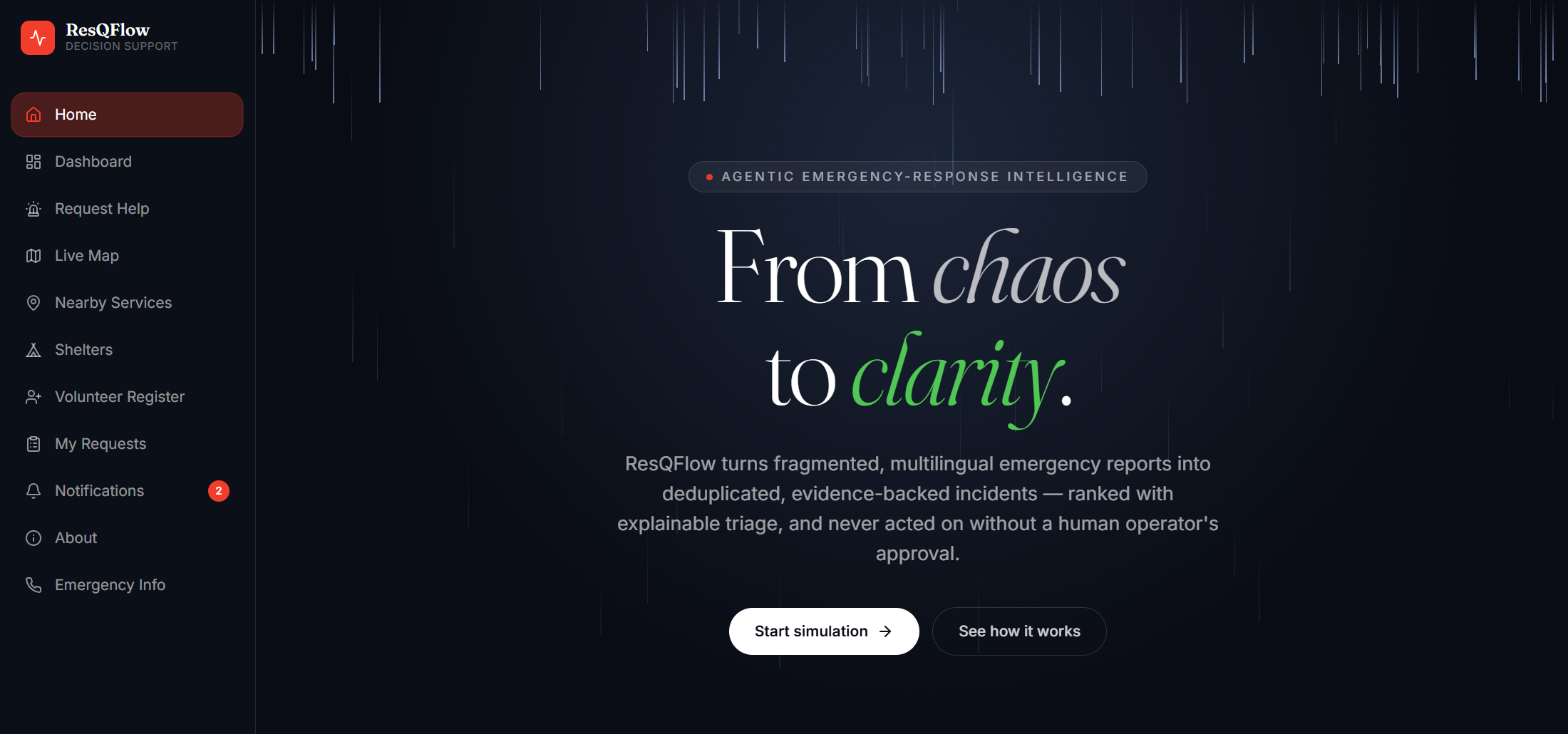
ResQFlow: an AI emergency command center that triages incidents, routes responders and keeps every team in sync, live.
Inspiration
During floods and other disasters, help is often delayed by messy information, not by a lack of responders. Reports arrive as voice notes, texts and photos in different languages, the same incident gets reported ten times, and control rooms waste critical minutes sorting it all out. We wanted to close the gap between "someone called for help" and "help is on the way."
What it does
-ResQFlow is an agentic AI emergency-response platform that turns scattered, multilingual reports into one live command center.
- Understands messy reports: voice, text and image reports, including code-mixed language, are converted into structured incidents.
- Removes duplicates: repeated reports of the same event merge into a single evidence-backed incident.
- Triages by priority: a deterministic scoring system ranks incidents so the most urgent ones come first.
- keeps a human in control: the AI recommends, and a human verifies or rejects before any task is dispatched.
- Shows everything live: a real-time map, priority queue and live report feed keep every team on the same page.
- Serves the public too: people can request help, find nearby services and shelters, and volunteers can register to assist.
How we built it
- Frontend: a dark "Tactical Command Center" UI with a live report feed, priority triage queue and interactive map (Leaflet + OpenStreetMap, no API key needed).
- Backend and data: real-time storage and sync of incidents, requests and notifications.
- AI agents: separate agents handle intake, extraction, deduplication and triage recommendations, with deterministic rules deciding priority so results are predictable and explainable.
- Simulation mode: a built-in flood simulation lets us demo the full flow without waiting for a real emergency.
Challenges we ran into
- Making AI output reliable enough for emergencies, which is why we kept triage deterministic and added human approval.
- Handling multilingual and code-mixed reports with inconsistent location details.
- Merging duplicate reports without losing important evidence.
- Building a full multi-page system solo within a short hackathon window.
What we learned
- Trust matters more than automation in life-critical tools. AI should assist decisions, not make them alone.
- A clear demo flow and a tight scope beat adding more features.
- Real-time maps and queues make complex data much easier to act on.
What's next for ResQFlow
- Direct integrations with emergency helplines and SMS/WhatsApp intake.
- More regional languages and offline-friendly access for low-connectivity areas.
- Predictive resource planning (boats, medical teams, shelters) before a disaster peaks.
- Pilot testing with local volunteer and disaster-management groups.
Built With
- ai
- base44
- css3
- generative-ai
- html5
- javascript
- leaflet.js
- llm
- openstreetmap
- react
- rest-api
- tailwind-css


Log in or sign up for Devpost to join the conversation.