-
-
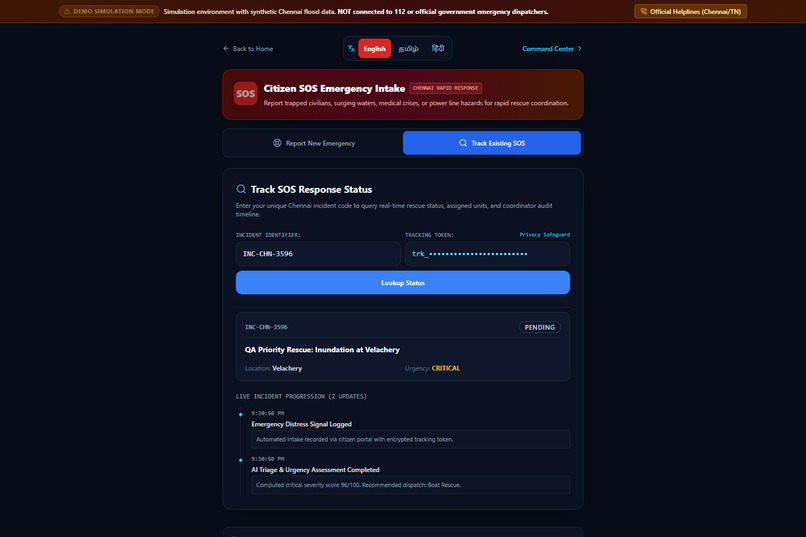
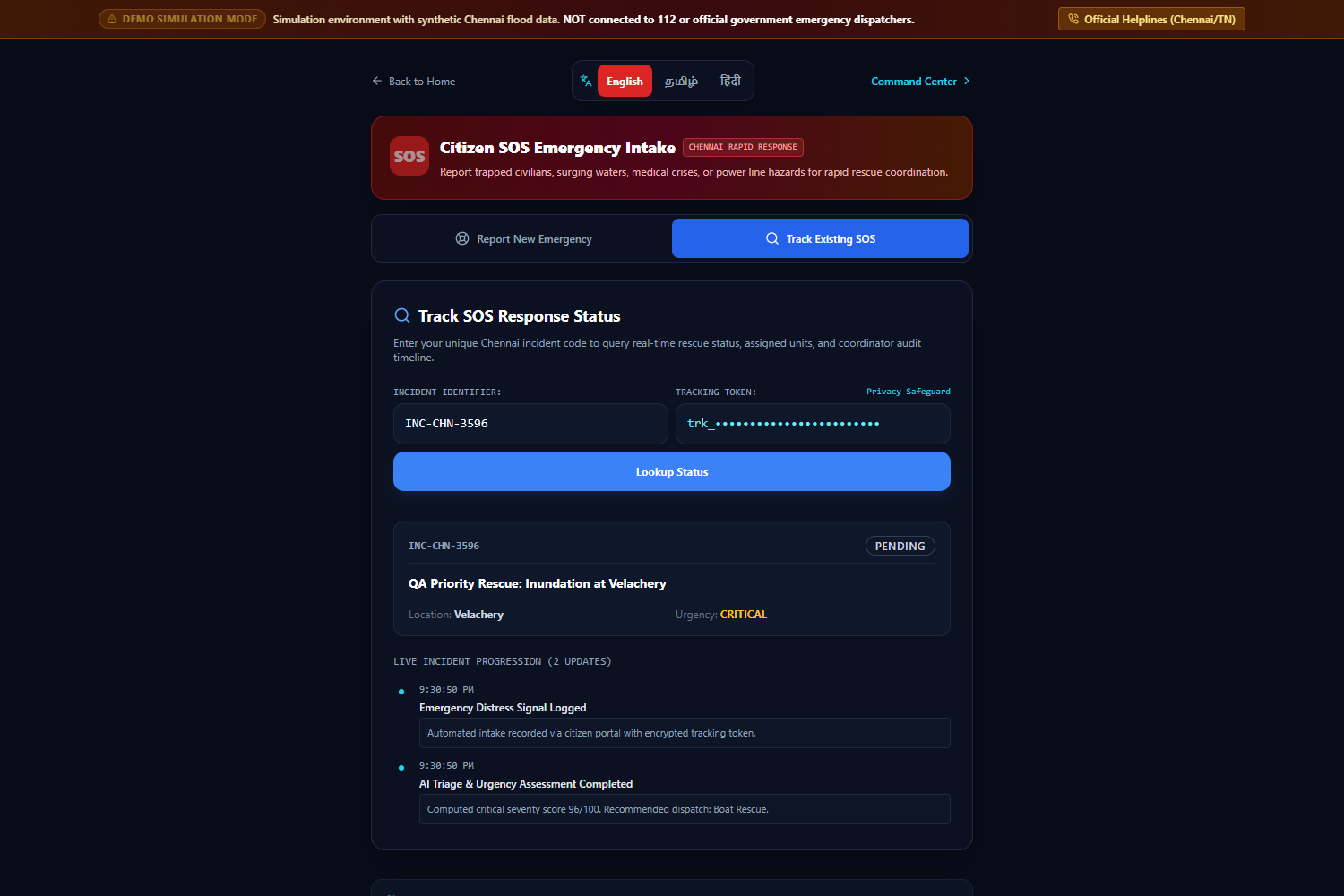
Secure SOS tracking lets citizens check incident status and view recorded progress updates.
-
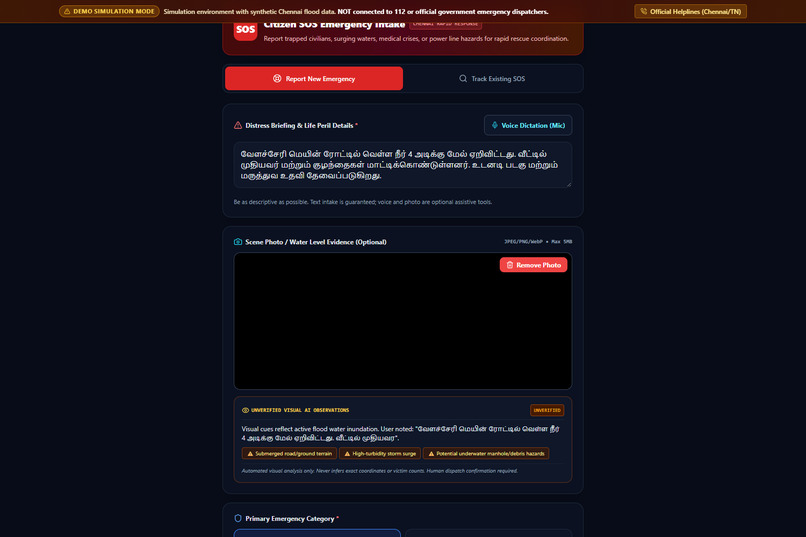
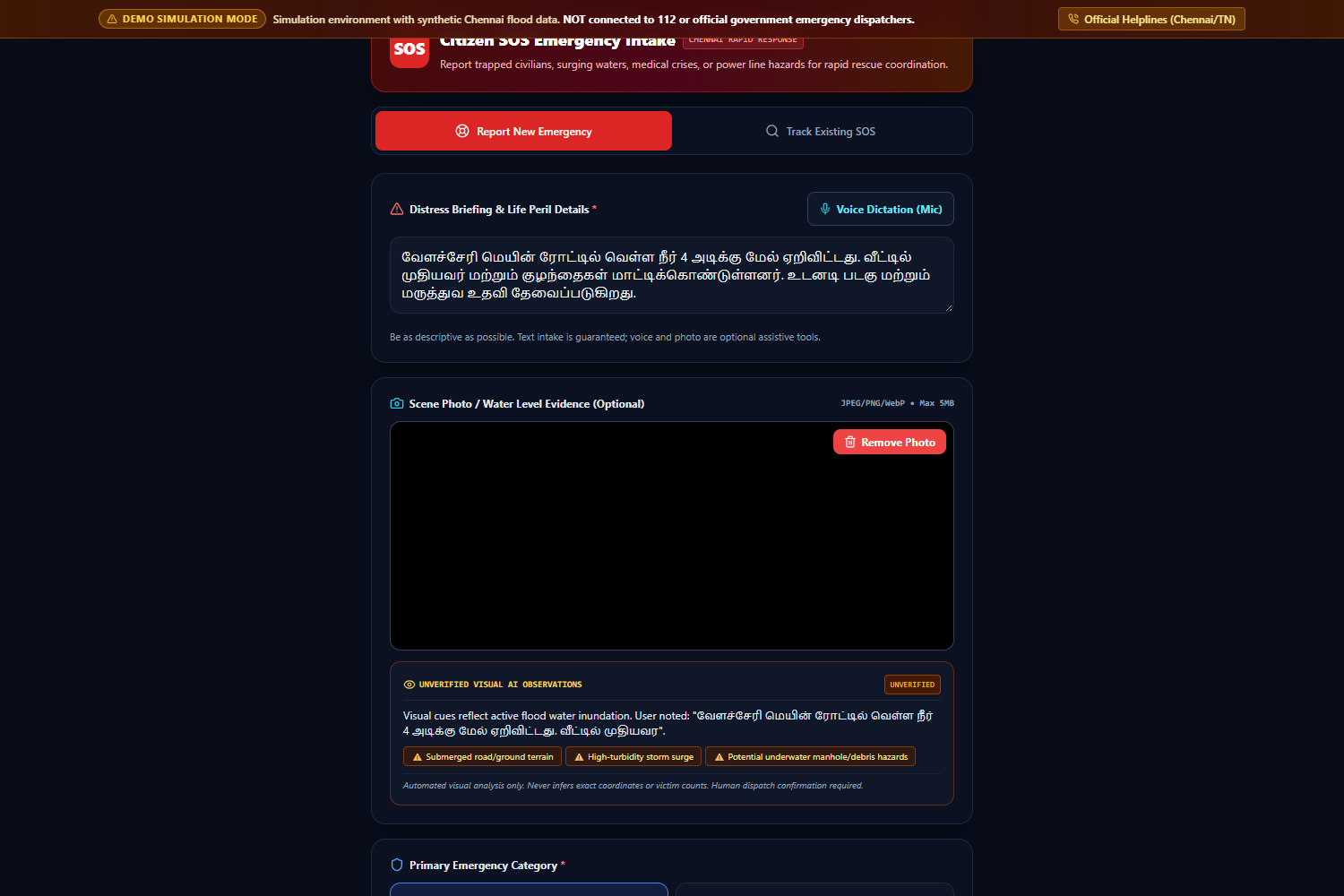
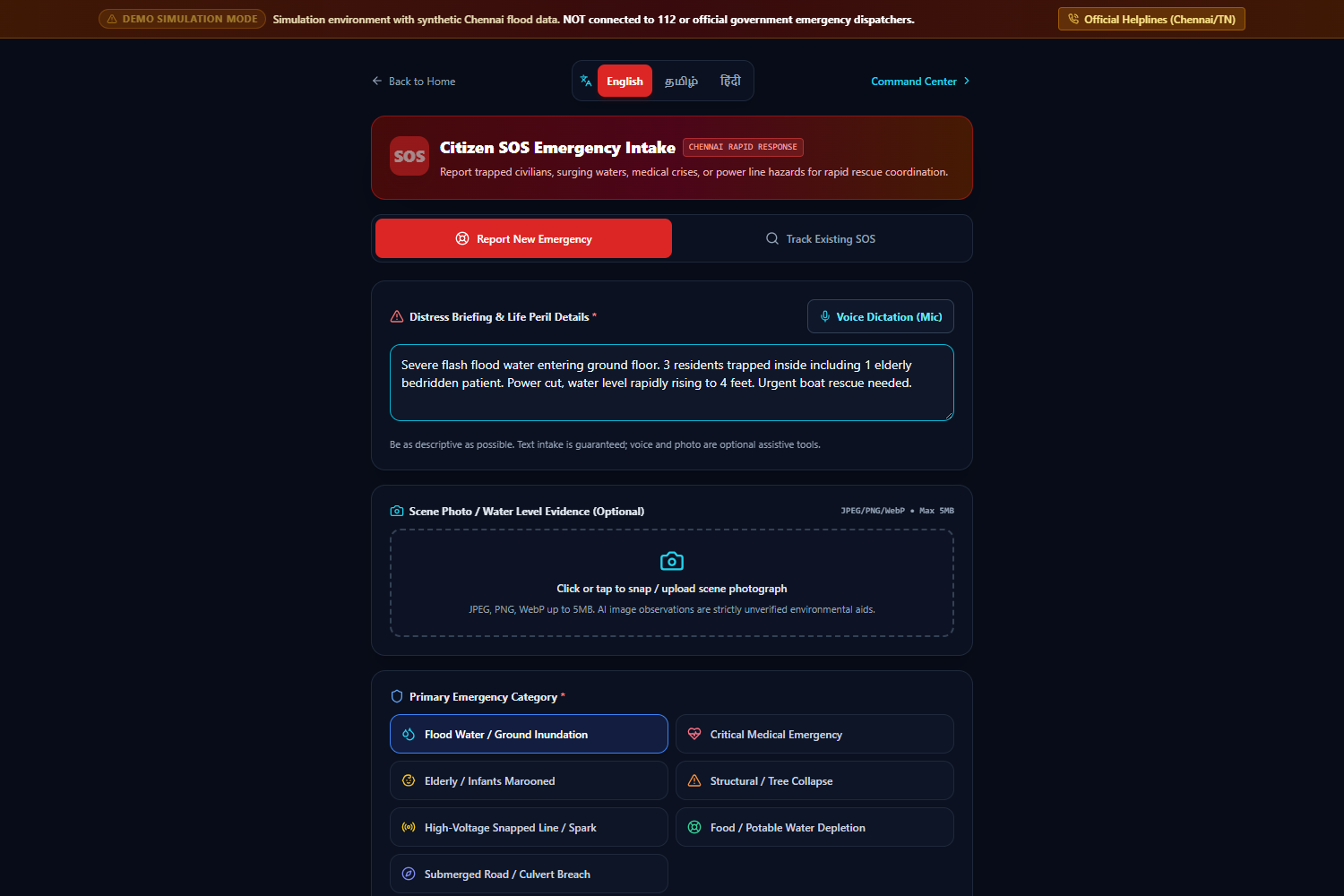
Optional voice dictation and photo uploads help capture emergency details, with AI visual observations marked unverified.
-
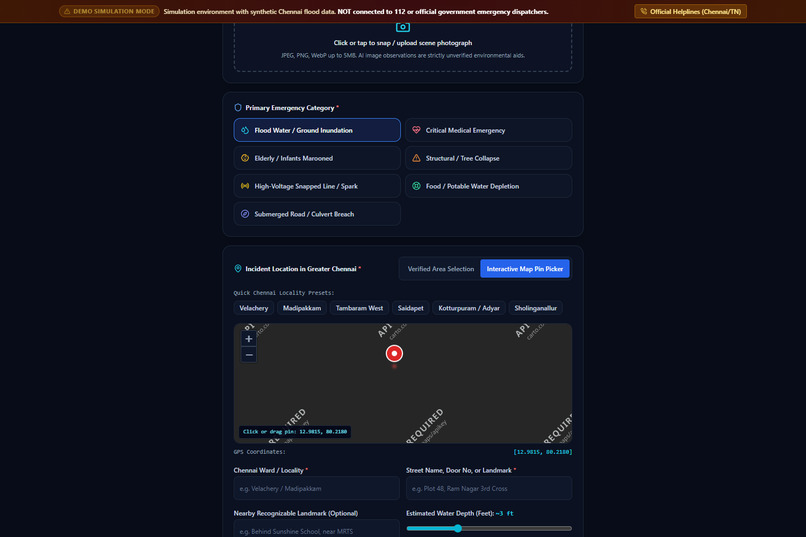
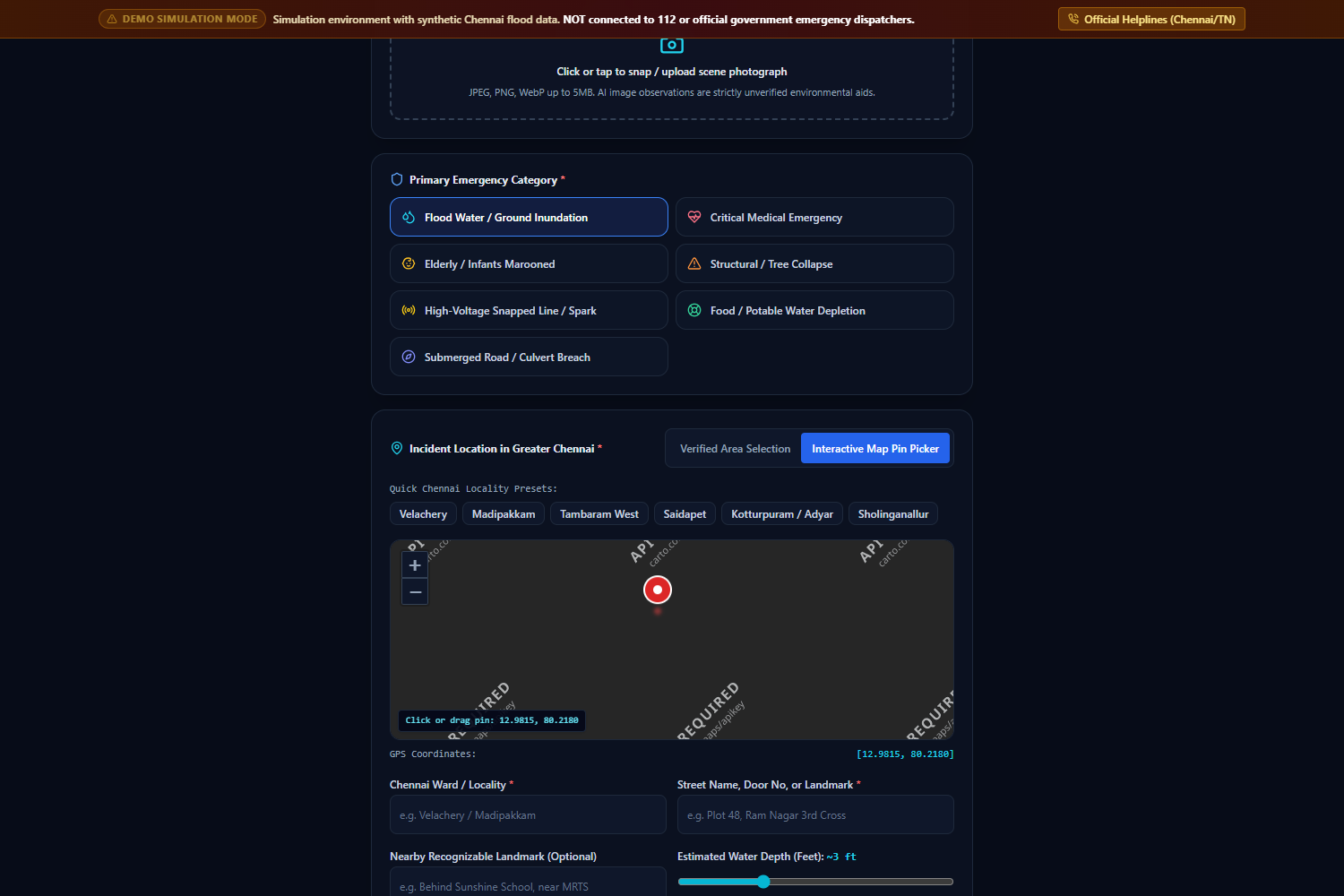
Pinpoint emergency locations using an interactive map, Chennai locality presets, and estimated water depth.
-
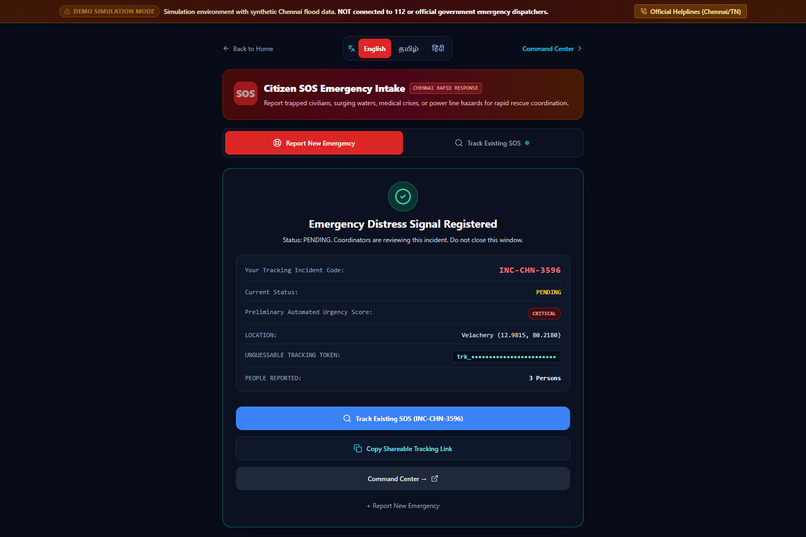
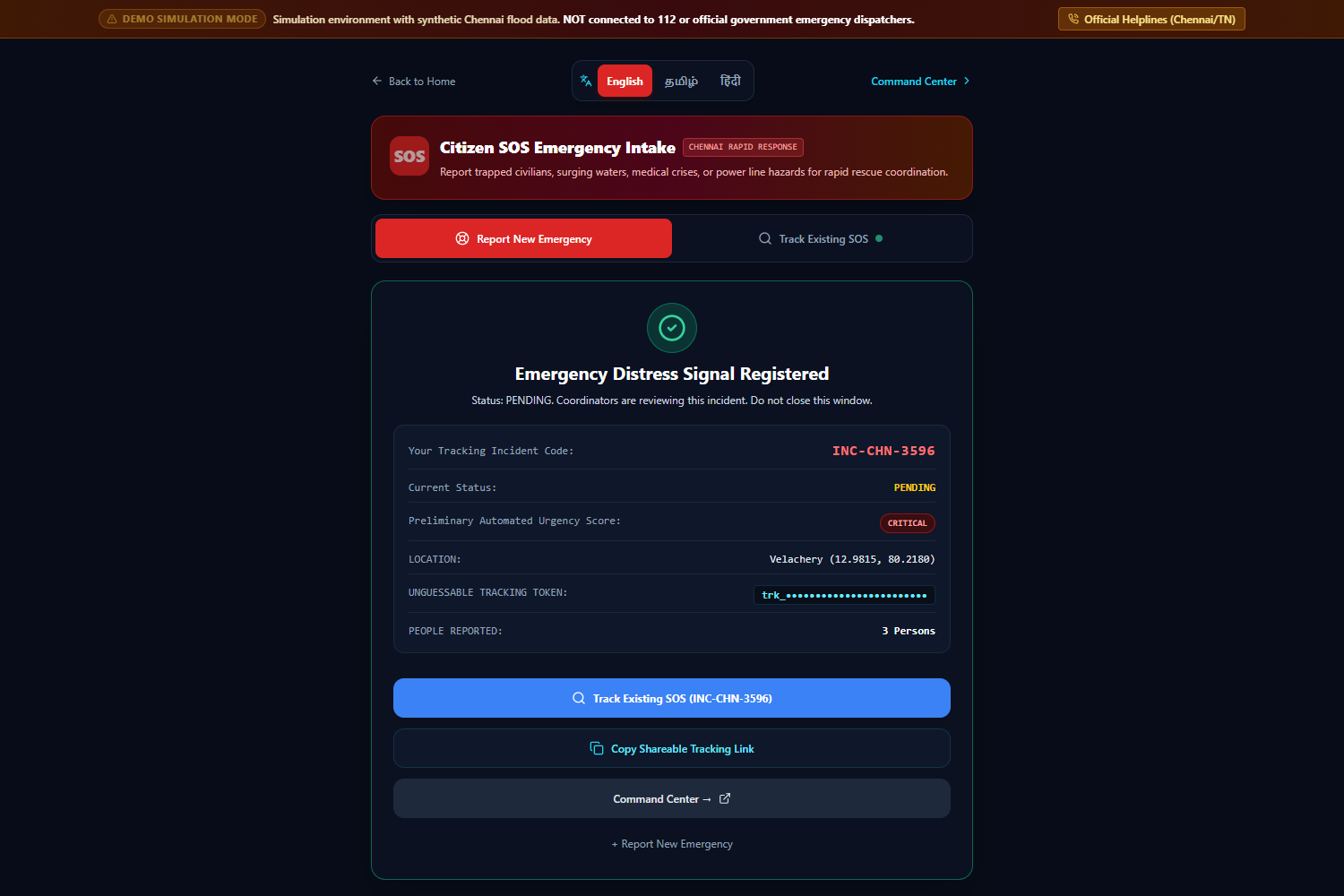
Emergency report registered with an incident ID, urgency assessment, and secure citizen tracking token.
-
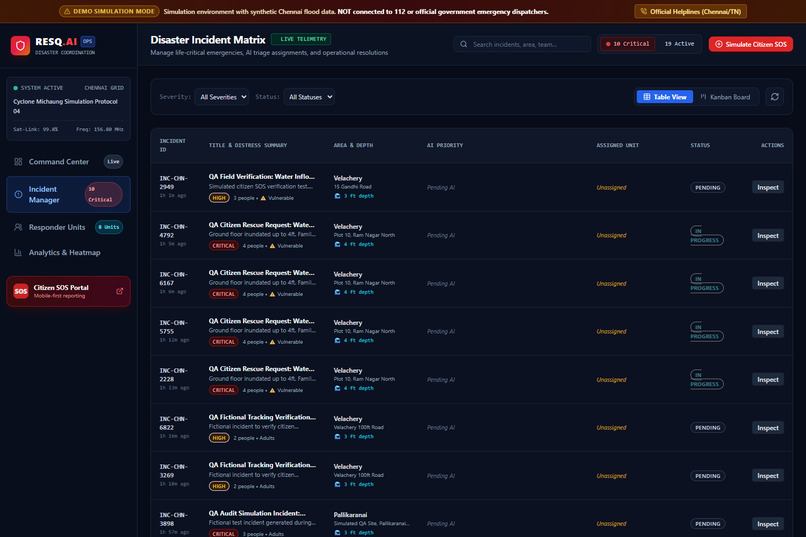
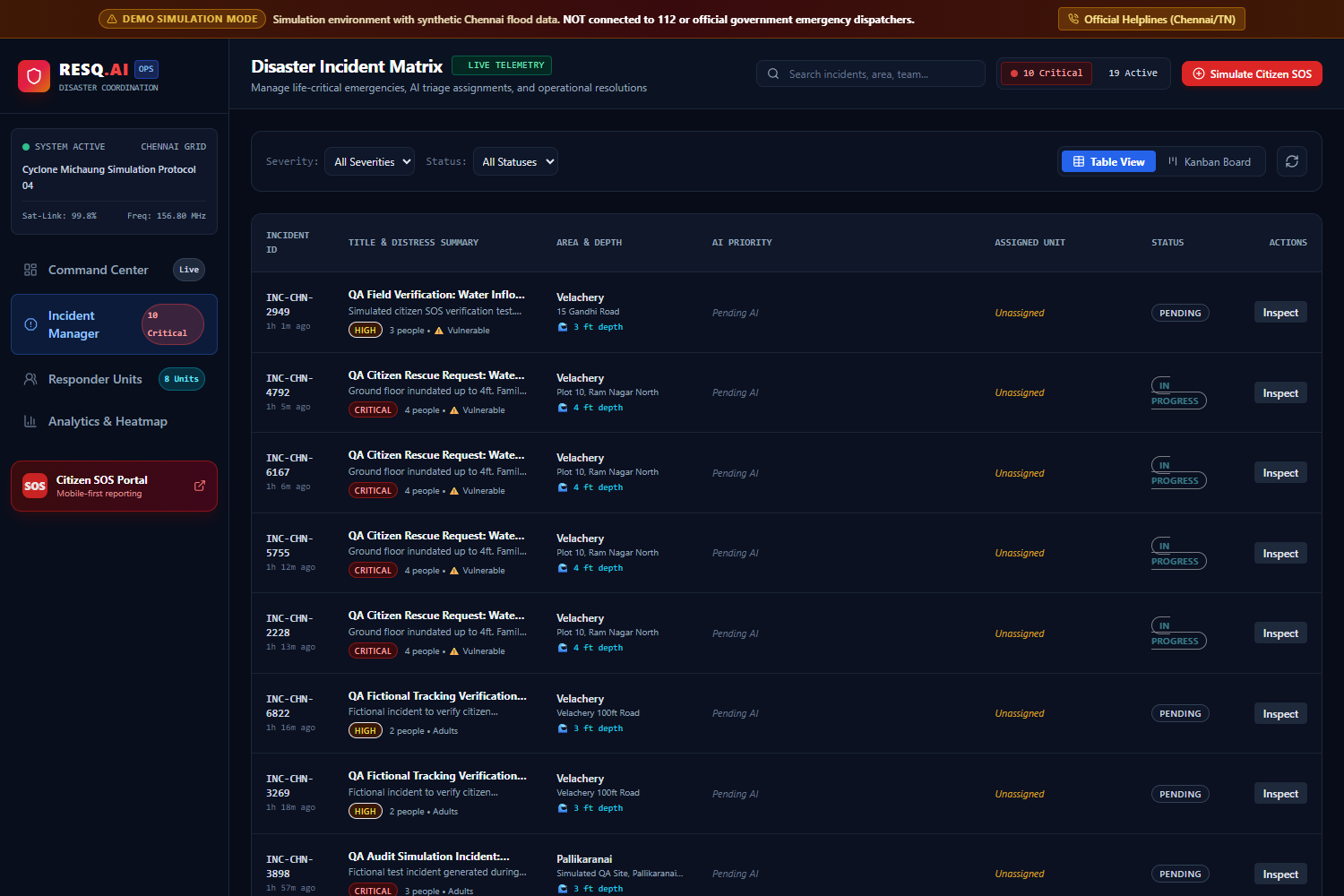
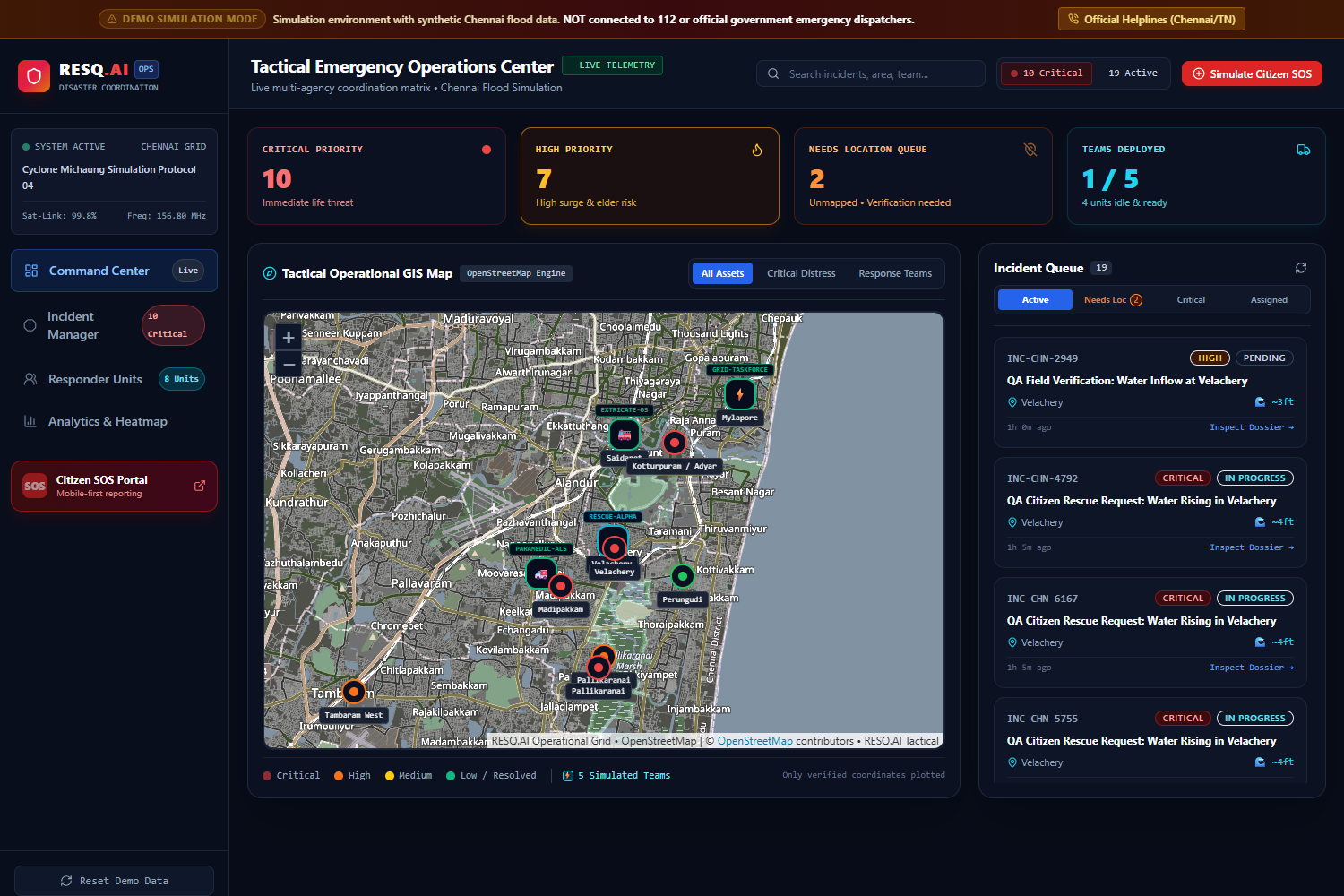
Manage emergency incidents by priority, status, location, and team assignment through a unified incident workspace.
-
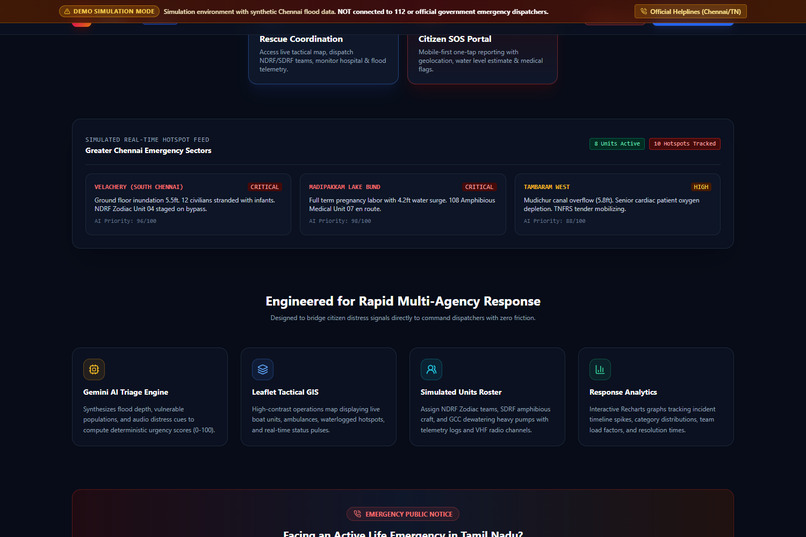
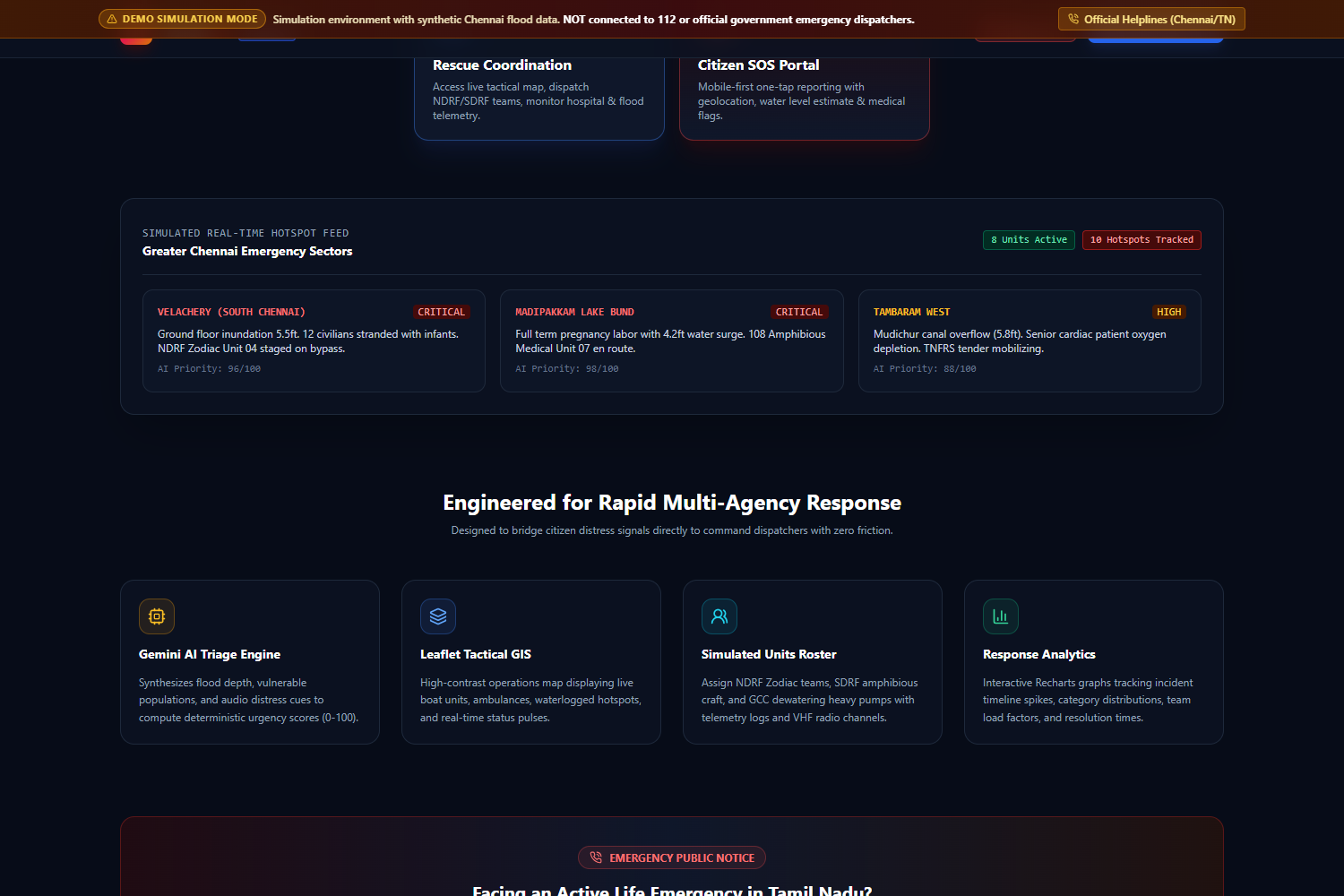
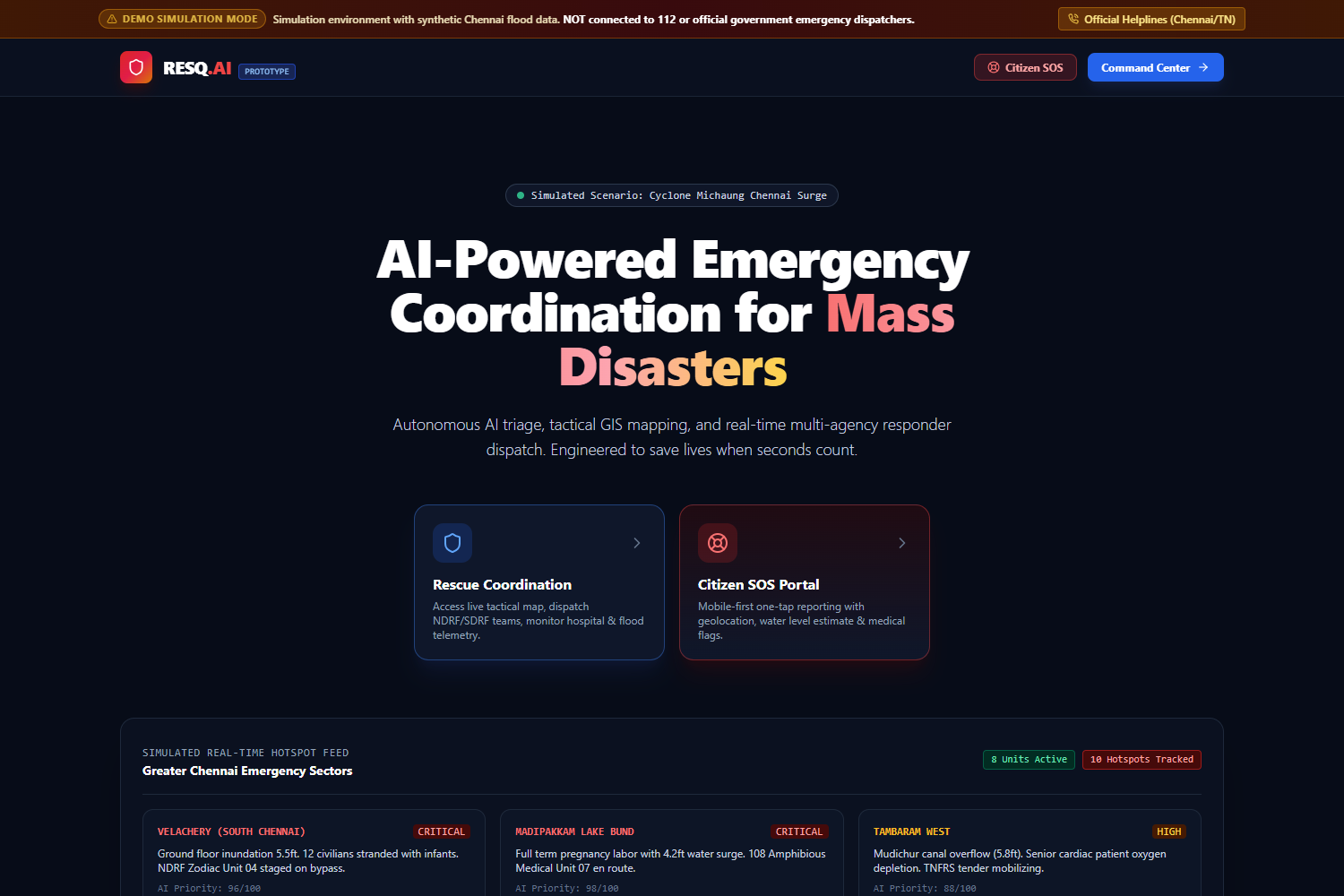
One platform combining Gemini AI triage, tactical mapping, simulated rescue teams, and disaster response analytics.
-
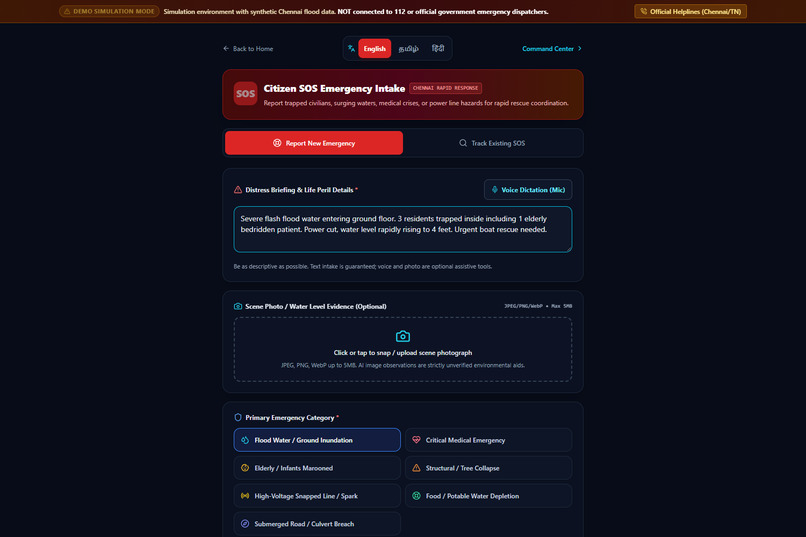
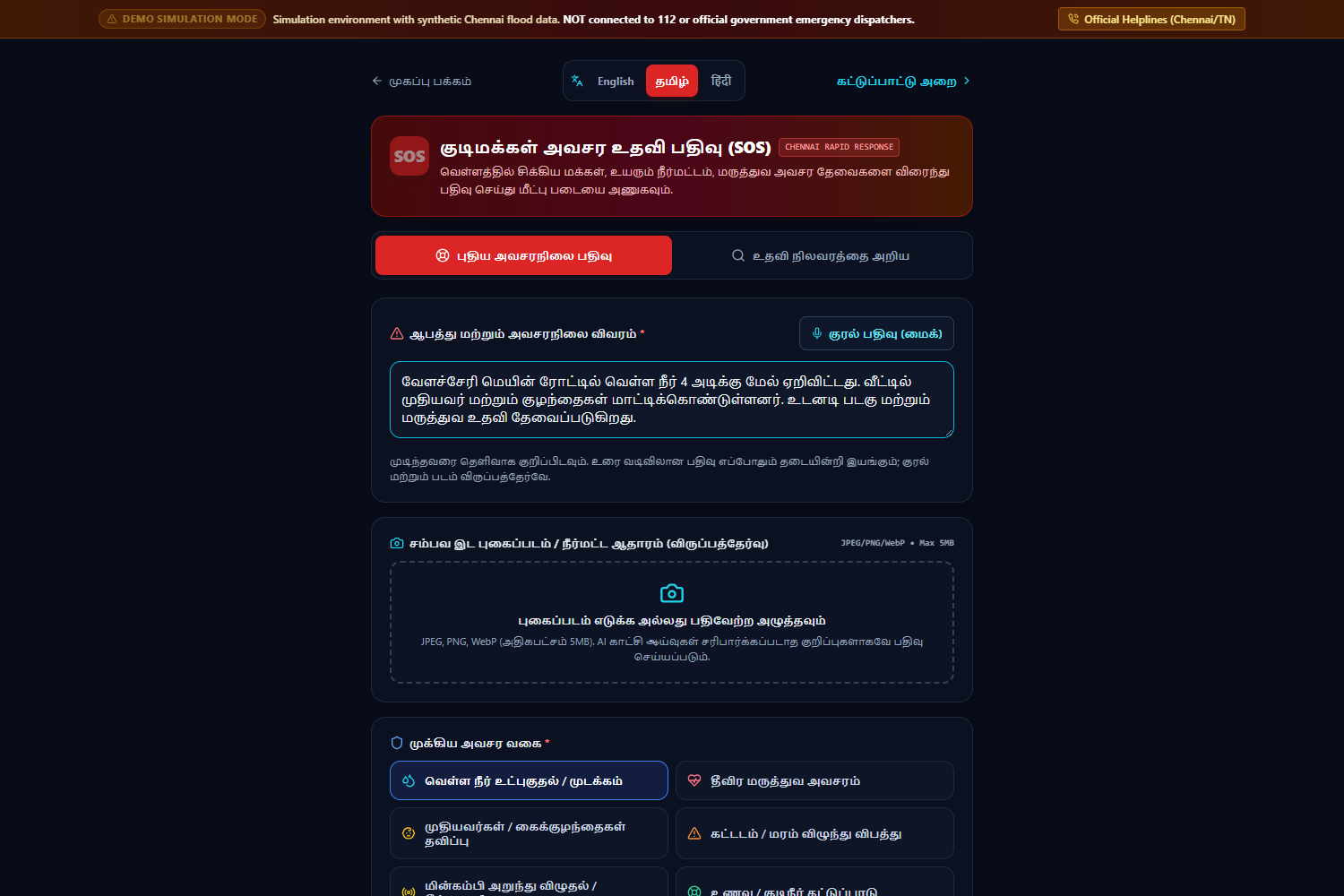
Report emergencies quickly with location details, flood severity, medical needs, and optional supporting evidence.
-
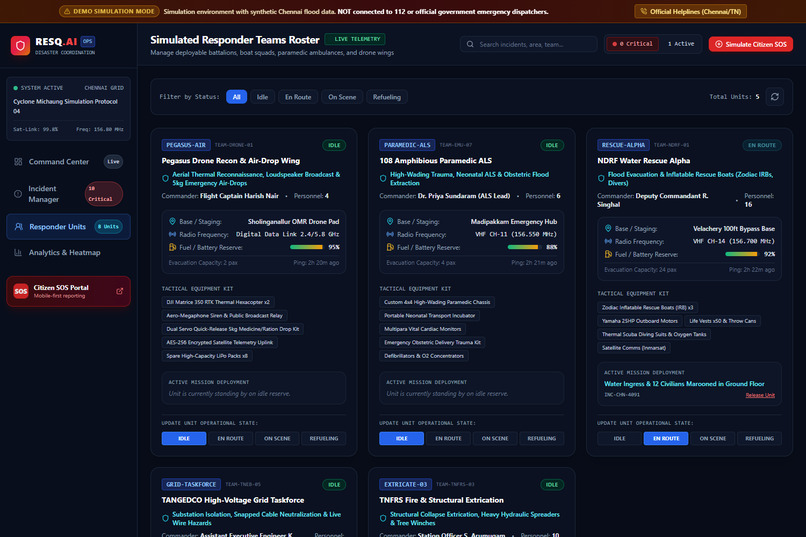
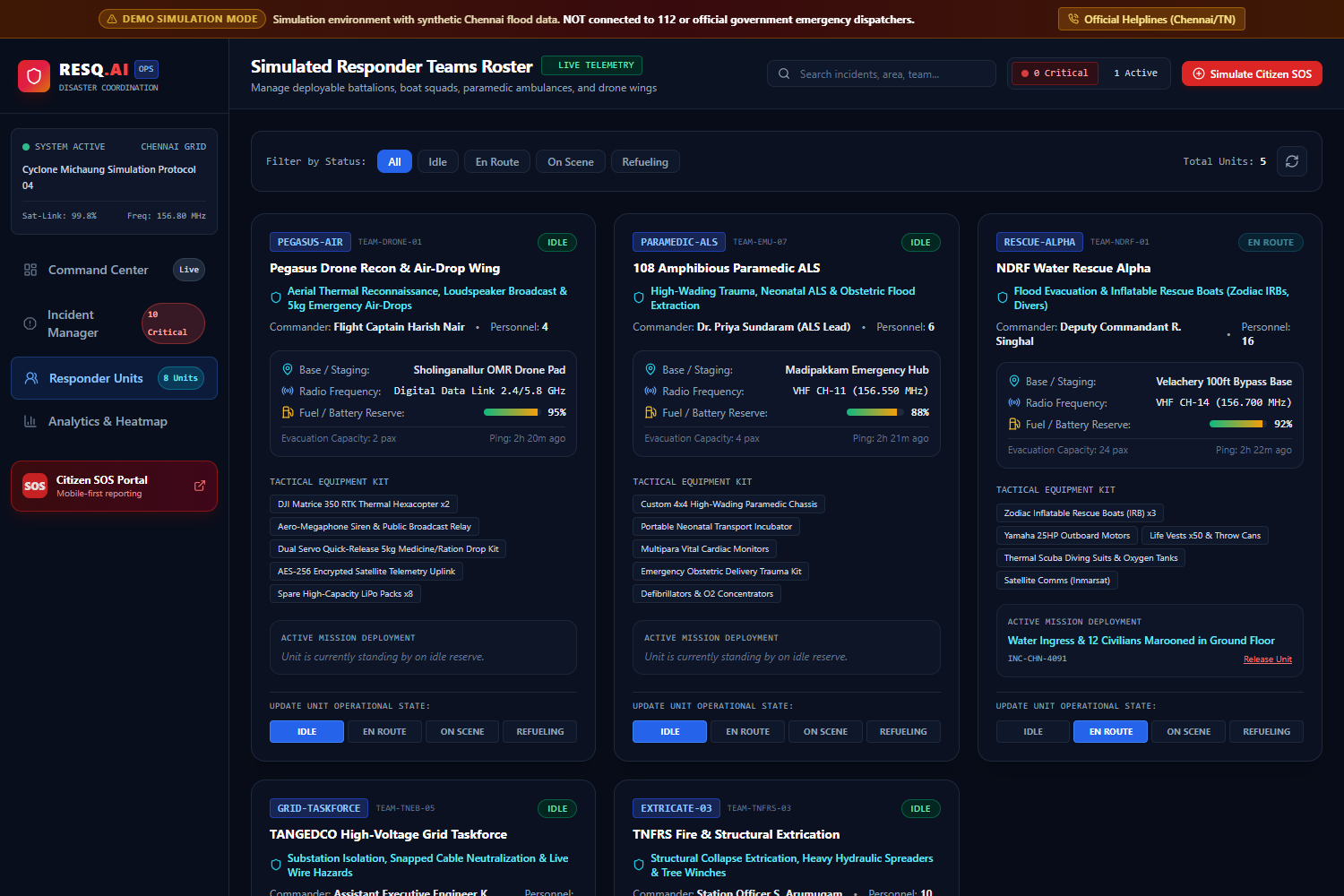
Simulated rescue-team roster displays specialized units, equipment, availability, and operational status.
-
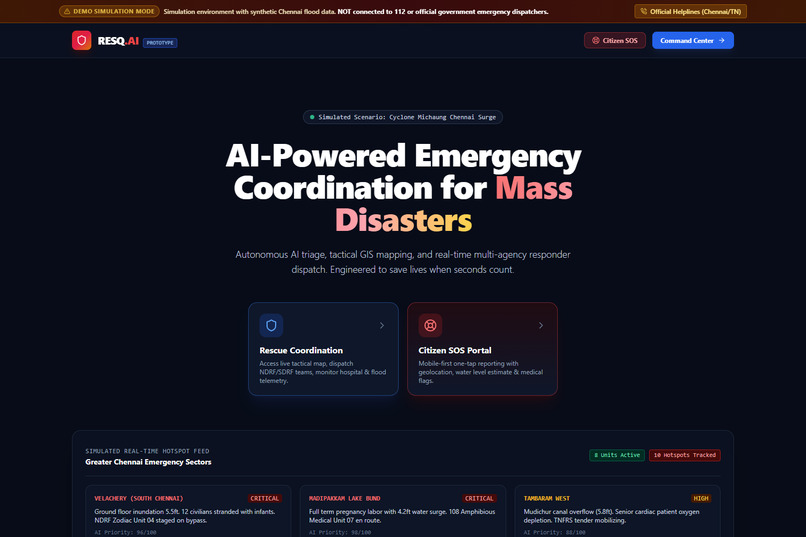
RESQ.AI: An AI-powered multilingual disaster SOS and simulated rescue coordination platform. Every Second Matters.
-
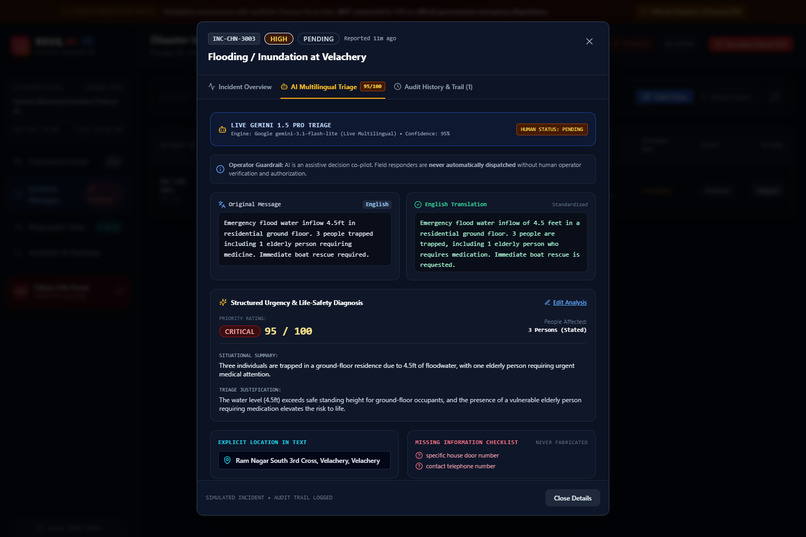
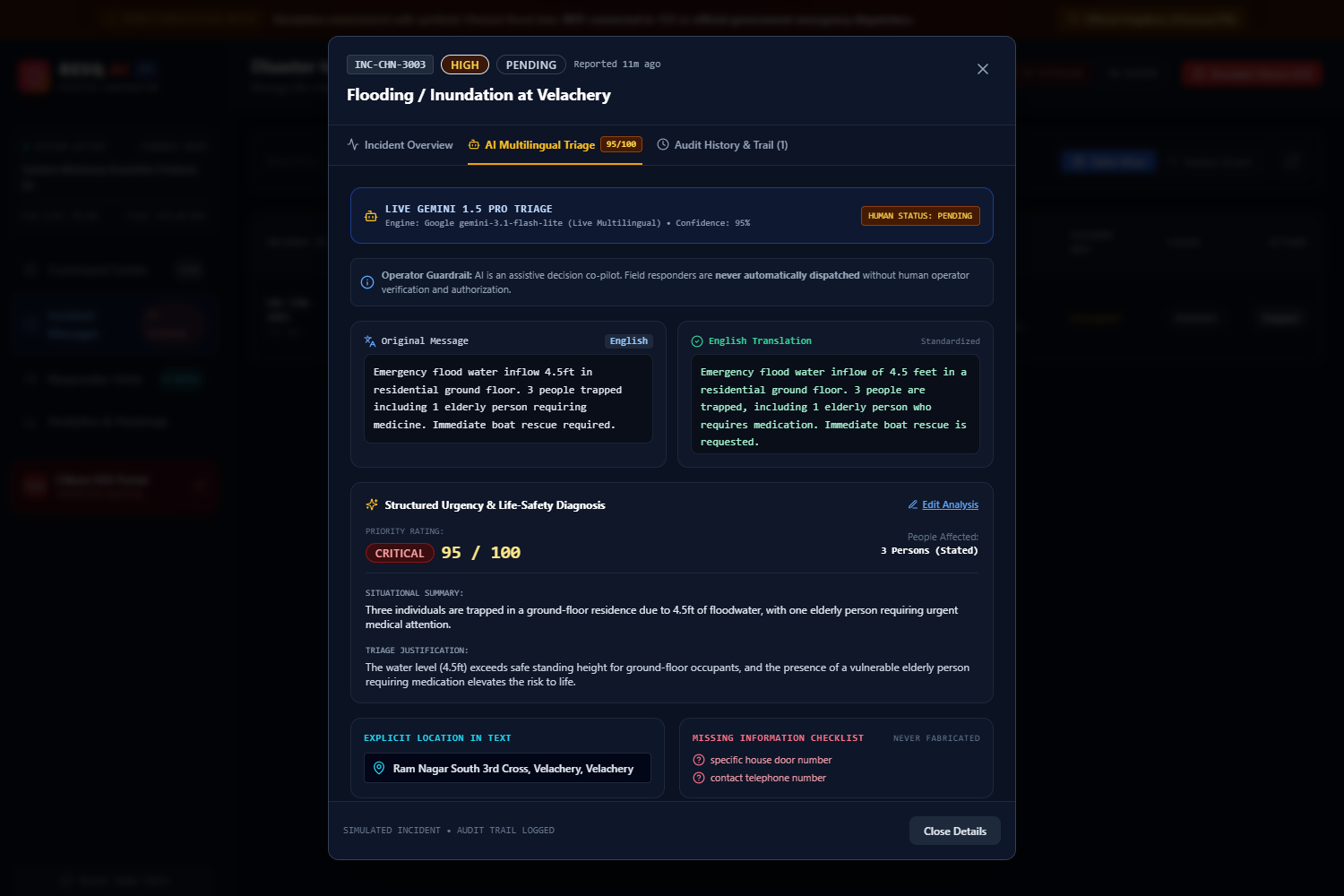
Google Gemini analyzes SOS reports, translates messages, identifies hazards, and recommends urgency for human review.
-
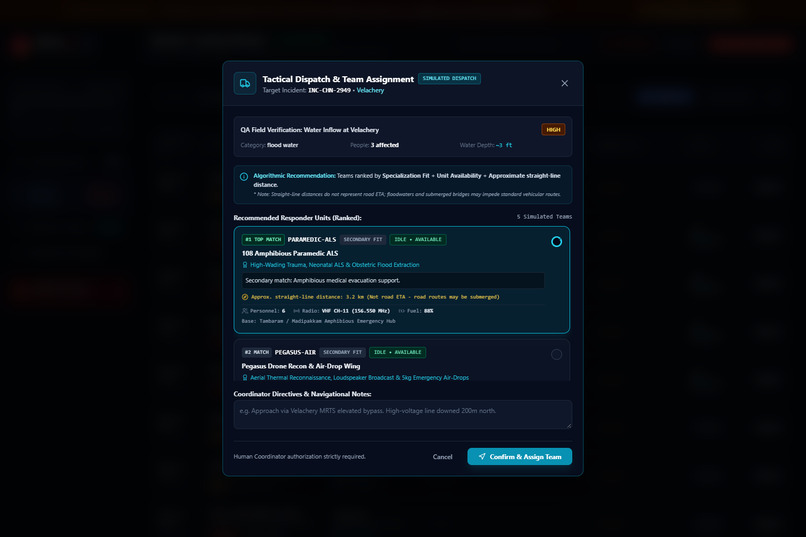
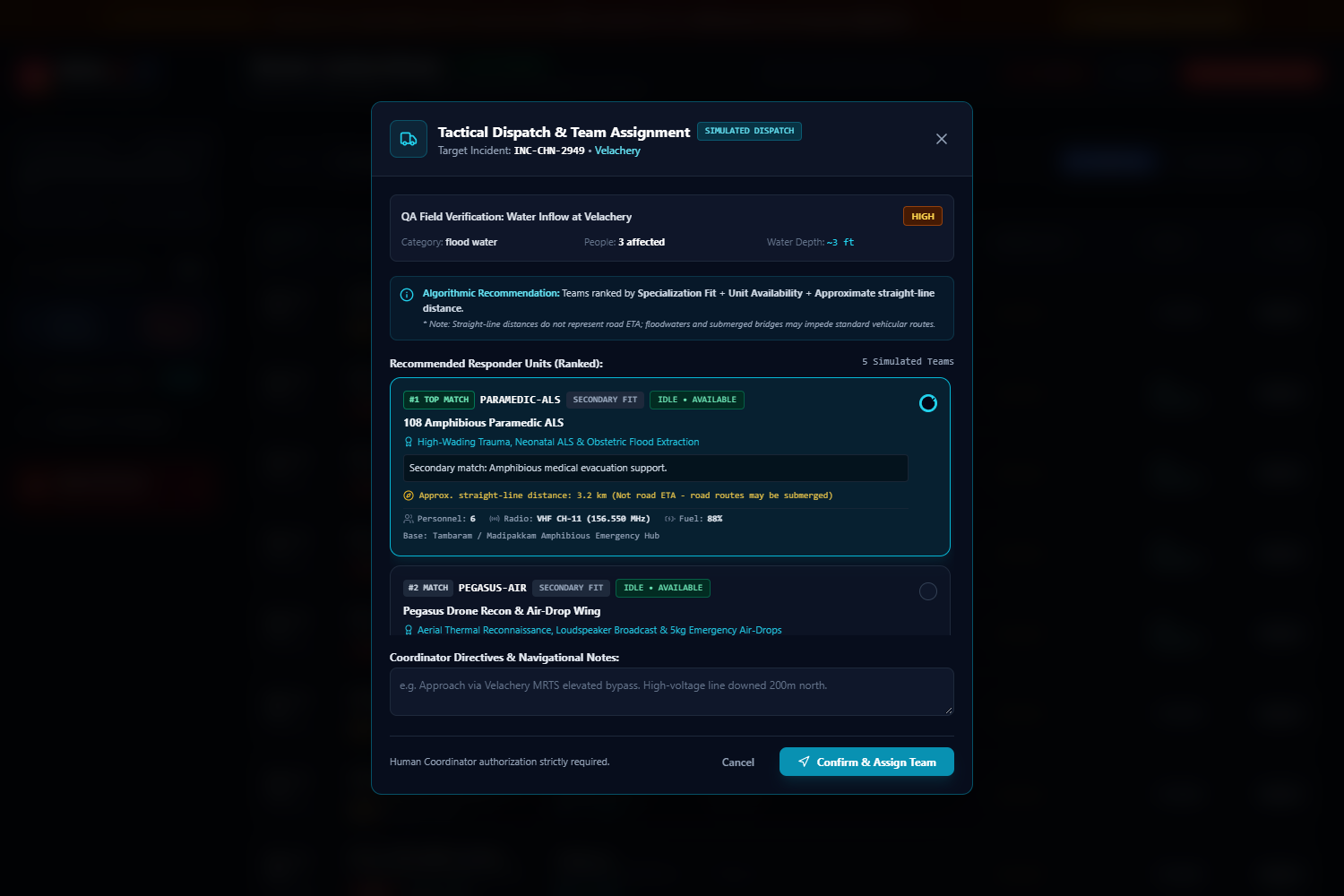
AI-assisted team recommendations consider specialization, availability, and distance; human authorization is required.
-
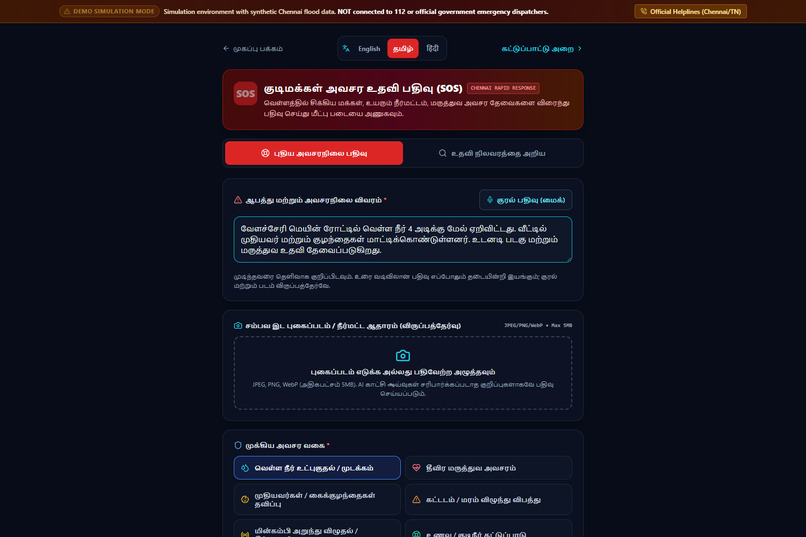
Breaking language barriers: citizens can submit emergency SOS reports in Tamil, Hindi, or English.
-
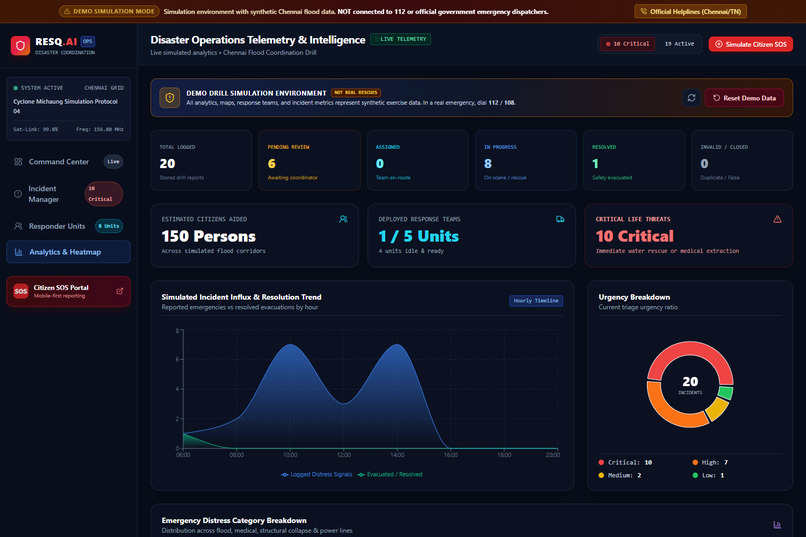
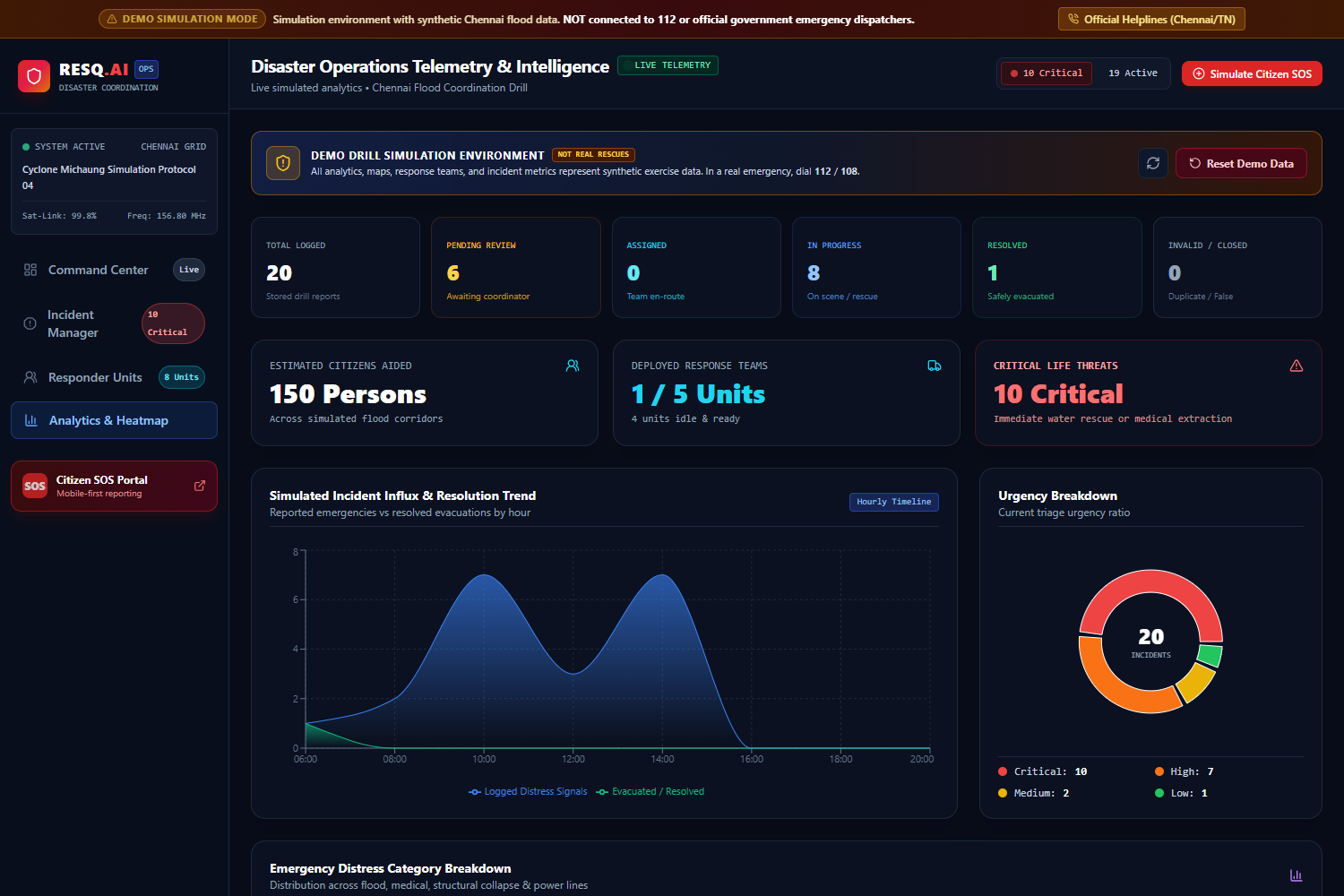
Operational analytics visualize simulated incident trends, urgency distribution, team deployment, and response progress.
-
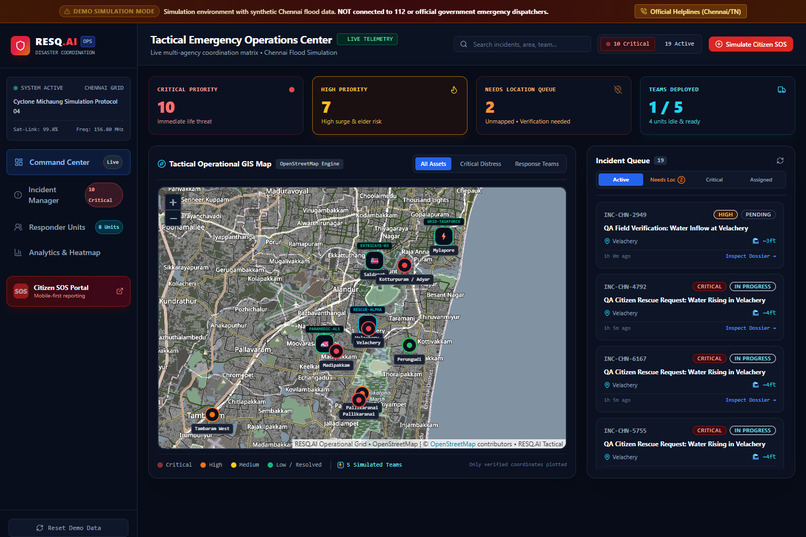
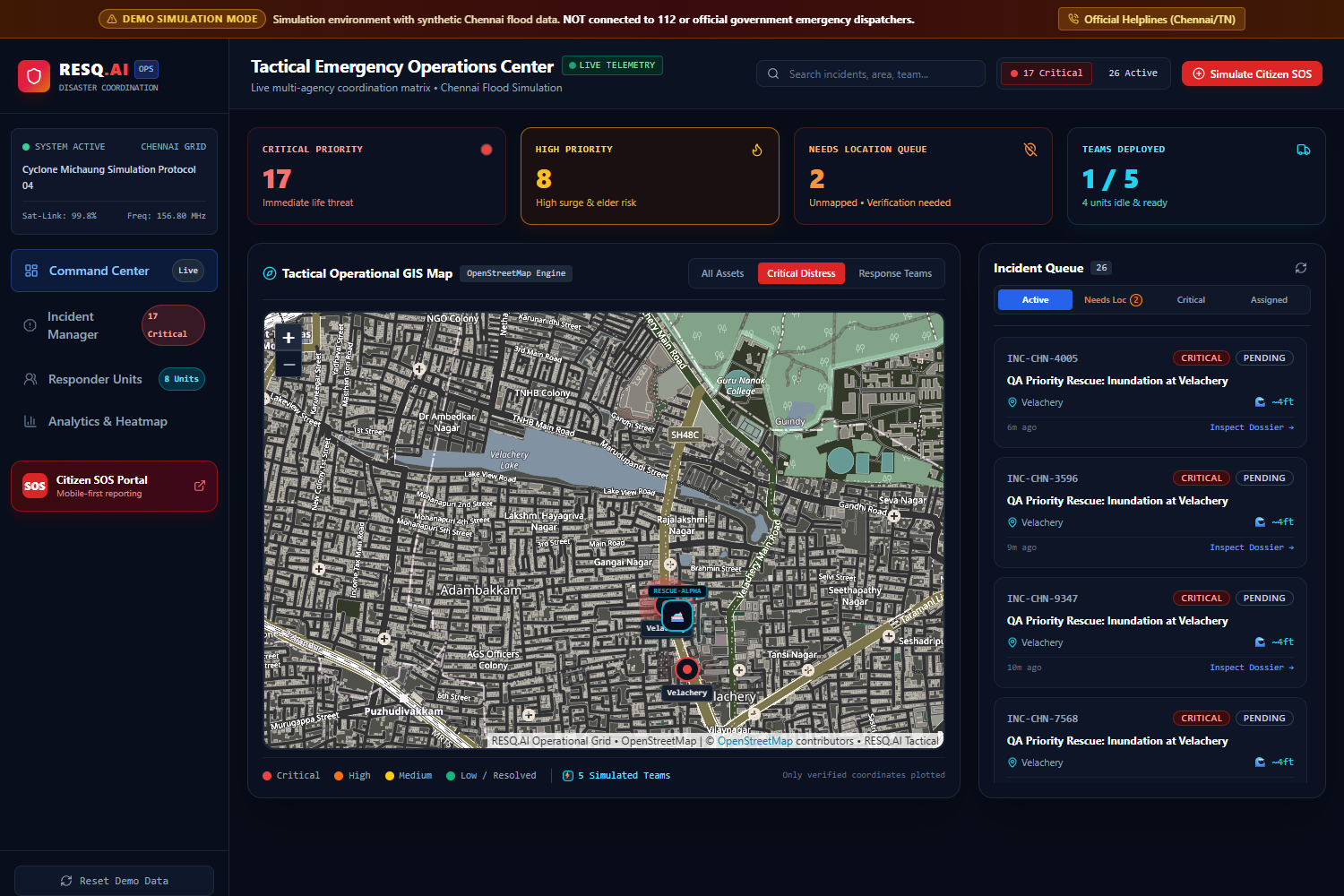
Centralized command center showing simulated incidents, urgency levels, responder availability, and tactical GIS mapping.
-
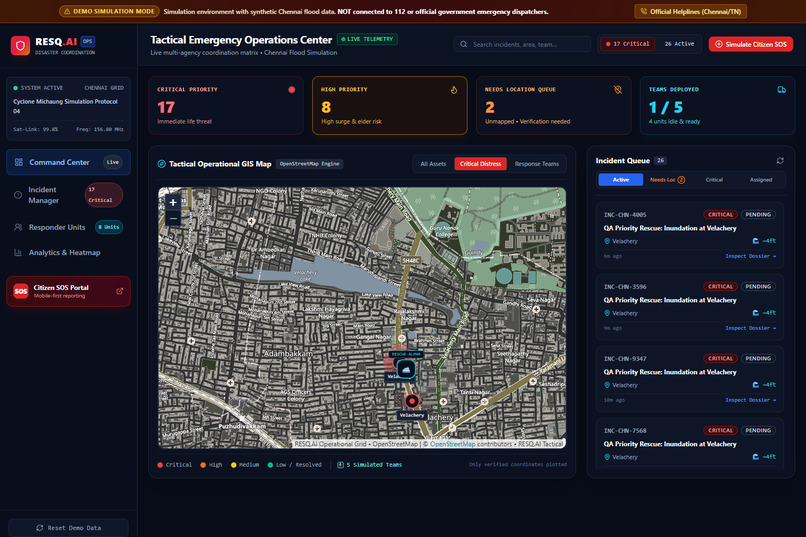
Interactive OpenStreetMap view highlights verified incident locations and simulated rescue-team positions.
Inspiration
When disaster strikes, every second matters. But what happens when someone's cry for help gets lost in translation?
During disasters like the Chennai floods and Cyclone Michaung, communities face overwhelming challenges. People become stranded, emergency requests arrive simultaneously, and crucial information is often communicated in different languages.
Imagine an elderly person trapped in rising floodwater, urgently needing medical oxygen. Their family sends an SOS in Tamil, but the response coordinator must first understand the message, identify the urgency, locate the family, and determine what assistance is needed.
What if AI could help accomplish those first steps in seconds?
That question inspired us to build RESQ.AI — an AI-powered multilingual disaster SOS and rescue coordination platform.
Our vision is simple: No emergency should be overlooked because of a language barrier, information overload, or delayed coordination.
What It Does
RESQ.AI connects citizens requesting assistance with a centralized emergency coordination interface.
The platform consists of two interconnected experiences:
1. Citizen SOS Portal
People can report emergencies in Tamil, Hindi, or English through a mobile-friendly interface.
Citizens can:
- Describe their emergency in their preferred language.
- Share their location through an interactive map.
- Use supported browser voice dictation.
- Attach photographs for additional context.
- Submit an SOS and receive a unique incident ID and secure tracking token.
- Track the status of their reported incident.
2. AI-Powered Command Center
Google Gemini analyzes incoming emergency descriptions to help coordinators understand and prioritize incidents.
The system can:
- Identify and translate multilingual emergency descriptions.
- Classify the type and severity of an incident.
- Extract hazards and vulnerable-person information.
- Generate an urgency score and suggested response resources.
- Display geolocated incidents on an interactive tactical map.
- Support human-confirmed assignment of simulated rescue teams.
- Track incident progress and responder availability.
- Prevent conflicting assignments of the same simulated team.
All submitted incidents are stored using Firebase Cloud Firestore, allowing information to persist across browser sessions.
RESQ.AI is a functional coordination prototype operating with simulated disaster incidents and rescue teams. It is not connected to official emergency dispatch services.
How We Built It
We developed RESQ.AI as a full-stack web application, combining generative AI, cloud infrastructure, geospatial visualization, and operational workflow logic.
Our technology stack:
- Next.js 14 and TypeScript: Full-stack application, server APIs, and reliable type-safe development.
- Tailwind CSS: Responsive citizen and coordinator interfaces.
- Google Gemini: Multilingual emergency analysis, translation, structured triage, and supported image understanding.
- Firebase Cloud Firestore: Persistent storage for incidents and simulated response-team data.
- Firebase Admin SDK: Secure server-side database operations.
- React Leaflet and OpenStreetMap: Interactive disaster mapping and incident visualization.
- Vercel: Production deployment and hosting.
- GitHub: Source control and continuous deployment.
- Google Antigravity: AI-assisted development, debugging, testing, and implementation.
How the System Works
Citizen SOS → Gemini AI Analysis → Firestore Storage → Tactical Dashboard → Human-Confirmed Simulated Assignment → Citizen Tracking
When a citizen submits an emergency report, the backend stores the incident and provides a tracking reference.
Gemini analyzes the emergency description and produces structured information such as language, translation, category, urgency, hazards, and recommended assistance.
Coordinators can review the incident on a geographic dashboard, assess suggested resources, and manage a simulated rescue response.
The citizen can then check the incident's updated status using their secure tracking reference.
We also implemented straight-line distance calculations using the Haversine formula to support proximity-based recommendations for simulated response units.
Challenges We Faced
1. Integrating AI into a Time-Sensitive Workflow
Emergency reporting requires predictable behavior, but generative AI services can experience latency, unavailable models, or API errors.
During development, we encountered Gemini model compatibility issues that caused requests to fall back to a deterministic triage engine.
We investigated the supported model configurations, updated the integration, and verified successful live Gemini inference on the deployed application.
We also preserved fallback behavior so the prototype could handle AI unavailability more gracefully.
2. Connecting Browser Submissions to Cloud Firestore
One of our most significant bugs involved SOS persistence.
Initially, the citizen interface saved submitted incidents to browser localStorage, while the tracking API searched Cloud Firestore. This meant citizens could receive an incident reference but encounter a 404 error when attempting to track it.
We traced the issue through the frontend repository, backend API, and Firestore integration.
We fixed the workflow so SOS submissions use the server API and receive authoritative incident IDs and tracking tokens. We also added regression tests for incident creation, persistence, tracking, and privacy.
This taught us that successful UI interactions do not necessarily mean the complete system is working. End-to-end verification is essential.
3. Deploying Firebase Admin with Next.js
Our initial Vercel build encountered errors because server-only Firebase dependencies were being imported into browser-side code.
We resolved this by separating client-safe repository logic from server-side Firebase Admin operations.
This improved the application's architecture and allowed the production build to complete successfully.
4. Protecting Sensitive Emergency Information
Emergency reports may contain personal contact information and precise locations.
We implemented coordinator authentication, secure tracking tokens, and privacy-focused API responses that redact sensitive information from public views.
We also ensured that AI recommendations do not automatically trigger real-world emergency dispatch.
5. Creating a Clear and Accessible Interface
We needed two very different experiences: a simple SOS interface for citizens under stress and a data-rich dashboard for coordinators.
Balancing accessibility, multilingual support, map interactions, mobile responsiveness, and visual clarity was a major design challenge.
Accomplishments We're Proud Of
We built more than an AI chatbot or a disaster dashboard. We connected multiple technologies into one functioning workflow.
Our key accomplishments include:
- A multilingual emergency reporting interface supporting Tamil, Hindi, and English.
- Live Gemini-powered analysis of fictional emergency messages.
- Cloud-backed incident persistence and cross-session tracking.
- An interactive map for visualizing reported emergencies.
- Simulated rescue-team assignment with double-assignment prevention.
- Privacy-conscious public tracking and authenticated coordinator functionality.
- A deployed web application accessible through a public URL.
- Automated verification, including 40 passing smoke tests and 15 passing tracking regression checks.
One particularly meaningful milestone was successfully testing a fictional Tamil flood SOS describing an elderly person requiring urgent oxygen support. Gemini translated the message, identified the medical vulnerability, classified the situation as critical, and produced structured information for coordinator review.
That demonstration captured the purpose of RESQ.AI: turning a human cry for help into information that can be understood and acted upon more efficiently.
What We Learned
Building RESQ.AI taught us several important lessons.
AI is most valuable when integrated into a complete workflow. Translation and classification become more useful when connected to persistent records, geographic context, and human decision-making.
Reliability matters as much as innovation. A polished interface is not enough if submitted incidents cannot be retrieved or tracked.
Privacy and safety must be part of the architecture. Emergency-related information requires careful handling, even in a prototype.
Human oversight remains essential. AI can assist with triage and recommendations, but operational decisions should remain accountable to trained people.
Finally, we learned how to bring together frontend development, backend APIs, cloud databases, generative AI, geospatial tools, testing, and production deployment into one integrated application.
What's Next for RESQ.AI?
Our current platform demonstrates the concept using fictional incidents and simulated rescue teams.
Future development could include:
- Additional Indian regional languages.
- Low-bandwidth and offline-first reporting capabilities.
- Improved geolocation and accessibility features.
- More advanced disaster forecasting and incident clustering.
- Verified responder accounts and stronger operational safeguards.
- Partnerships and authorized integrations with official disaster-response organizations.
- Field testing, security reviews, and reliability validation before any real-world emergency use.
Our long-term vision is to help make disaster-response coordination more inclusive, informed, and efficient.
Closing Thought
Disasters do not wait for translations. Emergencies do not wait for paperwork. And people in danger should not be invisible because their message is difficult to understand.
RESQ.AI demonstrates how multilingual AI, real-time data systems, and human-centered design can work together to support better emergency coordination.
RESQ.AI — Every Second Matters.
Live Demo: https://resq-ai-sigma.vercel.app
Built With
- antigravity
- cloud-firestore
- firebase
- firebase-admin-sdk
- generative-ai
- github
- google-gemini
- javascript
- next.js
- openstreetmap
- react
- react-leaflet
- tailwind-css
- typescript
- vercel
