-
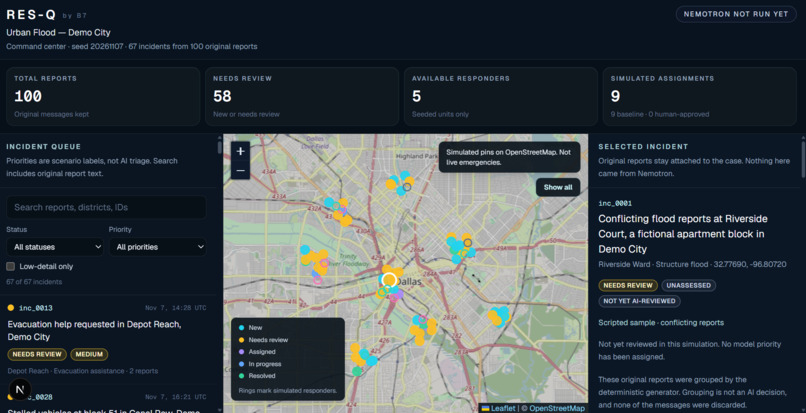
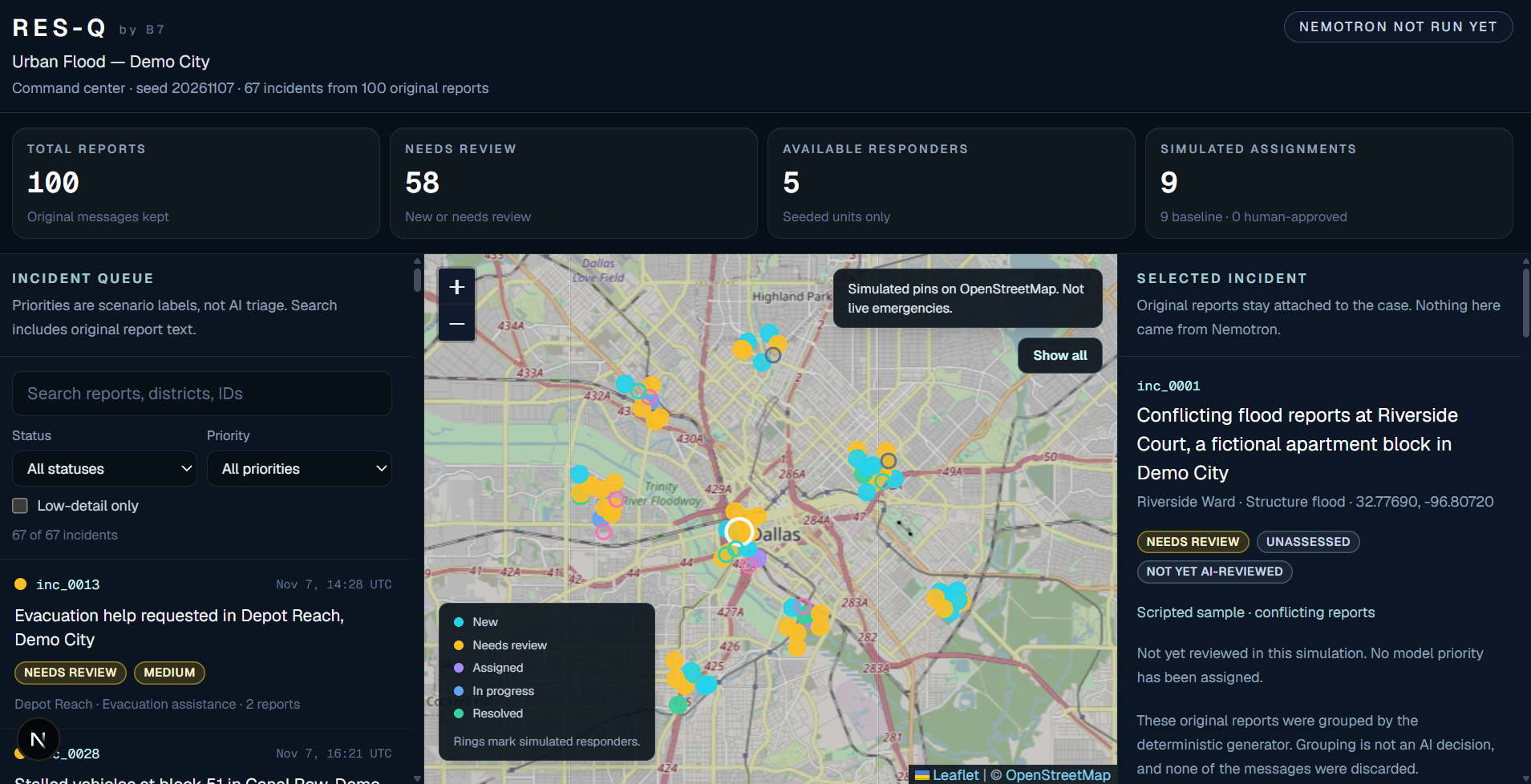
RES-Q Dashboard — Live map of simulated emergencies, reports, and rescue teams.
RES-Q by B7
During an emergency, information shouldn't be the bottleneck.
Inspiration
During major disasters, emergency teams can receive hundreds or thousands of reports within a short period. Some reports are incomplete, others contradict each other, and many describe the same emergency.
The challenge isn't just responding quickly. It's understanding what's happening, identifying the most urgent situations, and deciding how to use limited resources.
I built RES-Q to explore how AI could help organize this information and support faster decisions without taking control away from human operators.
What it does
RES-Q is an AI-assisted disaster response command center built around fictional emergency scenarios.
The dashboard brings together incoming reports, incident priorities, responder availability, and an interactive map. Operators can select an incident, review its evidence, and investigate it using NVIDIA Nemotron.
Nemotron uses tool calling to retrieve relevant reports, compare information, identify uncertainty, and recommend possible actions. Every recommendation remains advisory.
Human operators can approve, reject, or override suggested actions. The system validates decisions, prevents conflicting assignments, and records an audit history.
RES-Q also includes a separate Chaos Simulation view that displays emergency observations generated by the B7 Chaos Engine.
How I built it
I developed the command center using Next.js, React, TypeScript, Tailwind CSS, Leaflet, OpenStreetMap, and Supabase.
The original Urban Flood demo contains 100 fictional reports, 67 incidents, and 12 responder units. It demonstrates incident investigations, responder recommendations, and human-controlled simulated assignments.
I also built the B7 Chaos Engine, a fully independent disaster simulation system.
Unlike a basic random report generator, the engine simulates disasters as evolving events. It models communication failures, conflicting and duplicate reports, delayed information, cascading emergencies, responder fatigue, equipment limitations, and resource shortages.
The Chaos Engine uses deterministic seeds, allowing the same scenario to be reproduced exactly for testing and comparison.
In its EXTREME benchmark, the engine processed:
- 10,000 initial emergency reports
- 11,264 final reports
- 200 simulated responders
- 15,511 simulation events
- Approximately 12.67 seconds of simulation runtime
The standalone engine passed 220 automated tests across 49 suites, including deterministic replay, public JSON validation, and hidden-ground-truth isolation.
To connect the two systems, I developed a versioned JSON import pipeline. RES-Q validates the Chaos Engine's public observations before storing them in isolated Supabase staging tables.
A small live sample import was successfully verified, and its fictional reports are visible in the RES-Q dashboard. The full 10,000-report end-to-end workflow has not yet been validated.
Challenges
One of my biggest challenges was the hackathon's time constraint. I had to build, integrate, debug, and test multiple complex systems within a single weekend while making sure the final demonstration remained reliable.
Performance optimization was especially challenging. During early testing, an EXTREME Chaos Engine simulation with 10,000 emergency reports took approximately 2 minutes to complete. That was too slow for the rapid testing and repeated simulations I wanted.
I worked on improving the simulation engine's performance, including its event processing and handling of large workloads, while preserving deterministic behavior. After optimization, the same scale of simulation completed in approximately 12.67 seconds, with another benchmark measuring 9.49 seconds.
That represents roughly a 9.5× speedup, reducing runtime by nearly 89% compared with the initial two-minute result.
Another challenge was connecting the Chaos Engine, Supabase, RES-Q dashboard, and NVIDIA Nemotron without compromising data consistency or security.
I designed the Chaos Engine to keep hidden simulation truth separate from the observations available to AI. This prevents Nemotron from accessing information that a real emergency operator would not know.
I also had to handle conflicting reports and ensure that AI recommendations never became automatic dispatch decisions. The human approval system uses explicit confirmation, server-side validation, audit records, and safeguards against conflicting assignments.
Balancing performance, accuracy, security, and development time was one of the most valuable parts of building RES-Q.
What I learned
This project gave me hands-on experience integrating AI tool calling into a full-stack application, designing secure Supabase workflows, and building complex interactive interfaces.
I also learned how to develop a deterministic event-driven simulator, design strict JSON contracts between independent systems, and test software for reproducibility, performance, and security.
Most importantly, I learned that building a useful AI system involves more than generating recommendations. It requires reliable data, clear uncertainty, and safeguards that keep important decisions under human control.
What's next
My next goal is to expand the Chaos Engine integration so RES-Q can process much larger simulations and evaluate AI investigations against increasingly difficult scenarios.
I also plan to develop B7 Chaos Lab, an interactive simulation environment where users can configure disaster types, severity, population, responder resources, communication failures, and cascading events.
The long-term goal is to create a reproducible testing environment for evaluating how AI systems handle incomplete information, conflicting reports, evolving situations, and limited resources.
All scenarios are fictional. RES-Q is a research and demonstration prototype, not a live emergency dispatch system.
RES-Q by B7 — During an emergency, information shouldn't be the bottleneck.
Built With
- ai-agents
- codex
- cursor
- generative-ai
- git
- javascript
- leaflet.js
- next.js
- node.js
- nvidia-api
- nvidia-nemotron
- openstreetmap
- postgresql
- react
- simulation
- supabase
- tailwind-css
- tool-calling
- typescript

