-
-
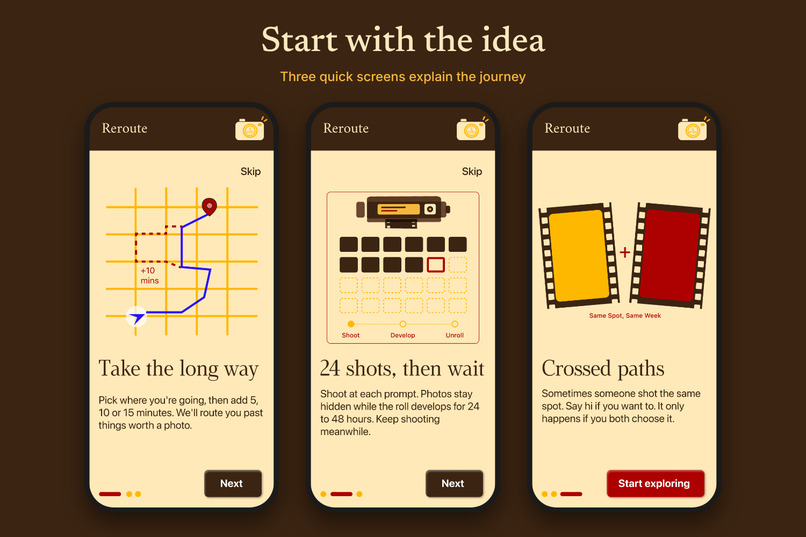
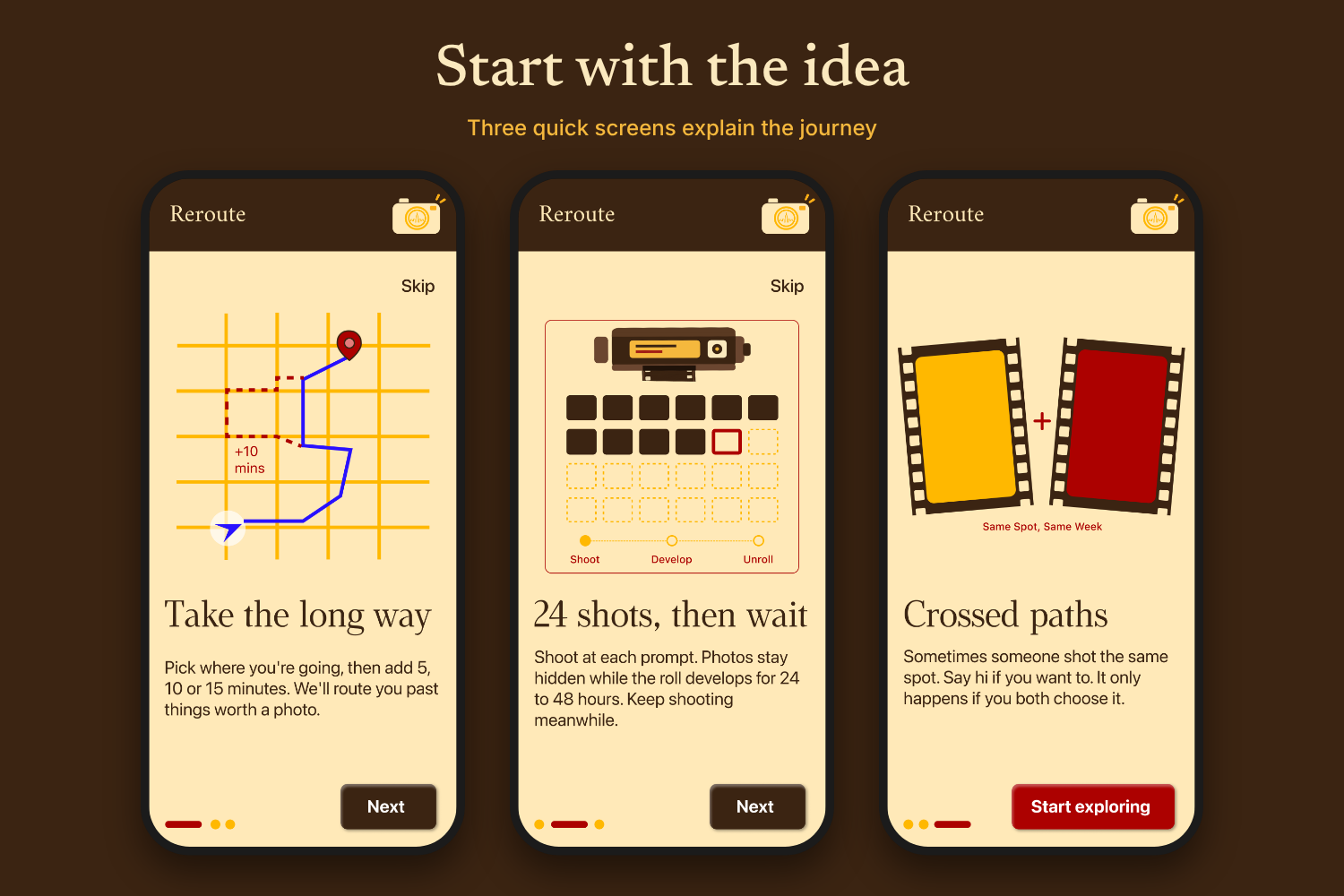
The three onboarding screens that introduce the app.
-
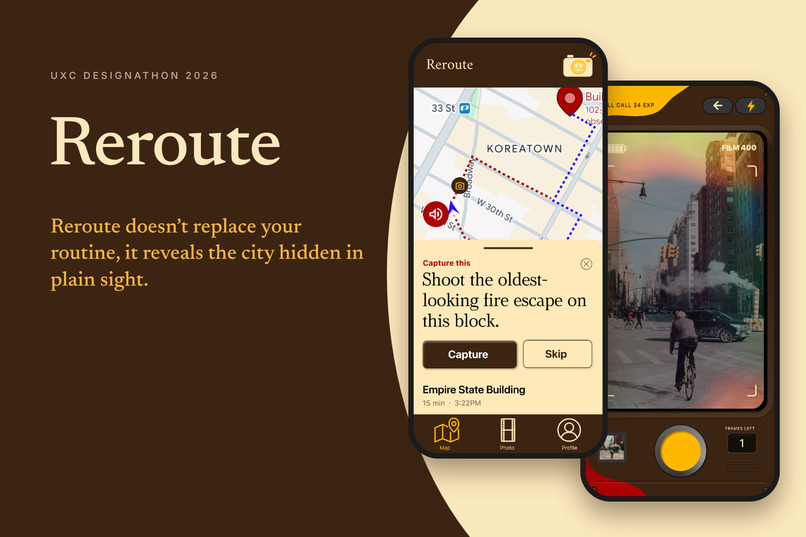
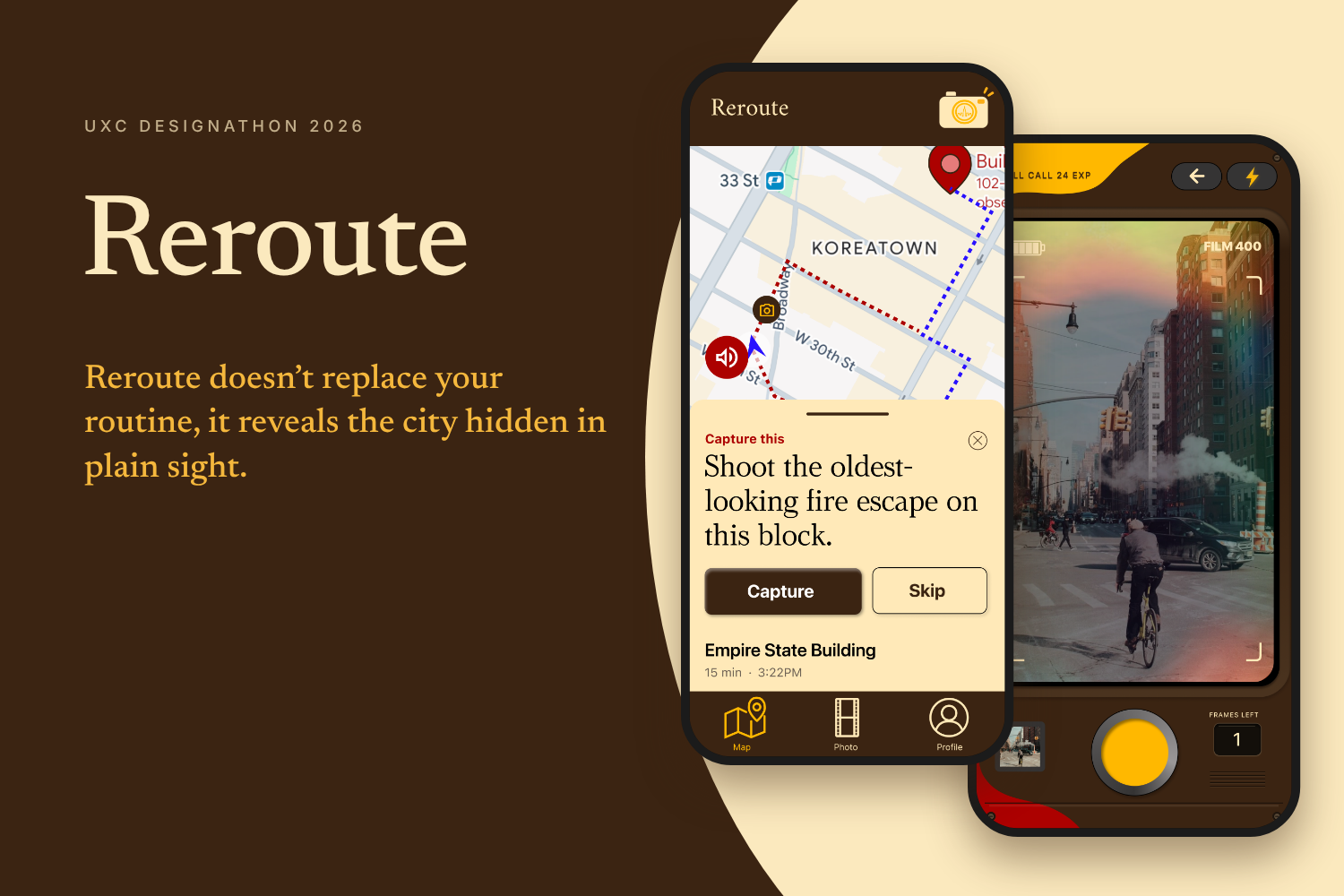
Reroute’s hero image, with the tagline.
-
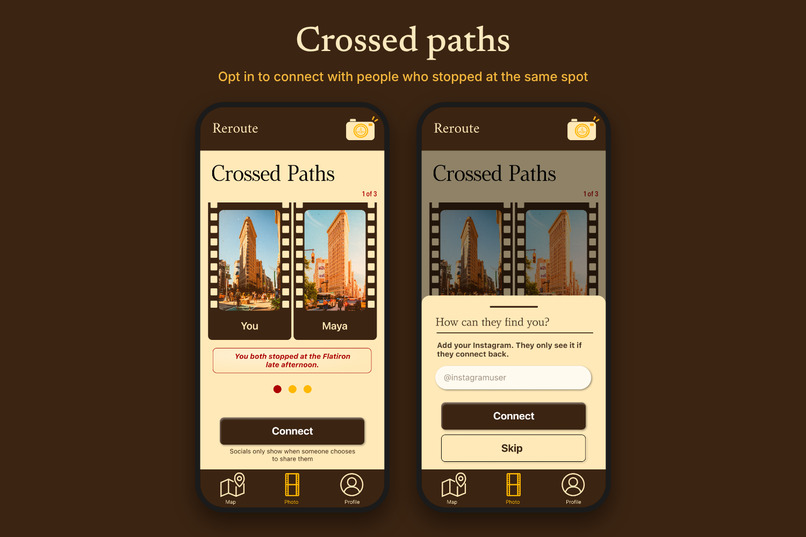
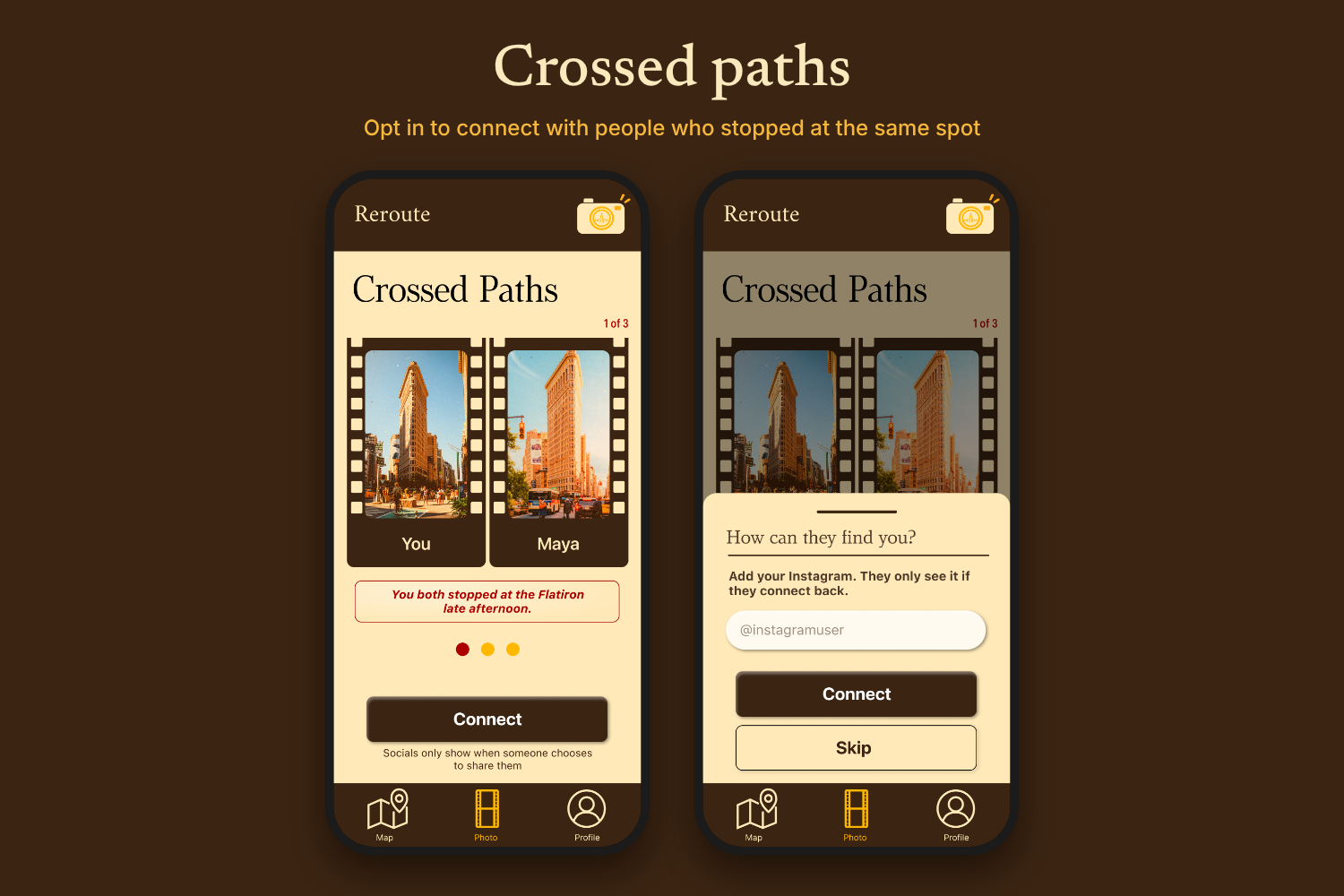
The crossed paths match screen and the connect screen.
-
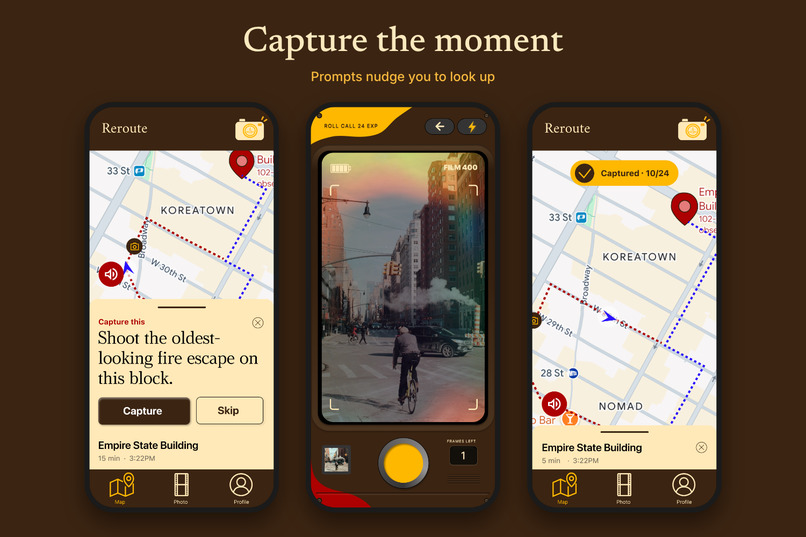
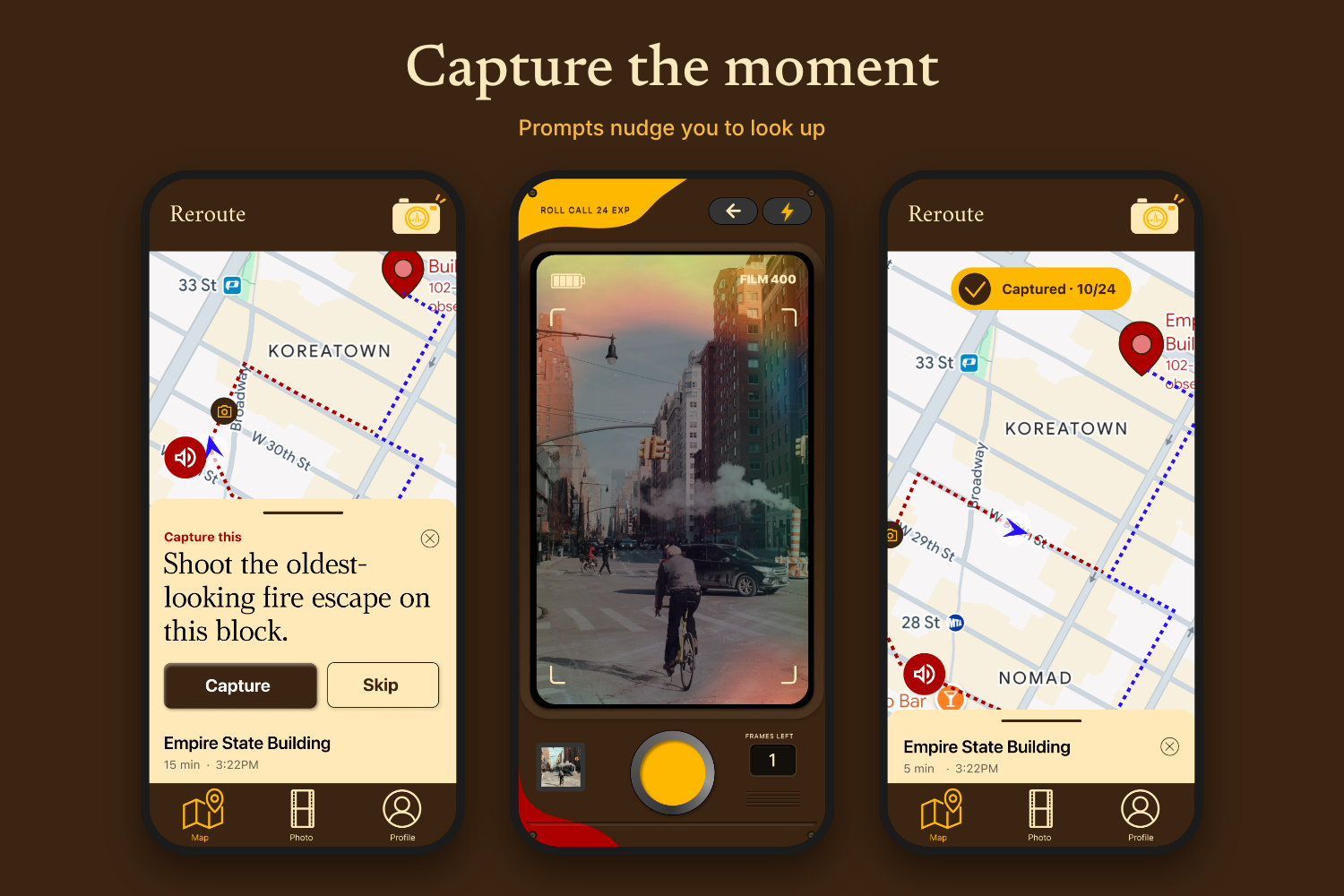
The photo prompt, the camera, and the captured confirmation.
-
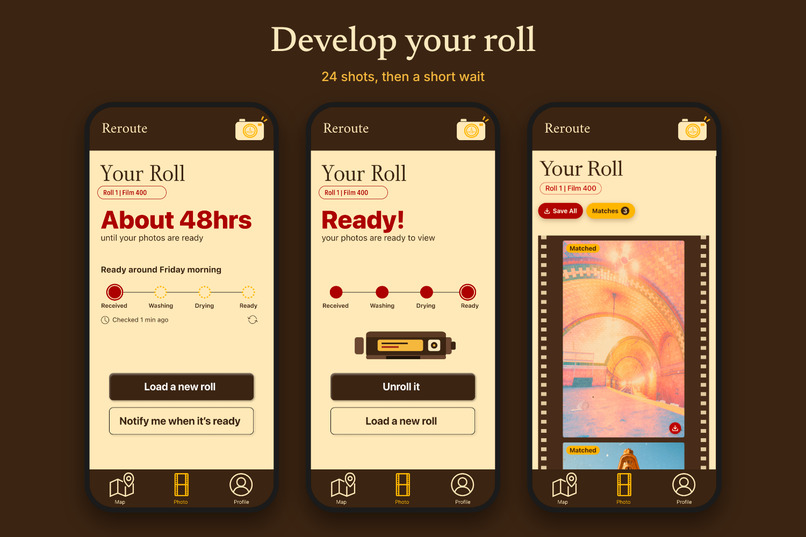
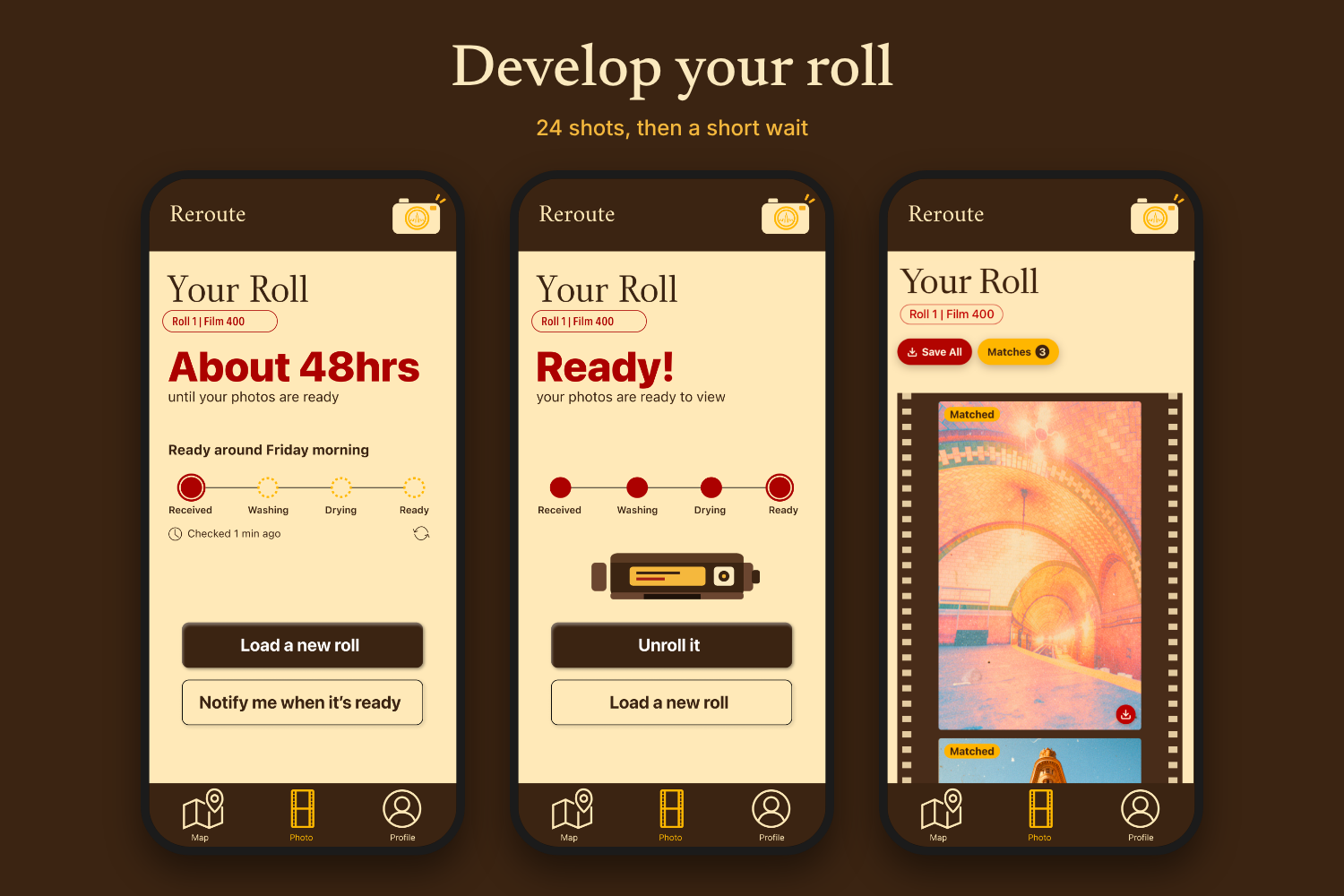
Wait for your roll to develop, tap Unroll, then scroll through your photos.
-
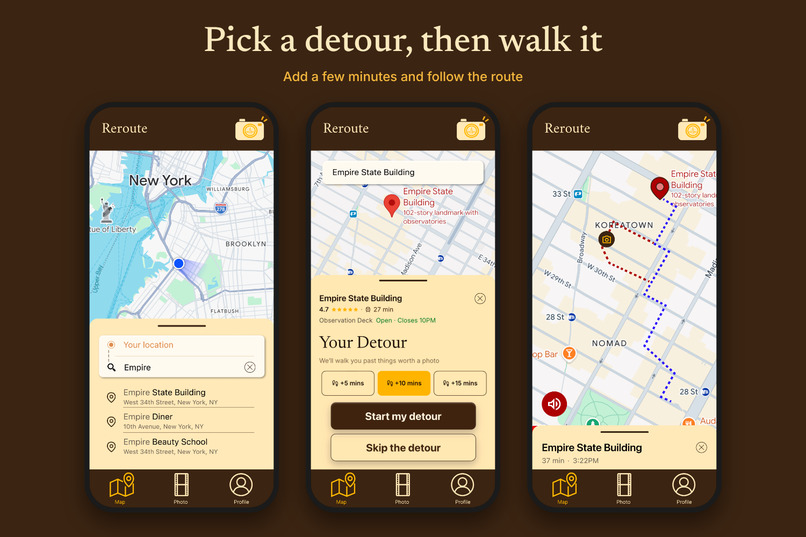
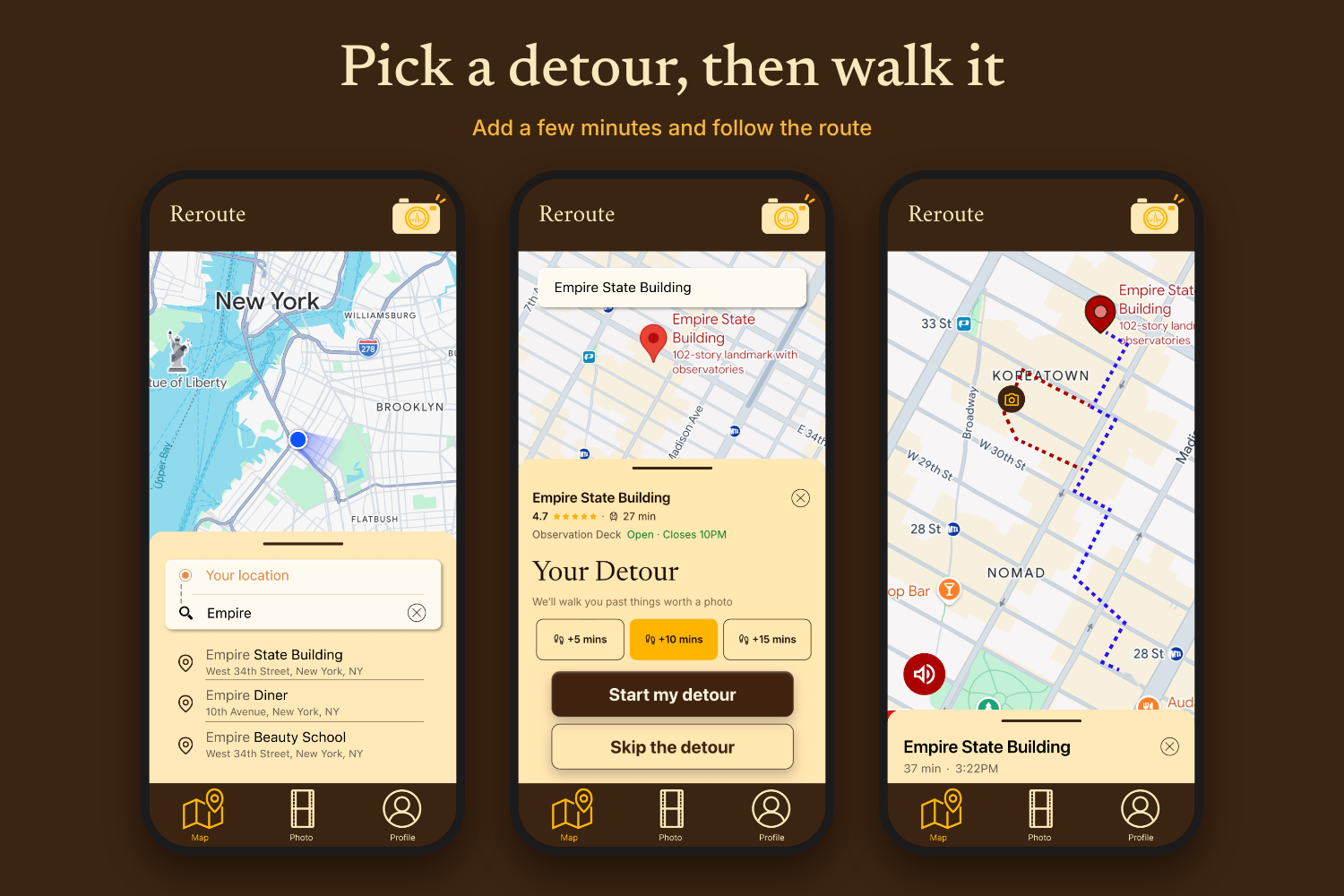
The search, detour options, and walking route screens.
-
 GIF
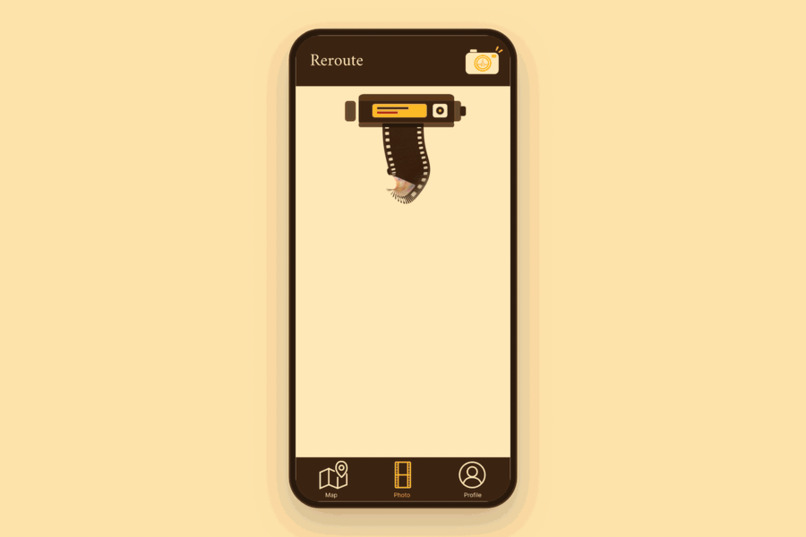
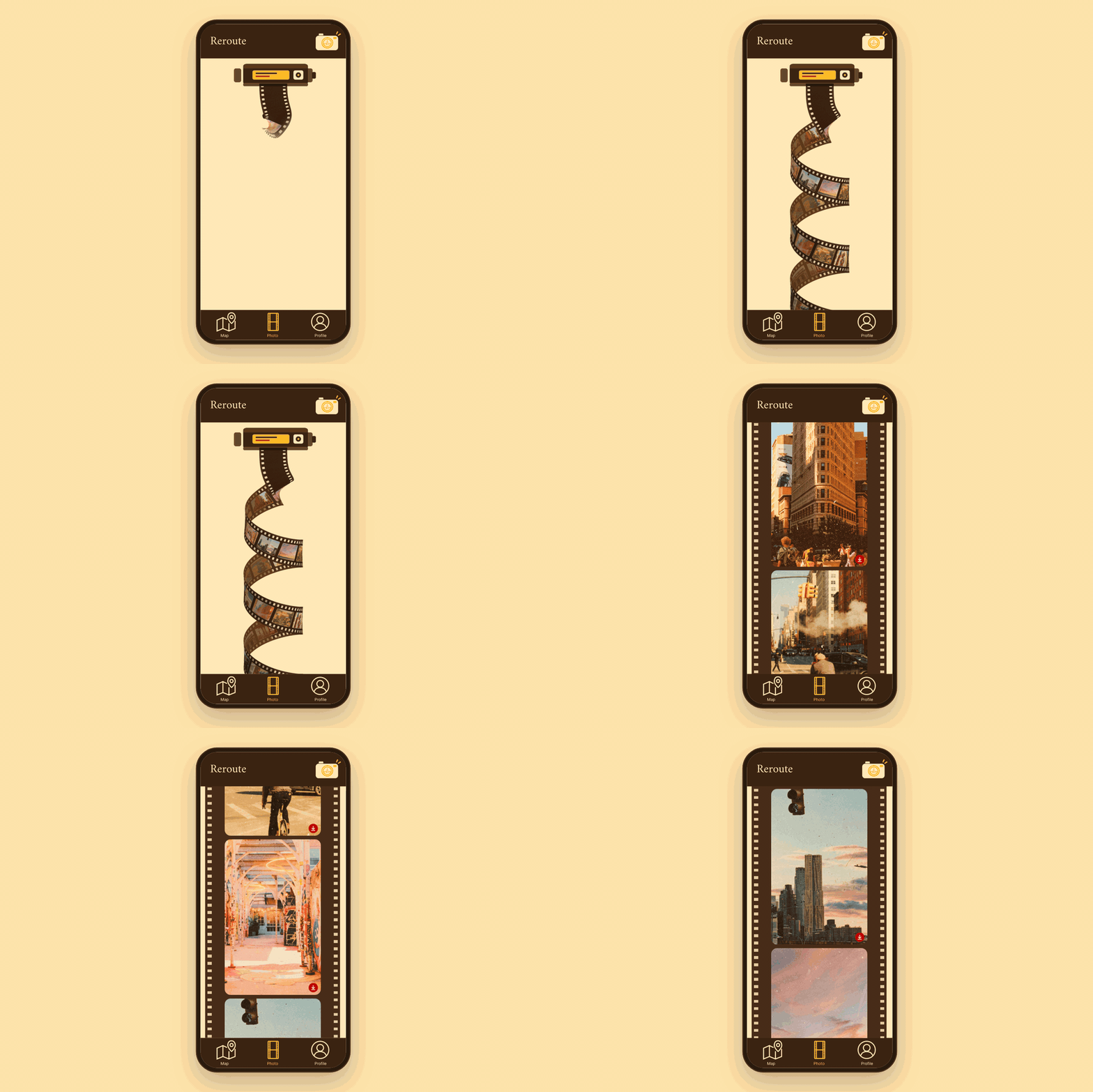
A film roll unrolling into the photos from your walk.
-
 GIF
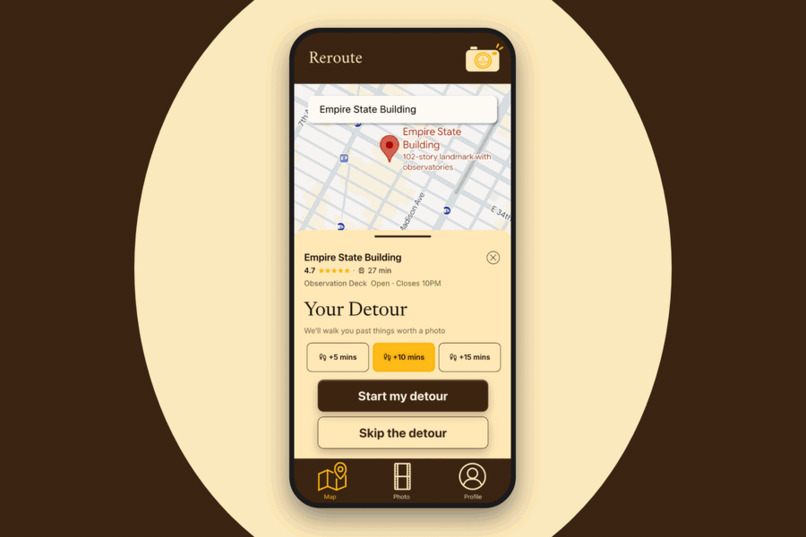
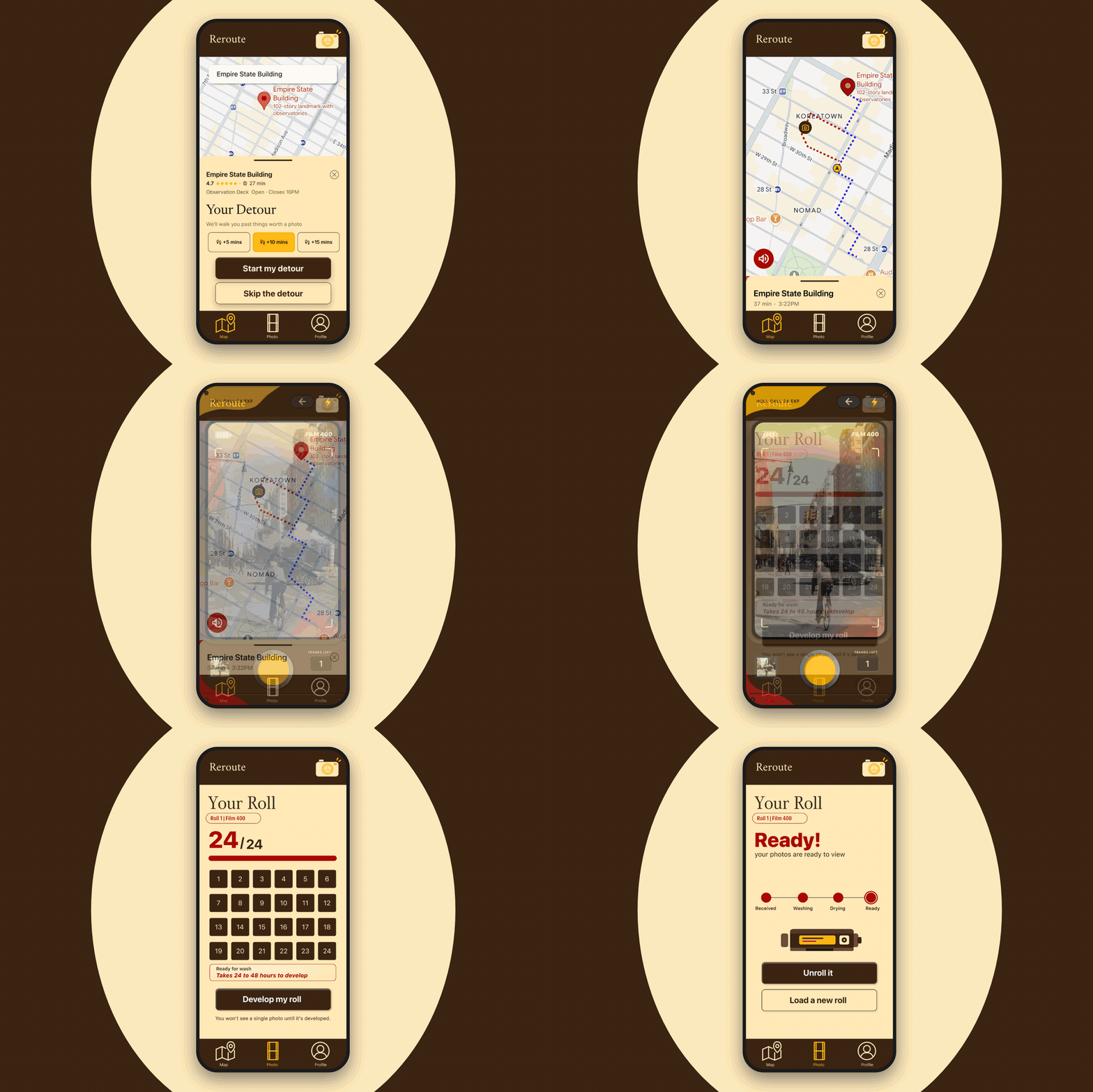
The full journey at a glance, from choosing a detour to developing your roll.
Inspiration
New York moves fast, and it’s easy to get swept up in it before you’ve had a chance to get to know the city. In our interviews, five of six people take the fastest route, and four said they run on autopilot on routes they know. But five also had a story of discovering something by accident, and every one was positive. We wanted to give people a reason to take that small detour on purpose.
What it does
Reroute adds small detours of +5, +10, or +15 minutes to the walks you already take. A disposable camera gives you 24 photos with prompts that nudge you to look up, and your roll develops 24 to 48 hours later. If you want, you can opt in to connect with people who crossed paths with you.
How we built it
We designed the screens and flow in Figma, then imported them into Base44 and used AI prompts to connect the screens and add interactions. We also ran Base44’s testing agent to find flow issues. It’s a clickable prototype, and the map, camera count, and matching are scripted.
Challenges we ran into
Testing showed that people didn’t understand why they’d match with others, and that the wait for the roll needed explaining earlier. We added onboarding, reworded matching to “crossed paths,” and explained the wait up front. Limited credits also meant we used a map screenshot with a scripted walk instead of a live map.
Accomplishments that we're proud of
We’re proud that Reroute exists as a complete, clickable journey, from choosing a detour to developing your roll, in one week. It has a look of its own, with a film-camera palette, a 24-frame roll, and an unroll moment that testers liked. The idea itself worked on people. Testers liked holding the camera, the limited number of photos, and the analog feel, and said they’d use it in a new city. We’re also proud that the idea comes from real people. Our interviews showed that everyone who stumbled on something by accident remembered it fondly, and Reroute tries to make those moments happen on purpose.
What we learned
We learned that the hardest part of an unusual idea is explaining it early enough. Almost every point of friction in our testing came from people not knowing why something worked the way it did, such as the wait, the matching, or the detour step, and not from the features themselves. Testers liked the limits, and the analog feel once they understood them. We also learned that a social feature has to earn trust. People will share a moment with a stranger only if they know why, and photos alone weren’t enough of a reason. Finally, we learned that our biggest risk, the 24- to 48-hour wait, can only be tested with real use, which a scripted prototype can’t give us.
What's next for Reroute
First we’d rework matching so people see the point of it, and test whether they want a social side at all. Then we’d make Reroute fully functional, replacing the scripted map, camera, and matching with real ones, and supporting more than one destination. That’s also what lets us test the 24- to 48-hour wait with real users. Once Reroute works well in NYC, we’d take it to other cities, starting with others that have the same fast pace.
Built With
- adobe-illustrator
- base44
- claude
- codex
- figma
- figmaai
- figmamotion
