Inspiration
What it does
How we built## Inspiration
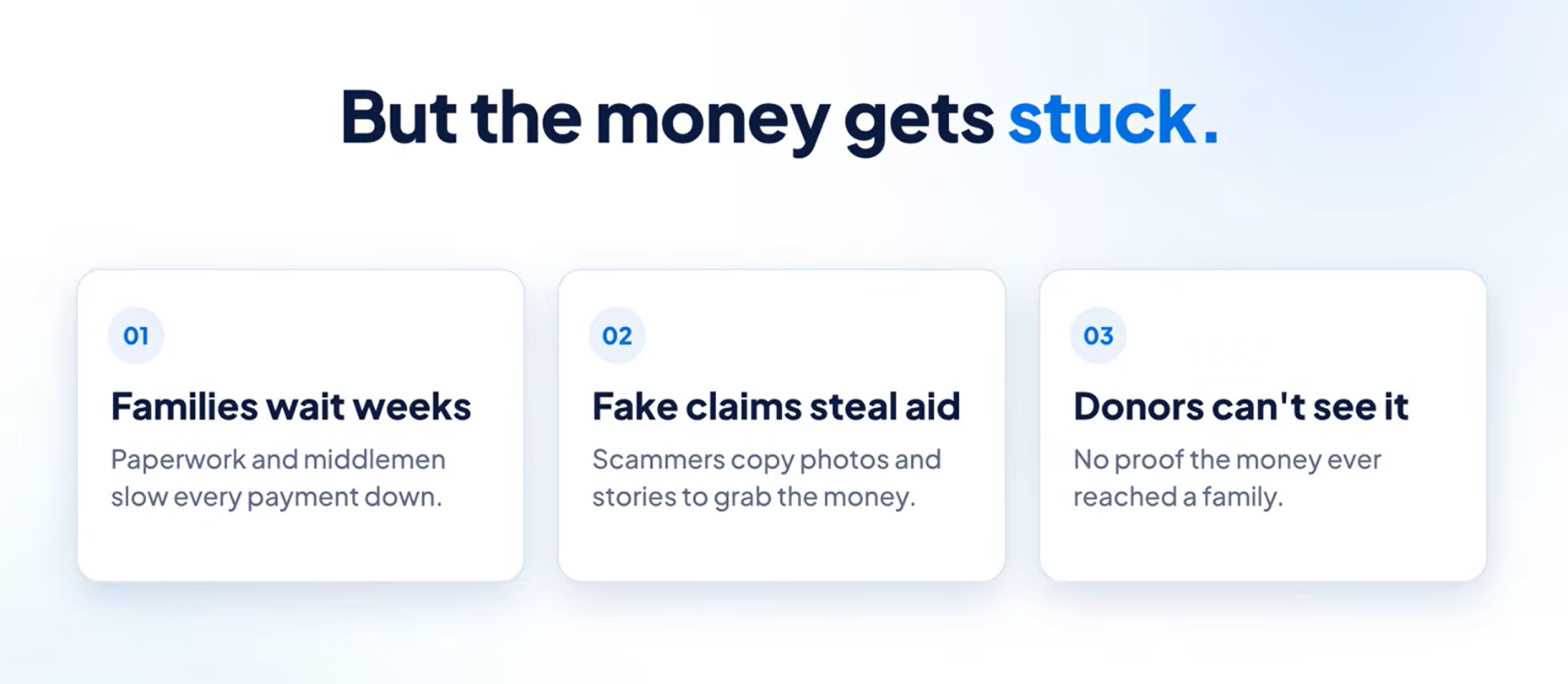
When a typhoon or flood hits, the world wants to help, but the money gets stuck. Families wait weeks for paperwork and middlemen. Fake claims steal aid meant for real victims. And donors never learn where their money went. US authorities (FTC, DOJ, CFPB) warn after every major disaster that scams target both the people who need help and the people trying to give it. Payment platforms like PayPal carry that money, so trust is everything. We asked: what if AI could check every request, and PayPal could send the cash straight to the right family in hours?
What it does
ReliefPay connects three hands: the family that needs help, the donor who wants to give, and the fraudster who wants to cheat. ReliefPay is the hand in the middle.
- Families ask for help in any language: English, Hindi, Tamil, Filipino or Spanish, by typing or by voice. They say what the money is for (food, shelter, medicine, school), upload a photo, and choose to be paid by PayPal or Venmo. They get a code to track their request. No account, no paperwork.
- Donors give with PayPal Checkout in their own currency (USD, EUR, GBP, INR, PHP, JPY and more), one-time or monthly with PayPal Subscriptions. They see exactly what their gift covers, appear on a donor wall that counts the families they helped, and can follow their receipt code to the family it reached.
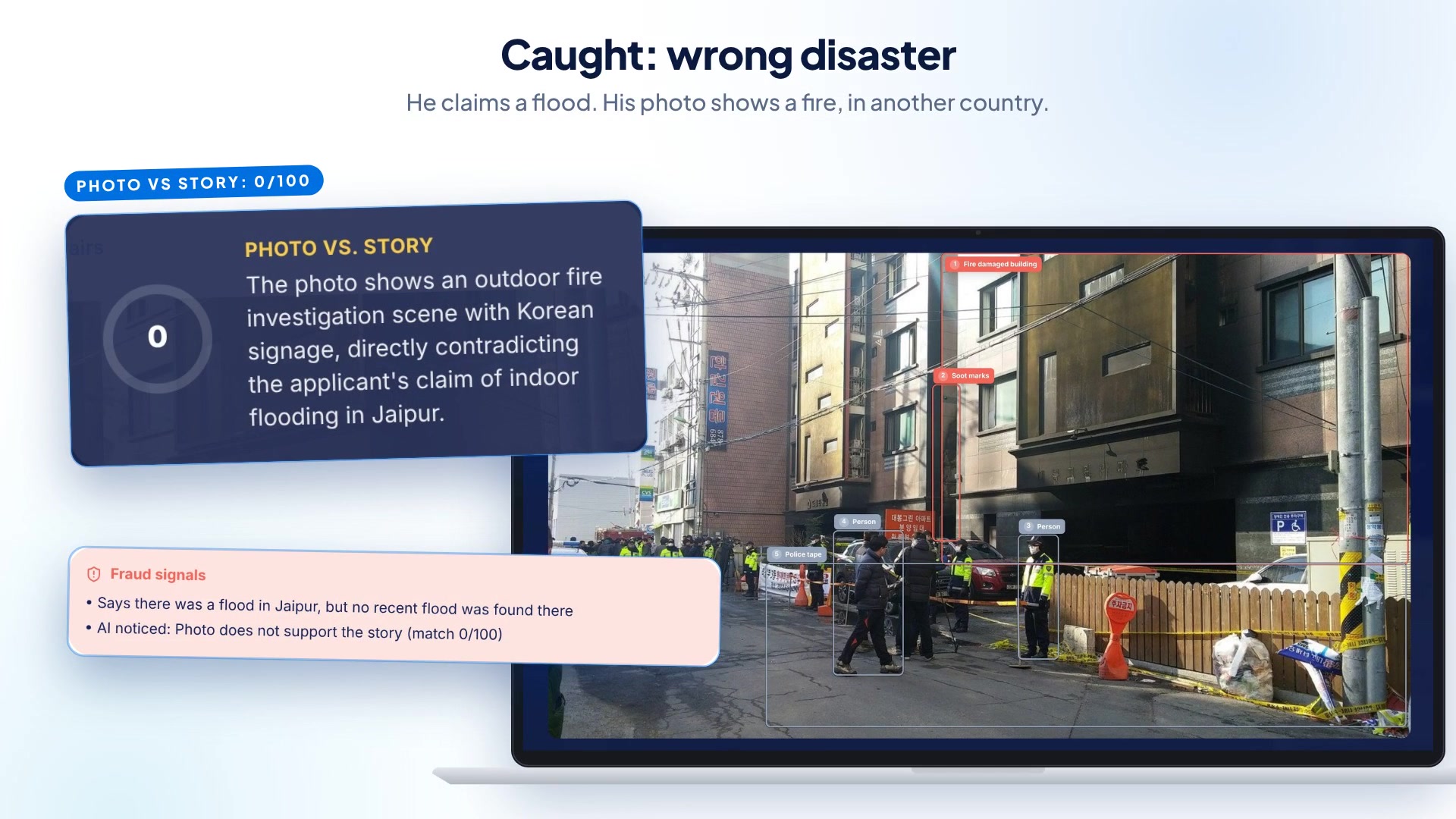
- AI checks every request. Gemini reads the story and scores urgency and fraud risk. It analyses the damage photo, labelling what it sees with boxes on the image, and checks whether the photo really fits the story. It also flags downloaded or stock images.
- It checks whether the disaster really happened. ReliefPay checks UN/EU GDACS alerts, NASA EONET events and AI web search. If someone claims a flood where none happened, the request is flagged before any money moves. It is never rejected automatically: a person decides.
- It stops fraud. Duplicate photos (perceptual hashing), the same phone or payout account, and copied stories are caught. When staff mark a request as fraud, that person's phone, photo and payout account are remembered, so their next attempt is flagged automatically.
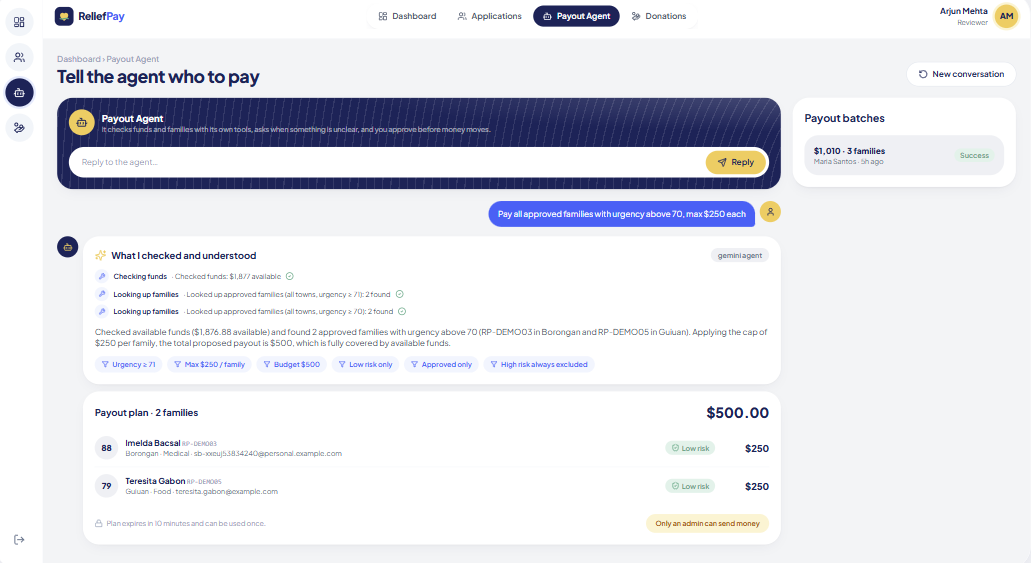
- An AI payout agent. Staff type "Pay all approved families with urgency above 70, max $250 each". The agent checks the funds, finds the right families and builds a plan. A person approves it, then PayPal Payouts sends the money to each family's PayPal or Venmo. Staff can also pay one family directly, after a safety checklist passes.
- Full transparency. A public page shows every donation and payout, and every staff action is written to a tamper-evident, hash-chained audit log.
How we built it
- Frontend: React (Vite), Tailwind CSS, Framer Motion, Leaflet maps, Web Speech API for voice input, a 5-language i18n system.
- Backend: Python FastAPI, SQLModel and SQLite, packaged with Docker and deployed on Render as a single service.
- PayPal: Orders v2 (Checkout) for donations, Payouts for families (PayPal email and Venmo phone), Subscriptions for monthly giving, webhooks with signature verification, and PayPal-Request-Id idempotency so money is never sent twice.
- AI (Google Gemini): triage of every request (urgency, damage, vulnerabilities, need), photo analysis (labelled object boxes, story match score, real vs. stock image), disaster verification with web search, and a function-calling payout agent. If Gemini is unavailable, it switches to backup models and then to a rule-based fallback.
- Disaster data: GDACS, NASA EONET and OpenStreetMap Nominatim geocoding.
- Security: bcrypt passwords, httpOnly SameSite JWT cookies, reviewer and admin roles (only admins can send money), rate limiting, a strict Content Security Policy and server-side checks on every payment amount.
Challenges we ran into
- Making AI helpful but never the final judge: the AI flags and explains, a person approves, and money only moves after every check passes.
- Proving a disaster really happened, by combining official disaster feeds with AI web search and handling "unknown" honestly instead of guessing.
- Multi-currency giving, including INR, where PayPal charges the USD equivalent, while still showing donors their own currency.
- Making payouts safe: idempotency keys, a one-at-a-time lock, and checks for funds, fraud and approval before every payment.
Accomplishments that we're proud of
- In our own test, Gemini caught a fake claim end to end: an applicant claimed a flood in Jaipur, the disaster check found no flood, and the photo analysis showed a building fire in another country (story match 0/100).
- A complete money loop on PayPal: Checkout in, Payouts and Venmo out, every step tracked publicly.
- An app a family can use by voice, in their own language, in a few minutes.
What we learned
Trust is the real product in disaster aid. Speed only matters if donors believe the money reaches real families, and AI is most useful when it explains its reasons and leaves the decision to a person.
What's next for ReliefPay
- Appeals shared by SMS and WhatsApp when a verified family needs help.
- Partnerships with NGOs and local governments for on-the-ground verification.
- More payout methods and languages, and offline-first support for areas with weak signal.
Demo photos: Wikimedia Commons (credits in PHOTO_CREDITS.md in the repo). it
Challenges we ran into
Accomplishments that we're proud of
What we learned
What's next for ReliefPay
Built With
- docker
- fastapi
- framer-motion
- gdacs
- gemini
- google-ai
- leaflet.js
- nasa-eonet
- openstreetmap
- paypal
- paypal-checkout
- paypal-payouts
- paypal-subscriptions
- python
- react
- render
- sqlite
- sqlmodel
- tailwindcss
- venmo
- vite

