-
-
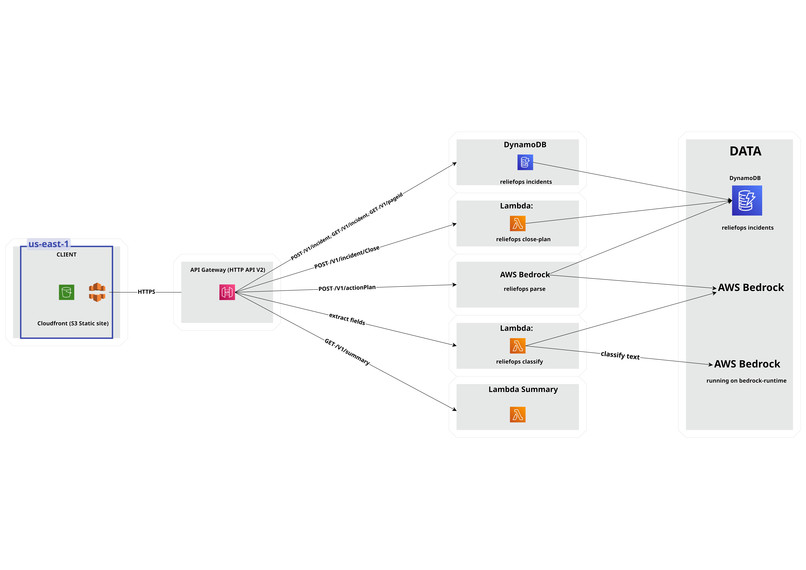
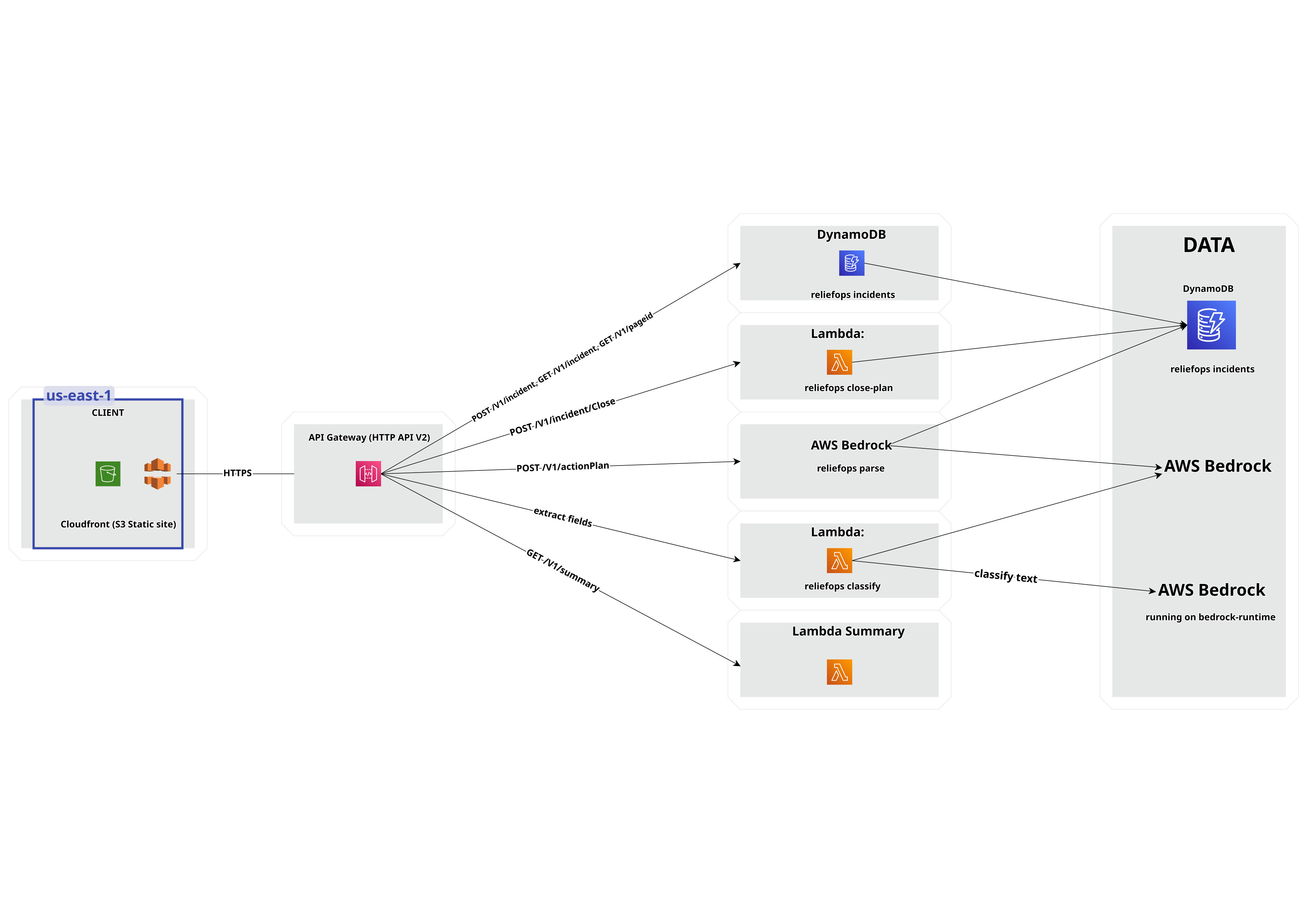
ReliefOps AI - AWS Architecture Diagram
As a team, we began by discussing what kind of project we should work on. Our first ideas included an AI agent for child online safety and another for managing emergency crowds. However, we eventually decided to focus on climate-related disasters, which later expanded into a broader disaster management system that could handle floods, earthquakes, fires, and storms.
We researched how such a tool could make disaster response faster, easier, and more efficient by getting aid to the right places on time. A lot of research went into creating the first version of our project document, which differs from the final plan you see now. The earlier version helped us explore the potential use cases and real-world impact of this system.
As part of our proof of concept, we wanted to showcase how AI could understand and classify disaster situations. Initially, we planned to use the Titan G1 Lite model and began experimenting with vector stores and RAG (Retrieval-Augmented Generation) structures in Bedrock’s playground. Just as we were preparing for our first test, we learned that Titan G1 Lite was being deprecated at the start of October. Because of that, we switched to using Claude 3 Sonnet via the Bedrock API to handle the reasoning tasks instead.
ReliefOps is now a smart, serverless platform designed to help manage disasters efficiently. It allows responders, analysts, or local authorities to report incidents like fires, floods, or storms in plain English through a web page. The system uses Amazon Bedrock AI models to understand the report, classify it, and suggest response actions with mapped locations.
The ReliefOps web app, hosted on AWS S3 and CloudFront, provides a simple and responsive interface for users to log incidents. Each report goes through API Gateway and AWS Lambda to Bedrock Claude 3 Sonnet, which extracts key details such as location, radius, type of incident, priority, number of people affected, and recommended actions.
The system converts the given location into latitude and longitude using OpenStreetMap + OpenCage so that incidents appear automatically on the ReliefOps map for easy visual tracking. All incident data and updates are stored in DynamoDB, while CloudWatch tracks the logs and metrics for each Lambda function.
Future integrations may include OpenSearch and SageMaker for deeper insights and pattern analysis. The platform is flexible enough to use either Claude 3 Sonnet or Titan Text Lite (fine-tuned) for specialized disaster response understanding. Bedrock can also manage additional tasks like checking knowledge bases, applying safety rules, and prioritizing responses more effectively.
Built With
- api
- bedrock
- claude
- cloudfront
- cloudwatch
- dynamodb
- github
- lambda
- opencage
- openstreetmap
- python
- react
- s3
- terraform
- typescript


Log in or sign up for Devpost to join the conversation.