-
-
Logo
-
Banner
-
Project thumbnail
-
Application Screenshot
About the project
Inspiration
It began with a school project. A student, Ayaan, designed a child-safety idea around passive RFID tags read at gates. It is a good idea with one big weakness: it only works where a reader happens to be, and it never knows what was supposed to happen. A parent does not worry because a tag was missed. A parent worries because the child did not arrive when expected.
Bee gave us the missing piece: the plan. A parent already says the plan out loud ("Ayaan has class today, I'll pick him up from school at 5"). RakshaSutra listens for that sentence and turns it into something a safety system can check.
Raksha means protection and sutra means thread: a thread of care between a family and a child.
What it does
- Bee hears the plan. The guardian wears Bee (an Apple Watch running the Bee software). A spoken note becomes a proposed plan: who, where, and when.
- The guardian confirms. Nothing happens until they tap confirm. A reminder is then written back to their Bee todos.
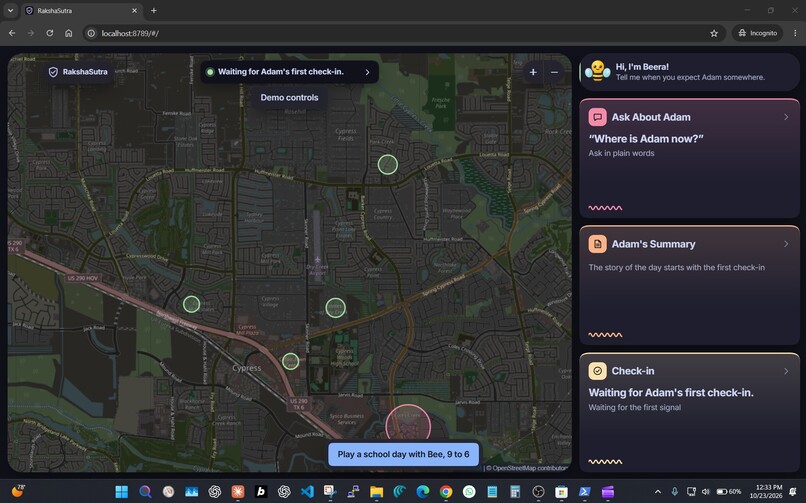
- The safety engine judges against the plan. The child's location reports are compared with what was expected. A late arrival, a walk into a flagged area, a vehicle-speed jump away from a pick-up point, a sudden stop, hours without moving or a silent phone each raise a graded alert.
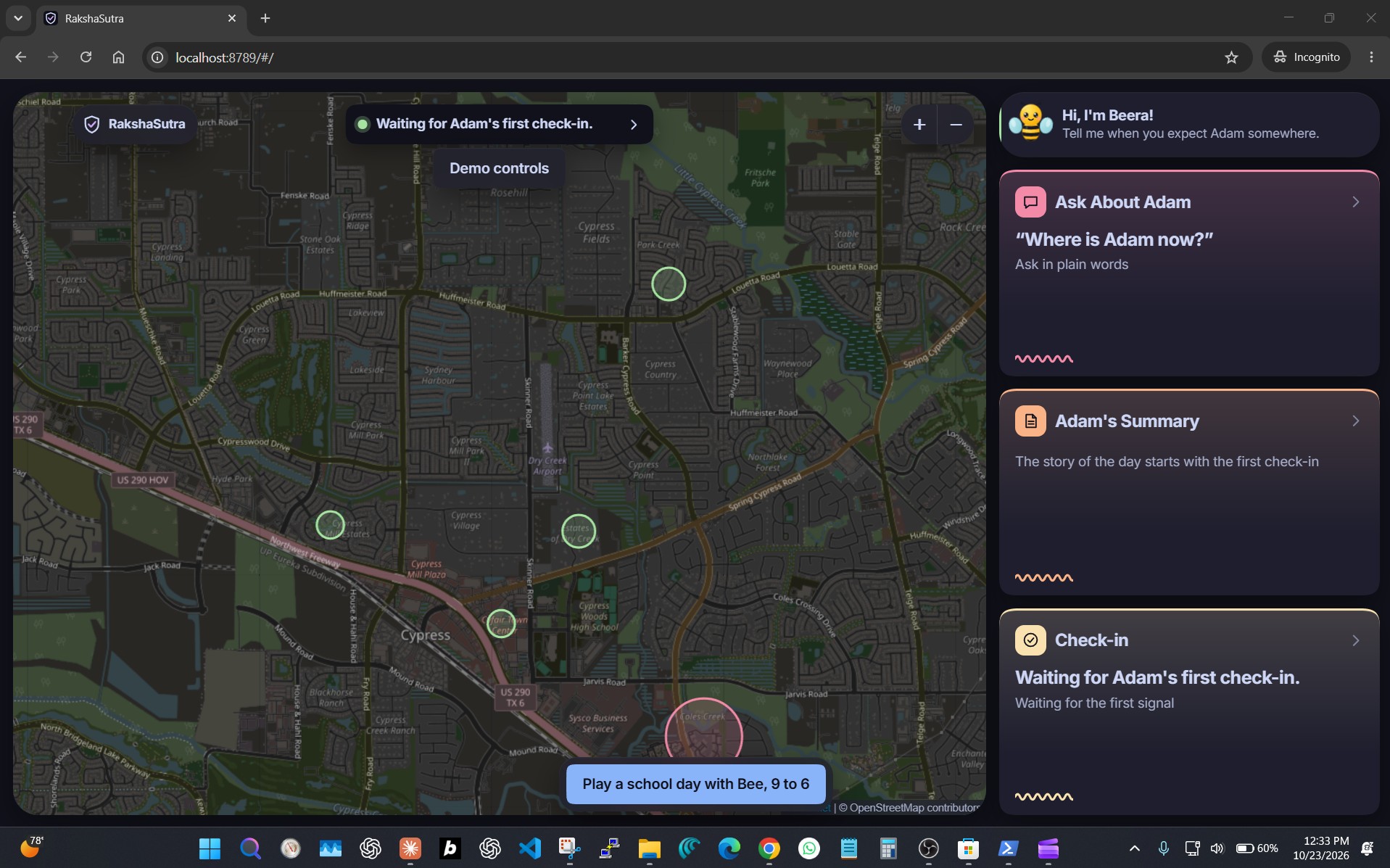
- Alerts explain themselves. Every alert says what was expected, what is known and what is not known. A late arrival is a calm "worth a look", never a claim of danger. A 3-hour timeline, speed and heading, battery, nearest help, backup contacts and a short brief for a dispatcher come with it.
- Beera, a friendly bee, narrates in plain words, and the parent can ask "Where is Ayaan now?".
Emergency numbers are display-only. The app never dials or messages them, in tests or demos, and refuses them as a destination or a saved contact.
How Bee is used (track requirement)
Accomplishments
- A real, working loop: spoken plan → proposed plan → confirmation → reminder in Bee → judged alert → resolved.
- Alerts that are honest about what they do not know.
- An app that looks and feels friendly (Beera, Catppuccin colours, expanding sheets) while saying serious things plainly.
- A one-command simulator for repeatable demos of every scenario.
What we learned
Context beats sensors. A child 30 minutes late to a plan is more informative than any amount of passive tracking, and a wearable that hears the plan is the cheapest way to get it.
What's next
A native iPhone app, a verified run with a real phone, a deployed AWS stack, and a parent-curated trusted circle and handoff packet for emergency services. We deliberately did not build alerts to nearby strangers who own a Bee: there is no supported API, and it would expose a child's identity and location.
Built With
- amazon-bedrock
- amazon-sns
- aws-cdk
- bee
- bee-cli
- claude-code
- github-actions
- hono
- leaflet.js
- mermaid
- node.js
- openstreetmap
- owntracks
- react
- typescript
- vite
- vitest


Log in or sign up for Devpost to join the conversation.