Inspiration
QuickAlert AI was inspired by a common real-world problem: many accident victims do not get immediate help because bystanders are often afraid of being blamed, questioned, or held responsible. In many emergency situations, people want to help but hesitate due to fear, confusion, or lack of a fast way to contact emergency services.
We wanted to create a solution that removes this hesitation and makes emergency reporting faster, safer, and more accessible. Our goal was to build a platform that allows anyone to instantly report an accident and connect victims with nearby hospitals in real time.
What it does
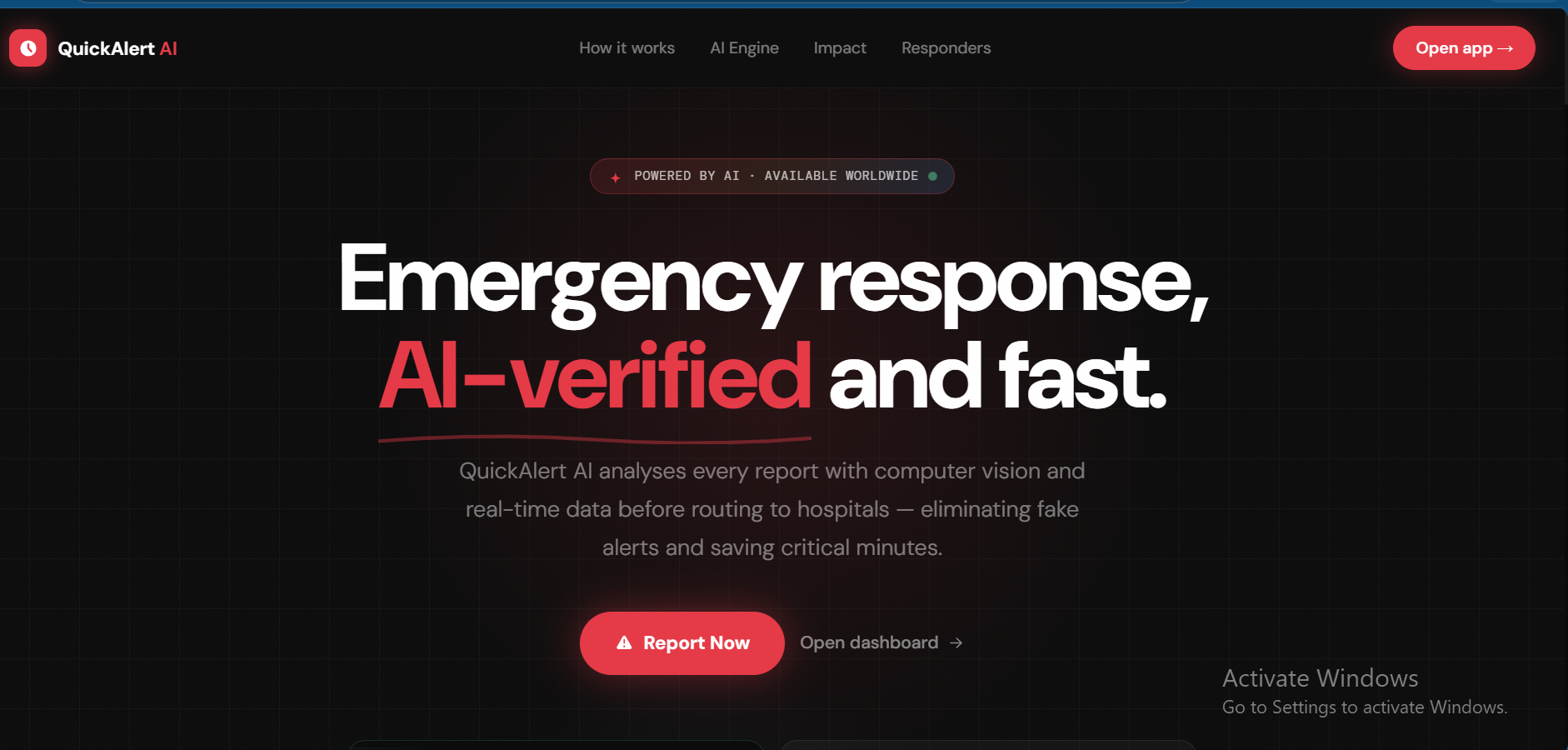
QuickAlert AI is an AI-powered emergency response platform that helps accident victims receive faster medical attention.
When a user witnesses an accident, they can instantly start a live emergency report through the platform. The system captures the user's live location and sends the report to the nearest hospitals or emergency responders nearby.
The AI analyzes the emergency report to help classify the severity of the situation and prioritize urgent cases. QuickAlert AI is designed to reduce emergency response time and encourage more people to safely report accidents without fear.
Key features include:
Real-time emergency reporting Live location tracking AI-powered emergency analysis Nearby hospital notification Fast and simplified reporting system Potential anonymous reporting support
How we built it
We designed QuickAlert AI as a modern web-based platform focused on speed, simplicity, and accessibility.
The frontend was built to provide a smooth and user-friendly emergency reporting experience. We integrated location services to detect and send the user's current coordinates during emergency reporting.
The backend handles emergency data processing, hospital routing, and AI-powered analysis. AI was integrated to help identify the seriousness of emergency situations and improve response prioritization.
We also focused on designing a scalable system that can later support:
multiple emergency types low-network environments multilingual reporting emergency response dashboards
Challenges we ran into
One of the biggest challenges was designing a system that balances speed, accuracy, and simplicity during emergencies. Emergency situations are stressful, so the reporting process needed to be extremely fast and easy to use.
Another challenge was thinking through real-world implementation, such as:
connecting with hospitals handling inaccurate reports managing poor internet connections ensuring reliable location tracking
We also explored how AI could assist emergency response without making the system overly complicated for users.
Accomplishments that we're proud of
We are proud of building a solution that addresses a real human problem with potential life-saving impact.
Some accomplishments include:
Creating a practical AI-powered emergency reporting concept Designing a system focused on reducing bystander hesitation Building a scalable healthcare-focused solution Combining AI, geolocation, and real-time reporting into one platform Developing a project with strong social impact potential
We are especially proud that QuickAlert AI is not just a technical project, but a solution designed around real human behavior and emergency response challenges.
What we learned
Through building QuickAlert AI, we learned the importance of designing technology around human behavior and real-world situations.
We learned:
how AI can support emergency response systems the importance of accessibility and simplicity in critical situations how location-based systems can improve healthcare response the challenges involved in real-time communication systems how impactful technology can solve both technical and social problems
We also gained experience in problem validation, system planning, and designing solutions for real-world scalability.
What's next for QuickAlert AI
Our future plans for QuickAlert AI include expanding the platform into a more complete emergency response ecosystem. Planned improvements include:
AI-based accident severity detection
Anonymous emergency reporting
SMS and offline emergency support
Integration with ambulance and emergency hotlines
Multilingual and voice-based reporting
Hospital and emergency responder dashboards
Support for other emergencies such as fires, flooding, and public safety incidents
Our long-term vision is to make QuickAlert AI a reliable emergency response platform that helps save lives and improves emergency accessibility for communities worldwide.
Built With
- firebase
- gemini
- gps
- nextjs
- tailwindcss
- typescript


Log in or sign up for Devpost to join the conversation.