-
-
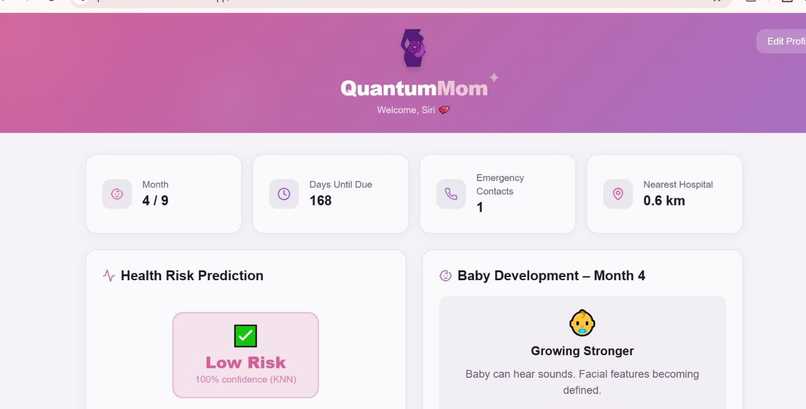
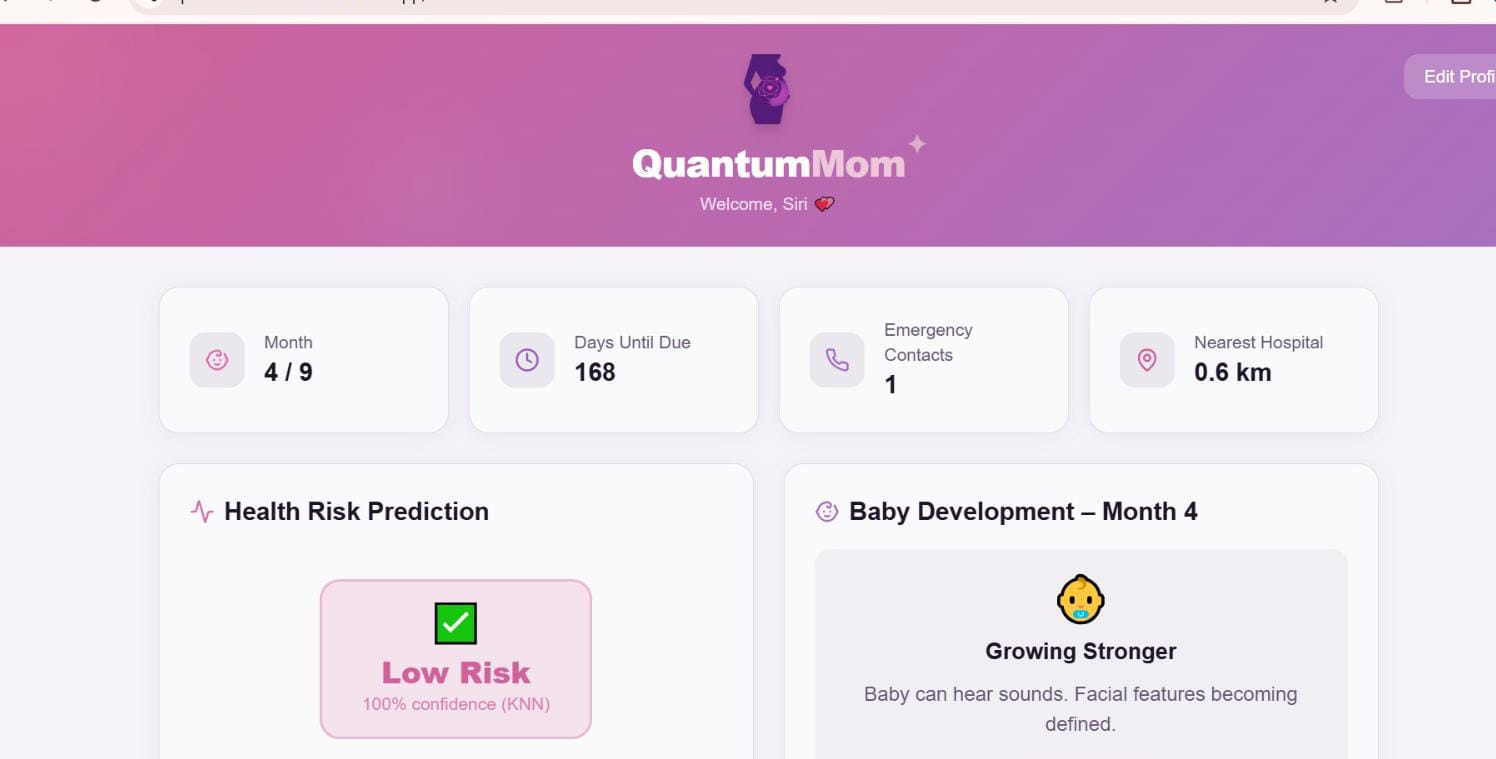
Dashboard
-
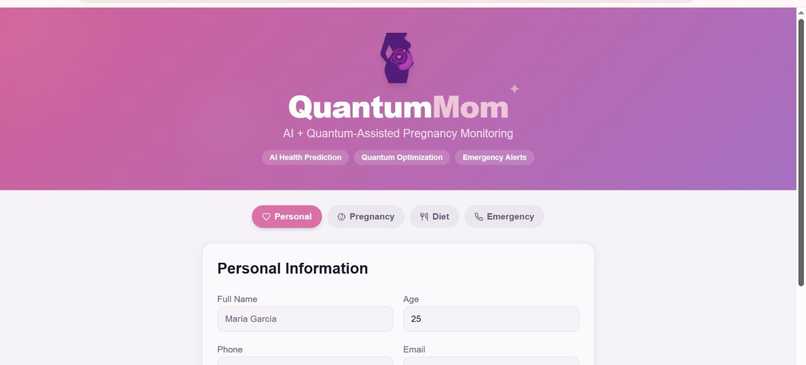
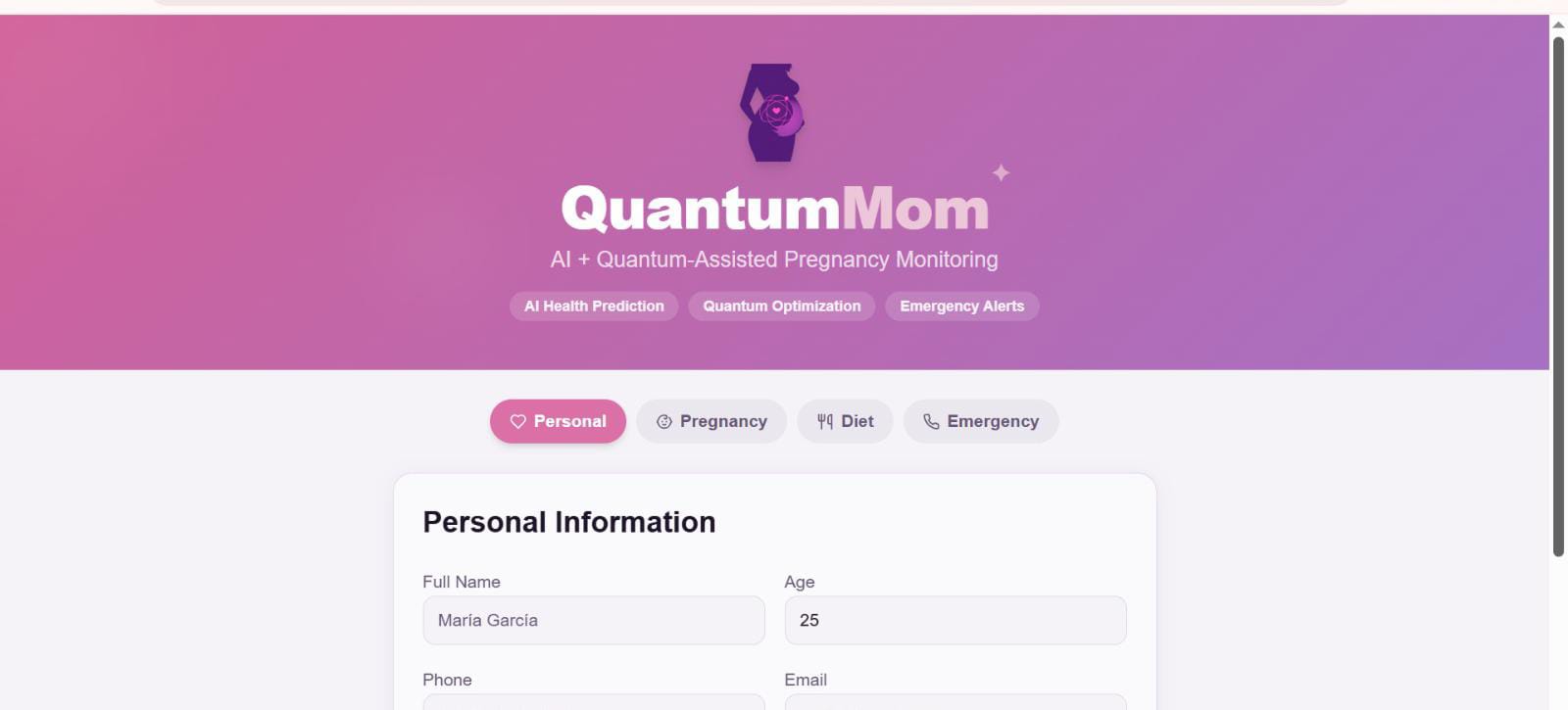
registration page
-
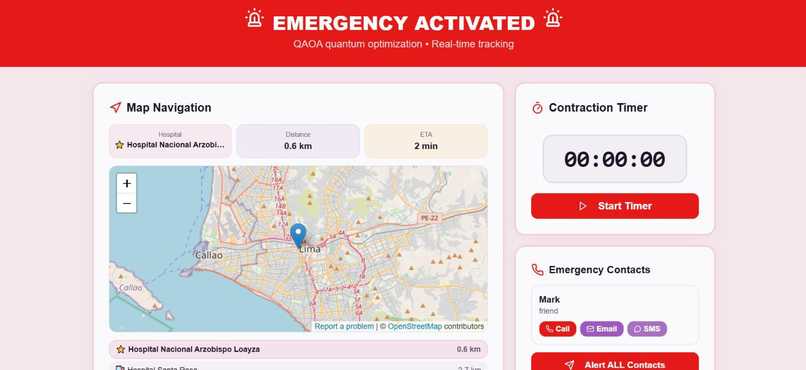
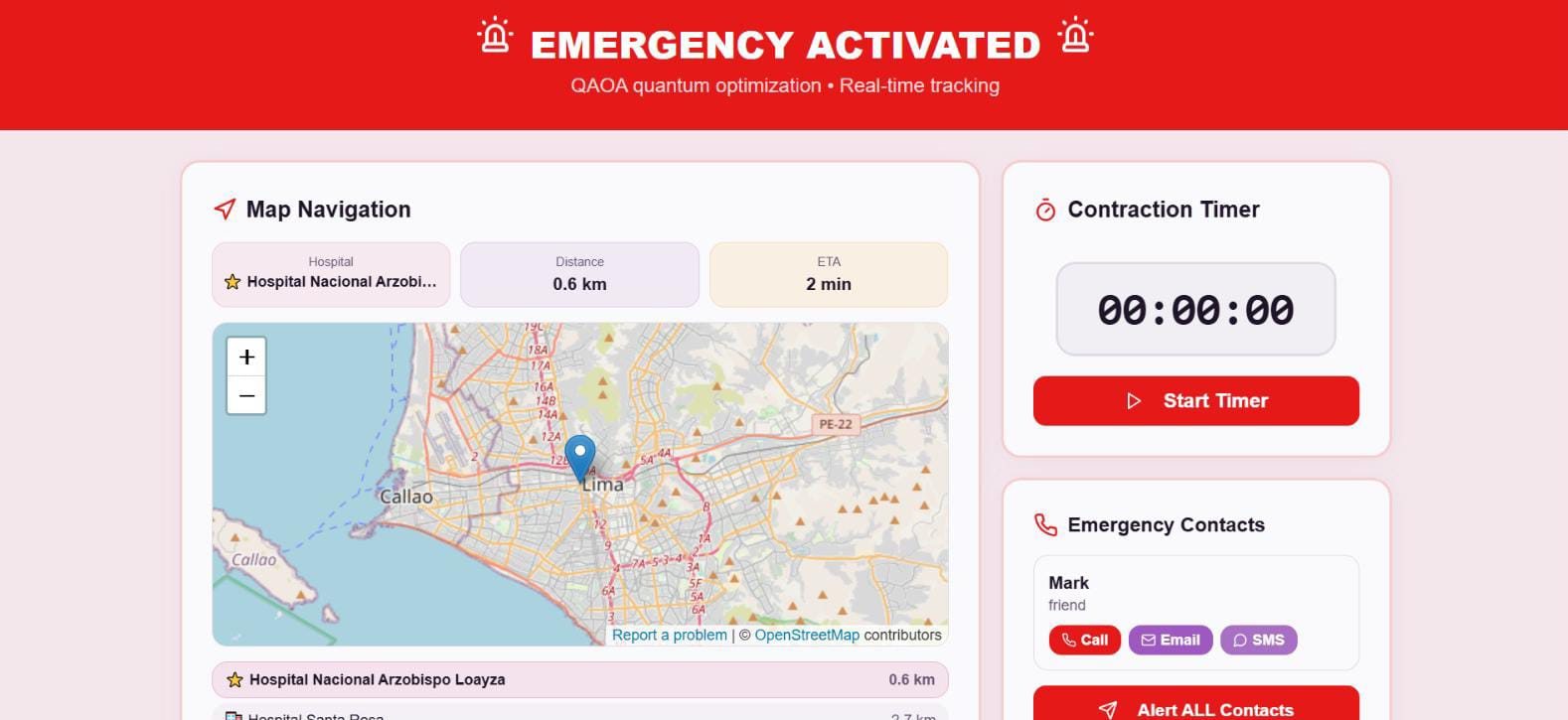
Emergency alert
-
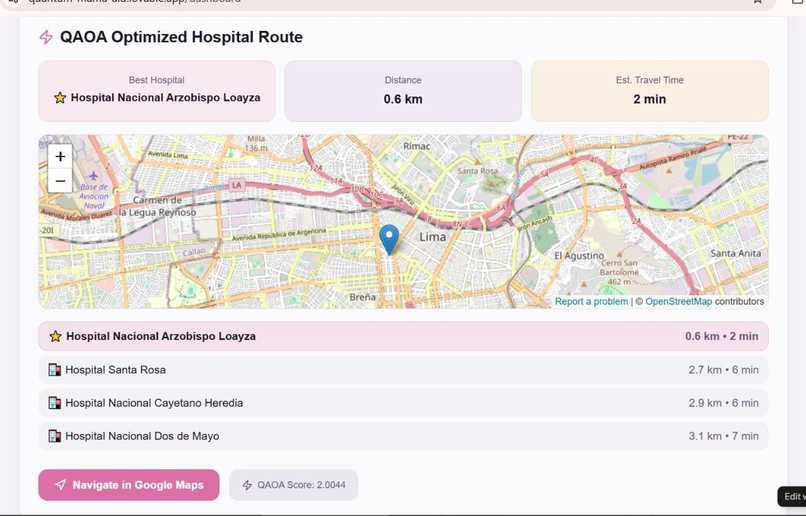
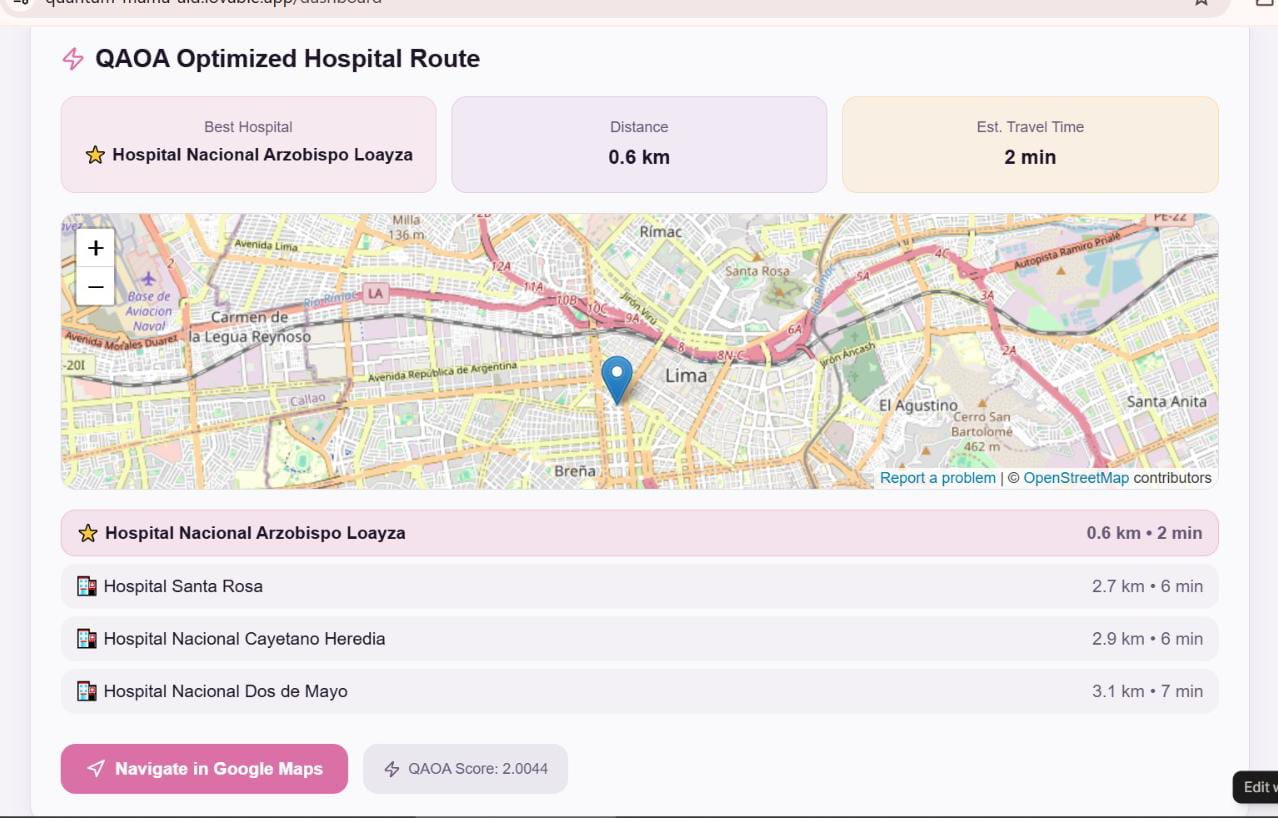
Map Navigation which is made by QAOA
QuantumMom – An Emergency Care System for Pregnant Women
Inspiration
Maternal healthcare remains a critical challenge in many parts of the world. In countries like Peru, pregnant women often struggle with delayed access to hospitals, lack of immediate medical guidance, and difficulty identifying the most suitable healthcare facility during emergencies.
In high-risk situations such as labor complications or sudden health deterioration, every second becomes crucial. However, most existing pregnancy apps mainly provide reminders or general information rather than real-time emergency decision support.
This inspired us to build QuantumMom, a smart maternal healthcare platform that combines machine learning, quantum-inspired optimization, and geospatial navigation to assist pregnant women during both routine monitoring and emergency situations. Our goal was to create a system that can guide mothers toward faster, safer, and more informed healthcare decisions.
What it does
QuantumMom is a web-based maternal healthcare application designed to support pregnant women throughout their pregnancy journey.
The system provides:
- Patient Registration where users enter health information such as age, blood pressure, weight, pregnancy stage, due date, and emergency contacts.
- A Health Dashboard that displays baby development insights, nutrition recommendations, and predicted pregnancy risk levels.
An Emergency Mode that can be activated instantly. When triggered, it:
- Starts a contraction timer
- Sends alerts to emergency contacts
- Identifies and navigates to the most optimal nearby hospital
To determine the best hospital during emergencies, the system evaluates nearby facilities using a quantum-inspired optimization approach combined with geospatial distance calculations.
How we built it
QuantumMom was built using modern web technologies combined with intelligent algorithms.
The frontend interface was developed using React and TypeScript, enabling a dynamic and responsive user experience. Styling and UI components were implemented using Tailwind CSS and shadcn/ui, ensuring a clean and accessible design suitable for healthcare environments.
For location services, the platform integrates OpenStreetMap for hospital visualization and Google Maps for navigation routing.
On the computational side, several algorithms power the system.
To calculate the geographic distance between the user and nearby hospitals, we implemented the Haversine formula:
$$ d = 2r \cdot \arcsin \left(\sqrt{\sin^2\left(\frac{\phi_2-\phi_1}{2}\right) + \cos(\phi_1)\cos(\phi_2)\sin^2\left(\frac{\lambda_2-\lambda_1}{2}\right)}\right) $$
where:
- $r$ is the Earth's radius
- $\phi$ represents latitude
- $\lambda$ represents longitude
For pregnancy risk prediction, we used a K-Nearest Neighbors (KNN) model:
$$ d(x,y) = \sqrt{\sum_{i=1}^{n}(x_i - y_i)^2} $$
This model classifies pregnancy risk levels into Low, Medium, or High based on features such as age, blood pressure, and weight.
For hospital optimization, we implemented a Quantum Approximate Optimization Algorithm (QAOA) inspired cost function:
$$ |\psi(\gamma,\beta)\rangle = e^{-i\beta H_M} e^{-i\gamma H_C} |+\rangle^{\otimes n} $$
Where:
- $H_C$ represents the cost Hamiltonian encoding hospital selection criteria
- $H_M$ represents the mixing Hamiltonian
- $\gamma$ and $\beta$ are optimization parameters
This approach helps rank hospitals by evaluating multiple factors such as distance and accessibility, ultimately recommending the most suitable healthcare facility.
Challenges we ran into
One of the biggest challenges was translating theoretical computational concepts into a practical healthcare application. Implementing quantum-inspired optimization through QAOA and adapting it for hospital ranking required significant experimentation.
Another challenge was designing a reliable emergency workflow that integrates several processes simultaneously, triggering alerts, calculating hospital rankings, and providing navigation. all while maintaining a smooth user experience.
We also faced challenges with geospatial data handling, particularly ensuring accurate hospital location mapping and efficient distance calculations.
Additionally, creating a user interface suitable for pregnant women required balancing simplicity, accessibility, and clarity, especially for situations where the user may be under stress.
Accomplishments that we're proud of
One of our proudest achievements is successfully applying quantum-inspired optimization techniques to a real-world healthcare scenario. This demonstrates how emerging computational approaches can help solve practical problems.
We are also proud of building a system that integrates health monitoring, risk prediction, and emergency response into one platform. Instead of focusing only on pregnancy tracking, QuantumMom actively assists mothers during critical moments.
Another accomplishment is the intuitive and accessible user experience, allowing expecting mothers to easily register, monitor their health, and activate emergency assistance when needed.
What we learned
Through this project, we learned how to combine healthcare applications with advanced computational algorithms.
We explored the practical implementation of machine learning techniques such as KNN for health risk prediction, as well as the potential of quantum-inspired algorithms like QAOA for solving optimization problems.
Beyond technical knowledge, this project reinforced the importance of human-centered design, particularly when developing applications that support vulnerable users in emergency scenarios.
We also gained valuable experience in geospatial systems, healthcare data modeling, and emergency workflow design.
What's next for QuantumMom – An Emergency Care for Pregnant Women
QuantumMom represents an early step toward intelligent maternal healthcare systems, but there are many opportunities for expansion.
Future improvements could include:
- Integration with IoT wearable devices for real-time monitoring of maternal vital signs.
- An AI-powered conversational assistant to provide personalized pregnancy guidance.
- Multilingual support and voice-based interaction to improve accessibility.
- Direct hospital integration for real-time emergency coordination.
Our long-term vision is to transform QuantumMom into a comprehensive maternal healthcare ecosystem that connects mothers, hospitals, and caregivers through intelligent technology.
Conclusion
QuantumMom demonstrates how emerging technologies such as machine learning, geospatial analytics, and quantum-inspired optimization can be used to address real-world healthcare challenges.
By providing predictive health insights, optimized hospital navigation, and rapid emergency response, the platform aims to support pregnant women during one of the most critical phases of their lives.
Technology has the power to save lives when designed with empathy and purpose.
“QuantumMom — Where intelligent technology protects every mother and every heartbeat.”
Built With
- google-maps
- haversine
- knn
- openstreetmap
- qaoa
- react
- tailwind
- typescript
- vite
- vitest


Log in or sign up for Devpost to join the conversation.