-
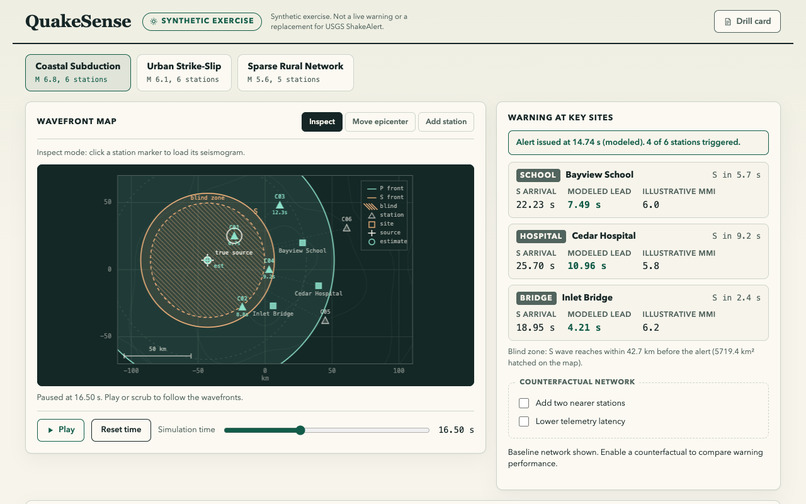
QuakeSense seismic network workbench comparing alert confirmation, STA/LTA traces, and site countdowns.
-
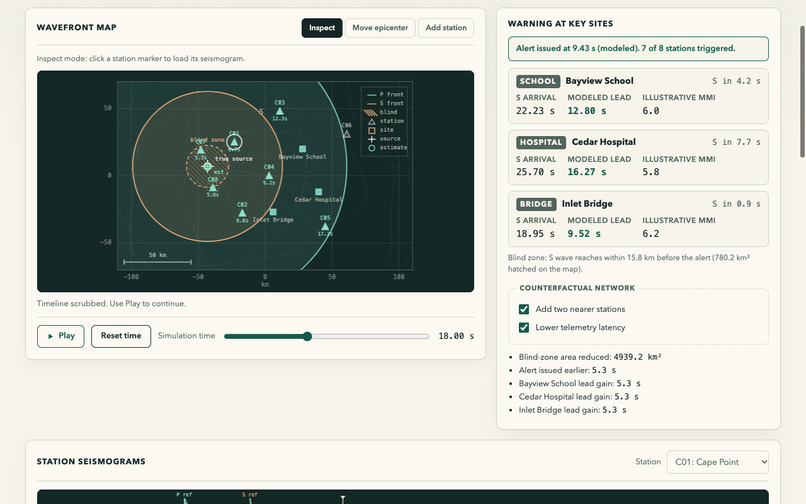
QuakeSense expanding P/S wavefront map showing modeled blind-zone reduction and hypocenter uncertainty ellipse.
Inspiration
An earthquake early warning is not a prediction. The rupture has already started, and electronic telemetry can outrun the slower damaging S-wave. That timing gap is easy to describe on paper yet hard to visualize. QuakeSense lets students and communities watch the expanding wavefronts open and close that countdown window and see why the exact same alert gives one school precious seconds while another sits inside the blind zone.
What it does
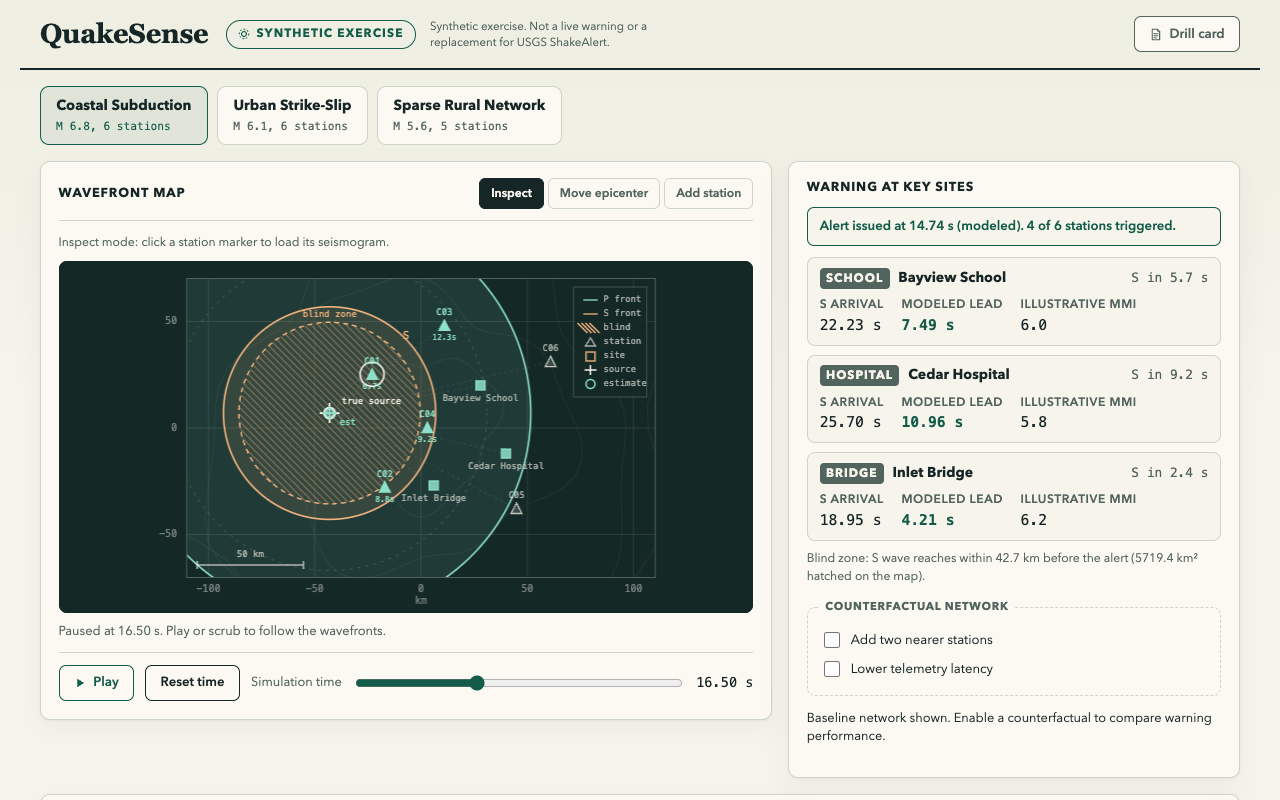
- Interactive 3D P/S Triangulation and Blind-Zone Workbench. Explore three fictional seismic networks (Coastal Subduction, Urban Strike-Slip, and Sparse Rural Network) or place custom epicenters and stations. Scrub time from origin through expanding P and S wavefronts down to a single station's three-component trace.
- Real-Time STA/LTA Picker and Nonlinear Hypocenter Fit. Computes repeatable noisy seismograms, detects onset candidates with a short-term to long-term energy ratio, separates threshold crossing from multi-station confirmation time, and fits the 3D hypocenter using only currently available picks while displaying a geometry-based uncertainty ellipse.
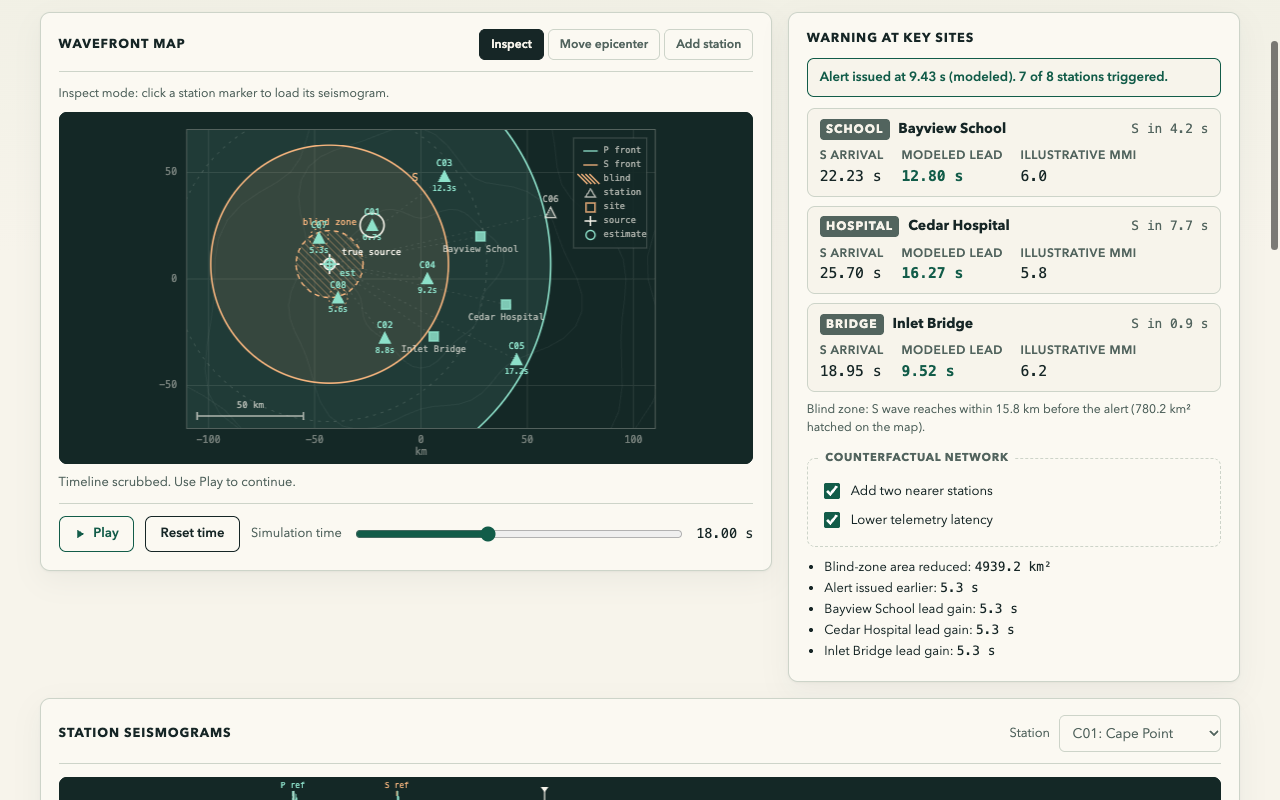
- Bilingual School Drill Cards and Auditable Exports. Toggle two nearby stations or lower telemetry latency to see exact countdown changes for a school, hospital, and bridge. Print a clean one-page school drill card in English or Spanish, or export GeoJSON, formula-neutralized CSV, and a SHA-256 checksummed JSON scenario record.
How we built it
QuakeSense runs offline in plain ES-module JavaScript, HTML5 Canvas, CSS3, and Web Crypto with zero runtime dependencies and zero external requests. Pick times are rebased to a reference epoch to avoid float64 cancellation, localization caches are fingerprinted on active picks, and exports neutralize formula injection including Unicode combining marks.
Challenges we ran into
Issuing an alert, locating the hypocenter accurately, and delivering usable lead time at a specific building are three separate milestones. A rural one-sided station array can trigger a valid alert while leaving the hypocenter uncertainty ellipse wide, and a shallow urban fault can leave a nearby school with zero usable lead time even after network upgrades. Keeping every distinction visible and honest was central to the design.
Accomplishments that we're proud of
- In the synthetic Coastal Subduction preset, adding two nearer stations and lowering telemetry latency shifts the modeled alert from 14.74 seconds to 9.43 seconds, raises Bayview School's modeled warning from 7.49 seconds to 12.80 seconds, and shrinks the modeled blind zone by about 4,939 square kilometers.
- In the Urban Strike-Slip preset, QuakeSense honestly shows that the same network upgrades still leave Juniper School with zero usable warning time.
- Passed 349 automated Node tests and 56 real-browser checks at 1280x800 and 390x844 with zero console errors, zero external requests, and one-page English and Spanish drill printouts.
What we learned
Separating picker onset from telemetry confirmation time reveals how much warning is lost to sensor spacing versus packet delay. Showing both numbers side by side turns seismic safety into a quantitative engineering lab.
What's next for QuakeSense
Build classroom lab worksheets where student teams optimize station placement under a fixed sensor budget and compare the teaching crust models against published historical events. QuakeSense is an educational simulation and does not predict earthquakes, transmit real alerts, or replace USGS ShakeAlert or school emergency procedures.
