Inspiration
The inspiration for this idea was the movie "The Lost Bus" where a school bus driver is tasked with evacuating children during Camp Fire in Paradise California. We were inspired by this movie because it brought forth the idea of trying to find ways to help bus drivers route through dangerous natural disasters like in the movie.
What it does
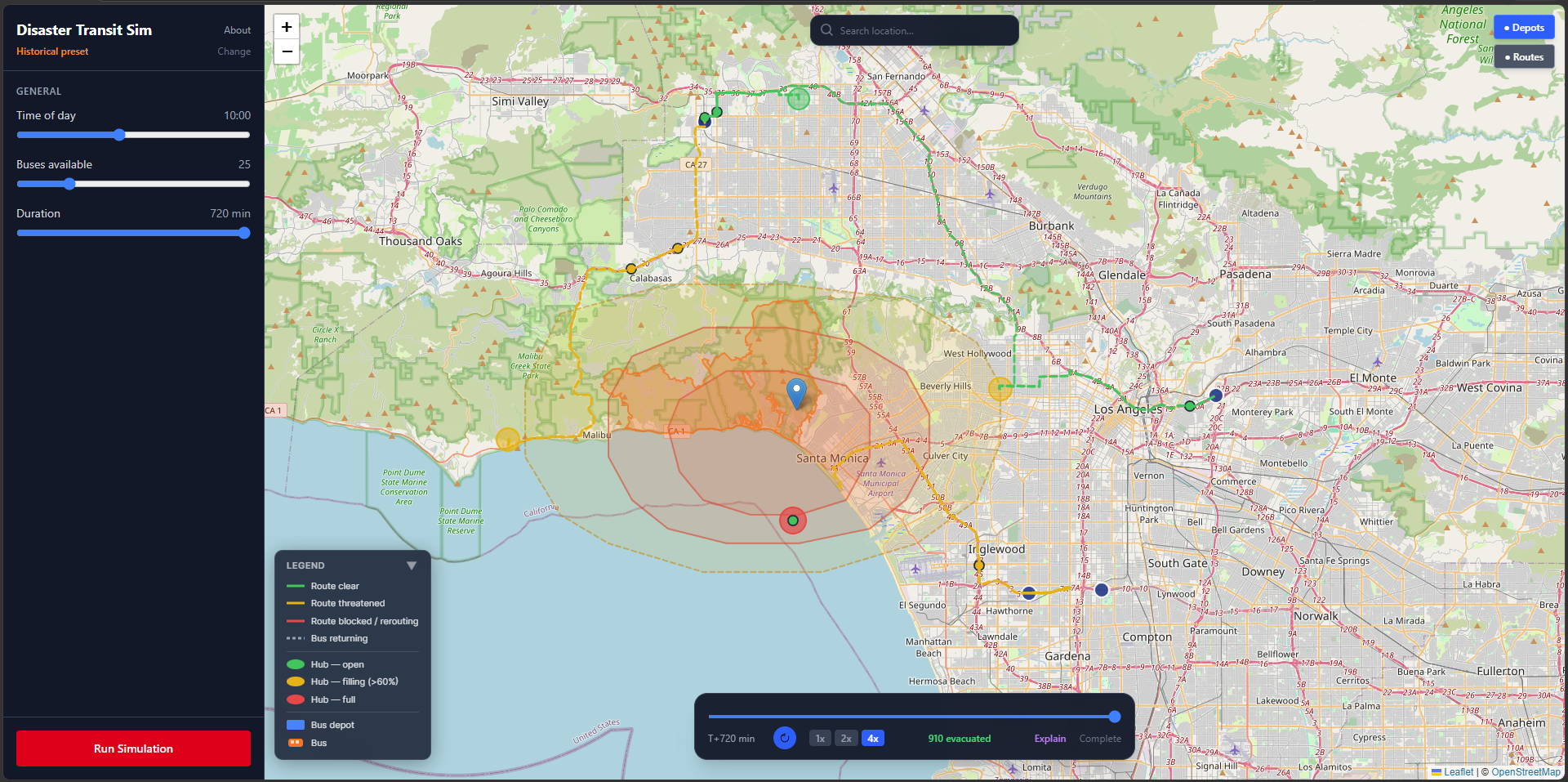
Disaster Dispatch is a simulation demo to showcase the idea of utilizing algorithms or machine learning to determine where public transportation must be sent and where it should be routed in order to evacuate as many people as possible before and during a natural disaster
Currently the project is just a simulation that shows the spread of a disaster, and dynamic bus routes that move as the disaster spreads.
How we built it
The programming languages we used to build this project are: React, Typescript, and Python. The frontend runs as a vite server using react leaflets for the mapping engine, and tailwind css for styling. The backend is uses FastAPI and Uvicorn for serving HTTP responses, Pydantic for request/response validation, httpx for HTTP calls to Overpass and OSRM API, NumPy for simulation math, and Shapely for Geometry checks.
The external APIs that we used and what they are used for are:
- OpenStreetMap Overpass: This was used to fetch locations of roads, public transit stops, and buildings to be used as hubs where busses go to pick people up
- Google Maps: This was used to snap hub/depot poitns to roads and public transit stops, as well as obtain routes between depots and hubs, and computing alternative routes when previous routes are considered unsafe.
Challenges we ran into
One of the big challenges we ran into was seeing whether or not our ideas were 100% feasible within a three day time frame, and figuring out how logic would work if we were to implement our ideas. We ended up navigating through this challenge by using the socratic method to figure out exactly what we wanted and to find out what sorts of logical flaws we had with our ideas.
Another challenge we ran into was with utilizing OSRM and Google Maps API. We ran into bugs that made it so that we might've been rate limited or were not getting responses from OSRM and with Google Maps API, we ran into bugs where routes were initially not mapping correctly
Accomplishments that we're proud of
One of the accomplishments that we're proud of is that we were able to come with a pretty cool project idea.
What we learned
One of the things that we learned is the usefulness of mapping APIs, and how to utilize them.
What's next for PubTransit Dispatch
In the future we hope that PubTransit Dispatch can built upon to be a system that helps governments plan and send evacuation information to public transit workers and the community. We envision PubTransit to be built to do real time routing depending on the trajectory of a natural disaster and population. Calculating the optimal number of public transit vehicles, and the routes and hubs they should take to have a larger chance of evacuating as much people as possible

Log in or sign up for Devpost to join the conversation.