-
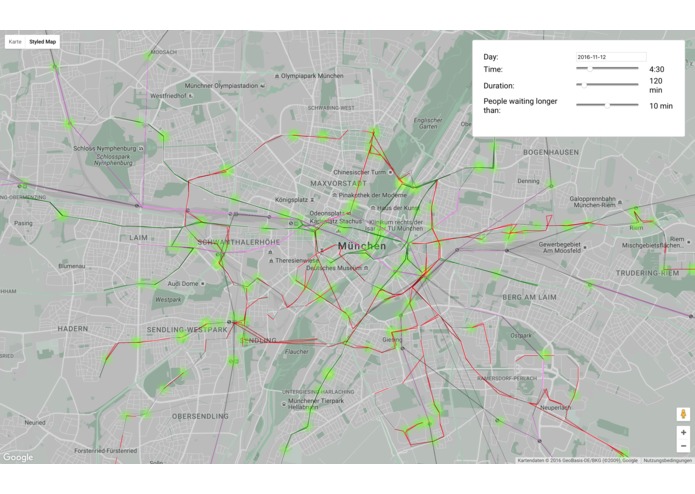
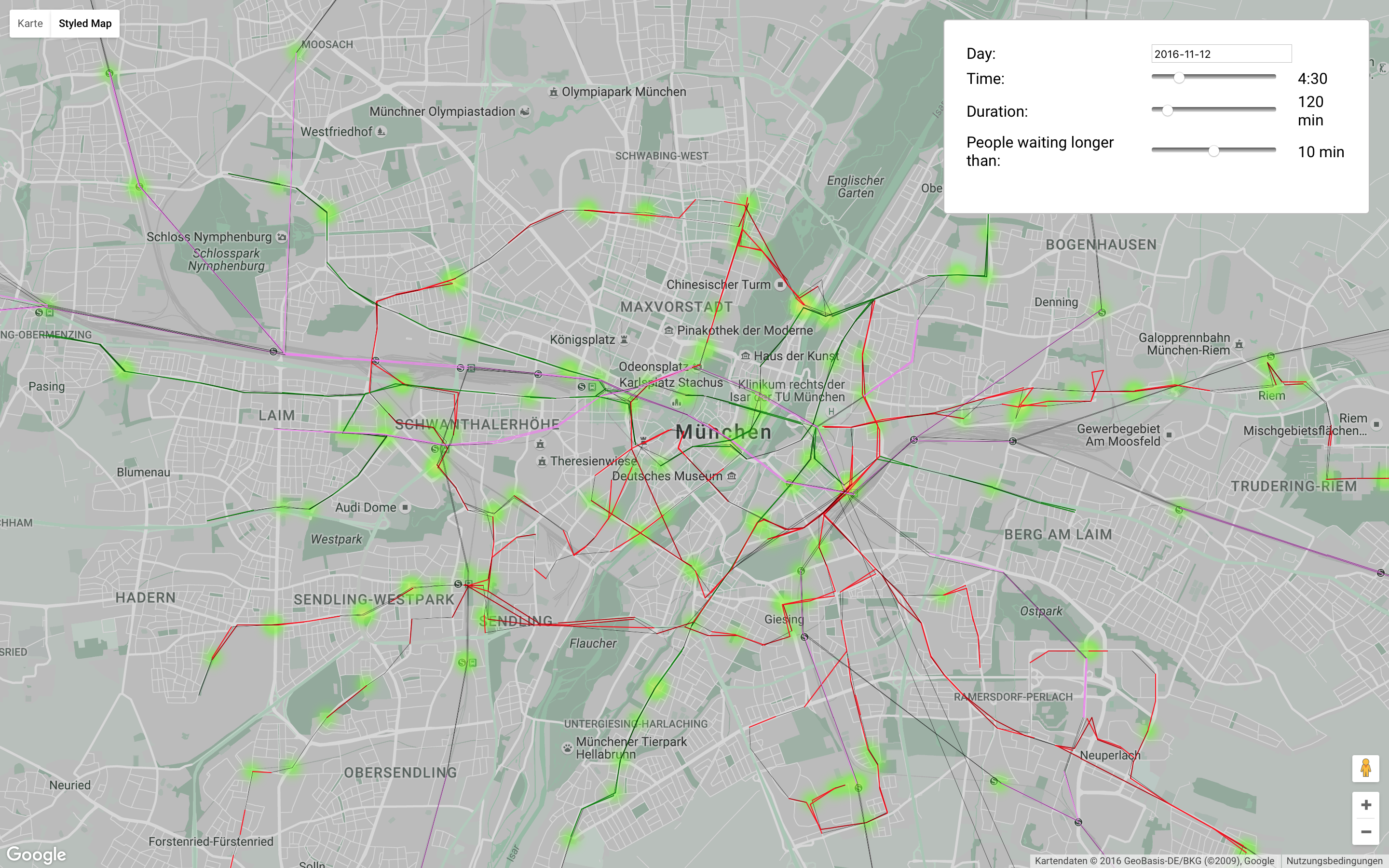
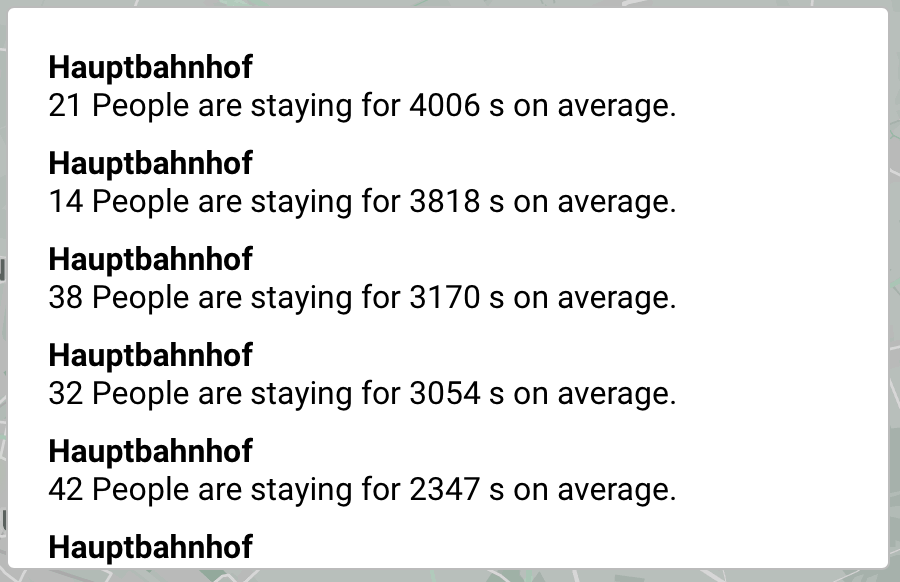
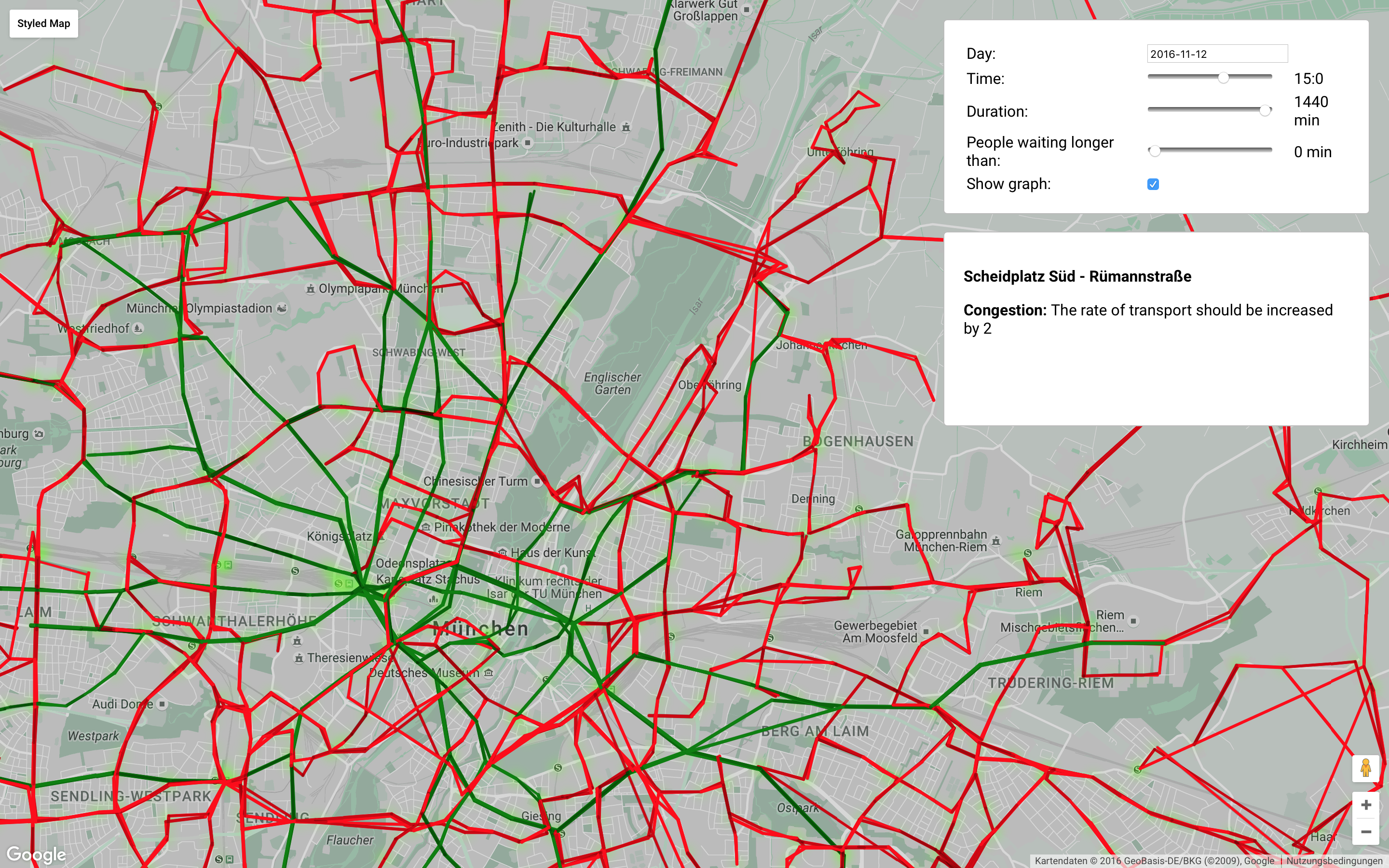
Lines show public transport connections, color indicates saturation of those connections. The Heatmap shows how full stations are.
-
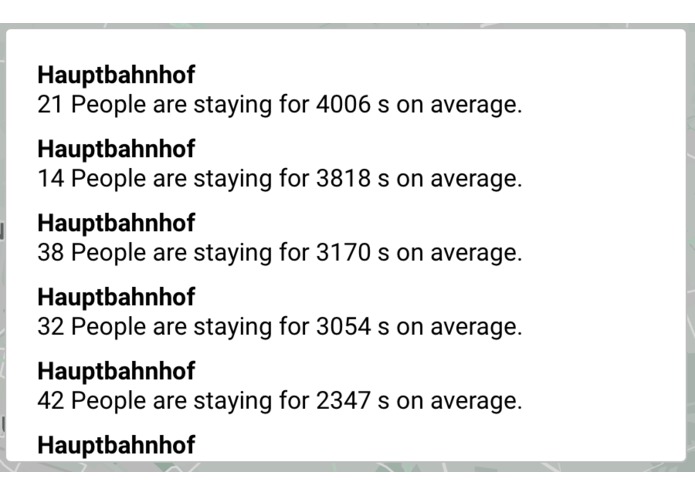
Suggestions for reducing waiting times
-
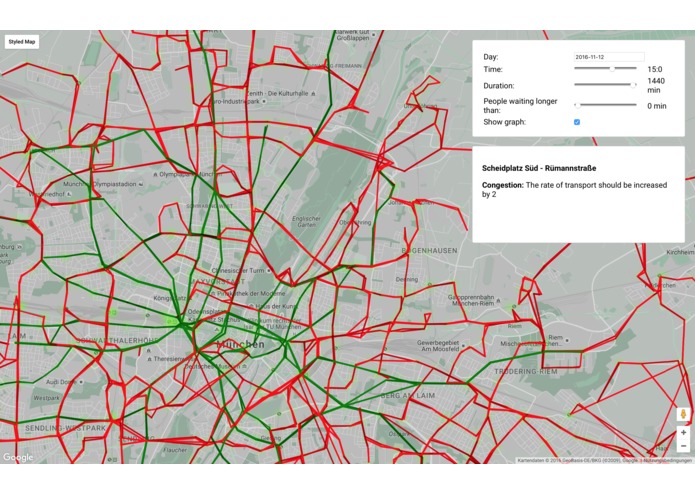
Bigger dataset
Inspiration
Nearly everyday I use public transport to get to university. The first part is by bus, the second by subway. At the station, where I switch between them, the subway leaves the station one minute before the bus reaches the station so I have to wait unnecessarily long for the next train.
What do I want to change?
By collection a big dataset of the routes, people take using public transport, I want to optimize the public transport system.
How can the data be collected?
By equipping every bus and tram stop, every subway station and every vehicle with an iBeacon - a small, inexpensive Bluetooth sender, which can be used for geofencing applications - and equipping an existing transport app with a broad install base (like the MVG app), I can track routes, which people are using and how full trains, busses and stations are.
What can be done using this data
... for the provider of public transport?
- Long waiting times can be reduced by finding spots, where many people wait a long time for their next connection
- Commonly used routes can be detected. This data can be used to provide more connections on a given route or even to check, if a new route may be more efficient.
- If possible, more busses could be provided nearly instantly on demand
... for the user of the public transport app?
- The iBeacons could be used to help people inexperienced with a station navigate through it.
- By finding commonly used routes of a person, the app can notify the user, if a route often used by him/her becomes unavailable (accidents, construction) and he/she could be notified in advance (using push notifications).
How I built it
I collected data using the overpass turbo api to find out about the public transportation graph of Munich. The data I collected, was then used to create a representation of this graph in a relational database. A mockup dataset was developed on top of this graph. To provide insight into the data, a web interface was created.
Challenges I ran into
This project requires powerful analytics algorithms, which need to be written. Doing that was impossible during this short amount of time, so it was hard to find team members. The dataset needed was not easy to obtain and generating it took a long time. Also, it is hard to generate meaningful data in a short period of time. As I wanted to move my database to the cloud using Microsoft Azure, I ran into volume limits of the provided database.
What's next for this project
Many of the possibilities mentioned for the analytics tool are not implemented yet. Using machine learning and statistics tools in the cloud, the dataset can be processed for better insight. A better dataset needs to be optained and real world tests need to be performed.

Log in or sign up for Devpost to join the conversation.