-
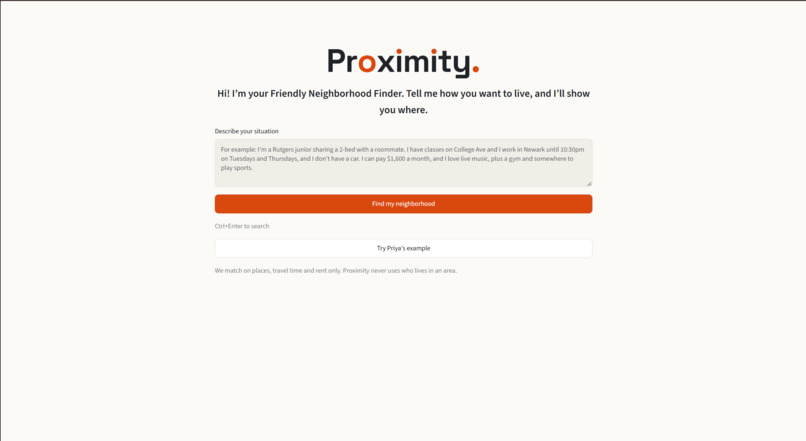
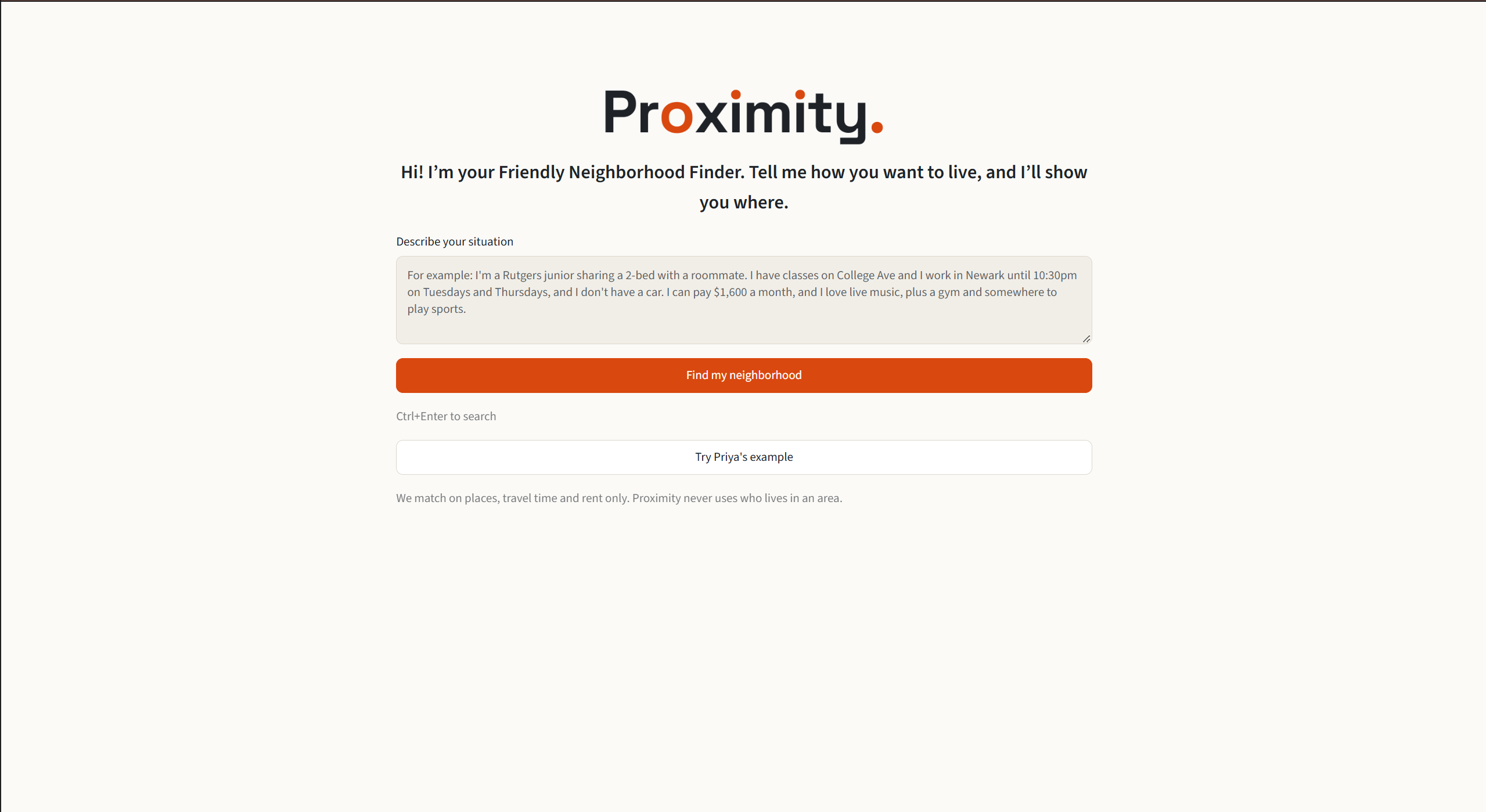
Tell Proximity how you want to live.
-
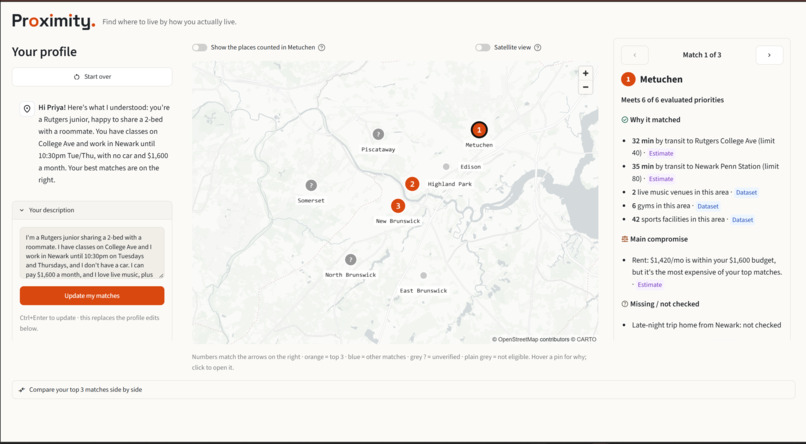
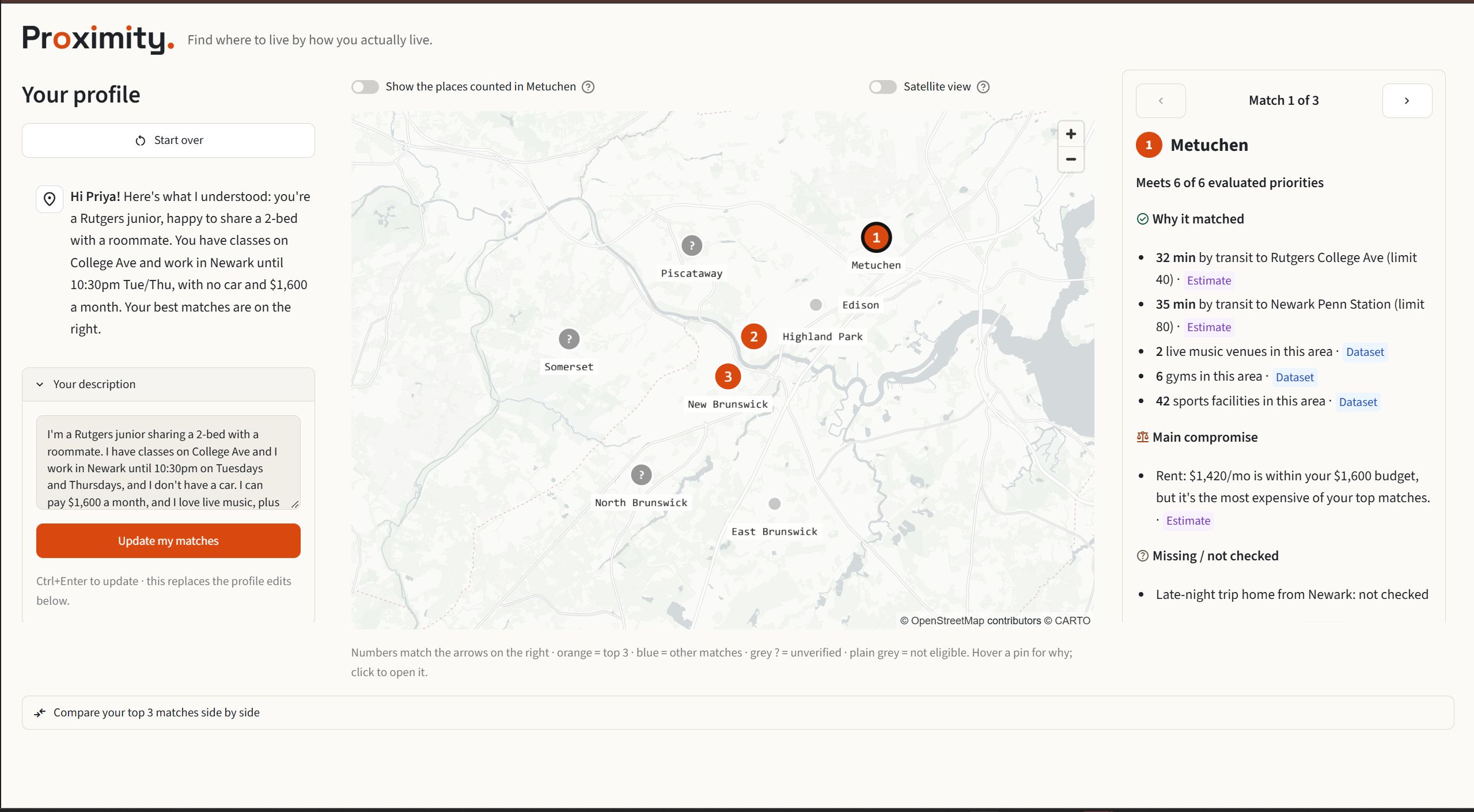
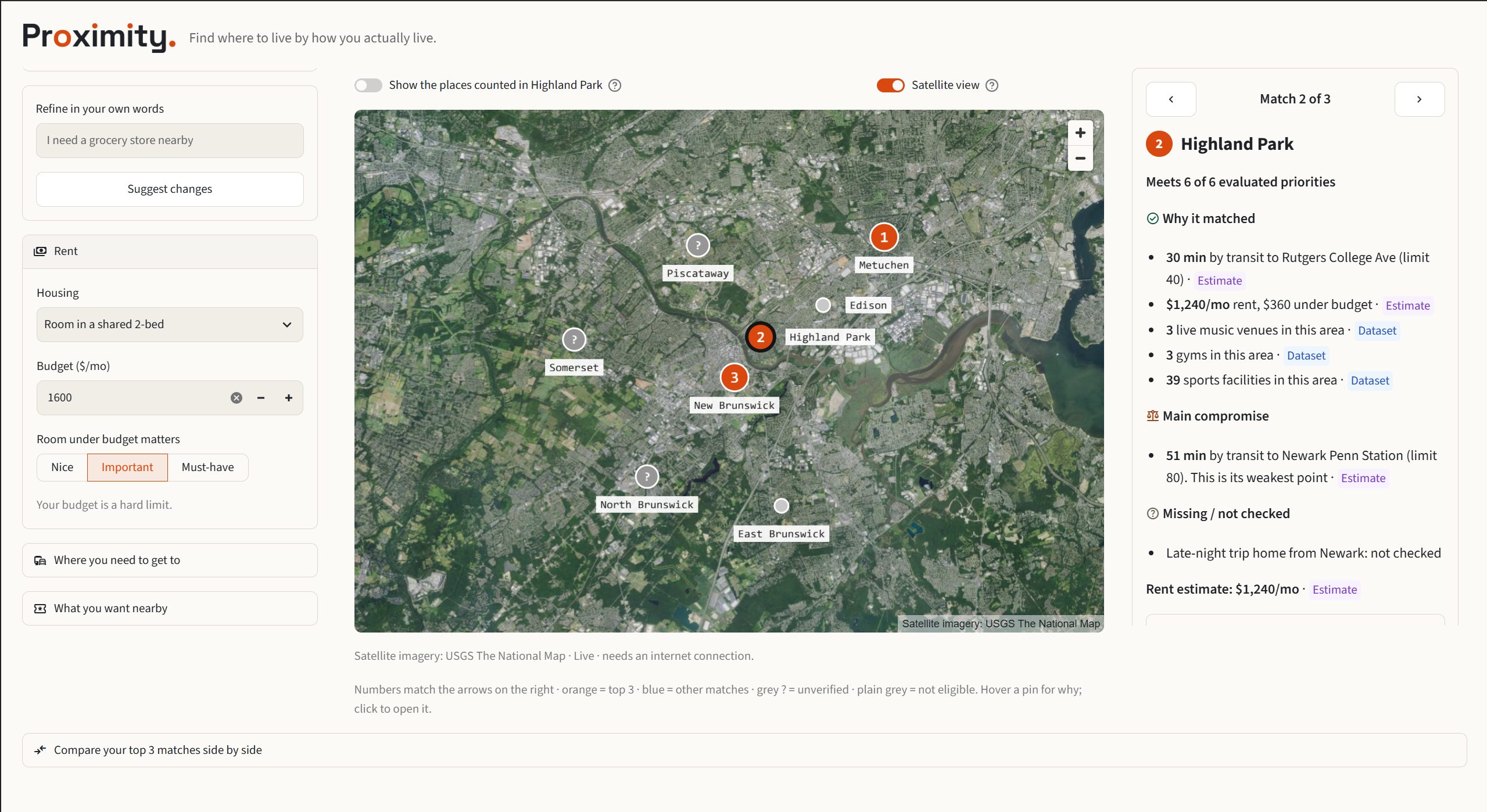
Every area ranked, with the reasons.
-
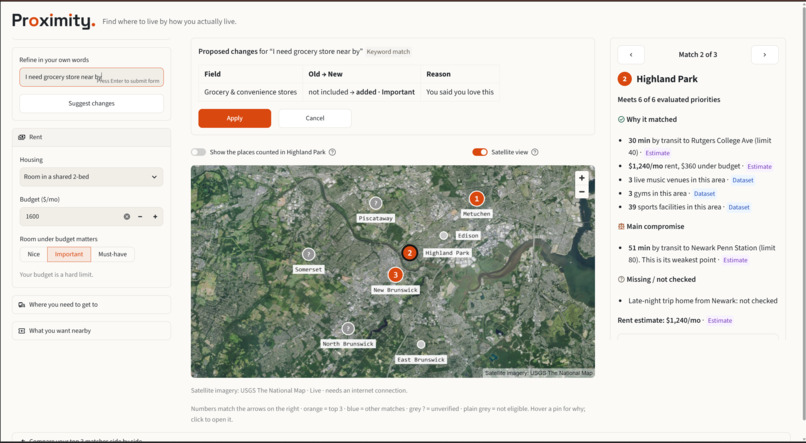
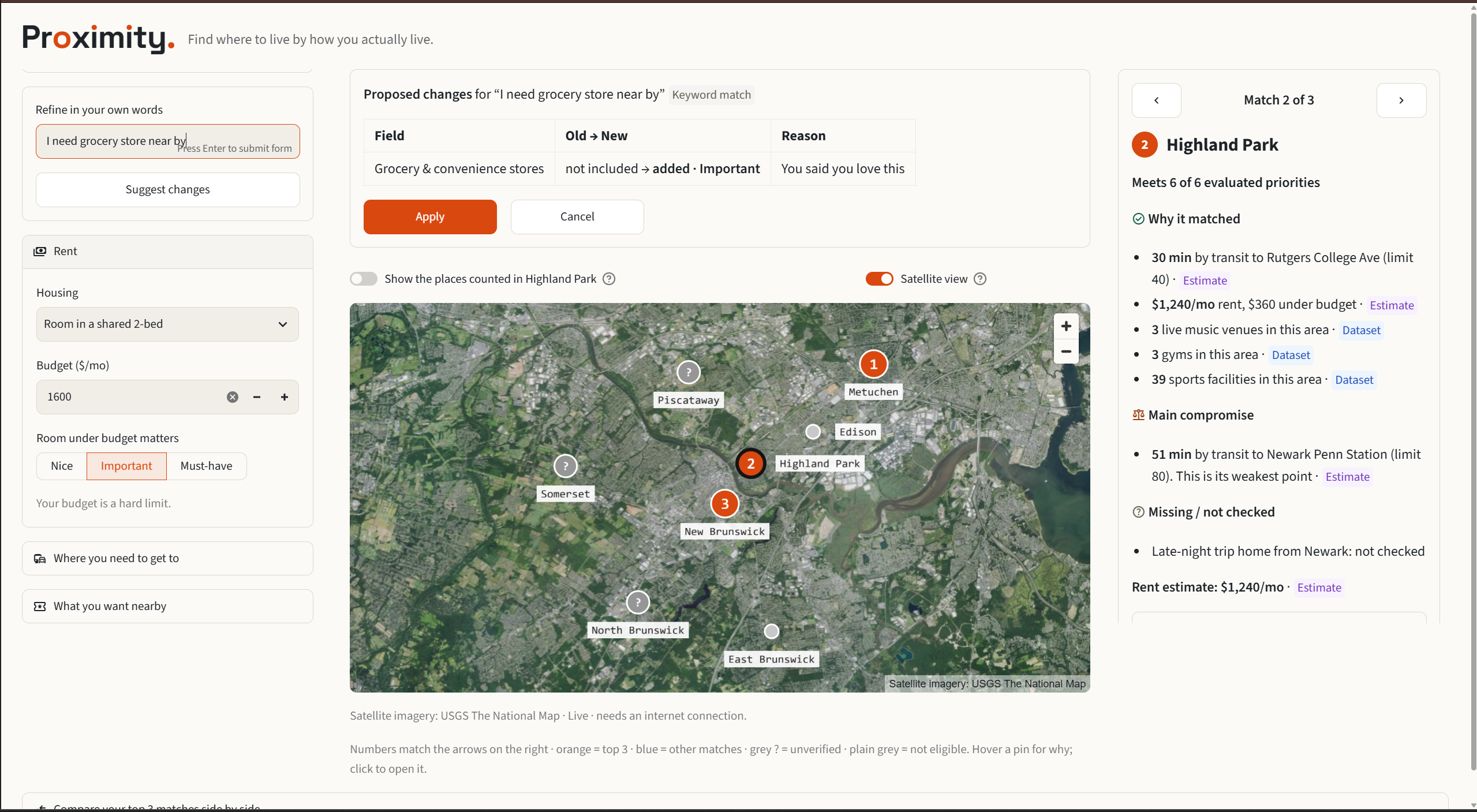
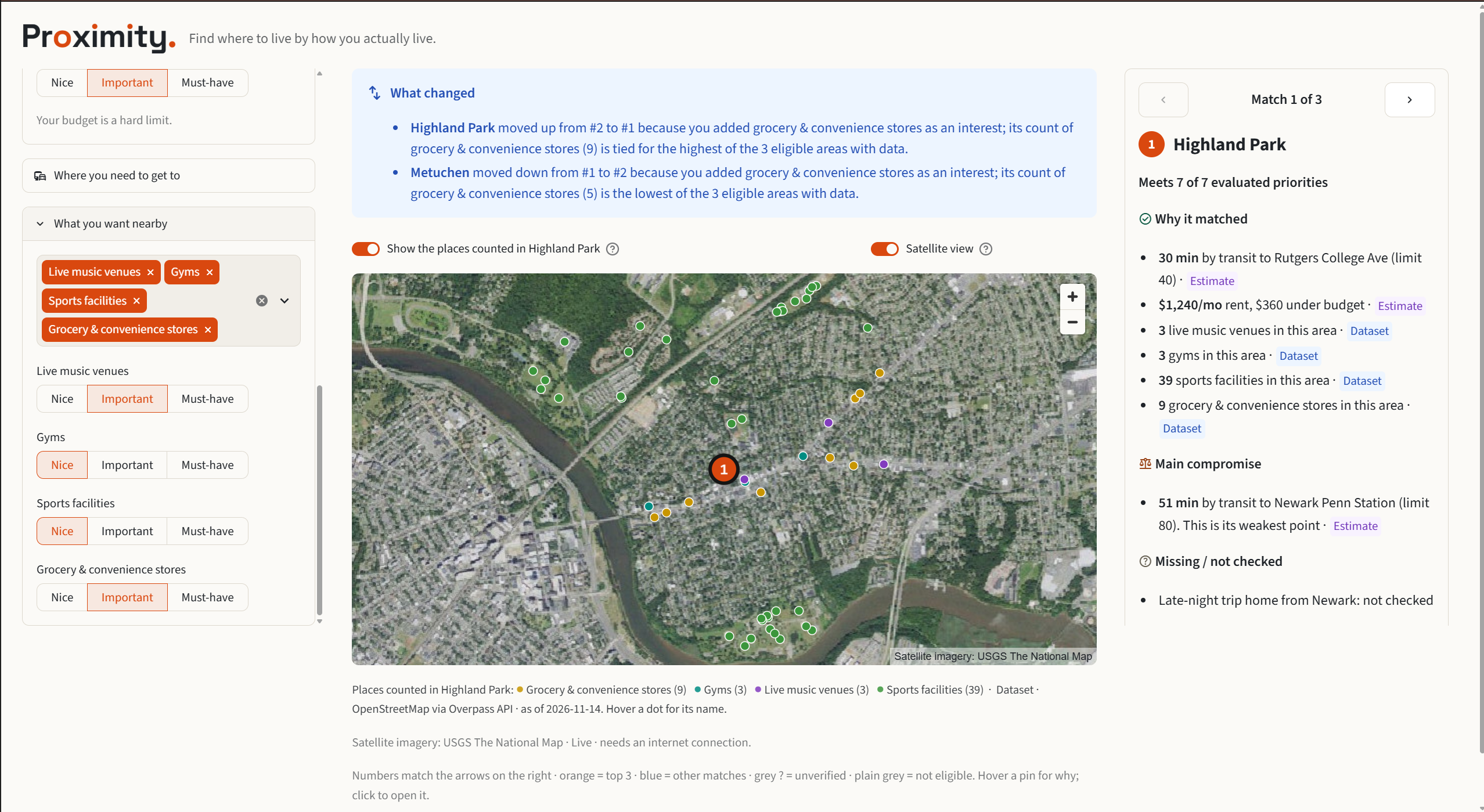
See every change before you apply it.
-
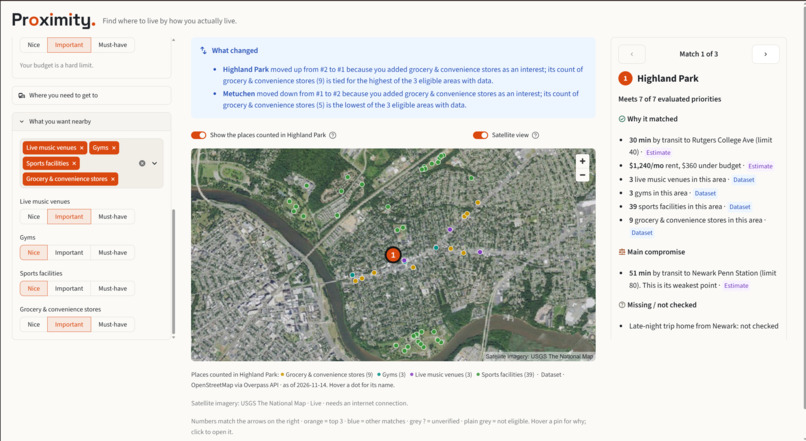
“Grocery store nearby” moves Highland Park to #1.
-
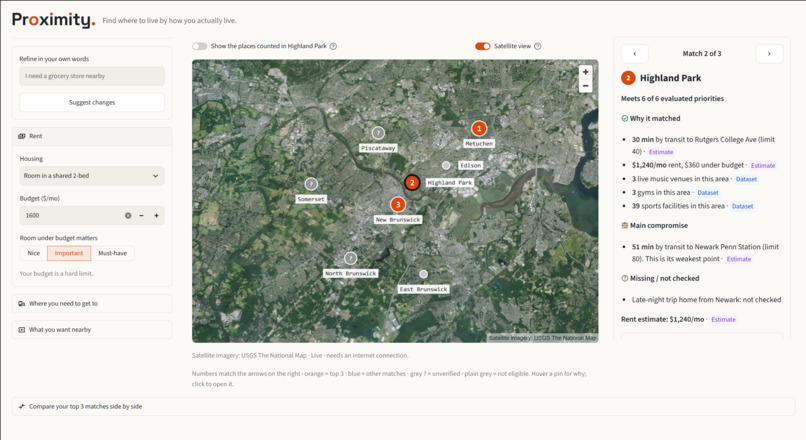
Your top 3 matches on satellite view.
Inspiration
In my freshman year at Rutgers, I visited my uncle in Highland Park and fell for the place: a walkable main street, parks close by, everything you need within a few minutes on foot. It was the first time a neighborhood, not an apartment, made me want to live somewhere.
When I went looking for more places like that, I couldn’t. Every site I tried could show me apartments. None could tell me whether the surrounding area was walkable, close to what I do, or alive on a weekend. I could describe what I loved about Highland Park, but there was nothing to search it with.
My teammate Siddhesh had lived the expensive version of this. When his family moved to the US, his father stayed in different places for about three months just to learn which area suited them. That’s three months of guessing, for a question a good tool should help answer in minutes. That’s why we built "Proximity".
What it does
Proximity turns what you love about a place into a search. It starts with renters near Rutgers–New Brunswick, across 8 areas.
Describe your life, not a ZIP code. Budget, how you get around, where you go every day (class, work), and what you’re into (gyms, parks, live music, sports). Mark each one as Must-have, Important, or Nice. Get every area ranked, with the reasons. Each area is scored on rent, transit time, and the real places nearby, and you see exactly why it landed where it did. See what’s happening there. Hot News shows real events and places in each area, like the Middlesex County Jazz Festival in Metuchen. Change your mind in plain English. Type something like “I need a grocery store I can walk to,” and Proximity proposes exact changes to your profile (field, old value, new value, reason). Nothing changes until you click Apply, and then it shows you what moved.
WHO WE BUILT THIS FOR
Anyone choosing where to live: students, new arrivals, families. Before building, we phoned five people deciding where to live near Rutgers this weekend: three Rutgers students and two parents of two. What they told us shaped the product directly:
“I want to walk to class.” Every student raised this first, so commute time to campus is a core score, not a filter you have to find. “Somewhere lively” vs “somewhere quiet.” Same question, opposite answers, so there’s no single “vibe score”. You say what you mean, and you approve exactly how it changes your ranking. “An Indian grocery and a temple nearby.” Both parents asked for things tied to their culture. Proximity answers with places, never with who lives in an area. Describing residents is how neighborhood tools end up steering people, so we use zero resident demographics. Schools are deliberately left out for now for the same fair-housing reason.
We also read five public posts from people house-hunting elsewhere in New Jersey: Jersey City, near Princeton, and NYC commuters. They were asking the same kinds of questions: a short walk to the train, a quiet street, groceries and restaurants nearby, a playground for the kids, all within a budget. This isn’t only a Rutgers problem.
Post 1 (r/jerseycity): What neighborhood do you live in and how much do you pay? https://www.reddit.com/r/jerseycity/comments/aa517u/what_neighborhood_do_you_live_in_and_how_much_do/
Post 2 (r/jerseycity): Confused with apartment hunting in JC https://www.reddit.com/r/jerseycity/comments/p9kll8/confused_with_apartment_hunting_in_jc/
Post 3 (r/MovingtoNewJersey): Suggestions for apartments near Princeton https://www.reddit.com/r/MovingtoNewJersey/comments/1vcxg16/suggestions_for_apartments_near_princeton_under/
Post 4 (r/MovingtoNewJersey): Renting in NJ for a year, need a complex with a playground https://www.reddit.com/r/MovingtoNewJersey/comments/1w87pev/renting_in_nj_for_a_year_need_a_complex_with_a/
Post 5 (r/jerseycity): JC/Hoboken home buying questions https://www.reddit.com/r/jerseycity/comments/1vzapxf/jchoboken_home_buying_questions/
How we built it
Python + Streamlit, with a deterministic scoring engine. Every priority becomes a 0–1 score (rent = share of your budget left over; commute and nearby places compared across areas), weighted: Must-have 3x, Important 2x, Nice 1x. A failed Must-have or rent over budget takes an area out. No area gets special weight: same inputs, same ranking, every point explainable.
AI where it helps, never where it decides. Gemini (gemini-3.5-flash) translates what you type into proposed profile changes. If it’s slow or unsure, a keyword parser takes over, and demographic requests never reach the model. The AI never scores.
Data: HUD Fair Market Rents and Zillow for rent (a room = 2-bed HUD rent ÷ 2), 655 OpenStreetMap places, 18 hand-verified events, transit times per area (spot-checked by hand: New Brunswick to Newark Penn 69 min measured vs 71 in our data), and a USGS satellite map layer.
162 automated tests, including ones that refuse demographic requests.
Challenges we ran into
Real data is messy. OpenStreetMap has no “live music” tag, so we label that category honestly as bars & live music. Nearby areas share places, so each place counts toward its nearest area only.
Unreliable AI. Gemini sometimes timed out or couldn’t map a sentence, so we built the keyword fallback and made every AI suggestion wait for your approval.
Choosing what not to build. We cut a rent/buy toggle and live ticket feeds to ship one complete story.
Fair housing. Turning “near people like me” into an answer about places, not people.
Accomplishments that we're proud of
A working, explainable ranking on real data for 8 areas, built in 36 hours by two first-time hackers. And the CEO of CoStar told us that querying a neighborhood by what you care about is valuable and still unsolved.
What we learned
Talk to people before you build. Our first ideas were chosen around prizes; five phone calls gave us a better product. Our mentor Andrew summed it up in three words: proximity is power. And with great power comes great responsibility, which is why Proximity will never tell you who lives somewhere.
What's next for Proximity
Live event feeds, more towns and metros (same pipeline: rent + places + events + commute), and versions for buyers and families, with schools done right.
How it makes money: Proximity stays free for movers. Revenue comes from three places. Local businesses (gyms, venues, cafes) pay to appear in Hot News for the areas they serve. Listing partners pay to show available homes in the areas a mover has already chosen, never targeted by who that mover is. And institutions, like university off-campus housing offices and employer relocation teams, license Proximity for the people they’re moving. The CEO of CoStar, Mr Andy Florance, suggested advertising as the natural first model.
TEAM & AI DISCLOSURE
Sushant Elango (Discord: blackjack9900) and Siddhesh Venkat (Discord: sidd_7905). Most of the app code was assisted by AI coding assistants (Claude, ChatGPT, Gemini, Copilot), directed, tested, and reviewed by us. The data was collected and checked by the team.
Built With
- chatgpt
- claude
- google-gemini
- google-genai
- hud-fair-market-rents
- openstreetmap
- pandas
- pydantic
- pydeck
- pytest
- python
- streamlit
- usgs-national-map
- zillow
