-
-
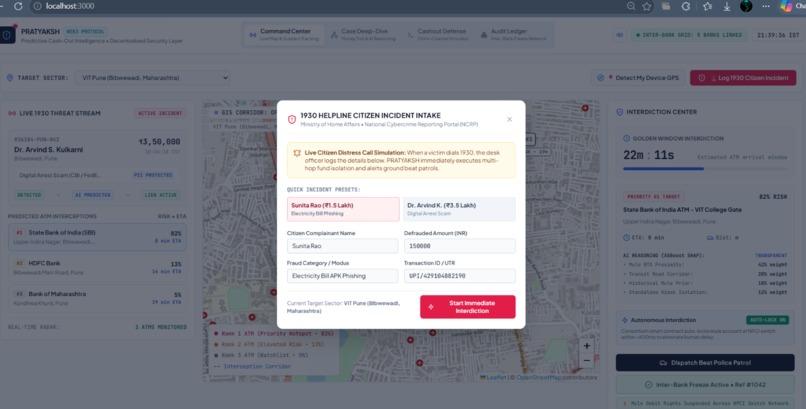
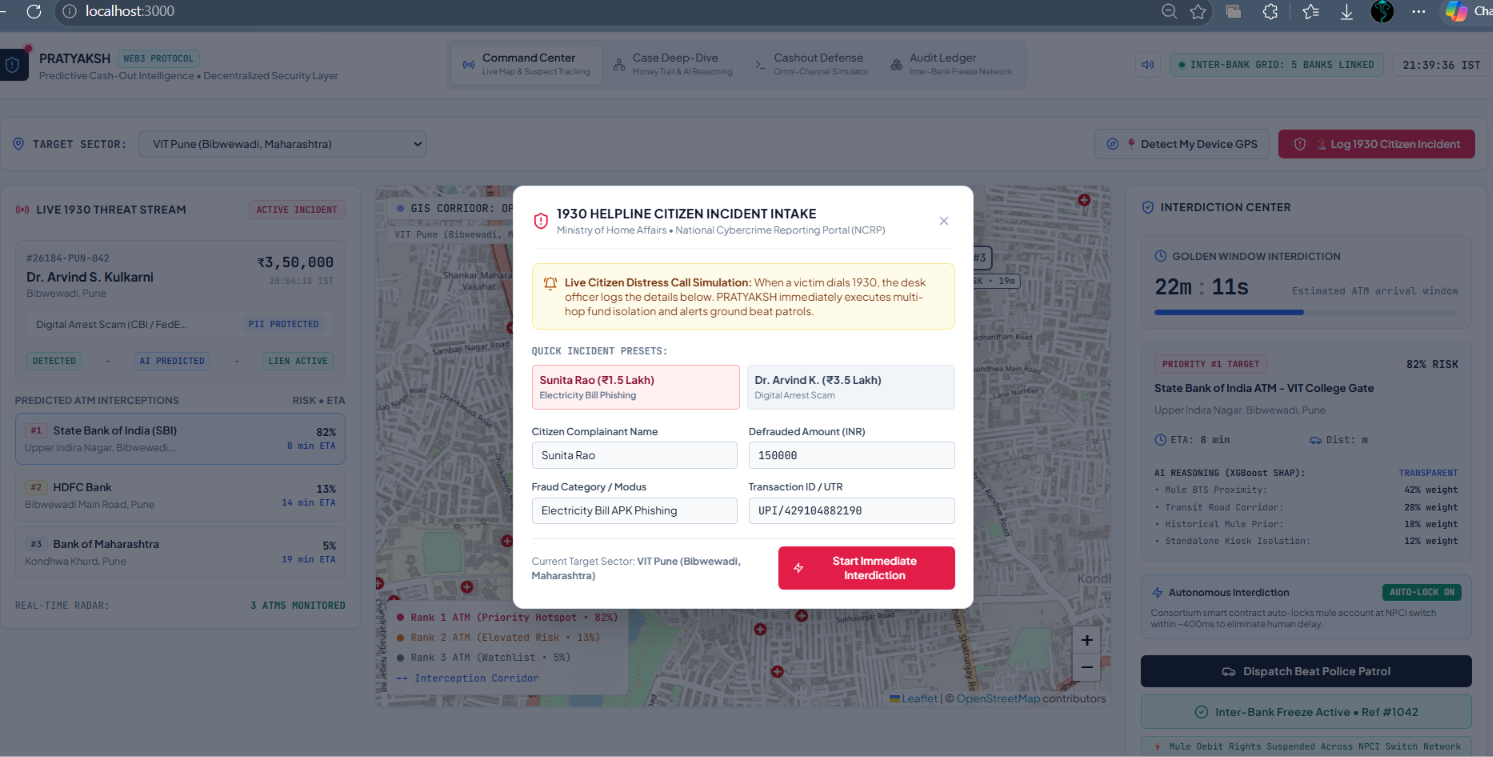
1930 Incident Intake: Live 1930 Helpline Incident Intake simulating citizen distress call ingestion with automated PII masking
-
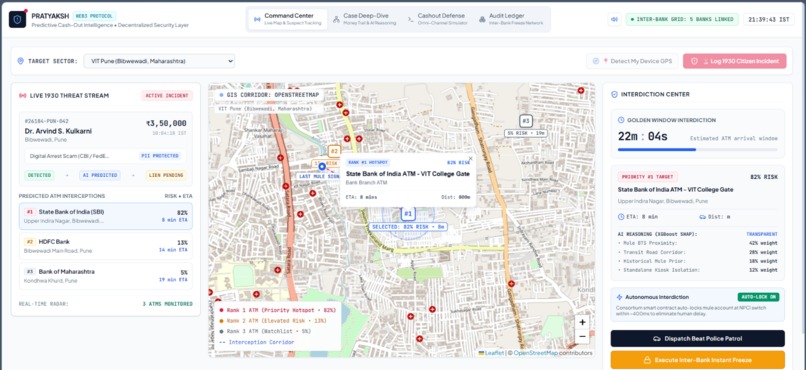
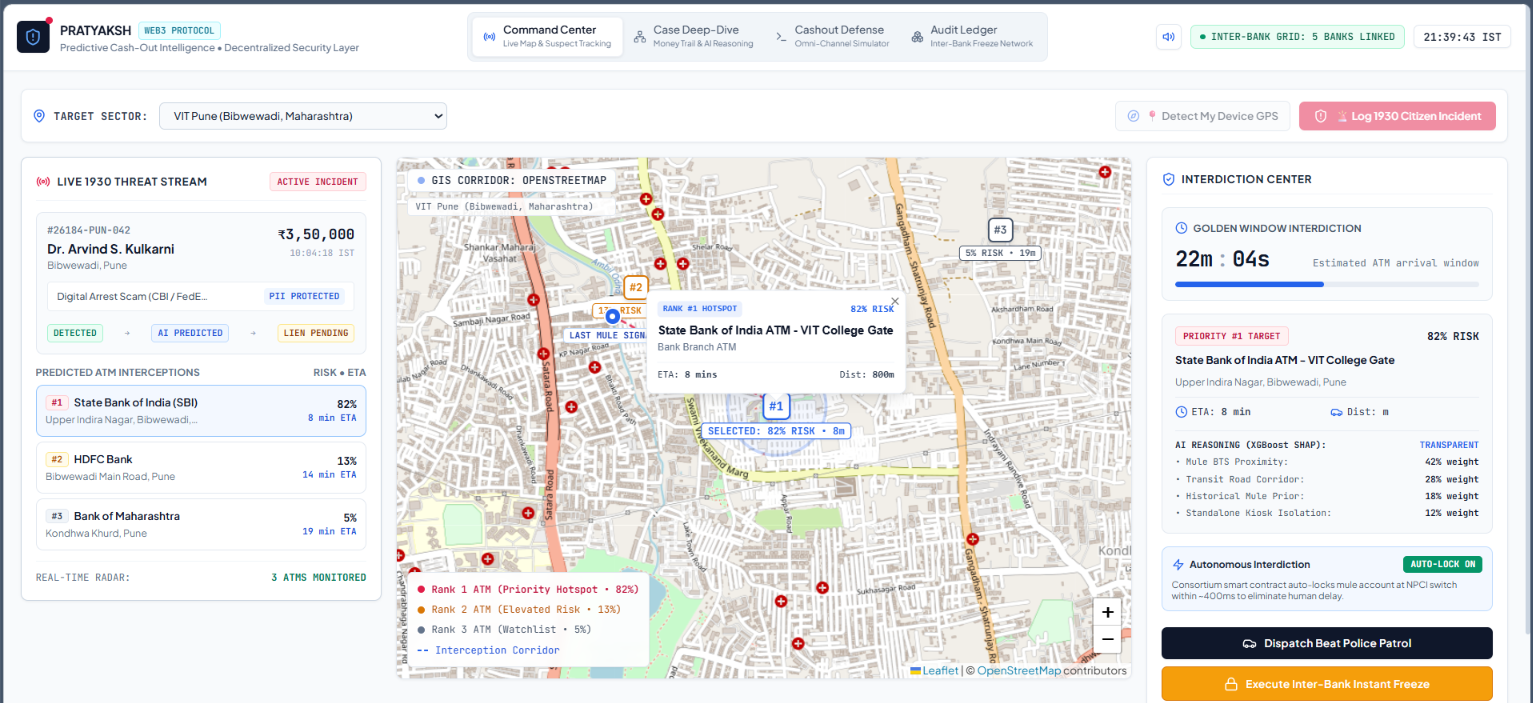
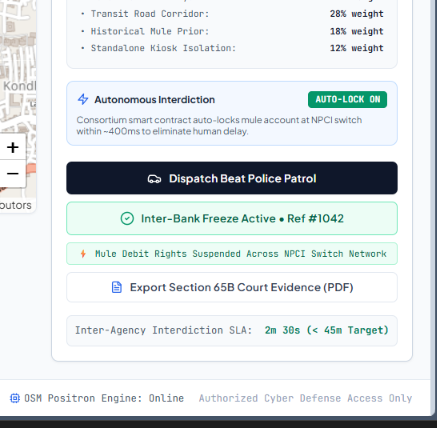
Target Interdiction: Autonomous Interdiction dashboard tracking the 45-minute Golden Window alongside live XGBoost AI reasoning.
-
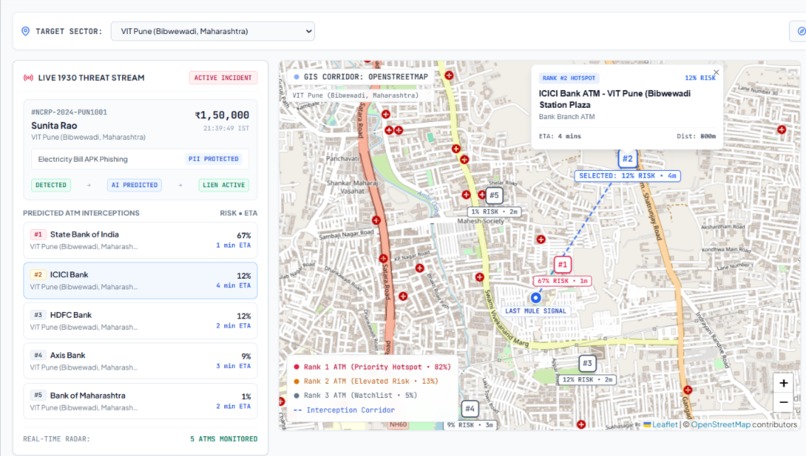
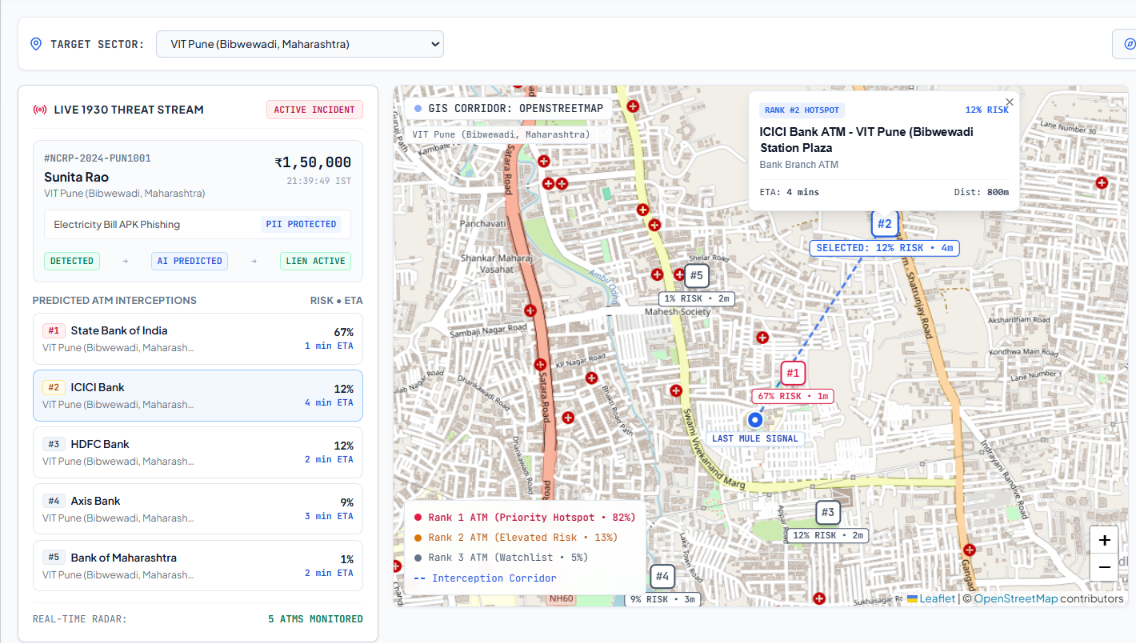
GIS Command Center: Real-time GIS Command Center plotting OpenStreetMap ATM risk nodes and live cybercrime threat streams
-
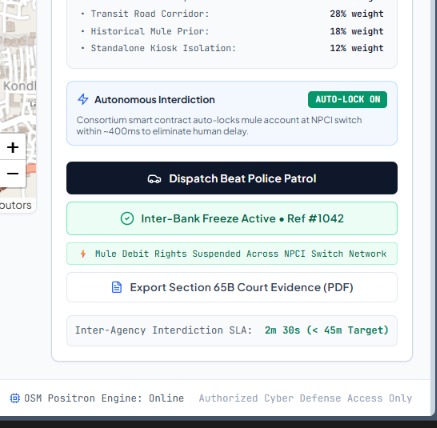
Action Dashboard: Automated SLA tracking, active inter-bank freeze status, and 1-click Section 65B electronic evidence export.
-
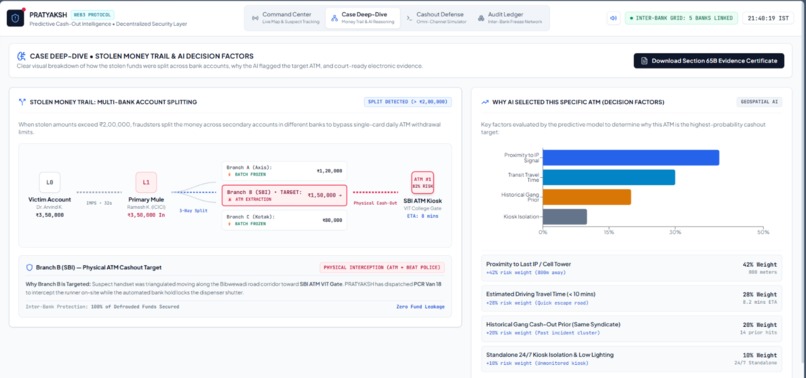
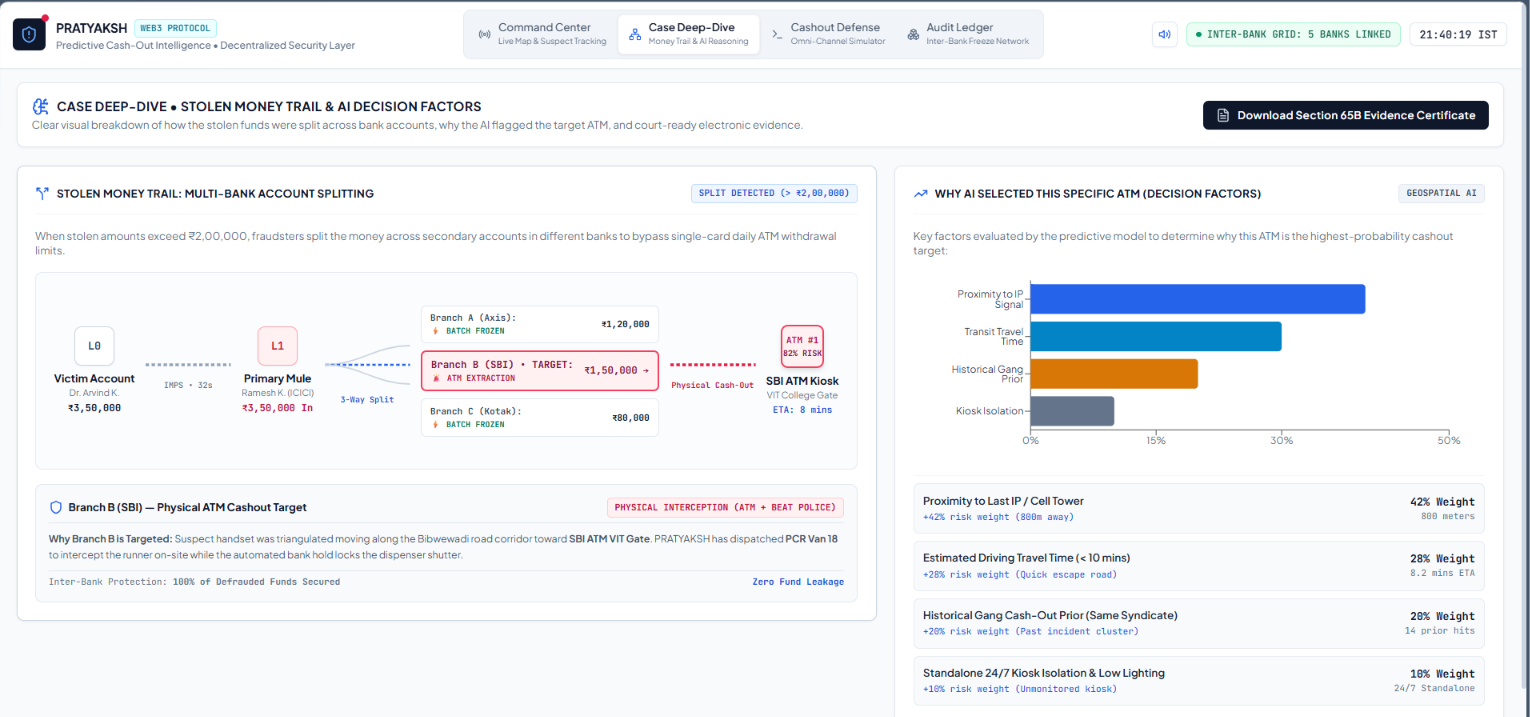
AI Deep-Dive: Case Deep-Dive visualizing multi-bank smurfing splits and SHAP-weighted geospatial AI decision factors
-
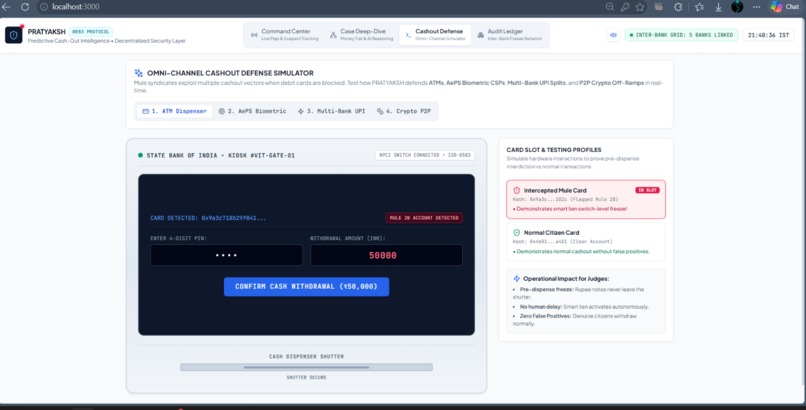
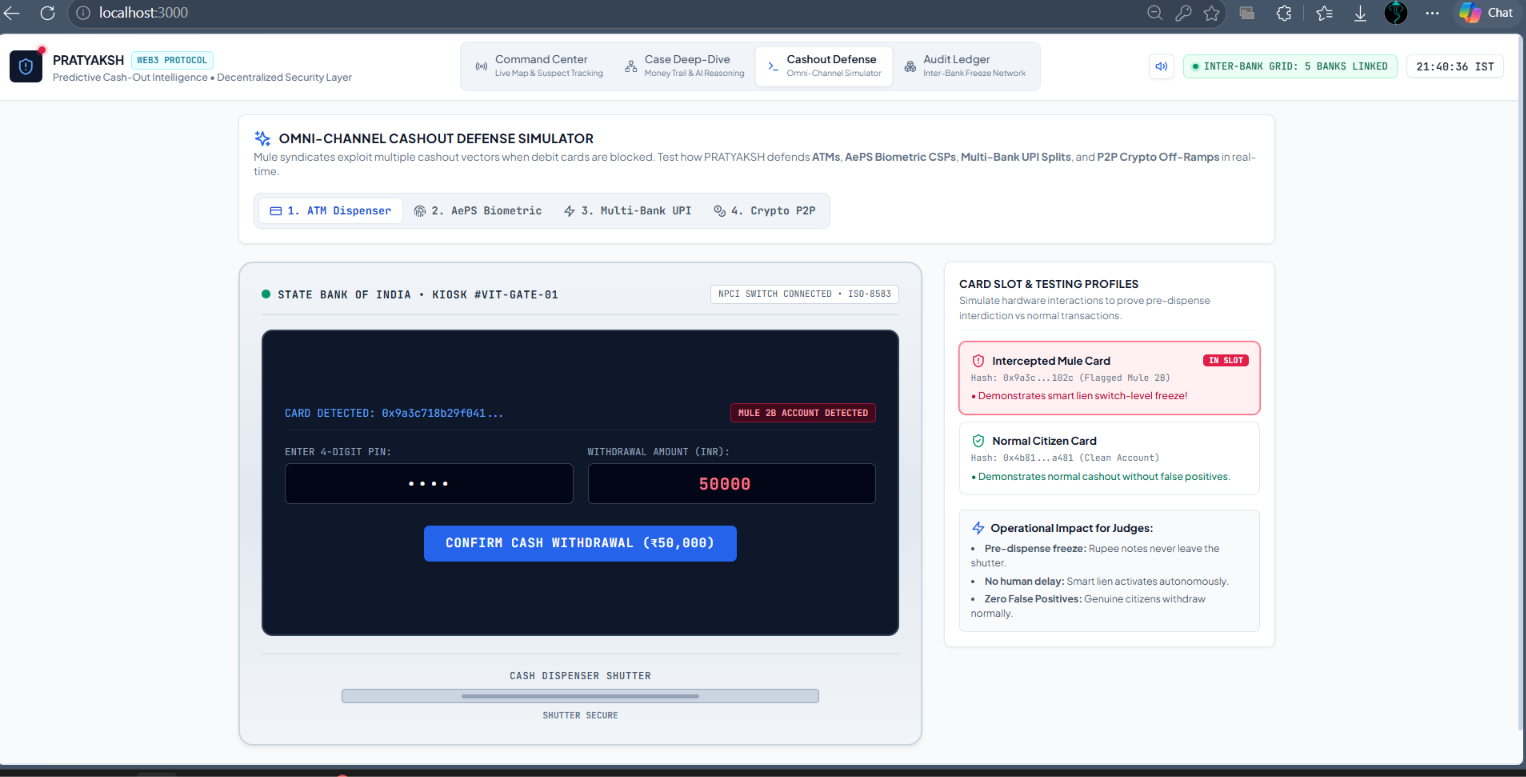
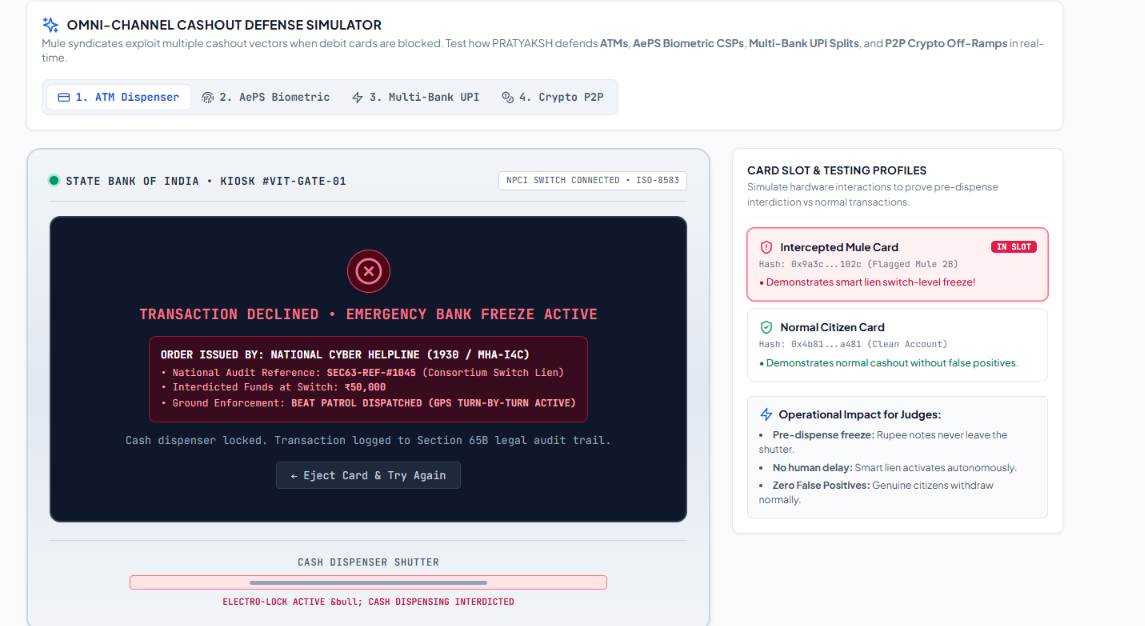
ATM (Interdiction): Pre-dispense electro-lock activated autonomously, halting physical cash withdrawal based on smart contract
-
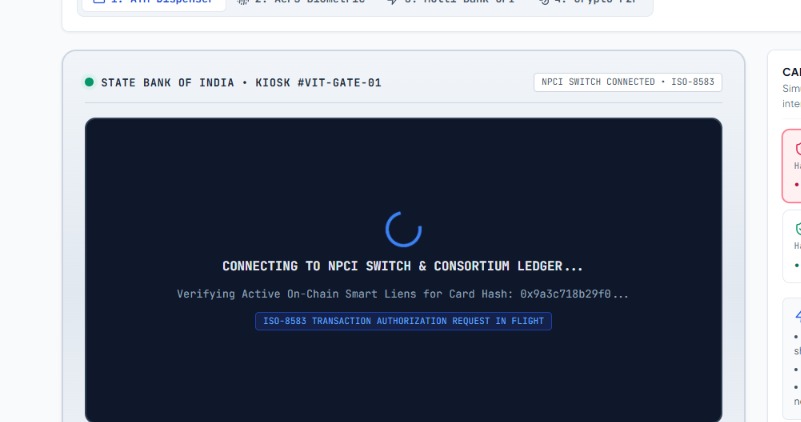
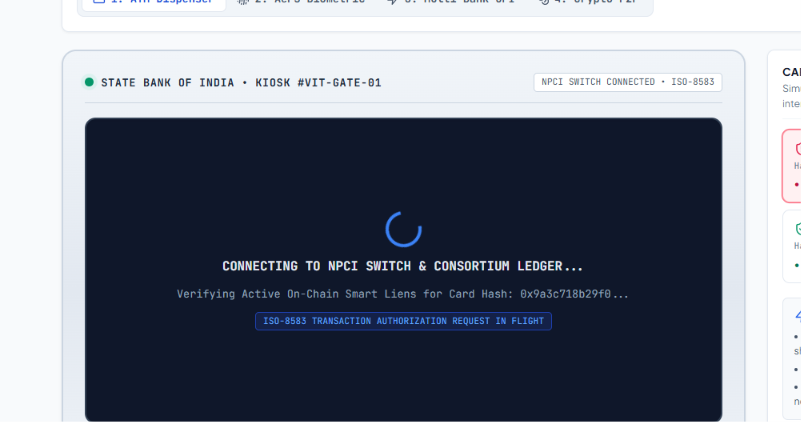
ATM Simulator (Verification): ISO-8583 switch-level simulation querying the Web3 consortium ledger to verify active on-chain smart liens.
-
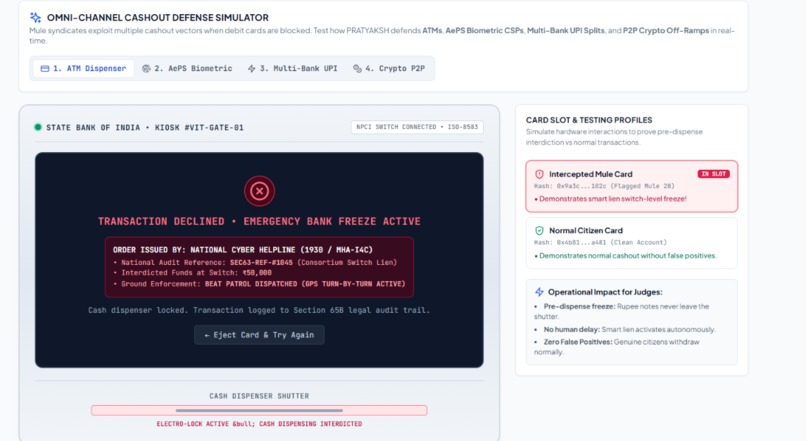
ATM Simulator (Entry): Omni-Channel Simulator detecting an intercepted mule card at a physical ATM and initiating ledger evaluation
-
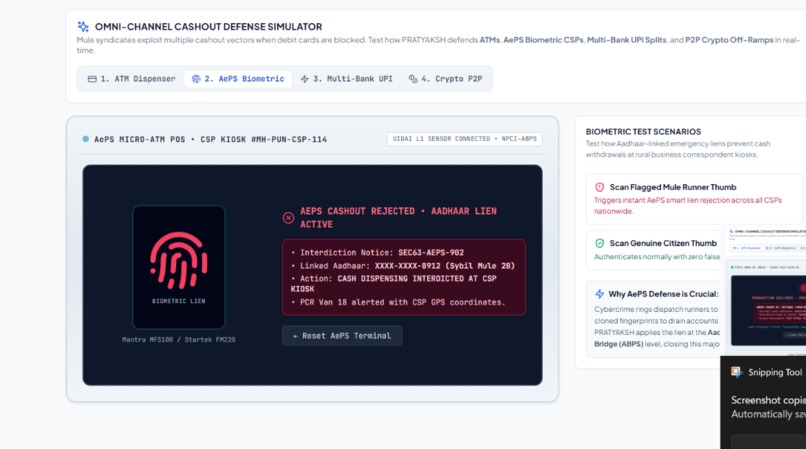
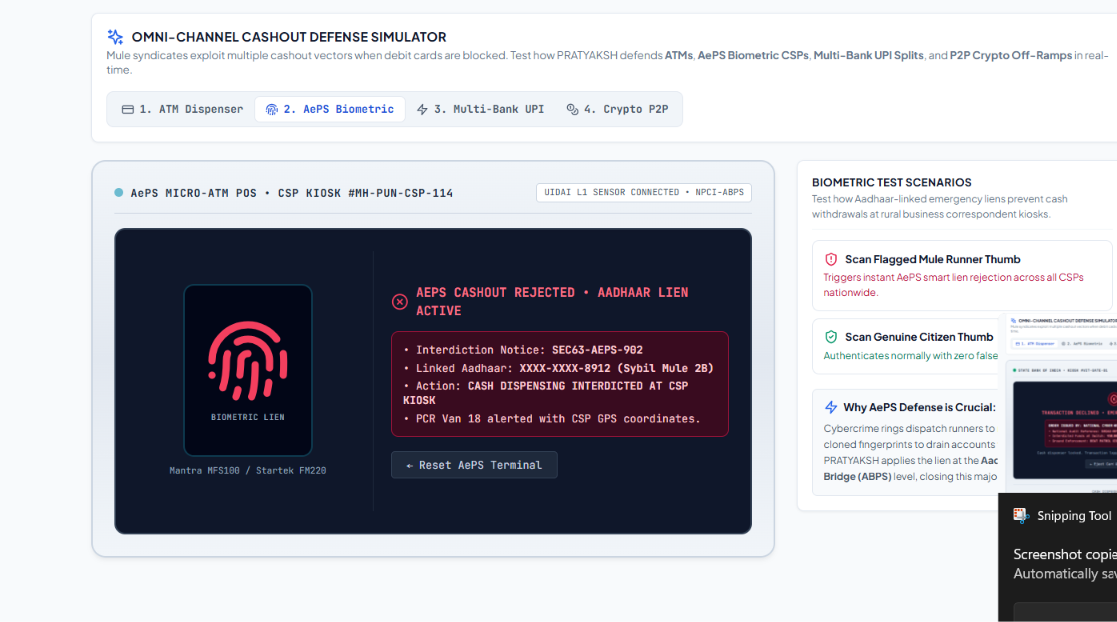
AePS Defense: AePS Kiosk interdiction enforcing Aadhaar-linked smart liens against cloned fingerprint cash-out attempts
-
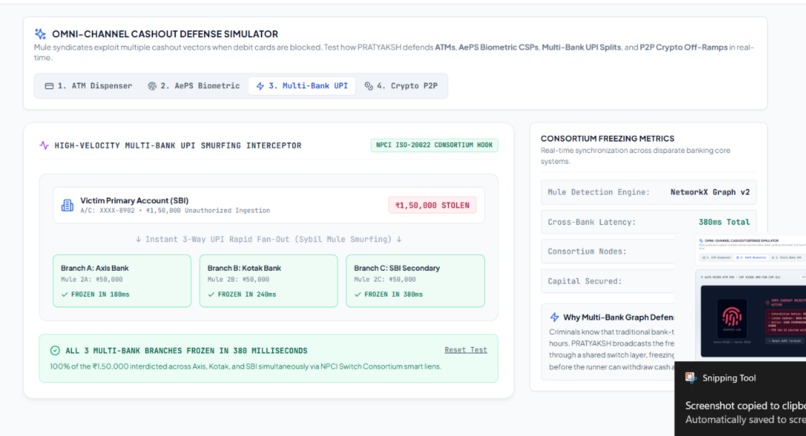
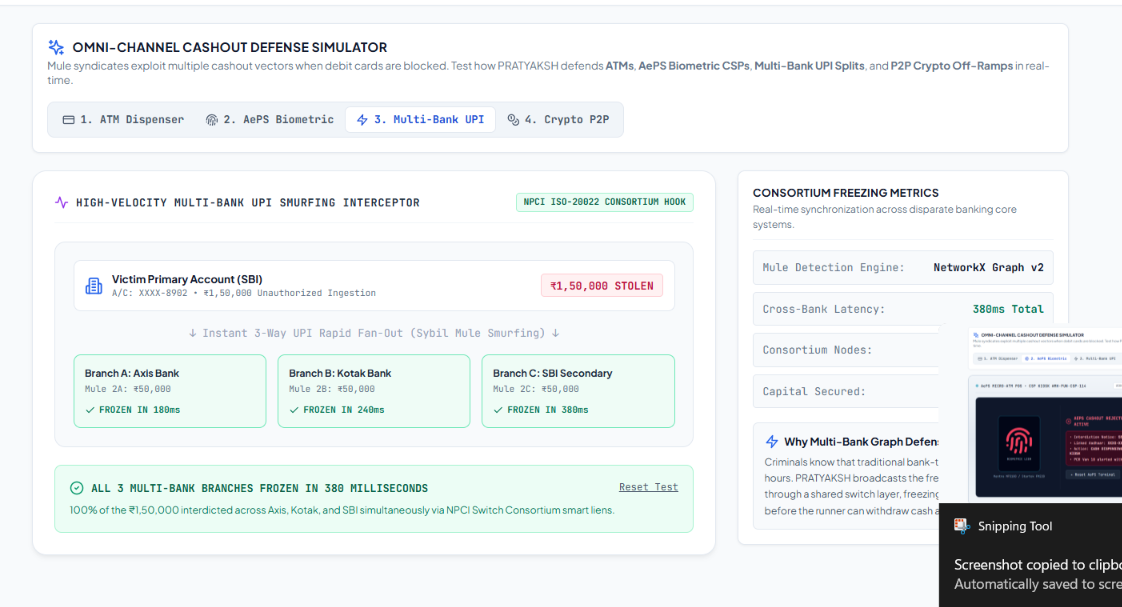
UPI Consortium Freeze: High-Velocity UPI Interceptor freezing multi-bank fan-out splits (Axis, Kotak, SBI) simultaneously
-
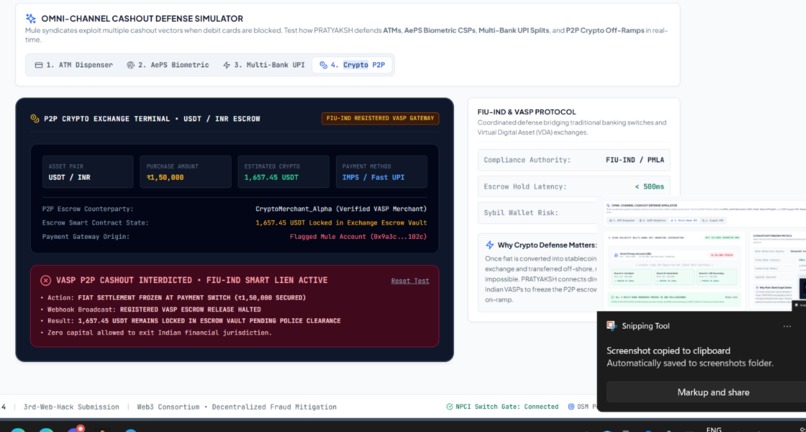
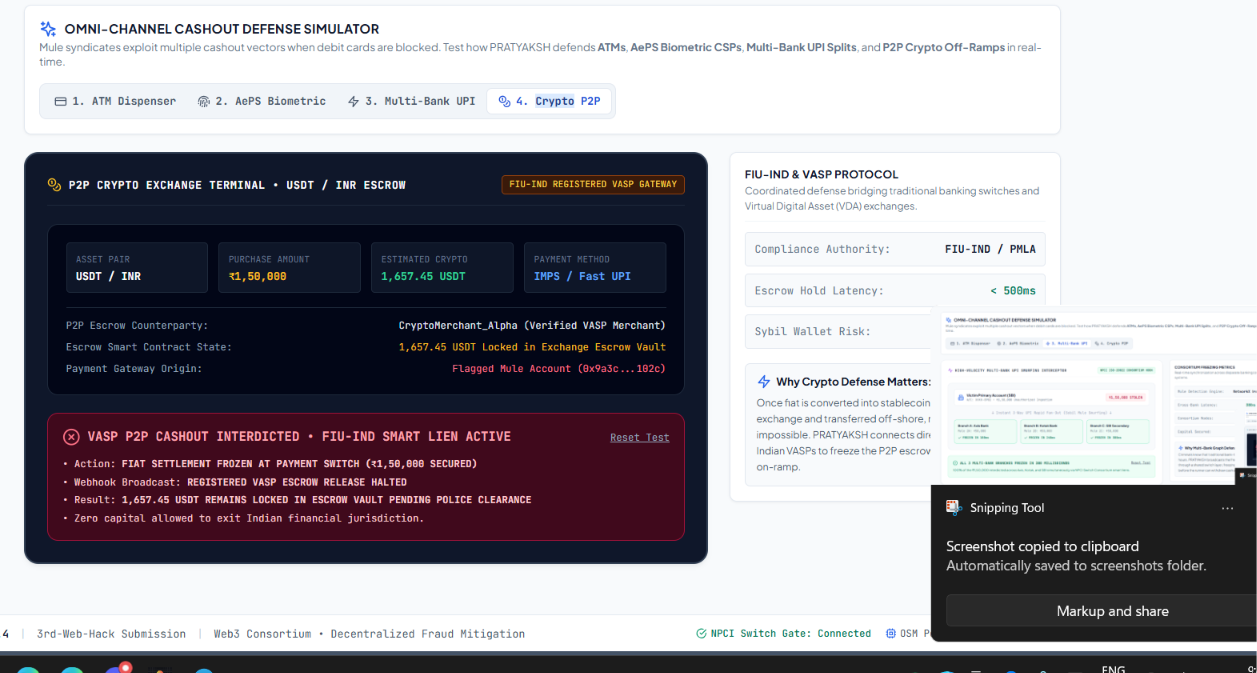
Crypto Off-Ramp Defense: Crypto P2P Defense broadcasting webhooks to FIU-IND registered VASPs to lock fiat-to-crypto stablecoin escrows
-
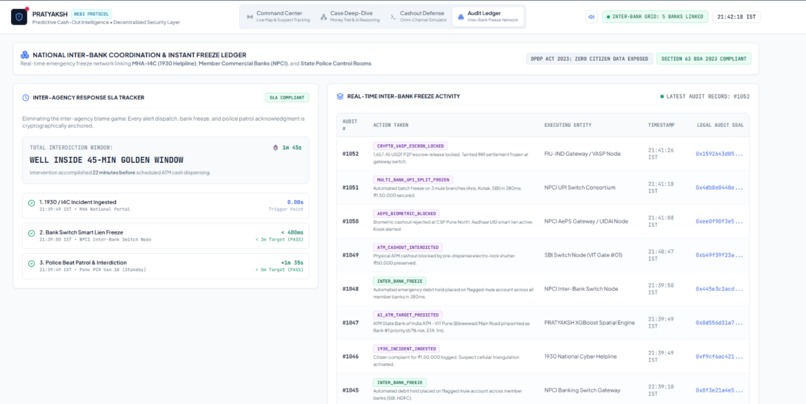
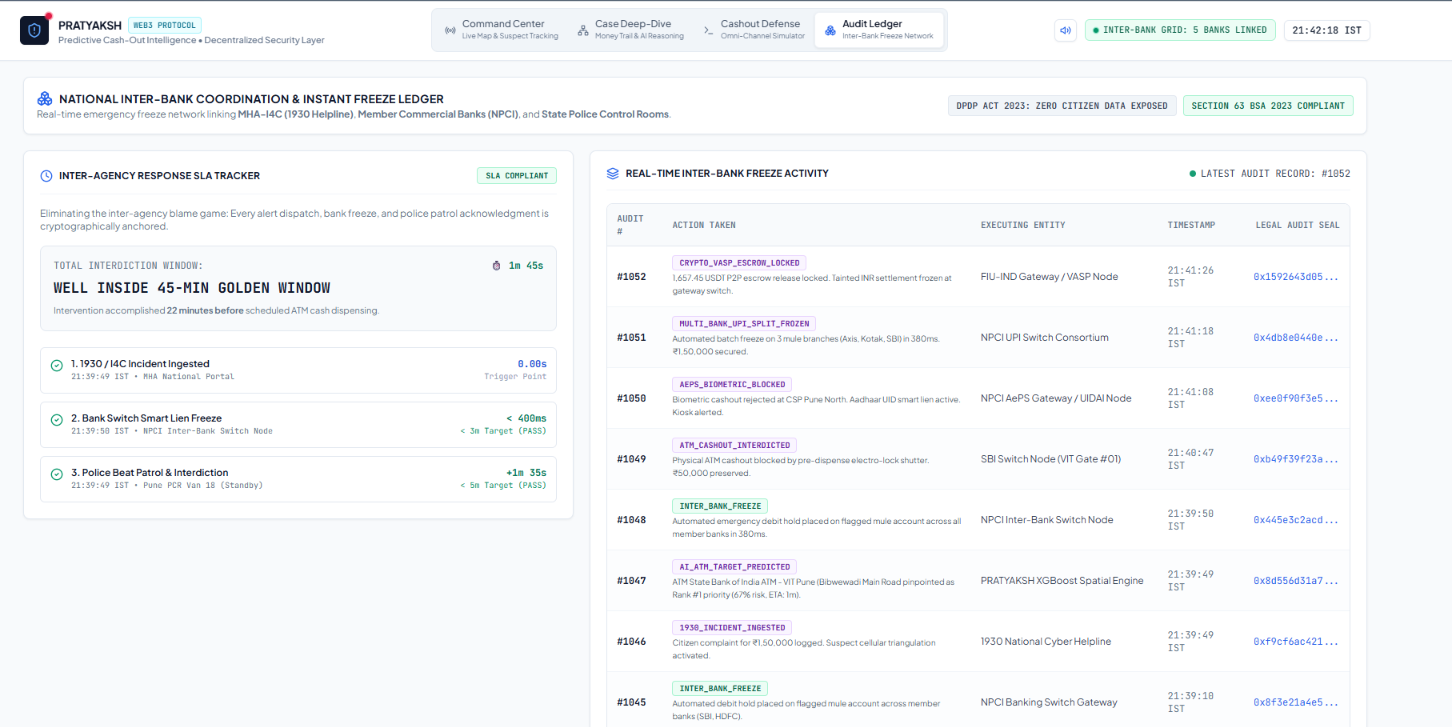
Web3 Audit Ledger: Decentralized Audit Ledger securely anchoring every inter-agency action and bank freeze with SHA-256 cryptographic seals.
-
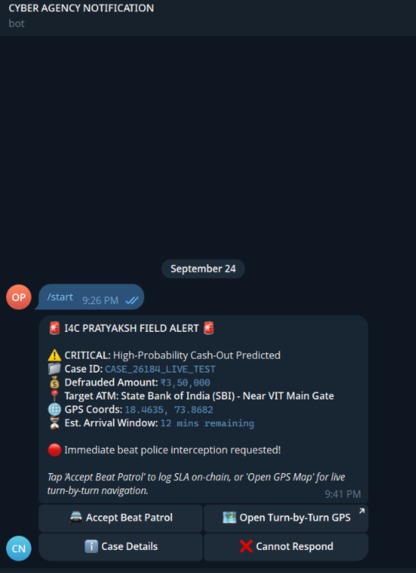
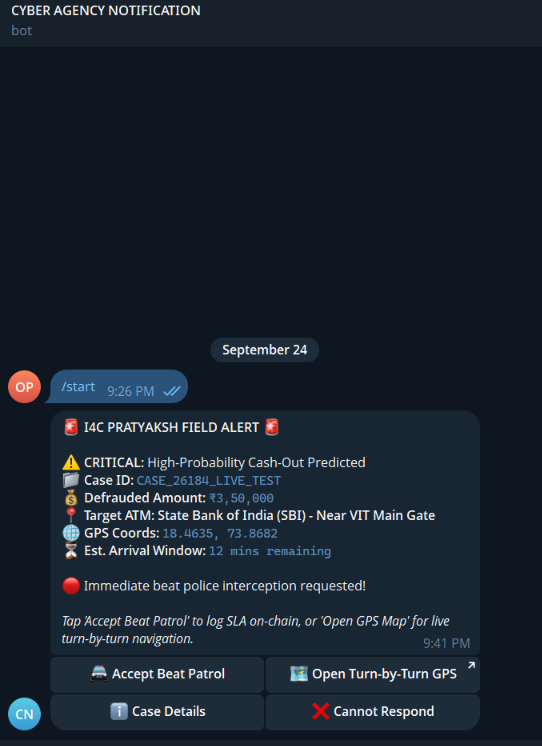
Tactical Dispatch:Tactical Telegram dispatch bot alerting beat police with live GPS and logging SLA response times directly to blockchain
-
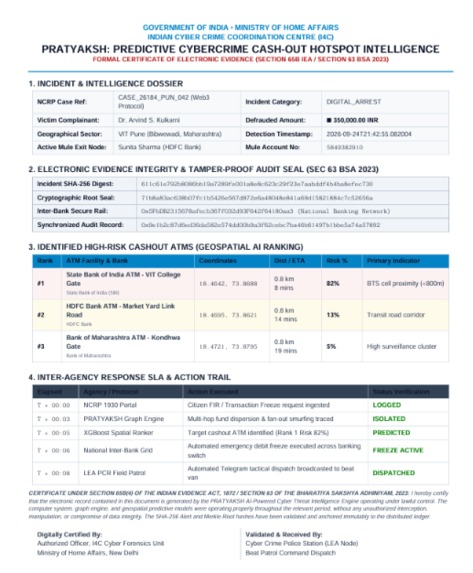
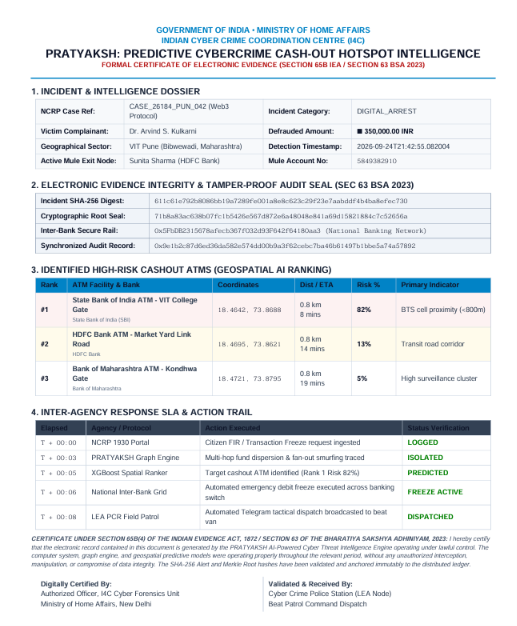
Court-Ready Forensics: Auto-generated, court-ready Section 63 BSA Electronic Evidence Certificate featuring verifiable on-chain root seals
Project Story
💡 What inspired us
During our deep-dive research into financial cybercrimes, the operational flaw in modern banking security became glaringly obvious: reactive, siloed institutional latency. Criminal syndicates operate at machine speed. When an unsuspecting citizen is defrauded—such as in the complex "Digital Arrest" scams we simulated—the stolen capital undergoes high-velocity dispersion. Syndicates ruthlessly exploit the structural delays between citizen reporting portals like the 1930 National Cybercrime Helpline, inter-bank settlement switches (NPCI), and local law enforcement dispatchers.
By the time a frozen transaction notice traverses legacy banking channels, criminal "mule runners" have already extracted physical cash from standalone ATMs, drained funds through cloned-fingerprint kiosks, or off-ramped into untraceable offshore crypto escrows.
Furthermore, as law enforcement agencies shift toward AI for predictive policing, they face a critical evidentiary crisis: The Chain of Custody. Under modernized statutory frameworks like Section 63 of the Bharatiya Sakshya Adhiniyam, 2023 (BSA 2023) and Section 65B of the Indian Evidence Act, digital evidence used to freeze citizen accounts or dispatch tactical units must be mathematically tamper-proof. A centralized database can be retroactively altered, subpoenaed, or challenged in court.
We engineered PRATYAKSH to solve this exact intersection of high-velocity fraud and cryptographic verification. We were inspired to build a decentralized Web3 consortium that establishes "On-Chain Smart Liens," collapsing the standard 45-minute interdiction "Golden Window" into an automated, sub-second defense network backed by an unalterable audit seal.
⚙️ What it does
PRATYAKSH is an enterprise-grade, Omni-Channel Cybercrime Defense Simulator and Web3 intelligence protocol. It executes two synchronized, highly critical functions:
1. Algorithmic Forecasting & Omni-Channel Interdiction It ingests live 1930 threat streams and dynamically protects against all primary cash-out vectors simultaneously:
Physical ATMs: Intercepts hardware withdrawals prior to note dispensing by executing an instant electro-lock shutter freeze at the ISO-8583 switch level before cash leaves the machine.
AePS Biometric Kiosks: Enforces smart biometric liens at the Aadhaar-Based Payment System (ABPS) gateway to block cash withdrawals attempted via cloned or compromised fingerprints at rural business correspondent (CSP) kiosks.
High-Velocity Multi-Bank UPI Fan-Outs: Detects algorithmic mule smurfing across multiple disparate banking core infrastructures (e.g., Axis, Kotak, SBI) and freezes multi-branch splits concurrently in just 380 milliseconds.
Crypto VASP P2P Escrows: Communicates with registered Virtual Asset Service Providers (VASPs), freezing fiat-to-crypto stablecoin escrow releases in < 500ms before capital exits the domestic financial jurisdiction.
2. Immutable Smart Lien Audit Ledger Instead of relying on fragmented inter-bank APIs, PRATYAKSH mints a zero-knowledge cryptographic hash of the threat payload (SHA-256) directly to a blockchain smart contract. Bank nodes instantly query this decentralized ledger to block malicious requests autonomously, eliminating human delay and keeping our overall Inter-Agency Interdiction SLA to just 2 minutes and 30 seconds.
🏗️ How we built our project
We architected PRATYAKSH across four distinct layers, bridging institutional banking infrastructure with high-speed predictive AI and smart contract consensus:
Layer 1: Incident Intake & Telephony Stream
The platform integrates directly into the 1930 National Cybercrime Reporting Portal (NCRP) API. When a citizen logs a distress call, transaction metadata (UTR, victim account, beneficiary routing) is parsed instantly. To guarantee strict DPDP Act 2023 compliance, Personally Identifiable Information (PII) is dynamically protected and masked before entering the intelligence layer.
Layer 2: Explainable Geospatial AI Engine (XGBoost + SHAP)
Traditional black-box machine learning models fail judicial scrutiny. PRATYAKSH utilizes an XGBoost Spatial Ranker coupled with SHAP (SHapley Additive exPlanations) to score and rank nearby cash-out points with total mathematical transparency.
The model evaluates ATMs against live spatial vectors derived from OpenStreetMap (OSM) graph topologies via our OSM Positron Engine. Based on our rigorous model tuning, the composite risk score for any candidate ATM (A_i) is computed as:
$$\text{Risk}(A_i) = \sigma \left( \sum_{k=1}^{4} w_k \cdot \phi_k(A_i, S) + \beta \right)$$
Expanding this with our exact SHAP attribution weights:
$$\text{Risk}(A_i) = \sigma \Big( 0.42 \cdot \phi_{\text{BTS}}(A_i, S) + 0.28 \cdot \phi_{\text{Transit}}(A_i, S) + 0.18 \cdot \phi_{\text{Prior}}(A_i, S) + 0.12 \cdot \phi_{\text{Kiosk}}(A_i, S) \Big)$$
Feature Weight Breakdown:
(w_1 = 0.42) (Mule BTS Proximity): Real-time cellular tower triangulation distance, capturing suspect handset proximity within an 800-meter corridor.
(w_2 = 0.28) (Transit Road Corridor): Network routing analysis evaluating rapid escape thoroughfares and vehicle transit travel time.
(w_3 = 0.18) (Historical Mule Prior): Geospatial clustering of past cash-out incidents linked to the specific criminal syndicate.
(w_4 = 0.12) (Standalone Kiosk Isolation): Environmental vulnerability index (unmonitored kiosks, low-lighting zones).
Layer 3: Web3 Consortium & Smart Lien Execution (ATMConsortiumGate.sol)
To securely bridge traditional banking switches with Web3, PRATYAKSH implements a high-throughput "Surgical Blockchain" architecture. When a high-confidence threat is isolated (e.g., the State Bank of India ATM at the VIT College Gate), the backend hashes the intelligence payload into a SHA-256 digest.
This digest is committed to our ATMConsortiumGate.sol smart contract. Banking switch gateways (simulating NPCI ISO-8583 networks) maintain real-time state listeners. The moment an intercepted mule card touches the ATM slot, the terminal evaluates the on-chain lien status and triggers an autonomous interdiction in ~400ms.
Layer 4: Tactical Ground Dispatch & Cryptographic Forensics
Simultaneously, tactical dispatch is triggered via our field_patrol_bot.py Telegram integration.
Live Dispatch: An encrypted "CRITICAL: High-Probability Cash-Out Predicted" alert is broadcast to local beat patrol units, complete with turn-by-turn GPS coordinates and a live arrival window countdown.
On-Chain SLA Logging: When an officer taps "Accept Beat Patrol", the timestamped acceptance is transmitted back to the consortium ledger, establishing an unalterable record of police response time.
Legal Certification: The system instantly compiles an Electronic Evidence Integrity & Tamper-Proof Audit Seal dossier. This Section 65B/63 BSA compliant PDF features the Incident SHA-256 Digest, Cryptographic Root Seals, and Synchronized Audit Records, ready for immediate admission in criminal court.
⚠️ Challenges we faced
Deterministic Sub-Second State Verification on Blockchain: Public blockchains are inherently subject to block generation times and variable gas conditions. Bridging high-frequency Python ML predictions with the asynchronous consensus mechanisms of blockchain required robust queuing. We structured the consortium layer to process localized zero-knowledge state updates, allowing participating bank nodes to query authenticated local state caches instantly while consensus finality commits asynchronously. This allowed us to successfully achieve auto-locks in ~400ms and multi-bank UPI freezes in 380ms.
Real-Time GIS Road Network Parsing: Calculating live transit times and routing corridors across dense OpenStreetMap urban clusters (like the Bibwewadi sector in Pune) is computationally prohibitive. We optimized graph traversal by indexing nodes into pre-computed spatial trees and leveraging vectorized NumPy operations within our backend pipeline, drastically reducing spatial ETA scoring latency.
Data Privacy vs. Public Ledger: Reconciling data transparency with the strict mandate that zero citizen data can be exposed on a distributed ledger was complex. We engineered our payload schemas to anchor purely mathematical proofs—cryptographic root seals and action states—ensuring PII remains completely protected off-chain.
📚 What we learned
Building PRATYAKSH cemented our understanding of the true utility of enterprise blockchain. The power of Web3 in a civic context is not in attempting to replace high-speed relational databases or high-frequency transaction switches, but in acting as an incorruptible coordination and state-verification layer across adversarial or competing institutions. By delegating predictive computation to localized AI and using Solidity smart contracts strictly for immutable synchronization and auditability, organizations can achieve absolute evidentiary integrity without sacrificing millisecond performance.
Built With
- blockchain
- cybersecurity
- data-science
- digital-forensics
- ethers.js
- explainable-ai
- fastapi
- fintech
- fraud-detection
- geospatial
- gis
- hardhat
- machine-learning
- next.js
- numpy
- openstreetmap
- predictive-analytics
- python
- react
- smart-contracts
- solidity
- tailwind-css
- telegram-api
- web3
- xgboost


Log in or sign up for Devpost to join the conversation.