Inspiration
What it does
How we built it
Challenges we ran into
Accomplishments that we're proud of
What we learned
What's next for PortMind AI
Inspiration
The Port of Colombo is one of Sri Lanka's most important maritime logistics hubs, handling complex operations involving vessel arrivals, container movements, berth allocation, cranes, trucks, and workforce coordination.
We were inspired by the challenge of managing these interconnected activities efficiently. A single crane breakdown or vessel delay can affect many other port operations.
Our team, Mora Minds, envisioned an intelligent digital control tower capable of bringing port operations together through AI-driven analysis, simulation, and coordinated decision-making.
What it does
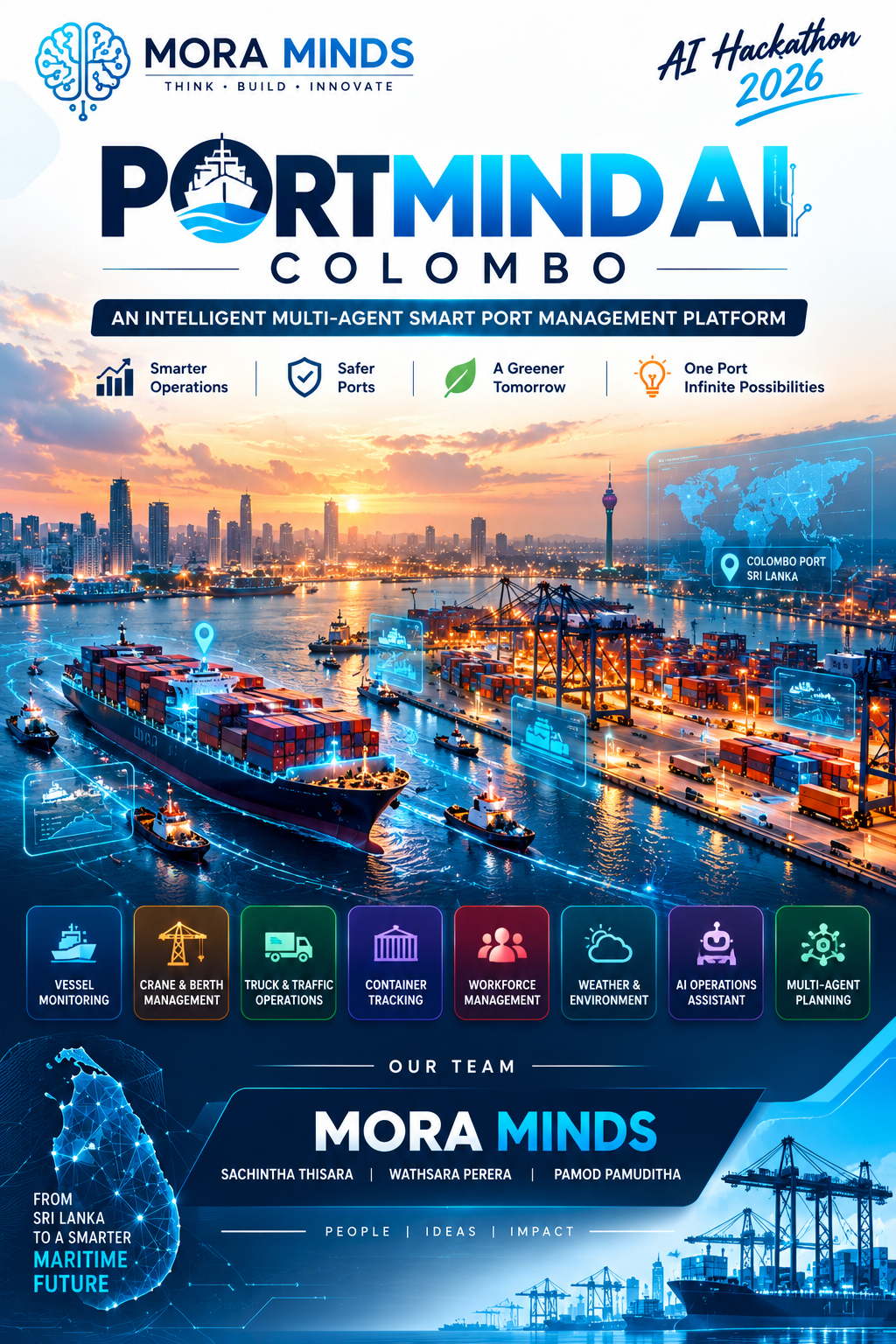
PortMind AI Colombo is a smart port digital twin prototype designed to visualize and simulate port operations through an interactive web application.
The platform explores several capabilities:
- Vessel Monitoring: Geographic visualization of simulated vessel movements, arrivals, departures, and berth assignments.
- Berth and Crane Management: Monitoring resource availability, handling capacity, and operational disruptions.
- Truck and Traffic Operations: Simulated truck movements, loading/unloading activities, and terminal logistics.
- Container Tracking: Visualization of import/export container movements and cargo-handling workflows.
- Workforce Management: Monitoring staff availability, qualifications, and shift assignments.
- Environment Monitoring: Weather information and environmental scenarios.
- Multi-Agent Operations: Nine specialized operational agents designed to analyze resource requirements, investigate disruptions, and coordinate recovery proposals.
- AI Operations Assistant: A conversational interface intended to support operational queries and future scheduling workflows.
Our objective is to demonstrate how intelligent digital systems can improve situational awareness and support coordinated port planning.
How we built it
We developed PortMind AI Colombo using Jac Hammer AI and the Jac/Jaseci ecosystem, together with web technologies for the interactive user interface.
We designed graph-oriented operational models connecting vessels, berths, cranes, cargo tasks, trucks, and workers.
The proposed multi-agent architecture separates responsibilities among nine specialized operational agents, including vessel intelligence, berth allocation, cargo planning, truck coordination, workforce management, maintenance, and operational negotiation.
We used synthetic Colombo-inspired port datasets to demonstrate operations without accessing confidential terminal systems.
Geographic visualization was designed around OpenStreetMap-based mapping, while weather integration was explored for displaying environmental information.
Throughout development, we used iterative prototyping, debugging, and testing to refine the interface, simulation workflows, and Jac source architecture.
Challenges we ran into
One of our biggest challenges was coordinating multiple interconnected port activities within a single application.
Implementing a Jac-first architecture also introduced challenges with Jac language syntax, graph relationships, backend integration, and compiler compatibility.
Other challenges included synchronizing vessel and truck movements, connecting UI controls to backend operations, and implementing reliable conversational data management.
These experiences helped us better understand the technical complexity of building multi-agent systems.
Accomplishments that we're proud of
We are proud of developing a unified smart port prototype that brings maritime operations, resource monitoring, and AI-based planning concepts together in one platform.
Our major accomplishments include creating an interactive operations interface, designing nine specialist-agent roles, modeling interconnected port resources, and producing a digital twin concept tailored to Sri Lanka's maritime logistics environment.
Most importantly, we transformed a real-world operational challenge into a practical AI hackathon project.
What we learned
Through this project, we gained valuable experience in Jac/Jaseci development, graph-based system design, multi-agent architectures, frontend integration, simulation modeling, and collaborative problem-solving.
We also learned the importance of validating AI-generated decisions through deterministic operational constraints and distinguishing simulated data from real-world information.
What's next for PortMind AI
Our next goals are to complete and validate the Jac backend, strengthen agent collaboration, improve conversational data management, and introduce persistent operational scheduling.
In the longer term, we aim to explore authorized vessel-tracking feeds, terminal-management integrations, predictive maintenance, traffic optimization, and advanced vessel turnaround planning.
Our Vision: Smarter Ports. Intelligent Decisions.
Team Mora Minds
Sachintha Thisara | Wathsara Perera | Pamod Pamuditha
Built With
- css
- digital
- html
- jac
- jac-hammer
- jaseci
- javascript
- leaflet.js
- multi-agent-ai
- openstreetmap
- python

Log in or sign up for Devpost to join the conversation.