Inspiration
Finding potential clients is often a fragmented and time-consuming process. A freelancer or small service provider may know what they can offer, but still has to manually search for businesses, visit websites, identify operational signals, determine whether a company is a good fit, and finally prepare a personalized outreach message.
PortalAgent was built to turn that entire process into an agentic workflow.
The idea was inspired by a real-world problem: instead of asking an AI chatbot to simply suggest companies, what if an autonomous agent could discover relevant local businesses, investigate their digital presence, evaluate their potential needs, and produce an actionable prospecting draft?
The goal was to move from "AI that answers questions" to "AI that performs useful work."
What it does
PortalAgent is an autonomous AI prospecting agent designed to discover and qualify potential business opportunities.
The user can provide a target market or business context, and PortalAgent independently:
- Searches for relevant local businesses.
- Collects information about the businesses it discovers.
- Fetches and analyzes their public website content.
- Identifies operational signals and potential business needs.
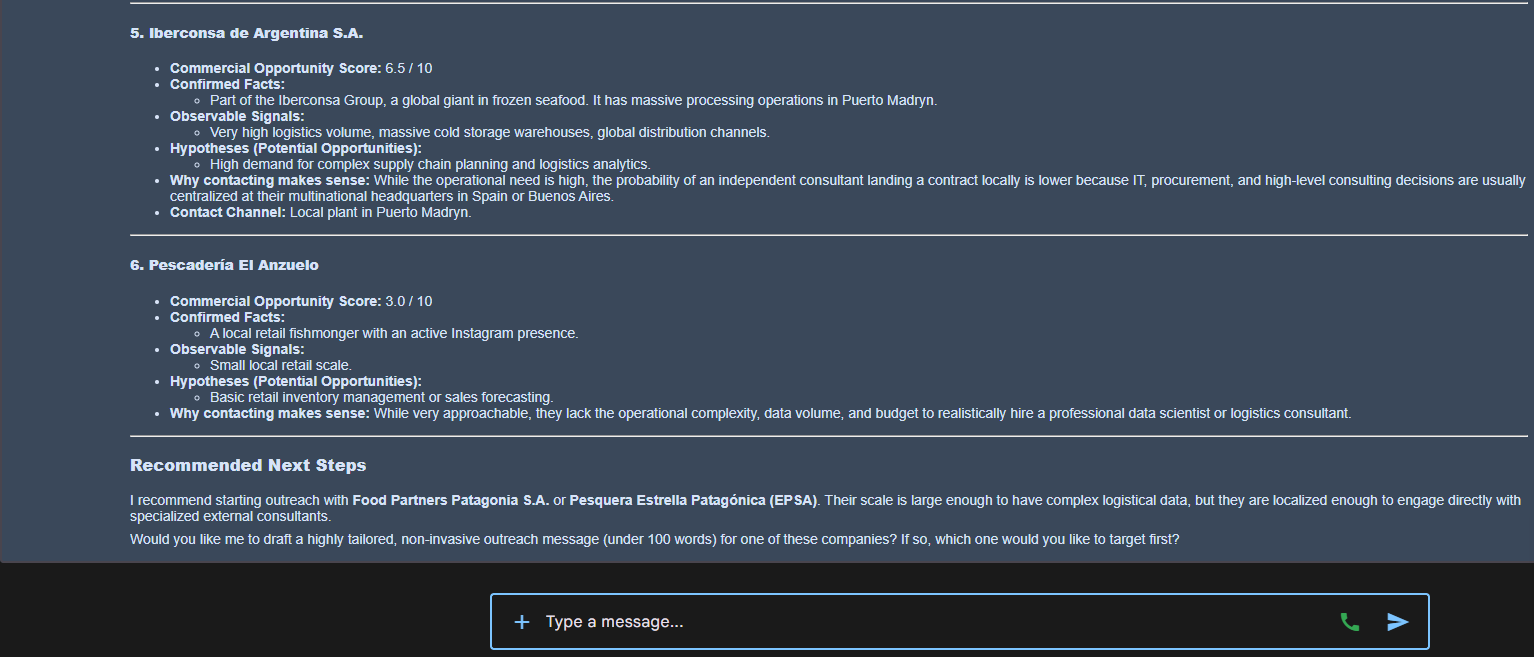
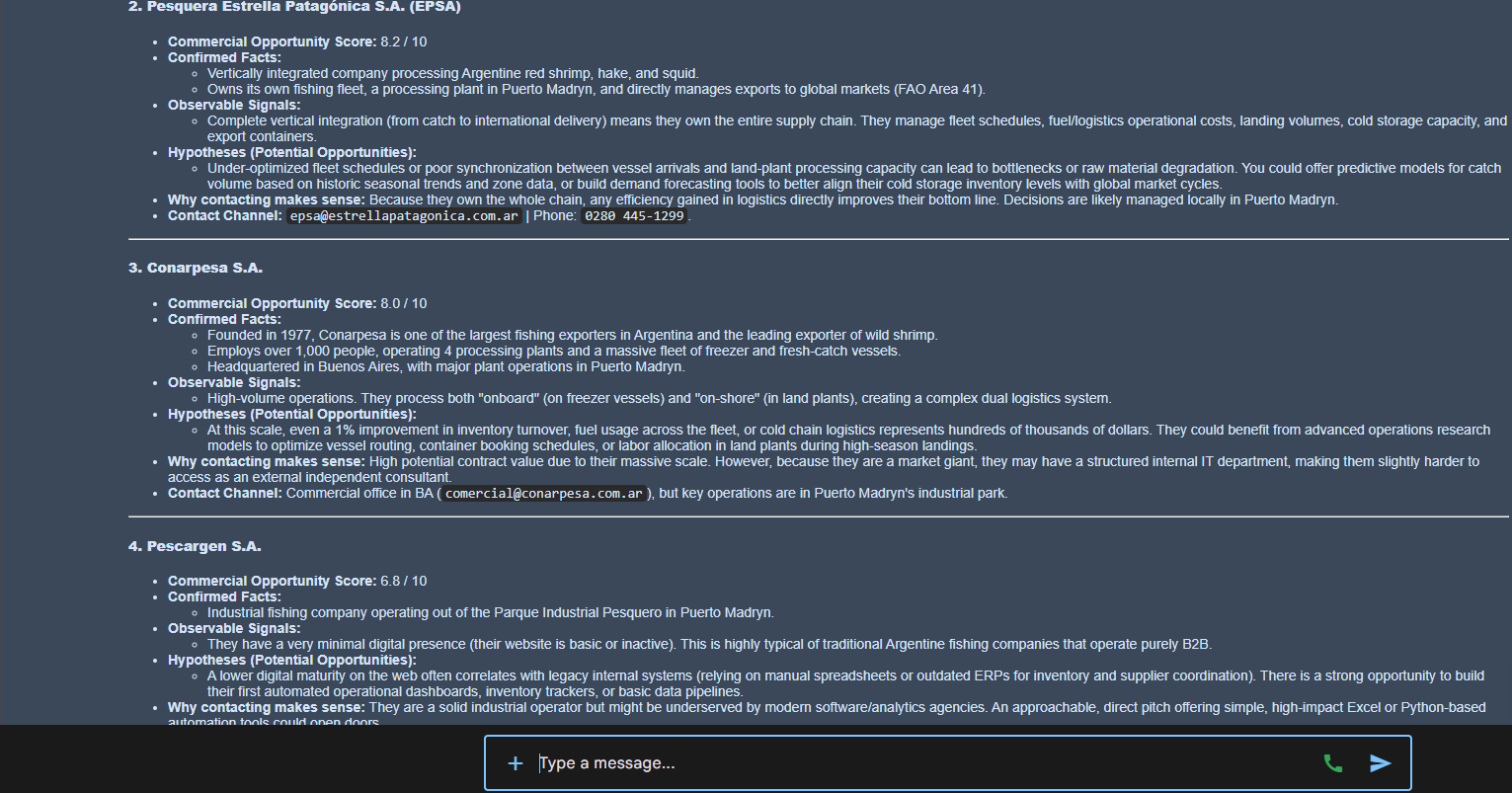
- Evaluates the commercial opportunity based on the user's capabilities.
- Prioritizes promising prospects.
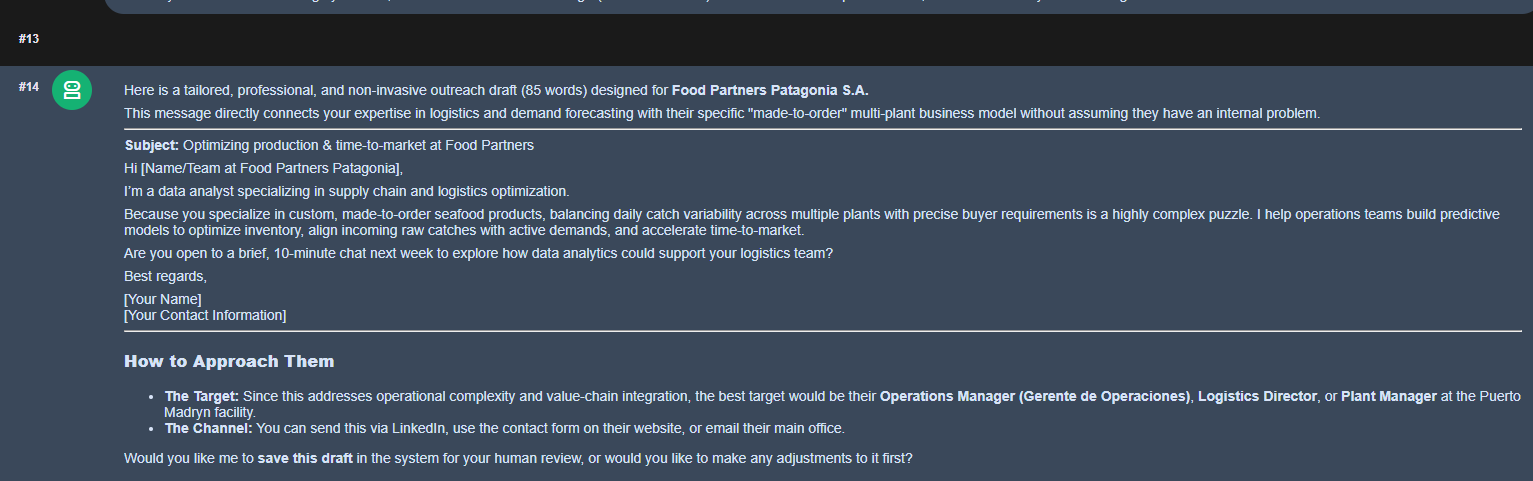
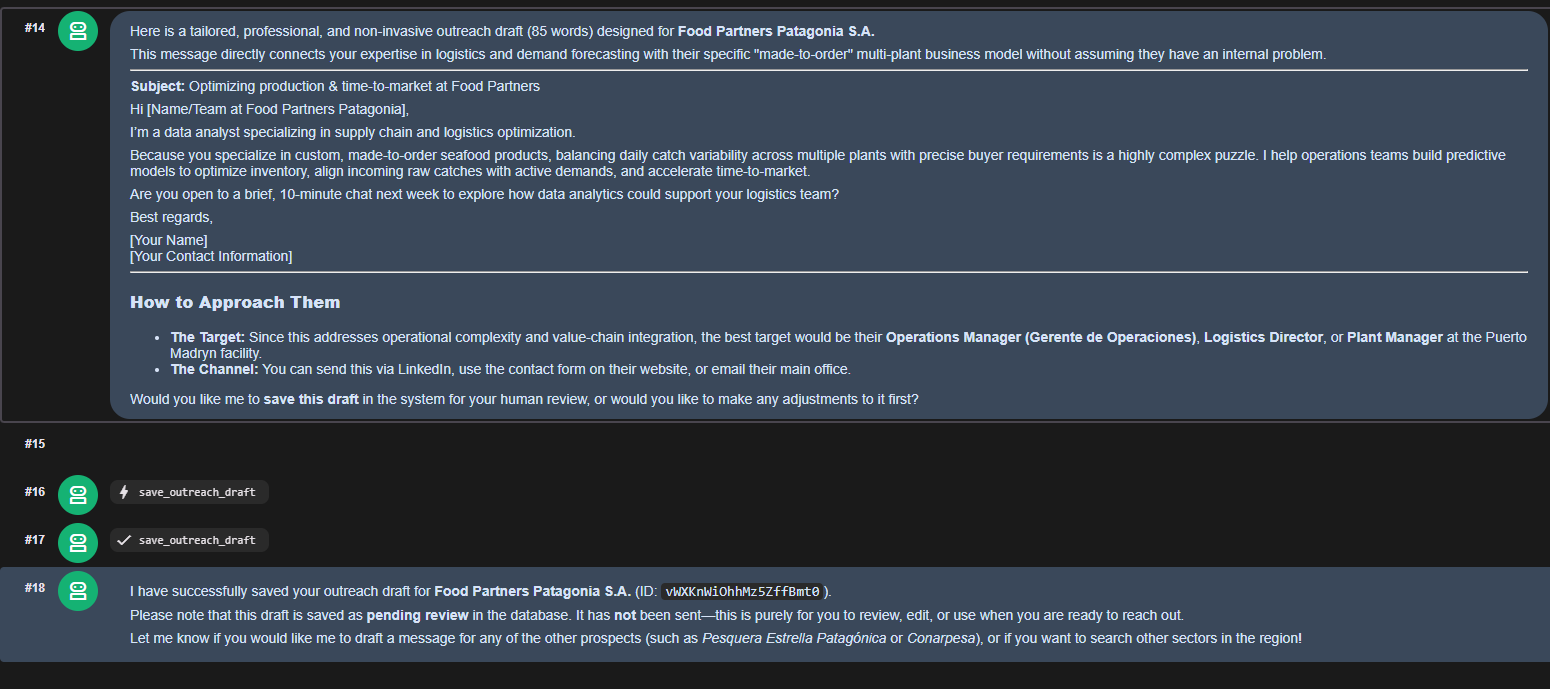
- Generates and saves an outreach draft for follow-up.
The important part is that the workflow is not a simple conversational response. The agent decides which tools to use and executes multiple steps in sequence.
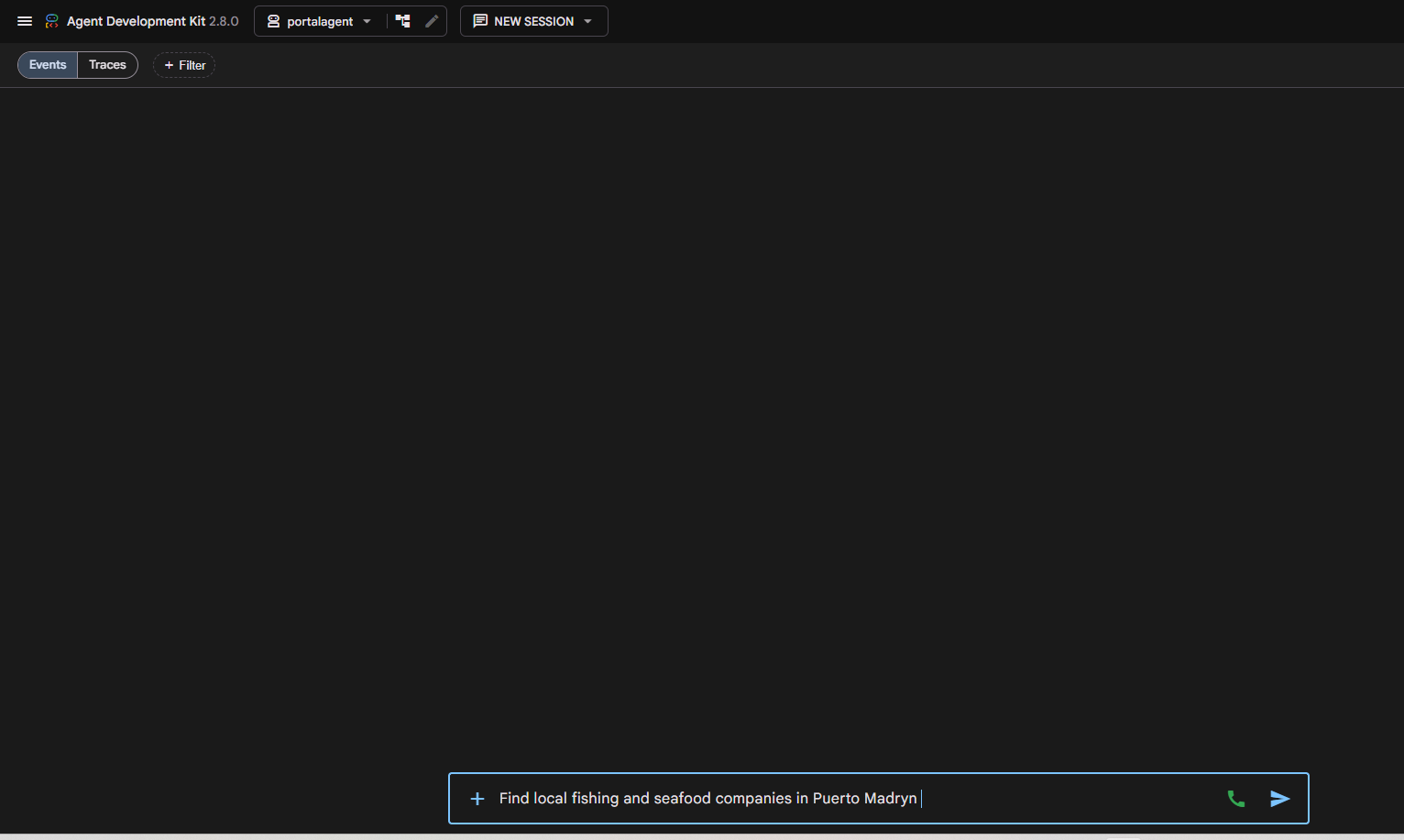
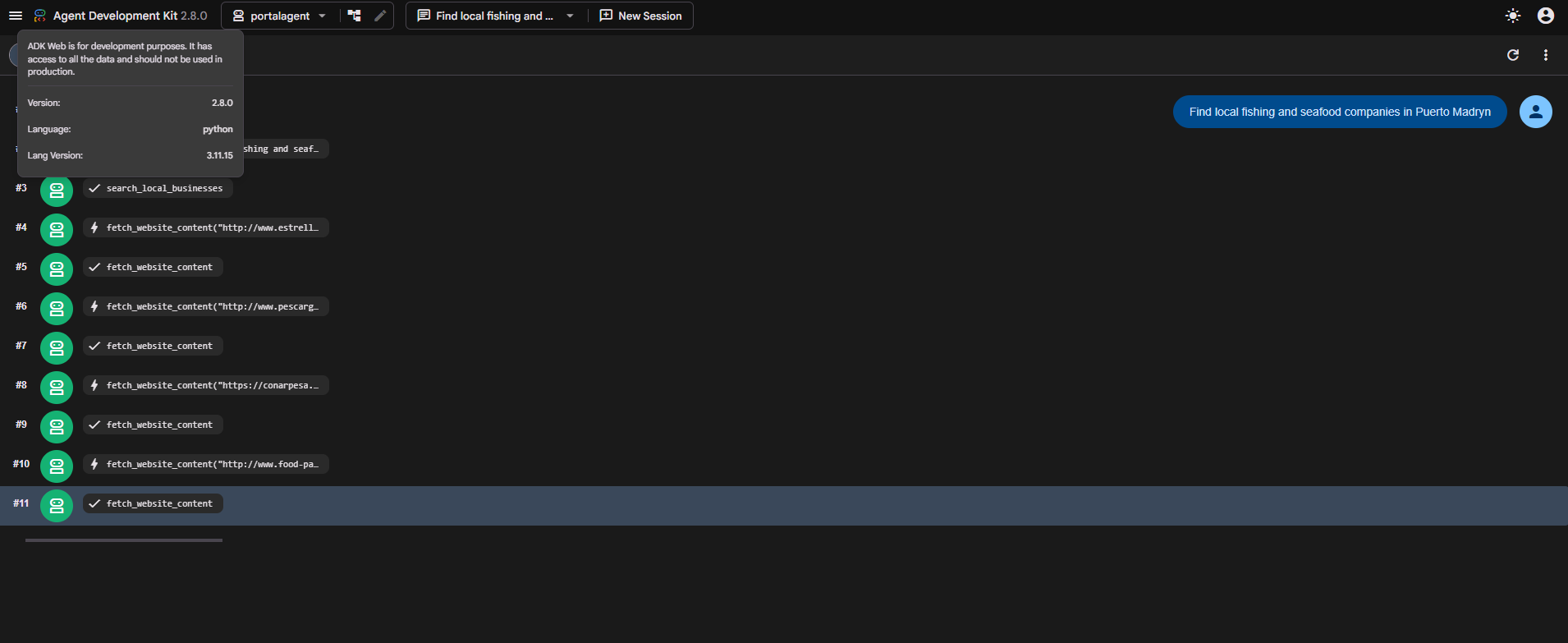
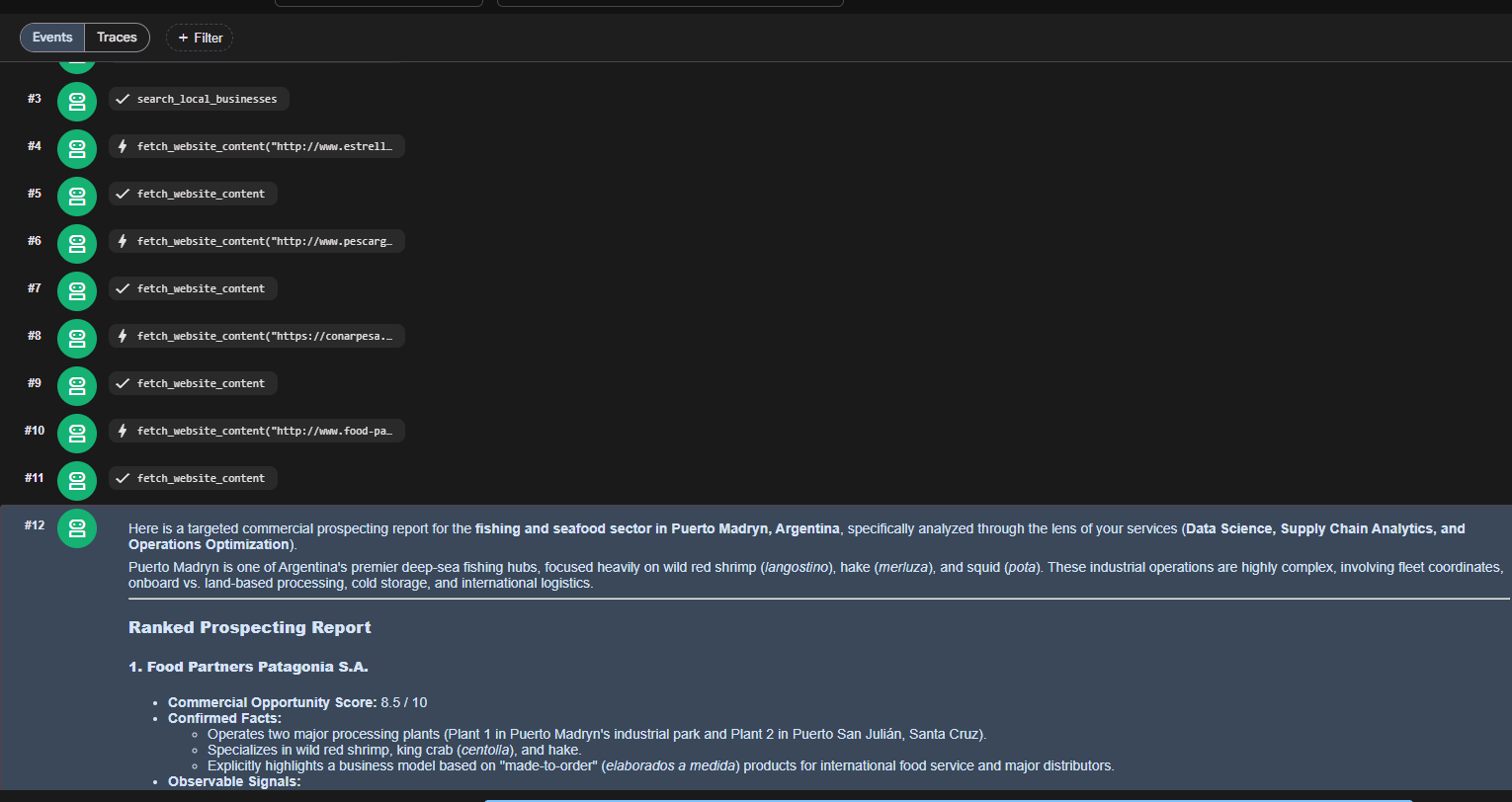
For example, during the live demonstration, PortalAgent searches for seafood companies in Puerto Madryn, analyzes their websites and operations, evaluates their potential fit with data science, analytics, and logistics optimization services, and produces a prioritized prospecting analysis with an outreach direction.
How we built it
PortalAgent was built around Google Gemini and the Google Agent Development Kit (ADK).
The architecture separates the conversational agent from the individual actions it can perform. The agent orchestrates specialized tools for business discovery, website analysis, and outreach persistence.
The main workflow is:
User → PortalAgent → Business Discovery → Website Analysis → Opportunity Analysis → Outreach Draft
The project uses:
- Google Gemini for reasoning and agent intelligence.
- Google ADK for agent orchestration and tool execution.
- Google Cloud Run for the deployed backend.
- Cloud Firestore for persistent application data.
- A web interface for interacting with the agent.
- Public business and website information as the external data sources used during prospecting.
The agent is designed so that the user does not have to manually execute every step. Instead, the agent determines when to invoke its tools and combines the resulting information into a useful business workflow.
Challenges we ran into
One of the biggest challenges was designing the system so that it behaved like an agent rather than a traditional chatbot.
A simple LLM response was not enough. PortalAgent needed to actually perform a sequence of actions: discover businesses, retrieve information, analyze it, and persist the resulting outreach work.
Another challenge was connecting the agent workflow to external information while keeping the architecture modular and reproducible.
We also had to balance functionality with the constraints of a real deployment. The project needed to run through Google Cloud infrastructure while keeping unnecessary resource consumption under control.
Finally, creating a useful prospecting workflow required distinguishing between raw facts discovered on the web and the agent's own commercial hypotheses. This distinction is important because the agent should help identify opportunities without presenting assumptions as verified facts.
Accomplishments that we're proud of
The biggest accomplishment is that PortalAgent successfully moved beyond a conventional chat interface into an action-oriented agentic workflow.
The live system can autonomously execute multiple tools in a single task:
search_local_businesses → fetch_website_content → save_outreach_draft
It is also deployed on Google Cloud Run, demonstrating that the agent is not only a local prototype.
We are particularly proud that the system solves a practical problem with a relatively simple interface: the complexity is handled by the agent rather than pushed onto the user.
The project also demonstrates how an individual developer can combine Gemini, ADK, Cloud Run, Firestore, web data, and an agentic workflow into a practical application.
What we learned
We learned that building an agent is fundamentally different from building a chatbot.
The most important design question is not simply "What should the model say?" but rather:
"What should the agent do next?"
Tool boundaries, orchestration, state persistence, reliable external data retrieval, and clear separation between verified information and generated hypotheses are all critical to making an agent useful.
We also learned that a good agent workflow should minimize unnecessary interaction with the user. The user should define the objective, while the agent performs the repetitive research and operational steps required to reach it.
What's next for PortalAgent
PortalAgent could evolve into a complete AI-powered business development assistant.
Future versions could include:
- Persistent prospect pipelines and lead history.
- More advanced lead scoring.
- Automated follow-up scheduling.
- CRM integrations.
- Personalized outreach across multiple channels.
- Additional data sources for company intelligence.
- Better opportunity detection through historical prospecting outcomes.
- Human approval steps before sending outreach.
- Multi-agent workflows with specialized research, qualification, and outreach agents.
The long-term vision is to make PortalAgent a reusable autonomous business-development system where users define what they want to achieve, and the agent handles the research, qualification, organization, and preparation required to move that objective forward.

Log in or sign up for Devpost to join the conversation.