-
-
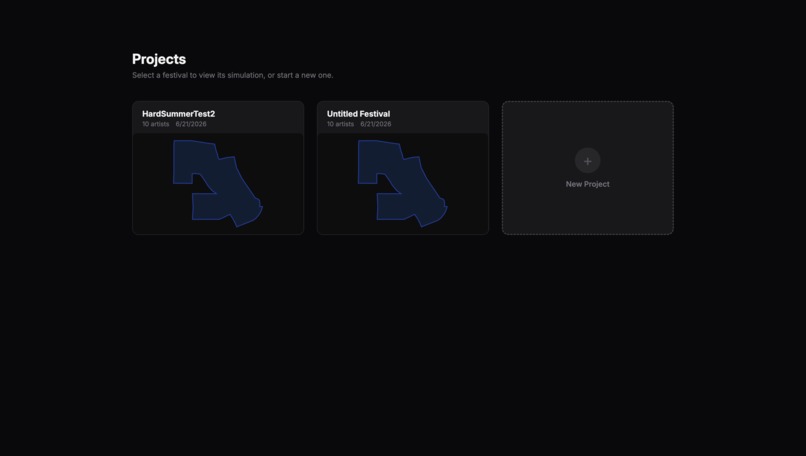
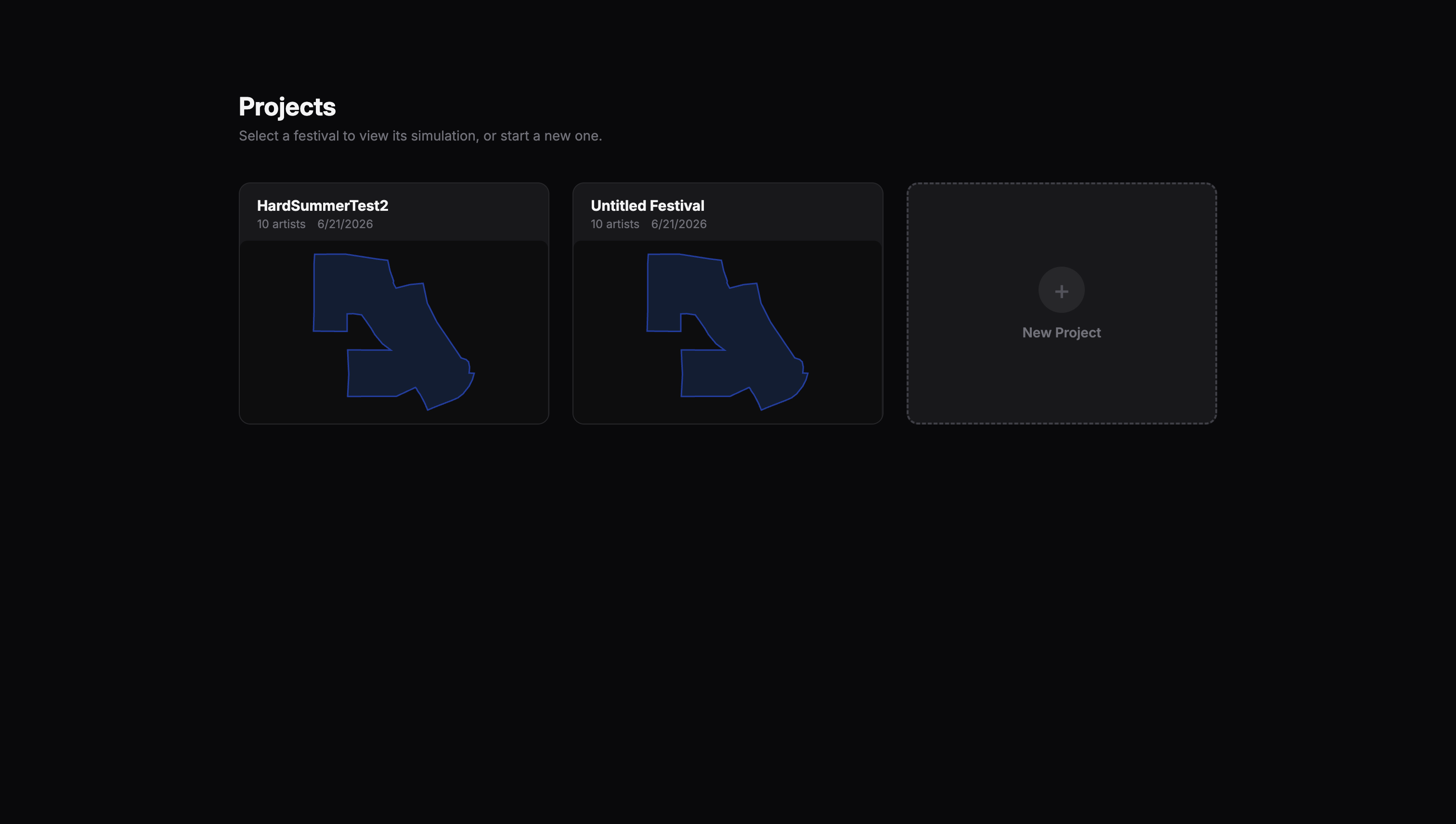
Map Selection
-
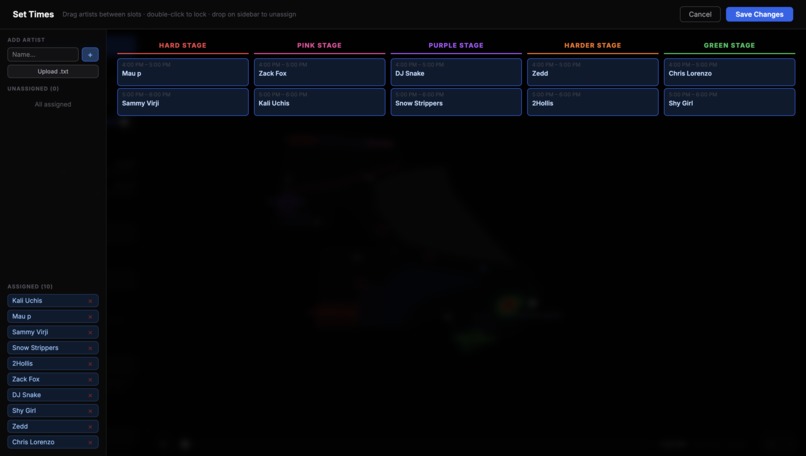
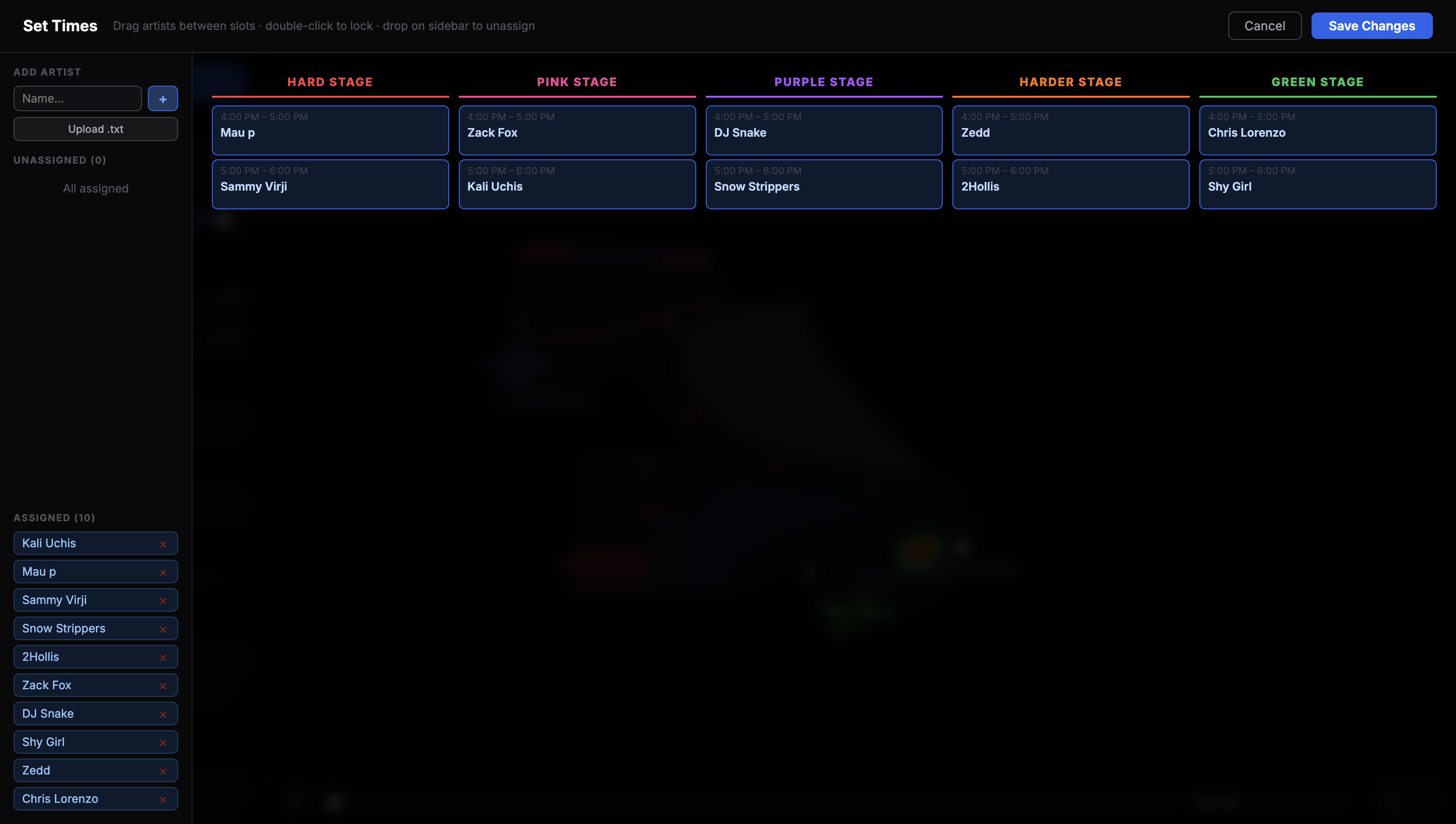
Set List Configuration
-
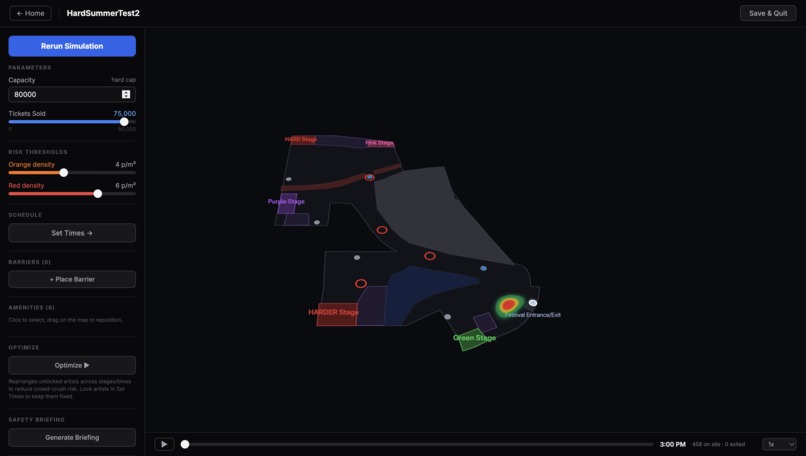
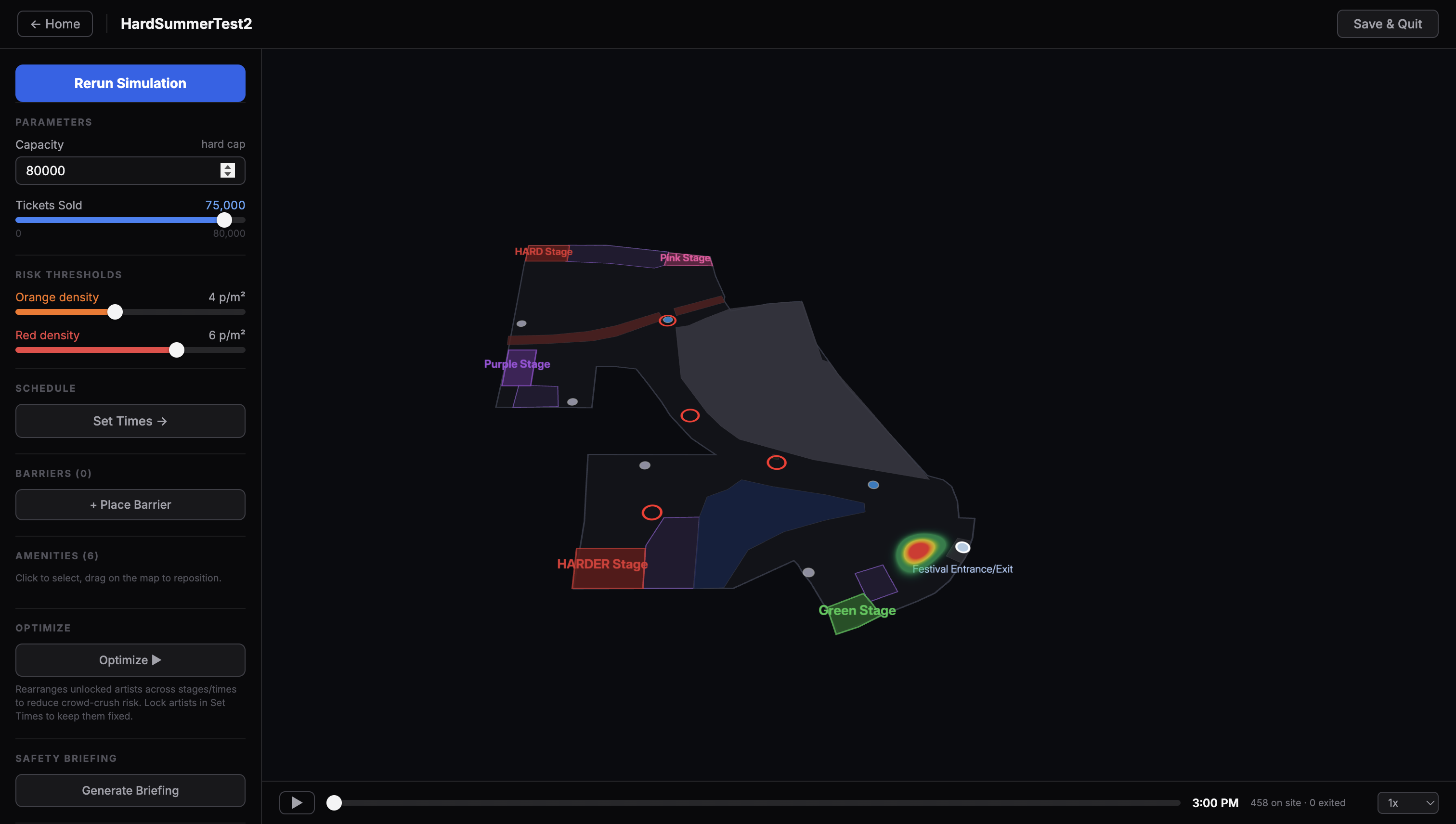
Map View
-
Start up Screen

🎵 PLUR — Predictive Large-Scale User Routing
Inspiration
PLUR (Predictive Large-Scale User Routing) was inspired by a problem that hits close to home for our team. We are all based in Los Angeles, avid concert and festival attendees, and several of us work professionally in event services and event security. We've experienced crowd management from both sides of the barricade—as staff responsible for keeping people safe and as patrons navigating massive crowds.
The tragedy at Astroworld was a major catalyst for this project. It highlighted how difficult it can be for organizers to predict dangerous crowd conditions before they occur and how devastating the consequences can be when crowd dynamics are misunderstood. We've personally witnessed overcrowding, bottlenecks, and crowd crush conditions at events, and we wanted to explore how technology could help prevent similar incidents in the future.
That led us to ask a simple question:
What if festival organizers could simulate, optimize, and stress-test an entire event before a single attendee arrived?
Our goal became building a platform that empowers organizers to make data-driven decisions about venue layouts, artist scheduling, crowd flow, and safety planning long before gates open.
🚀 What It Does
PLUR combines crowd simulation, venue planning, schedule optimization, and AI-assisted decision making into a single platform designed specifically for large-scale events.
Using a detailed geospatial model of a festival venue, organizers can simulate how tens of thousands of attendees move throughout the grounds. The system models:
- 🎤 Stages and artist performances
- 🚪 Entrances and exits
- ⭐ VIP areas
- 🚧 Barriers and restricted zones
- 🍔 Vendors and food courts
- 🍺 Bars and beverage stations
- 🚻 Restrooms and water stations
- 🏟️ Physical obstacles and venue infrastructure
Each attendee is represented as an autonomous agent that moves throughout the venue based on artist demand, venue constraints, and crowd behavior patterns. This allows organizers to identify dangerous congestion points, bottlenecks, and potential crowd crush scenarios before the event takes place.
One-Click Optimization
One of PLUR's most powerful features is the Optimize button.
With a single click, the platform automatically generates improved artist schedules and stage assignments based on projected attendance demand and artist popularity. The goal is to distribute crowds more effectively throughout the venue and reduce overcrowding risk without sacrificing the attendee experience.
Rather than manually experimenting with hundreds of possible schedules, organizers can instantly receive optimized recommendations backed by simulation and crowd-flow analysis.
AI Planning Assistants
PLUR includes AI-powered assistants that help transform simulation outputs into actionable planning decisions.
These AI agents can:
- Explain schedule and stage changes made during optimization
- Summarize crowd flow improvements
- Identify high-risk congestion areas
- Recommend crowd-control strategies
- Generate venue security briefings
- Suggest optimal restroom, water station, and bar placements
- Provide executive-level planning summaries
Instead of presenting planners with raw heatmaps and density graphs, PLUR translates complex crowd dynamics into understandable recommendations.
Interactive Venue Editing
Event planners can also directly modify the venue itself.
Users can:
- Move barriers
- Create or widen pathways
- Adjust vendor locations
- Relocate bars and beverage stations
- Reposition restrooms and water stations
- Test alternative venue layouts
Every change can immediately be re-simulated, allowing planners to evaluate the impact before making real-world decisions.
🏗️ How We Built It
At the core of PLUR is an agent-based crowd simulation engine powered by detailed geospatial venue data represented in GeoJSON.
We modeled real-world festival environments using:
- Walkable areas
- Stages and attractions
- Entrances and exits
- VIP sections
- Vendor locations
- Restrooms and water stations
- Physical obstacles
- Restricted areas and barriers
Each attendee is simulated as an independent agent navigating the venue while responding to attractions, obstacles, and crowd conditions. Running thousands of agents simultaneously allows us to generate realistic crowd-density maps and identify dangerous bottlenecks.
Distributed Optimization Infrastructure
To power our optimization engine, we deployed a distributed computing environment on a remote server cluster consisting of multiple virtual machine hosts totaling 44 CPU cores.
This infrastructure allowed us to rapidly evaluate large numbers of artist schedule and stage assignment combinations while modeling their effects on crowd movement throughout the venue.
The optimization engine considers:
- Artist popularity
- Projected attendance demand
- Venue layout
- Stage capacities
- Crowd movement patterns
- Bottleneck risk
By leveraging distributed computation, organizers can evaluate complex scheduling scenarios in seconds rather than hours.
AI-Powered Decision Support
After each optimization run, an AI agent reviews the proposed changes and generates a human-readable explanation detailing:
- What changed
- Why the changes were made
- Expected crowd-flow improvements
- Potential tradeoffs
- Additional recommendations
We also built specialized AI briefing agents that analyze venue layouts and simulation results to identify security risks, operational concerns, and infrastructure improvements.
By combining simulation, optimization, distributed computing, geospatial modeling, and AI analysis, we created a comprehensive planning tool for large-scale events.
⚠️ Challenges We Ran Into
One of our biggest challenges was balancing realism with performance. Simulating tens of thousands of attendees while maintaining an interactive user experience required significant optimization and efficient data structures.
Another challenge was accurately modeling human behavior. Real crowds don't move perfectly or predictably, and small changes in venue design can dramatically alter crowd flow. Capturing those dynamics in a meaningful way required extensive experimentation and testing.
Designing the optimization engine was also difficult. Popular artists naturally attract large crowds, but placing too many high-demand acts near each other—or scheduling them at conflicting times—can create dangerous conditions.
We also faced the challenge of making simulation results understandable. Event organizers don't necessarily want to spend their day interpreting density maps and technical metrics—they want actionable recommendations. This challenge ultimately led to the creation of our AI-powered planning assistants.
Finally, integrating venue editing, optimization, simulation, distributed infrastructure, and AI recommendations into a cohesive workflow within the limited timeframe of a hackathon was a significant challenge.
🏆 Accomplishments That We're Proud Of
We're incredibly proud that we were able to build a complete end-to-end event planning platform during the hackathon.
Some of our biggest accomplishments include:
- Building a large-scale agent-based crowd simulation system
- Creating a one-click optimization engine for artist scheduling and stage assignments
- Deploying distributed computation across a remote cluster with 44 CPU cores
- Developing AI agents that explain optimization decisions and generate security briefings
- Implementing venue editing capabilities for testing infrastructure changes
- Creating a system capable of identifying crowd crush risks before an event occurs
- Combining simulation, optimization, AI, and venue planning into a single workflow
Most importantly, we're proud that PLUR addresses a real-world problem that directly impacts public safety.
📚 What We Learned
This project taught us a tremendous amount about:
- Crowd dynamics
- Agent-based simulation
- Optimization algorithms
- Distributed computing
- Geospatial modeling
- AI-assisted decision making
We learned how interconnected event planning really is. Artist scheduling, venue design, infrastructure placement, security operations, and attendee behavior all influence one another.
A seemingly minor change—such as moving a restroom, widening a pathway, or adjusting a set time—can dramatically alter crowd flow throughout an entire venue.
Perhaps most importantly, we learned that technology has the potential to make large events significantly safer when used proactively rather than reactively.
🔮 What's Next for PLUR?
Our vision for PLUR extends far beyond this hackathon.
In the short term, we plan to continue improving the accuracy of our simulation models, optimization algorithms, and AI planning assistants. We also want to incorporate additional real-world datasets and support increasingly complex event environments.
Long term, our goal is to offer PLUR as a planning and safety platform for major event organizers and festival operators.
We believe the platform could provide significant value to organizations such as Insomniac, Live Nation, and other large-scale event producers by helping them:
- Proactively identify safety risks
- Optimize event operations
- Improve attendee experiences
- Reduce crowd-related incidents
Ultimately, we want PLUR to become a standard planning tool for large events—helping organizers create safer, smarter, and more enjoyable experiences for everyone.

Log in or sign up for Devpost to join the conversation.