Inspiration
I kept thinking about how businesses decide what to build in a particular place. They study demographics, income levels, foot traffic, competitors and market demand. Those things matter, but I felt something important was missing: an understanding of the people themselves, their cultural interests, what influences them, what they connect with, and how those things relate to the places they inhabit.
A place is more than its coordinates, and its people are more than demographic categories.
I wanted to build something that could bring those pieces together. Something that could help a developer, hospitality group, retailer or operator look at a location and ask a better question: What kind of commercial experience actually makes sense here, for these people, and why?
I kept coming back to one distinction: market research can tell you whether an opportunity exists; cultural research can help you understand what form that opportunity should take.
That became PlaceGraph.
What it does
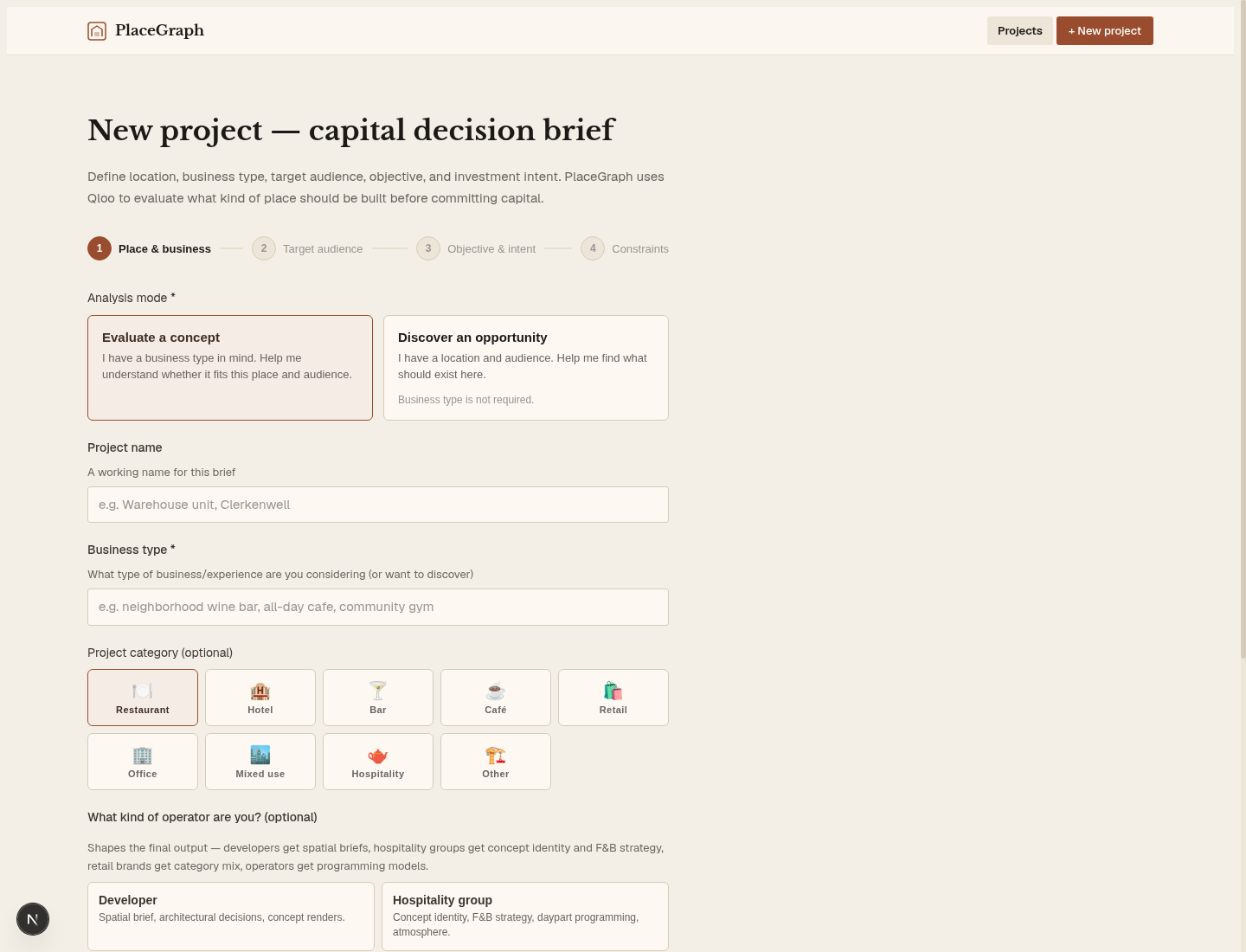
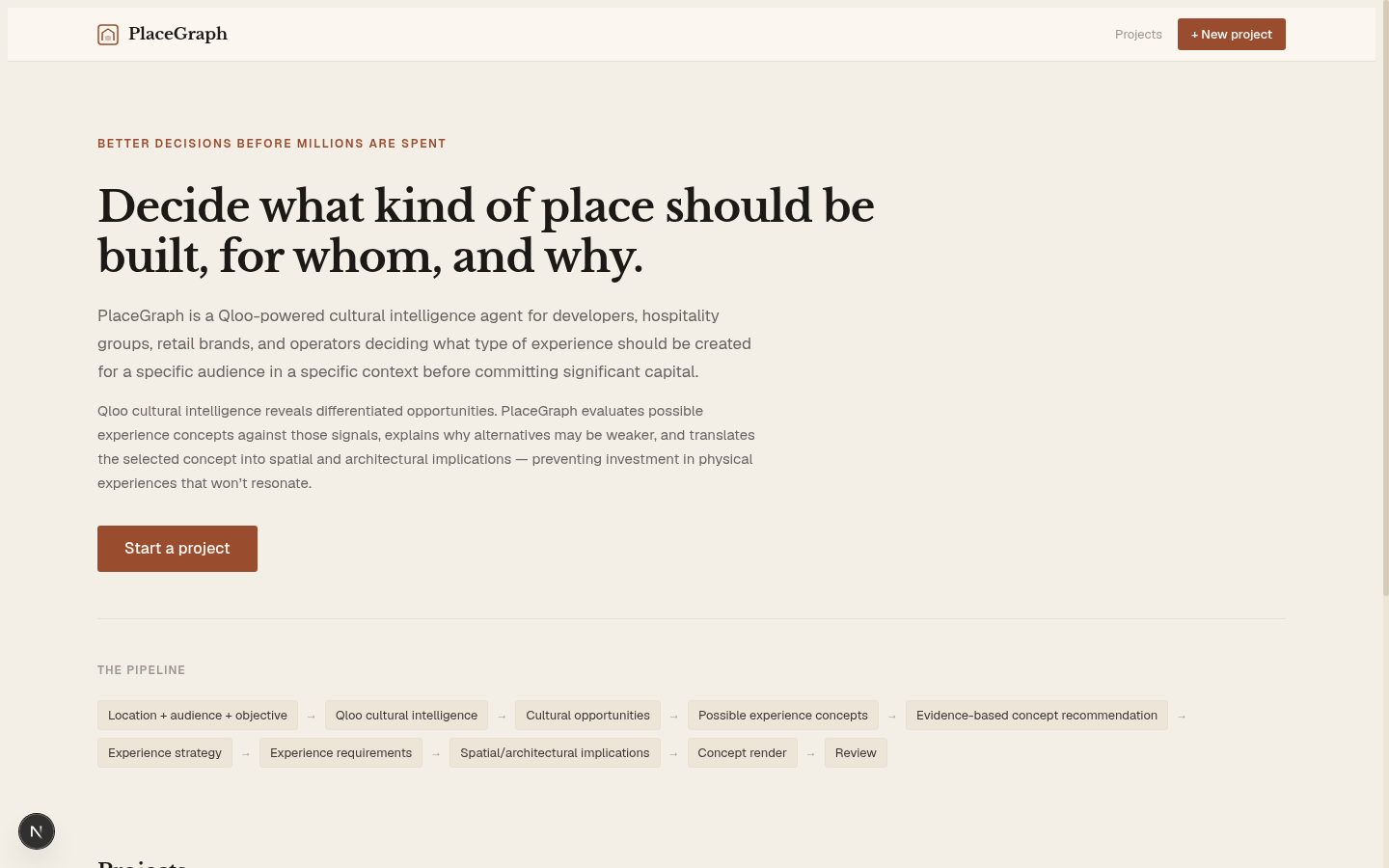
PlaceGraph is a cultural-intelligence platform for commercial place-making and investment decisions.
It connects a location, its audiences and their cultural affinities to uncover relationships that may reveal overlooked commercial opportunities. It uses Qloo's cultural intelligence alongside local geographic and commercial context to help users move from understanding a place to exploring what could meaningfully exist there.
Rather than simply generating business ideas, PlaceGraph aims to explain why a particular direction might make sense, who it could serve, what existing experiences it relates to, and what still needs to be validated.
It also takes those ideas a step further by translating them into experience and spatial directions.
How I built it
I built PlaceGraph as a web application using Next.js, React and TypeScript.
Qloo is central to the cultural-intelligence layer. I used its search and insights capabilities to retrieve cultural signals and affinities. OpenStreetMap data, supported by geographic services such as Nominatim and Photon, provides local and spatial context.
Groq powers the language-model reasoning that helps interpret evidence and translate it into commercial directions. I also use image-generation capabilities through Cloudflare's Flux Schnell to explore how some of those directions might take physical form.
The application brings these pieces into a workflow: from a location and an objective, through audience and cultural analysis, to commercial opportunities and spatial exploration.
A major part of the work has been figuring out how these different sources of information should relate to one another, rather than simply putting their outputs side by side.
Challenges I ran into
The hardest part was not connecting APIs. It was making the intelligence trustworthy.
A cultural affinity does not automatically tell you what people in a particular neighbourhood do. An entity returned by an API does not necessarily represent the audience you intended to investigate. And just because a place-data source does not show a business does not mean that business does not exist.
I encountered situations where broad geographic signals could easily be mistaken for neighbourhood-level insight, and where seemingly relevant cultural results could lead to completely unsupported conclusions.
That forced me to confront an important question: how do I stop an AI system from turning incomplete evidence into confident-sounding stories?
I am still working through that challenge. It does now shape how I think about evidence, confidence, geographic relevance and the distinction between what I know, what I infer and what I still need to investigate.
Accomplishments that I'm proud of
I am proud that PlaceGraph has moved beyond the original idea of using AI to generate business concepts.
I have brought cultural intelligence, geographic context, commercial reasoning and spatial exploration into one connected workflow. More importantly, I have started building around a question that I believe deserves much more attention: how can understanding the cultural relationship between people and places change the commercial decisions we make about those places?
I'm especially proud of making Qloo central to that vision. I don't want cultural intelligence to be a decorative feature or an extra data source. It should materially influence the opportunities PlaceGraph discovers and the reasoning behind them.
What I learned
I learned that having more data does not necessarily mean having more understanding.
I also learned how easily an AI system can produce a convincing explanation from evidence that does not actually support it. Cultural signals need context. Geographic precision matters. Assumptions must not be presented as facts.
The biggest lesson is that the valuable part is not simply identifying what people like. It is understanding how cultural interests, people, physical places and commercial experiences relate to one another.
That is a much harder problem than generating recommendations, but it is also the problem I want to solve.
What's next for PlaceGraph
I want to make PlaceGraph much better at understanding the relationship between a place and the different people who use it.
That means improving audience identification, bringing in richer local and social context, understanding existing commercial experiences more reliably, and making sure every recommendation is supported by evidence appropriate to the claim being made.
I also want to strengthen the way PlaceGraph translates its findings into decisions for developers, hospitality groups, retailers and operators.
Ultimately, I want PlaceGraph to become a tool people can use before committing significant capital to a place: not just to ask whether a business might work there, but to discover what they may be overlooking, what could genuinely belong there, and what they should investigate before making that decision.
Built With
- cloudflare
- flux-schnell
- groq
- large-language-models
- next.js
- nominatim
- openstreetmap
- photon
- qloo-api
- react
- turborepo
- typescript
- vercel
- zod

Log in or sign up for Devpost to join the conversation.