-
-
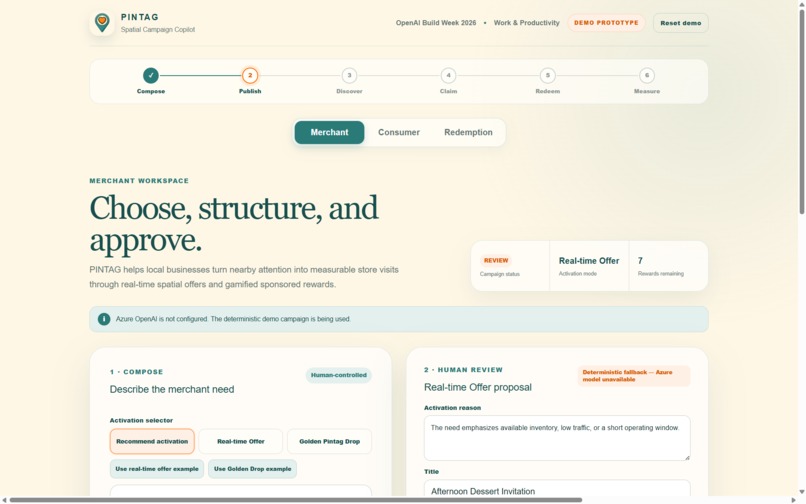
PINTAG Spatial Campaign Copilot:Turn merchant needs into real-time spatial offers and Golden Pintag Drops that drive measurable store visits
-
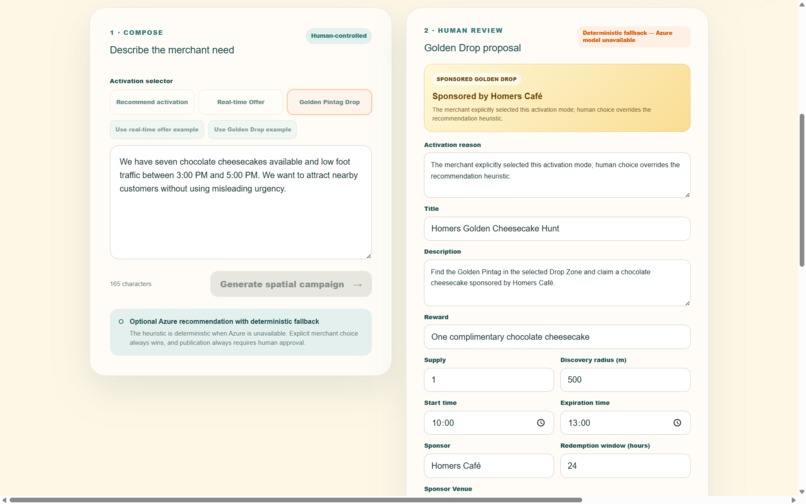
Two Spatial Activation Modes: Create immediate Real-time Offers or gamified Golden Pintag Drops through one shared spatial campaign engine.
-

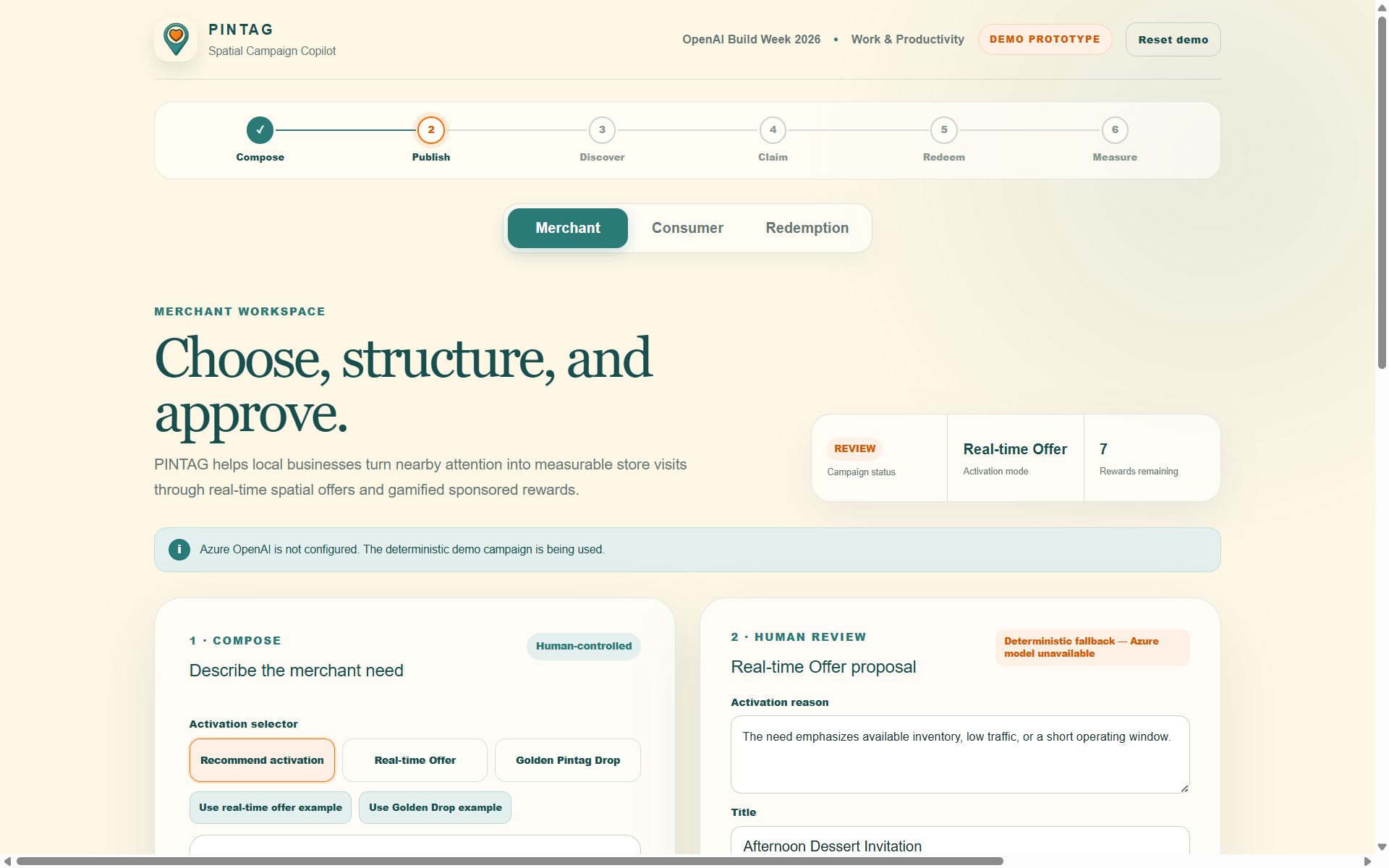
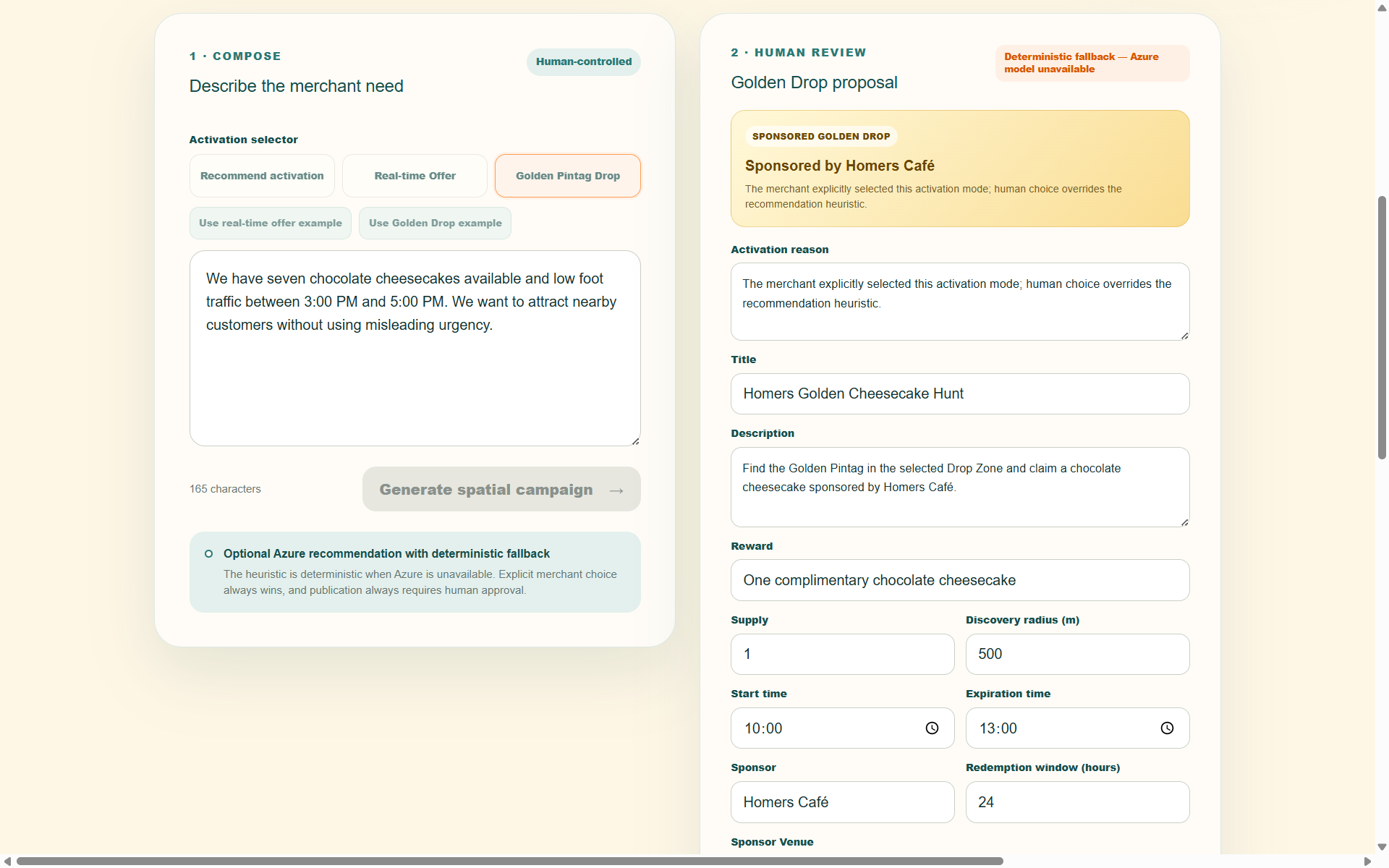
Merchant Review and Human Approval — Review campaign details, reward supply, Drop Zone and Sponsor Venue before approving publication.
-
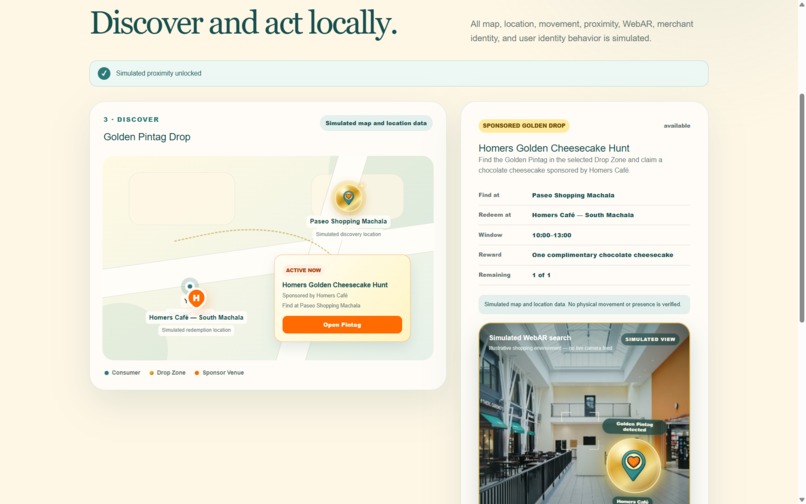
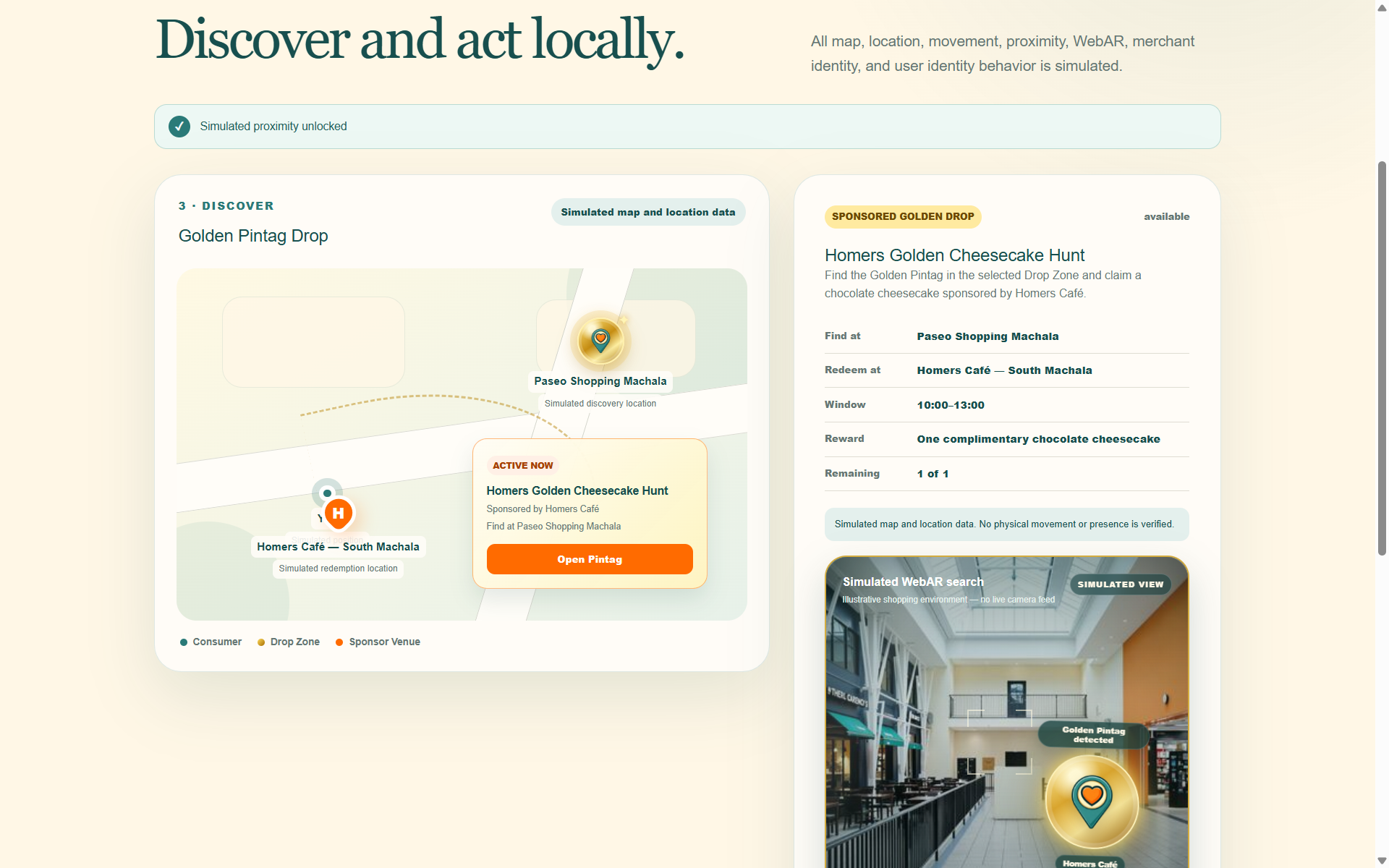
Simulated WebAR Reward Search — A realistic shopping scene demonstrates the simulated WebAR search for a sponsored Golden Pintag reward.
-
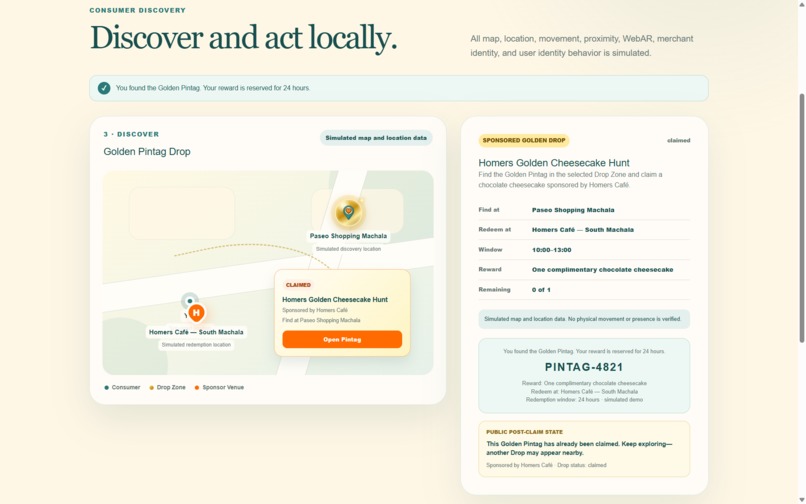
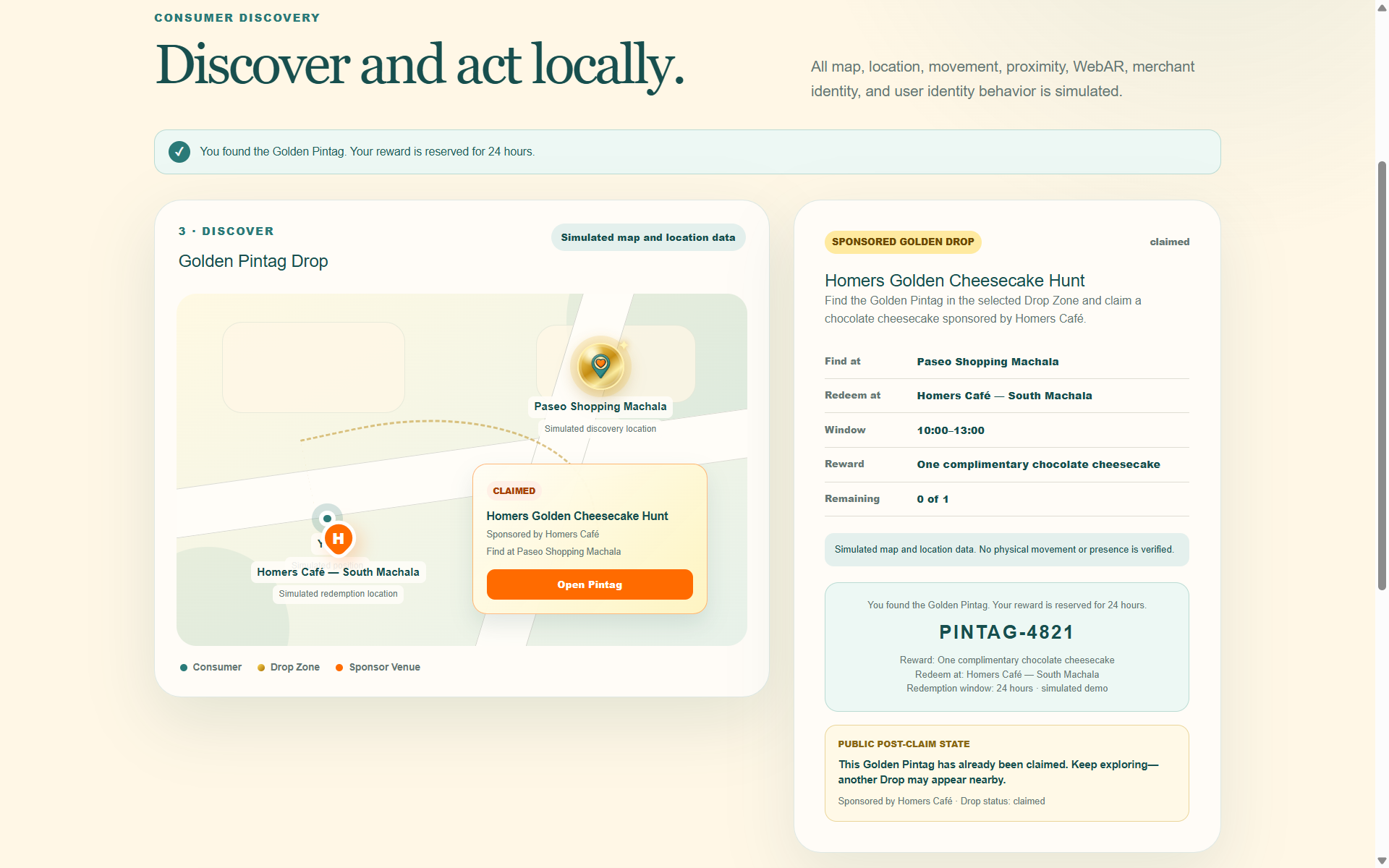
Golden Pintag Spatial Discovery — Users discover a branded Golden Pintag through a simulated map linking the Drop Zone and Sponsor Venue.
-
-
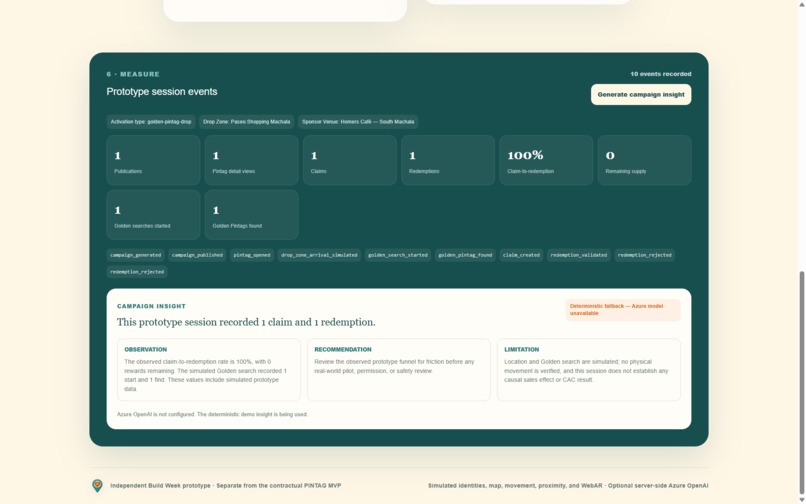
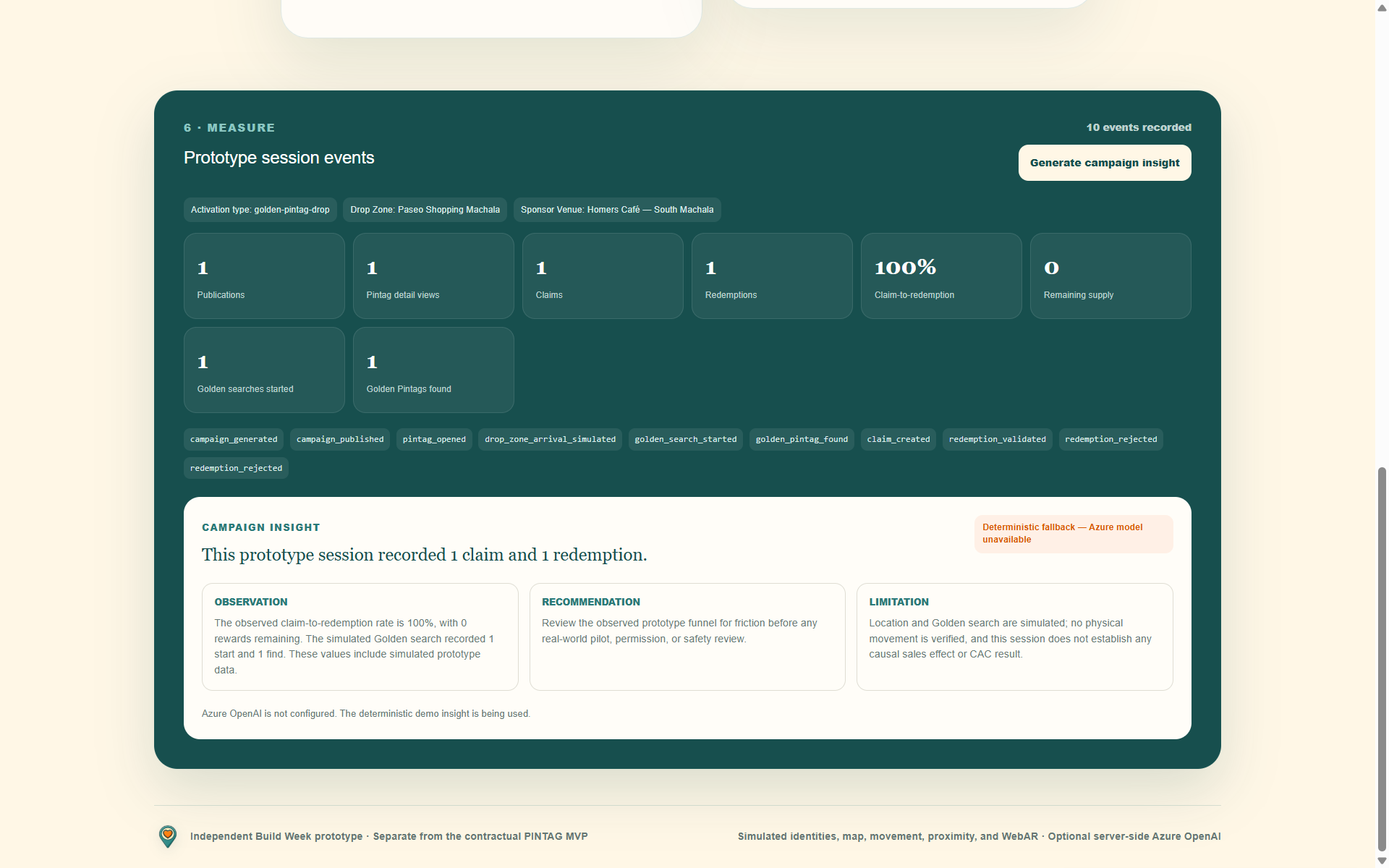
Campaign Funnel and Redemption Analytics — Track discovery, search, find, claim and redemption events through the complete campaign journey.

Inspiration
Local businesses constantly face short-lived operational problems: excess inventory, unused capacity, low traffic during specific hours, a new location that needs visibility, or a temporary experience that needs customers now.
Most digital channels are designed for broad reach, passive engagement, or historical visibility. They do not help a merchant create a place-bound, time-bound activation and measure the path from discovery to claim and redemption.
PINTAG began with a broader vision: make the physical world digitally alive through spatial objects connected to real places, moments, and actions.
For OpenAI Build Week, we focused that vision on one concrete commercial problem:
How can a local business turn nearby attention into measurable store visits?
The result is PINTAG Spatial Campaign Copilot, a prototype that supports two activation modes through the same spatial campaign engine:
- Real-time Offers for temporary inventory, unused capacity, or low-traffic periods.
- Golden Pintag Drops for localized visibility, exploration, and customer acquisition through limited merchant-sponsored rewards.
The AI Copilot helps structure the campaign, but the product is the complete spatial journey from publication and discovery to claim and redemption.
What it does
PINTAG helps local businesses turn nearby attention into measurable store visits through real-time spatial offers and gamified sponsored rewards.
A merchant begins by describing a business need in natural language.
Examples:
- “We have seven chocolate cheesecakes available and low foot traffic between 3:00 PM and 5:00 PM.”
- “We want to use one chocolate cheesecake as a sponsored reward to introduce Homers Café to customers in another part of Machala.”
The Copilot recommends or structures one of two activation modes.
Real-time Offer
A Real-time Offer is linked to the merchant location and designed to solve an immediate operational need.
The consumer journey is:
Publication → nearby discovery → campaign detail → claim → redemption → analytics
Golden Pintag Drop
A Golden Pintag Drop is a limited merchant-sponsored reward using two distinct locations:
- Drop Zone: an approved public discovery area where users search for the Golden Pintag.
- Sponsor Venue: the merchant location where the reward is redeemed.
The prototype demonstrates:
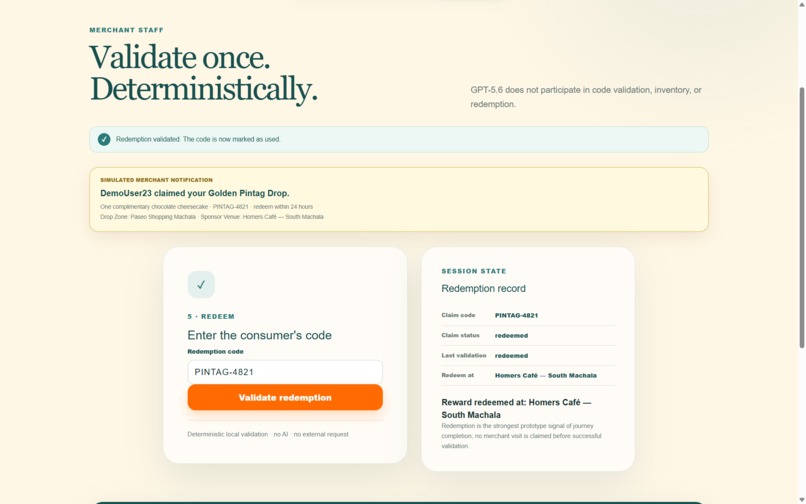
Publication → discovery → simulated arrival → simulated proximity unlock → simulated WebAR search → Golden Pintag found → claim → single-use redemption → analytics
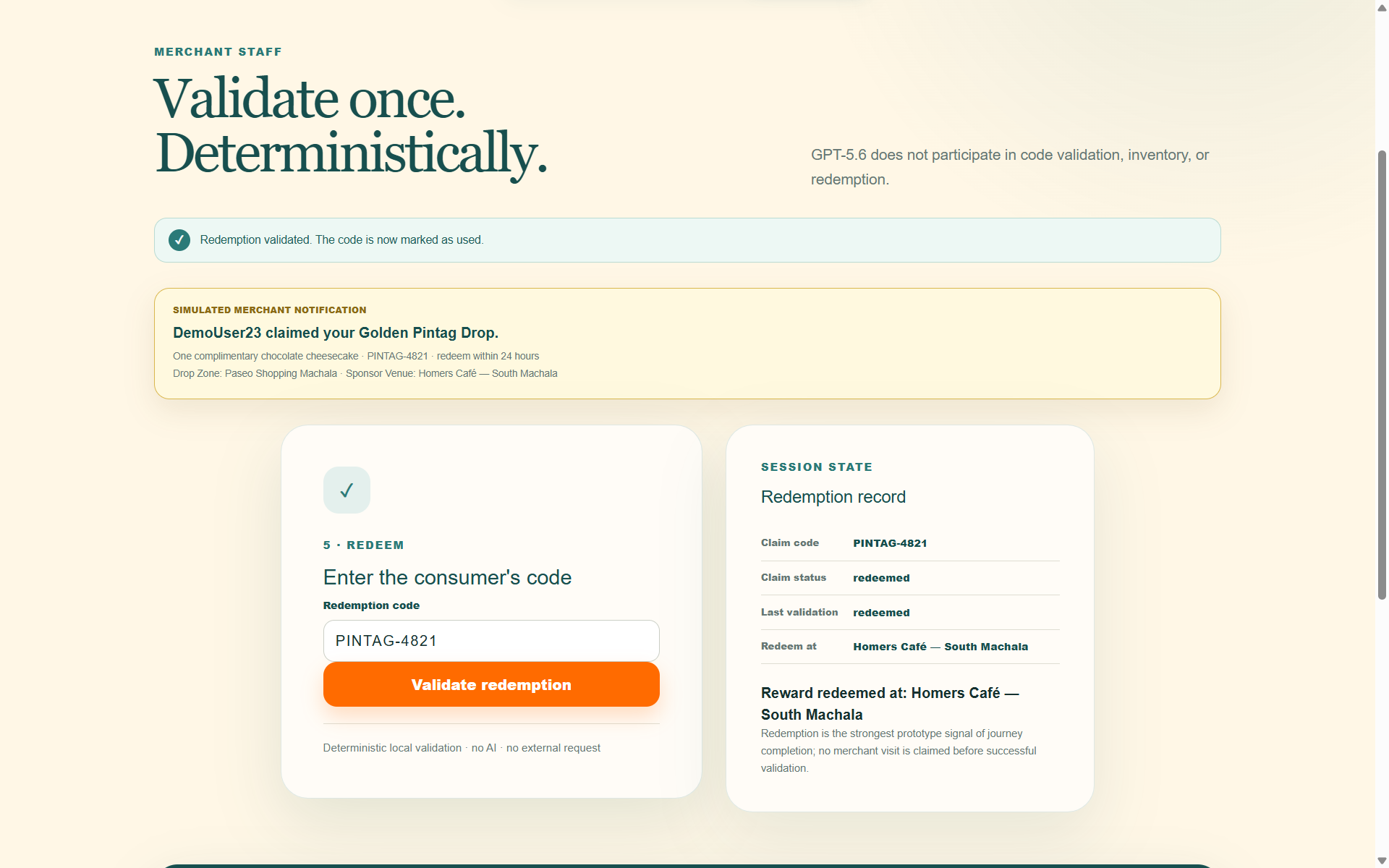
In the demo, Homers Café sponsors one chocolate cheesecake. The merchant selects a prototype Drop Zone such as Paseo Shopping Machala. A consumer discovers the Golden Pintag on a simulated map, unlocks a simulated WebAR search, finds the branded Golden Pintag, claims the reward, receives the code PINTAG-4821, and later redeems it at Homers Café — South Machala.
Both activation modes reuse the same infrastructure for:
- campaign status;
- time windows;
- supply;
- human approval;
- claims;
- claim expiration;
- redemption codes;
- single-use validation;
- events;
- campaign analytics.
The public prototype clearly labels location, map, proximity, Drop Zones, identities, and WebAR as simulated.
How we built it
We built the project from an empty repository with Codex and GPT-5.6 under human direction.
The application uses:
- Next.js with App Router;
- React;
- TypeScript;
- Tailwind CSS;
- server-side API routes;
- automated tests;
- Git and GitHub;
- Vercel;
- an optional Azure OpenAI integration through Microsoft Foundry.
Codex helped us:
- define the product specification;
- document architecture and trust boundaries;
- build the merchant, consumer, and redemption interfaces;
- implement the deterministic campaign lifecycle;
- create the claim and single-use redemption engine;
- add Golden Pintag Drops as a second activation mode;
- model separate Drop Zone and Sponsor Venue locations;
- implement simulated proximity and simulated WebAR;
- create automated tests;
- validate security and secret handling;
- maintain a traceable Git history;
- prepare the public repository and Vercel deployment.
GPT-5.6 is designed to:
- interpret the merchant’s natural-language need;
- recommend a Real-time Offer or Golden Pintag Drop;
- generate structured campaign content;
- identify missing or ambiguous information;
- recommend one primary metric;
- suggest approved prototype Drop Zones;
- warn against misleading urgency or unsafe behavior;
- interpret aggregate campaign metrics.
The application uses Azure OpenAI as the intended provider target with:
- model:
gpt-5.6-sol; - intended deployment:
pintag-gpt-5-6-sol; - strict structured output;
- server-side credentials;
- bounded prompts;
- response validation;
- timeout handling;
- deterministic fallback.
Azure quota remained externally controlled during the submission period, so the public deployment transparently uses the deterministic fallback. It never pretends that a live GPT-5.6 response occurred.
Business-critical behavior remains deterministic. GPT-5.6 cannot:
- publish campaigns;
- choose arbitrary coordinates;
- verify physical presence;
- control inventory;
- create redemption codes;
- validate claims or redemption;
- fabricate metrics;
- claim proven sales or customer-acquisition impact.
Challenges we ran into
The first challenge was scope.
PINTAG has a much broader long-term vision, but attempting to build the complete platform during a short hackathon would have produced an incomplete and unreliable submission. We reduced the scope to one measurable merchant workflow while preserving the larger spatial thesis.
The second challenge was separating probabilistic AI assistance from authoritative system state.
Campaign copy and recommendations can be AI-assisted, but publication, inventory, claims, redemption, and metrics must remain deterministic and auditable. Designing that boundary became one of the most important technical decisions in the project.
The third challenge was external Azure quota.
The Microsoft Foundry resource and project existed, and quota was requested for GPT-5.6 Sol Global Standard, but deployment availability remained externally controlled. Instead of fabricating a successful response or allowing the demo to fail, we built a transparent deterministic fallback that preserves the complete experience.
The fourth challenge was representing Golden Pintag Drops without falsely claiming production geolocation or augmented reality.
We created a simulated 2D map, simulated proximity unlock, and simulated WebAR search. Every simulated capability is clearly disclosed, while the complete product journey remains understandable and testable.
The final challenge was time. The project was built, tested, documented, deployed, recorded, and submitted in less than one day by a non-programmer founder balancing responsibilities as a teacher and father.
Accomplishments that we're proud of
We are proud that the prototype is not only a visual concept. It demonstrates a complete, measurable workflow.
The final version includes:
- two merchant activation modes;
- natural-language campaign composition;
- activation recommendation;
- human review and publication;
- approved prototype Drop Zone selection;
- distinct Drop Zone and Sponsor Venue locations;
- simulated spatial discovery;
- simulated proximity unlock;
- branded simulated WebAR search;
- Golden Pintag discovery;
- deterministic claim creation;
- single-use code validation;
- positive late-user experience;
- session-event analytics;
- campaign insight fallback;
- optional server-side Azure OpenAI architecture;
- secret and client-bundle scans;
- 26 passing automated tests;
- passing lint and production build;
- public GitHub repository;
- public Vercel deployment;
- complete Git history.
We are especially proud that the Golden Pintag Drop reuses the existing campaign, inventory, claim, redemption, and analytics engine. It expands the commercial and growth story without becoming a disconnected second product.
What we learned
We learned that AI-assisted software development works best when the human defines clear boundaries, acceptance criteria, and review checkpoints.
Codex was most useful when each task had:
- a precise objective;
- strict scope;
- allowed and prohibited changes;
- required tests;
- security requirements;
- a diff review;
- explicit human approval before commit and deployment.
We also learned that a strong AI product does not require AI to control every part of the system.
For PINTAG, the best architecture is:
- AI for interpretation, recommendations, copy, ambiguity detection, and aggregate insight;
- deterministic software for publication, timing, inventory, claims, redemption, events, permissions, and metrics;
- human approval for decisions that affect merchants and consumers.
We also learned that Golden Pintag Drops can serve two purposes simultaneously:
- provide merchants with localized visibility beyond their immediate neighborhood;
- give consumers a playful reason to explore, discover, and visit participating businesses.
This creates a testable growth hypothesis:
Concentrated, merchant-sponsored Golden Pintag Drops may reduce early acquisition friction and generate measurable redemptions.
The pilot is intended to measure that hypothesis rather than claim it as a proven result.
What's next for PINTAG Spatial Campaign Copilot
The next step is a controlled pilot in a compact, walkable area of Machala, Ecuador.
We plan to recruit an initial group of local merchants to test:
- Real-time Offers for inventory and low-traffic periods;
- Golden Pintag Drops using limited in-kind rewards;
- discovery-to-claim conversion;
- claim-to-redemption conversion;
- merchant satisfaction;
- user interest in future Drops;
- operational and safety requirements.
The production roadmap includes:
- real merchant onboarding;
- authentication and roles;
- PostgreSQL and PostGIS;
- real map integration;
- foreground geolocation;
- approved Drop Zone administration;
- production geofencing;
- mobile camera and WebAR exploration;
- push notifications;
- wallet and claim history;
- dynamic redemption codes or QR;
- merchant analytics;
- moderation and audit tooling;
- a PINTAG administrative console.
The broader vision remains larger than merchant campaigns.
PINTAG aims to become a spatial infrastructure layer where people, places, communities, and businesses can create and discover digital objects connected to the physical world.
The current prototype is the first focused commercial wedge:
Real-time Offers for immediate merchant needs, Golden Pintag Drops for growth and discovery, and a shared spatial engine for measurable local action.

Log in or sign up for Devpost to join the conversation.