Inspiration
We kept noticing the same pattern in our own kitchens: groceries bought with good intentions, forgotten in the back of the fridge, and eventually thrown away — while somewhere nearby, that same food could have fed someone else. Food waste isn't usually a lack of caring; it's a lack of visibility and a lack of an easy path to share. We wanted to build something that closes that gap — not just another recipe app, but a full loop that connects what's in your kitchen to what you cook, plan, share, and discover.
What it does
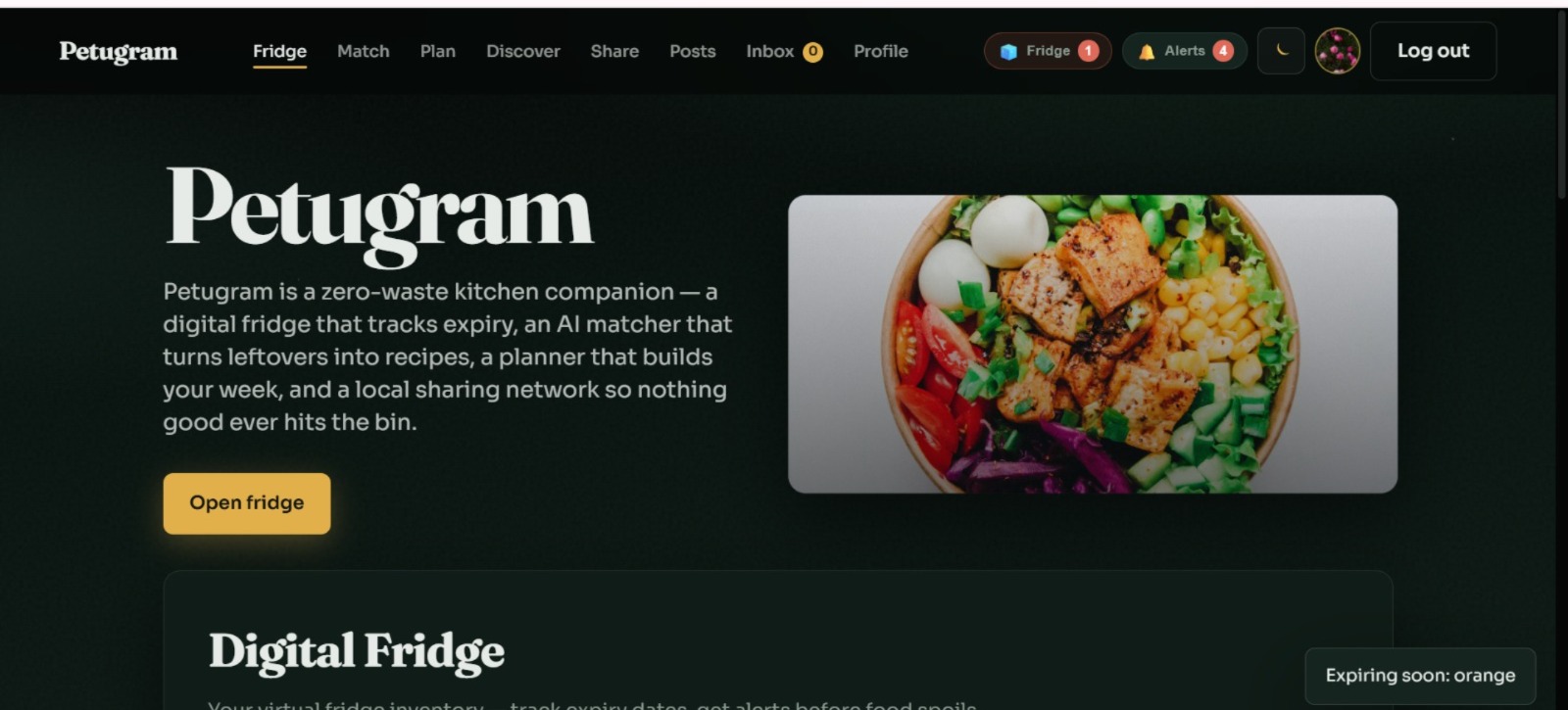
Petugram is a zero-waste kitchen companion and social food platform built around one core journey: Manage → Cook → Plan → Share → Discover → Create → Connect → Impact.
Digital Fridge — scan a receipt, photo, or barcode to track ingredients and expiry dates automatically, with alerts before food spoils AI Match — generates recipe suggestions from whatever's currently in your fridge, ranked by fit, with nutrition breakdowns and smart ingredient substitutions Meal Plan — builds a personalized 3–7 day meal plan and auto-generates a grocery list of only the ingredients you're actually missing Share + Inbox — lets users post surplus food for neighbors to claim, with in-app chat to coordinate pickup Discover — surfaces nearby restaurants, dishes, recipes, and food creators on an interactive map Social — a food-focused feed for posts, reels, and stories where users share what they cook Gamification & Impact — points, streaks, and badges reward sustainable behavior, while an Impact dashboard tracks money saved, food saved, and estimated CO₂ avoided, localized to the user's region How we built it
We built Petugram as a three-tier system: a vanilla JavaScript single-page frontend, a Python FastAPI backend, and a data/services layer combining MongoDB with AI services and external APIs.
On the AI side, we used Hugging Face's inference API for recipe generation, sentence-transformer embeddings (MiniLM) to rank generated recipes by how well they match available ingredients, and vision models for identifying food from photos and receipts during Quick Add.
For real-world data, we integrated Open Food Facts for barcode/product lookups, OpenStreetMap and Nominatim (via Leaflet) for restaurant discovery and geocoding, and search APIs as a fallback for recipe and food discovery.
We designed the database around ownership relationships — a User owns a Fridge containing FoodItems, generates Recipes and MealPlans, creates SharePosts and social content, and receives Notifications and Achievements — all mapped out in our UML class, use case, activity, and sequence diagrams before implementation.
Challenges we ran into
Getting AI Match to feel genuinely useful — not just technically working — was harder than expected. Generating a recipe from a list of ingredients is easy; generating one that's actually a good fit, accounts for what's missing, and suggests reasonable substitutions took real tuning of the ranking layer.
Designing the Share flow also took several iterations. Coordinating surplus food pickup between strangers needed to feel safe and low-friction at the same time — we had to balance location precision (enough to be useful) against privacy (not exposing exact addresses upfront), which shaped how we built the claim → inbox → pickup flow.
Tying together so many modules — fridge, AI, planning, sharing, discovery, and social — into one coherent product without it feeling cluttered was an ongoing design challenge throughout.
Accomplishments that we're proud of
We're proud that Petugram isn't a concept or a mockup — it's a fully working, end-to-end prototype. You can genuinely scan food into a fridge, get AI-ranked recipes, build a weekly meal plan, share surplus with the community, discover nearby restaurants, and post to a social feed, all in one live deployed app.
We're also proud of the depth of planning behind it — full UML documentation (use case, class, activity, and sequence diagrams), a real database schema across 13+ collections, and a business model that goes beyond the hackathon scope toward genuine sustainability.
What we learned
We learned how much thoughtful AI integration matters beyond just "calling an API" — ranking, filtering, and presenting AI output in a way that builds user trust takes real product thinking, not just a working model. We also learned a lot about designing for two-sided trust (donor and recipient) in a sharing economy feature, and how UX decisions around privacy and location data directly affect whether people will actually use a feature like Share.
What's next for Petugram Phase 2 — Mobile App: bringing the full experience to iOS/Android Phase 3 — Better AI: moving toward our own trained models for recipe generation and food recognition, rather than relying solely on third-party inference Phase 4 — Bigger Database: expanding our food and recipe database for broader cuisine and dietary coverage Phase 5 — Community Expansion: scaling city by city — more users, more surplus shared, greater collective impact
Longer term, we want to build out the Premium AI tier (personalized meal planning, advanced recommendations, dietary profiles) and explore partnerships with restaurants, grocery stores, and NGOs to plug Petugram into the broader food ecosystem, not just individual kitchens.
Built With
- css3
- fastapi
- googleoauth
- html5
- huggingface
- javascript
- leaflet.js
- minilm
- mongodb
- nominatim
- openfoodfacts
- openstreetmap
- pymongo
- python
- sentence-transformers
- t5
- uvicorn


Log in or sign up for Devpost to join the conversation.