-
-
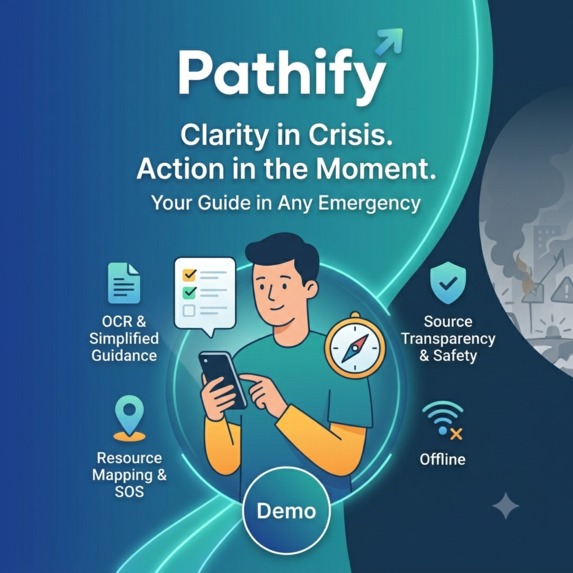
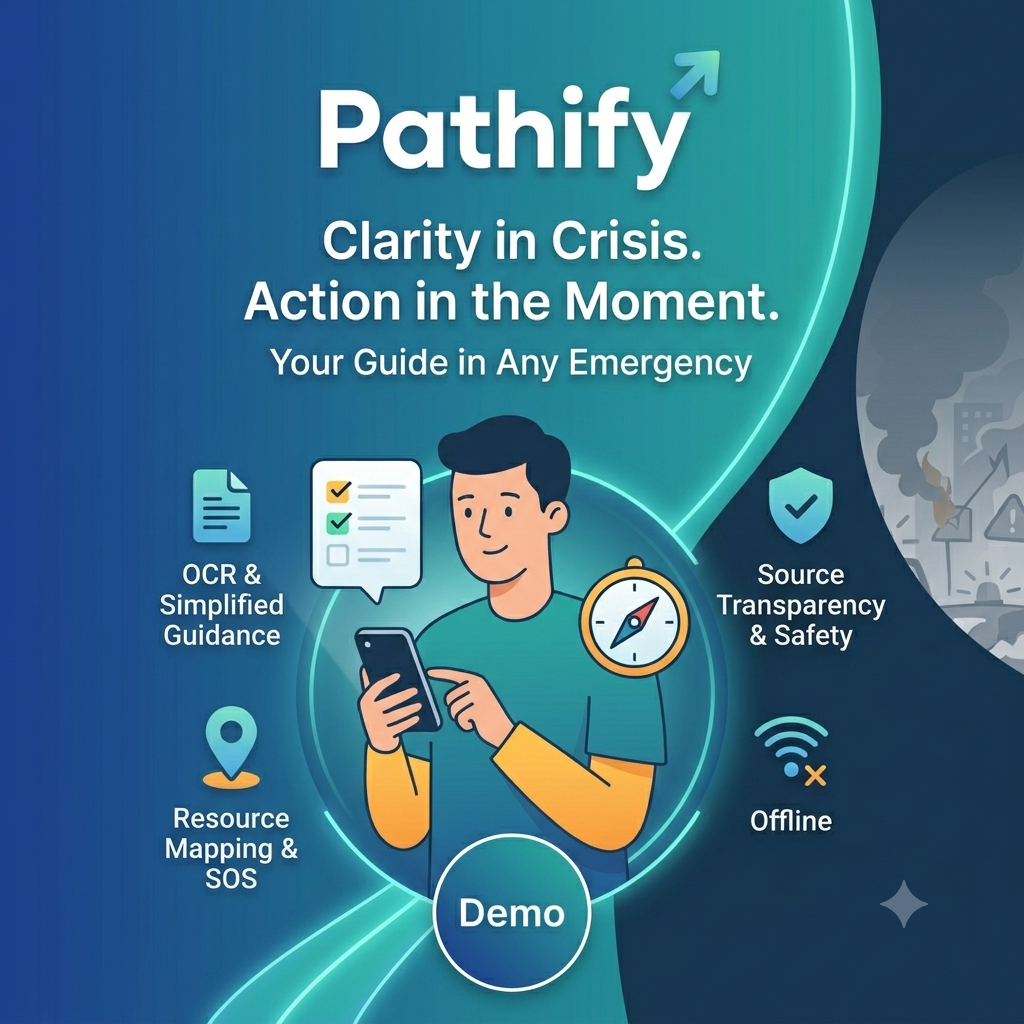
Pathify poster
Inspiration
Imagine you wake up one day and you hear people running, buildings on fire, you hear sirens, there are firefighters shouting down, and your phone is beeping with alerts. It took you so long to realise that there was a forest fire at midnight when you are half asleep. You don't know what to do next in the chaos, there is only one thing with you right now, and that's your device. You are stuck without any guidance; you don't know what to do and when and what is going to happen next. This is how over 2000 people died during the Peshtigo Fire in the US because even though there were resources, they sent emergency messages, etc., the people did not have guidance and time to understand and comprehend the message to figure out what to do next. Help is Hard to Find in a Crisis is a problem that we have been facing for a long time. Even after new AI technology has been developed, it is still a major problem. It is not because we don't have resources; it's because we don't have a system, a system which could guide the people in a natural disaster, a missile attack, a virus outbreak, or any life-threatening situation. We realised that in times of crisis, the people who need help most are the ones facing the highest cognitive load, the common people like the people who were stuck in the Middle East Crisis, the Gaza Crisis, the Waynad Landslide, the cyclones, and the 2014 Tsunami. These crises inspired us to build Pathify because people do not get enough time to understand and comprehend important notices and alerts in emergency life-threatening situations: no wifi, no electricity, just them and their device in their hand. They don't have proper guidance. We want to ensure that no person in this world loses something essential because they couldn't navigate the correct message in the correct time.
What it does Pathify is an AI-powered "Crisis-to-Action" agent that bridges the gap between institutional documentation and immediate user action.
OCR & Extraction: Automatically understands complex PDFs or physical scans.
Plain-Language Translation: Decodes heavy, hard to understand notices and alerts into understandable, simple language.
Smart To-Do Generation: Converts vague requirements into a prioritised, chronological action plan, with a to-do list.
Source Transparency and AI Confidence: Points out every recommendation to the original text via direct links, preventing AI hallucination. Also shows AI's confidence rate over the output.
Human-in-the-Loop Gateway: Enforces a safety boundary where important decisions such as raising an alert are flagged for manual human verification, the users can also flag outputs if they feel it is wrong.
Resource Mapping: Gets geo-location and maps out nearby essential resources and centres and directions to reach there.
SOS: Calls emergency number which can be set to a specific person, or automatically set to nearby emergency number.
Multilingual Support: Supports multiple languages including english, french, spanish, portuguese, mandrian, hindi and arabic.
Inbuilt Chatbot: Has inbuilt chatbot that the user can chat with.
Emergency Login: In emergencies just press the emergency button to login without any delay.
Offline Capabilities: This is a feature that most of the exsisting solutions don't have, in the case of a crisis there are high chances that there is no internet available, therefore we have designed our AI to run in any condition.
**Twin AI System: We have also built a twin AI system where Lovable's cloud AI (online)/Gemma 03 (offline) runs all the detection and Gemini 2.5 Flash (online) verifies the output.
Emergency Log-in info: When you log in using emergency mode, the devices searches for the name and the address of the user and guesses that it is the same person, and uses the same data for trigering the dispatch. If the user has not loged in before it sets the user account to guest.
How we built it We utilized a frontend-centric architecture using React, Tailwind CSS, and Framer Motion to create a distraction-free, accessible interface. We used a Python-based logic core to integrate fine-tuned Gemini, OCR, and other features. This allows our app to maintain strict Source Transparency when a user views an action step, the UI highlights the exact corresponding paragraph from the source document, ensuring the user is always in control and can verify the AI’s logic.
Challenges we ran into The biggest challenge was "information overload." When we first designed the checklist, it was too long and became stressful to read. We solved this by implementing an Urgency Priority Router, an AI layer that prioritizes tasks by deadline and consequence, showing only the most critical actions first. We also faced the black box problem of AI, which we solved by creating the Source Transparency Safeguard, ensuring the AI shows its work rather than just providing an answer. We had to trial with many pre-trained models such as Llama-3, SmoLM2'sm various model until we final decided to use gemma.
Accomplishments that we're proud of We are most proud of our Human-in-the-Loop Gateway. We designed a flow that requires manual oversight for sensitive alerts, we shifted the focus from "Automated AI" to "Assisted Decision-Making". We also successfully transformed a dense, 5-page municipal letter into a simple, 3-step action plan in under 5 seconds proving that Pathify can provide high-touch human impact.
What we learned We learned that eventhough technology has evolved to it's highest extent, there are are still problems which no one notices, that remain completely unsolved, and one such problem was improper guidance during the instant of a crisis, but today it is solved by Pathify.
What's next for PATHIFY Edge Processing: We plan to move our OCR/Translation pipeline to run locally on hardware, Raspberry Pi, ensuring Pathify works even without a device.
Multilingual Expansion: We aim to expand our translation engine to support local languages commonly spoken around the world to ensure true inclusivity.
Integration APIs: We hope to build a standard format that schools, agencies, and governments can use so their notices are "Pathify-ready", turning the documents themselves into accessible, easy-to-understand, step-by-step guides.
Built With
- android-native-stt
- android-studio
- framer-motion
- gdacs-api
- gemini-2.5-flash
- gemini-api
- gemma-03
- groq
- java
- kotlin
- lovable-cloud-database
- national-weather-service-api
- natural-language-processing
- open-weather-api
- openstreetmap
- python
- react.js
- tailwand-css
- usgs-earthquake-api
- web-ocr-api
- web-speach-api


Log in or sign up for Devpost to join the conversation.