-
-

-
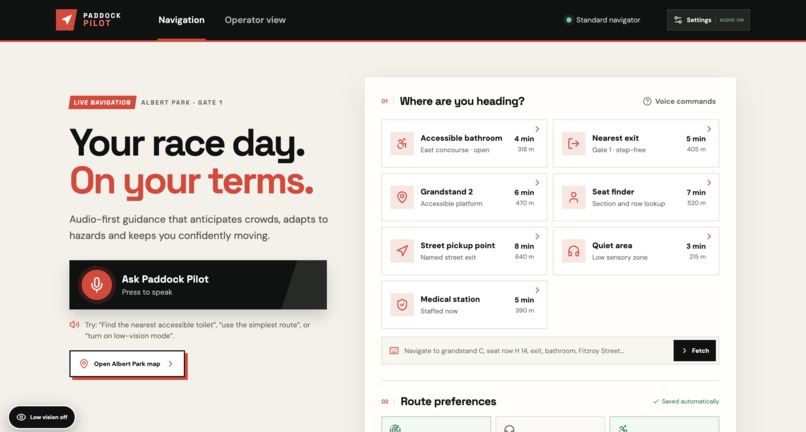
Standard Navigator (not Low-Vision) screen

Inspiration
Live sport is about atmosphere, excitement, and shared experiences. However, for many blind and low-vision spectators, navigating large sporting venues can be one of the biggest barriers to enjoying an event independently. Temporary infrastructure, crowded walkways, changing layouts, and limited accessible wayfinding often mean relying on others to get around.
We wanted to explore how AI could make live sport more inclusive, starting with Formula 1. Our goal was to create an intelligent race-day companion that enables fans to navigate confidently and focus on the action rather than the journey.
What it does
Paddock Pilot is an all-in-one race-day guide featuring an intelligent voice navigation assistant built for blind and low-vision Formula 1 spectators.
The app guides users around the Australian Grand Prix using GPS-powered voice navigation, helping them find grandstands, gates, food vendors, toilets, medical facilities, and other key locations without relying on visual maps.
Users can personalise routes through natural voice commands, choosing options such as the simplest route or avoiding stairs. A dedicated low-vision mode uses AI-powered computer vision to identify obstacles, signs, barriers, entrances, and other important landmarks, providing concise spoken guidance that improves safety while moving around the venue.
How we built it
We developed Paddock Pilot as an Android application centred around accessibility-first navigation.
The prototype combines GPS positioning with a custom map of the Australian Grand Prix venue and an accessibility-aware routing engine that optimises for navigation simplicity and estimated travel time.
Voice interaction is the primary interface, allowing users to search for destinations, adjust navigation preferences, and receive turn-by-turn guidance entirely through speech.
To improve safety, we integrated on-device computer vision that detects obstacles and recognises important venue features in real time, announcing only information relevant to the user's current journey.
Challenges we ran into
Sporting venues are dynamic environments. Crowds shift rapidly, temporary barriers appear throughout the day, and event layouts differ between venues. Designing navigation that remains useful in these constantly changing conditions was one of our biggest challenges.
Another challenge was deciding what information the AI should communicate. Too much environmental detail becomes distracting, while too little may reduce safety. Finding the right balance was essential to creating an effective accessibility experience.
Accomplishments that we're proud of
We built a complete accessibility-focused sporting companion rather than just another navigation app.
Paddock Pilot combines accessible routing, AI-powered computer vision, voice interaction, and personalised navigation into a single experience designed specifically for live sporting events. By allowing spectators to navigate independently, our prototype demonstrates how technology can help make major sporting events more inclusive.
What we learned
Developing Paddock Pilot showed us that accessibility challenges extend well beyond ramps and lifts. Navigation, confidence, and independence all play an important role in creating an inclusive sporting experience.
We also learned how mapping, routing algorithms, computer vision, and voice interfaces can work together to solve real accessibility problems in large, complex venues.
What's next for Paddock Pilot
We are planning to sync actual data of the site with the app's knowledge, as well as adding live GPS tracking tailored to users at the GP (unavailable in our prototype, since we do not have physical access).
Furthermore, Formula 1 is just the beginning. Our vision is to expand Paddock Pilot into a platform for accessible live sport, supporting stadiums, race circuits, arenas, and major sporting events around the world. Future work includes richer venue maps, improved indoor navigation, official venue integrations, real-time accessibility updates, and partnerships with sporting organisations to help make live events more accessible for every fan.
Built With
- css
- cv
- dart
- flutter
- javascript
- openstreetmap
- piper


Log in or sign up for Devpost to join the conversation.