-
-
Poster
Inspiration
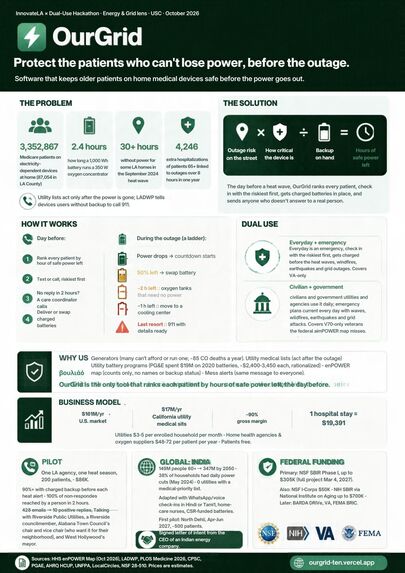
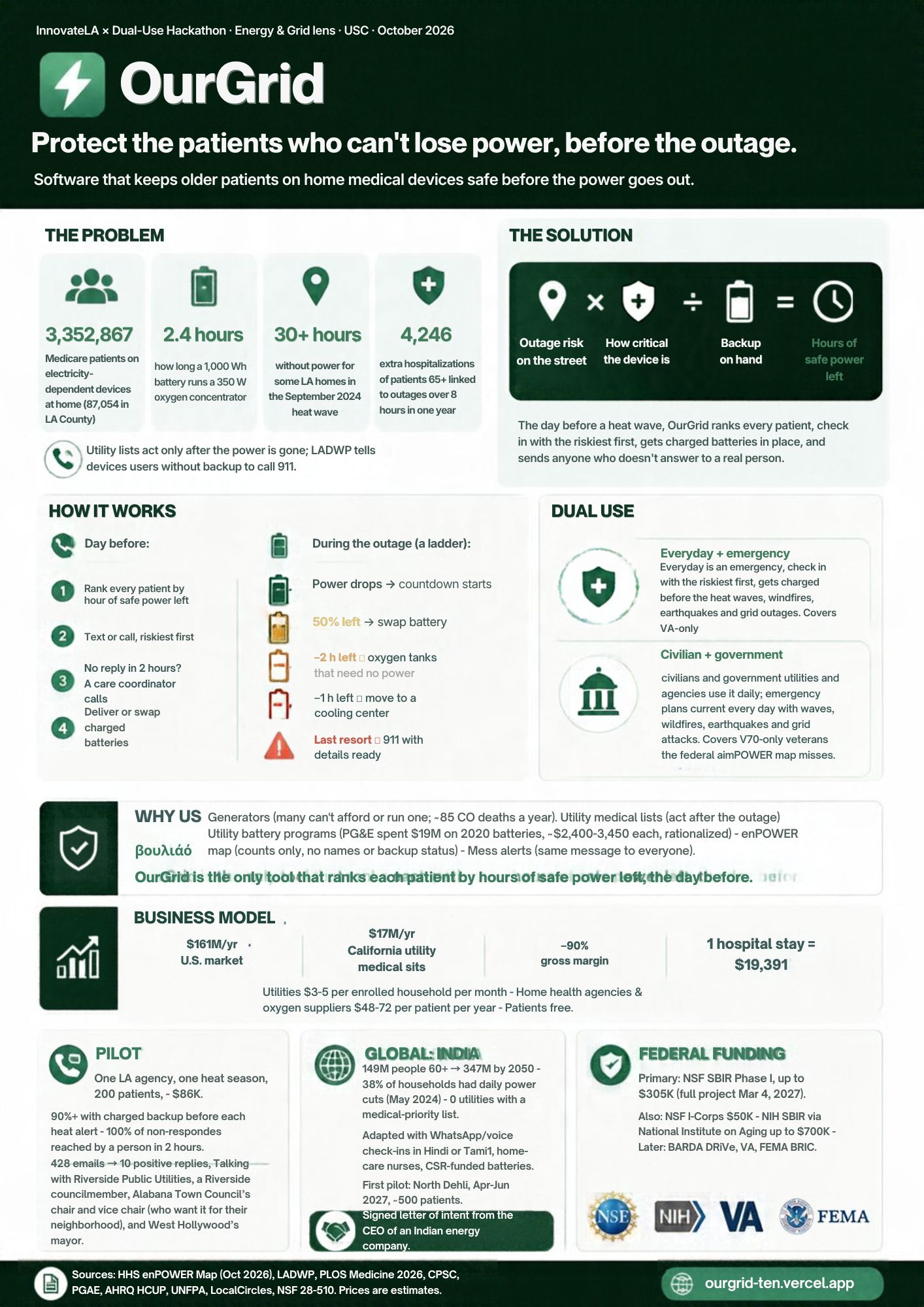
In the September 2024 heat wave, LADWP restored power to 130,648 customers. Some homes went more than 30 hours without power, and device users without backup were told to call 911. That stuck with us: 3,352,867 Medicare patients depend on electricity-powered medical devices at home (67,054 in LA County alone), and a typical oxygen concentrator draws 350 W around the clock. A 1,000 Wh backup battery runs it for about 2.4 hours. Utilities already keep lists of these patients, but those lists only help after the power is gone.
What it does
OurGrid keeps older patients on home medical devices (oxygen concentrators, ventilators, BiPAP, home dialysis, heart pumps) safe before an outage:
- Ranks every patient by hours of safe power left, using outage risk on their street, how critical their device is and the backup they have.
- Checks in by text or call, riskiest first. Anyone who doesn't reply within 2 hours gets a call from a real care coordinator.
- Gets charged batteries in place from a loaner pool owned by the utility or agency.
- During an outage, it runs a countdown per patient and climbs a ladder: at 50% battery, a swap; at about 2 hours left, oxygen cylinders or a dialysis slot; at about 1 hour, relocation. 911 is the last step, not the first.
The core score:
$$\text{hours safe} = \frac{\text{backup Wh} \times 0.85}{\text{device W}} \qquad \text{priority} = \frac{\text{outage risk} \times \text{criticality}}{\max(\text{hours safe},\ 0.5)}$$
It's dual use. On ordinary days it keeps batteries charged and emergency plans current, the records home health agencies must keep under 42 CFR 484.102. In heat waves, wildfires, earthquakes or attacks on the grid, the same engine tells responders who to reach first. Utilities and home health agencies pay; patients use it free.
How we built it
- Research first: we read live counts from the HHS emPOWER Map, LADWP outage reports, device power specs and PLOS Medicine's 2026 study on outage-related hospitalizations.
- Interactive demo (ourgrid-ten.vercel.app): a 3D North Hollywood neighborhood on real OpenStreetMap building footprints, with 20 fictional patients. The scoring model runs in the browser and walks through the day-before plan, the outage ladder and a with/without comparison. We built it quickly with AI coding tools.
- Customer discovery: we sent 428 emails to utilities and city leaders and got 10 positive replies. We're now in conversations with Riverside Public Utilities, a Riverside councilmember, Altadena Town Council's chair and vice chair and West Hollywood's mayor.
- Global: for India, the CEO of an Indian energy company signed a letter of intent to partner on a North Delhi pilot (April–June 2027, about 500 patients).
- Funding path: NSF SBIR Phase I (up to $305K) is the primary route, with NIH's National Institute on Aging as a backup.
Challenges we ran into
- Narrowing the idea. We started with neighborhood load-shifting and battery sharing between homes. We learned that power can't safely flow between homes during a blackout, so we cut it and focused on the people who can't lose power.
- "Isn't 350 W small?" One device isn't much, but it runs 24/7: 8.4 kWh a day, about 28% of an average home's electricity. That's why backup runs out so fast.
- Who pays and who owns the batteries. We designed it so the loaner pool belongs to the utility or agency. OurGrid is software, not a hardware business.
- Data access. Patient-level data is restricted, so the demo uses fictional patients, and real pilots will run through partners under HIPAA (and India's DPDP rules).
What we learned
- Utilities already record each life-support patient's "tolerance time" but can't guarantee power back within it. The gap is coordination, not data.
- Real conversations beat assumptions. City leaders responded to a concrete safety story far more than to an energy-efficiency pitch.
- Being honest about numbers matters. We label estimates, use fictional data in the demo, and don't claim lives saved until a pilot proves it.
What's next
A pilot with one LA home health agency next heat season (200 patients), an NSF SBIR Project Pitch, and the North Delhi pilot with our India partner.
Built With
- claudecode
- codex
- nextjs
- openstreetmap
- python
- react
- webgl

Log in or sign up for Devpost to join the conversation.