-
-
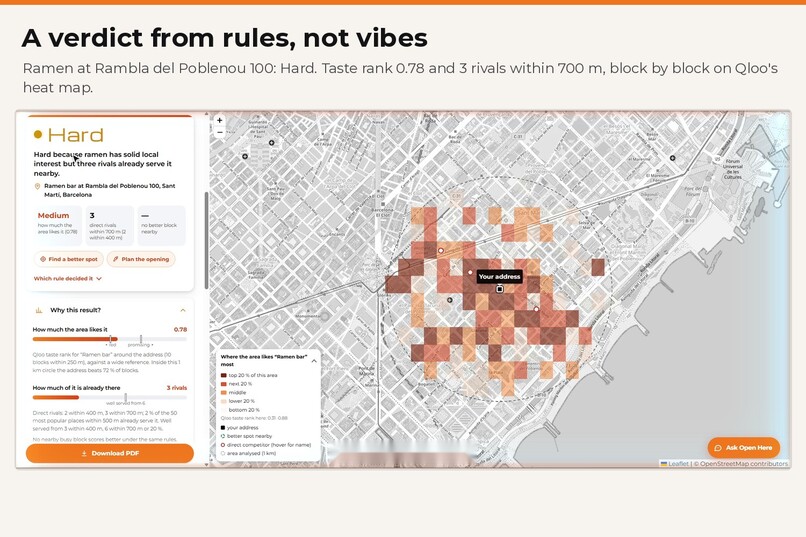
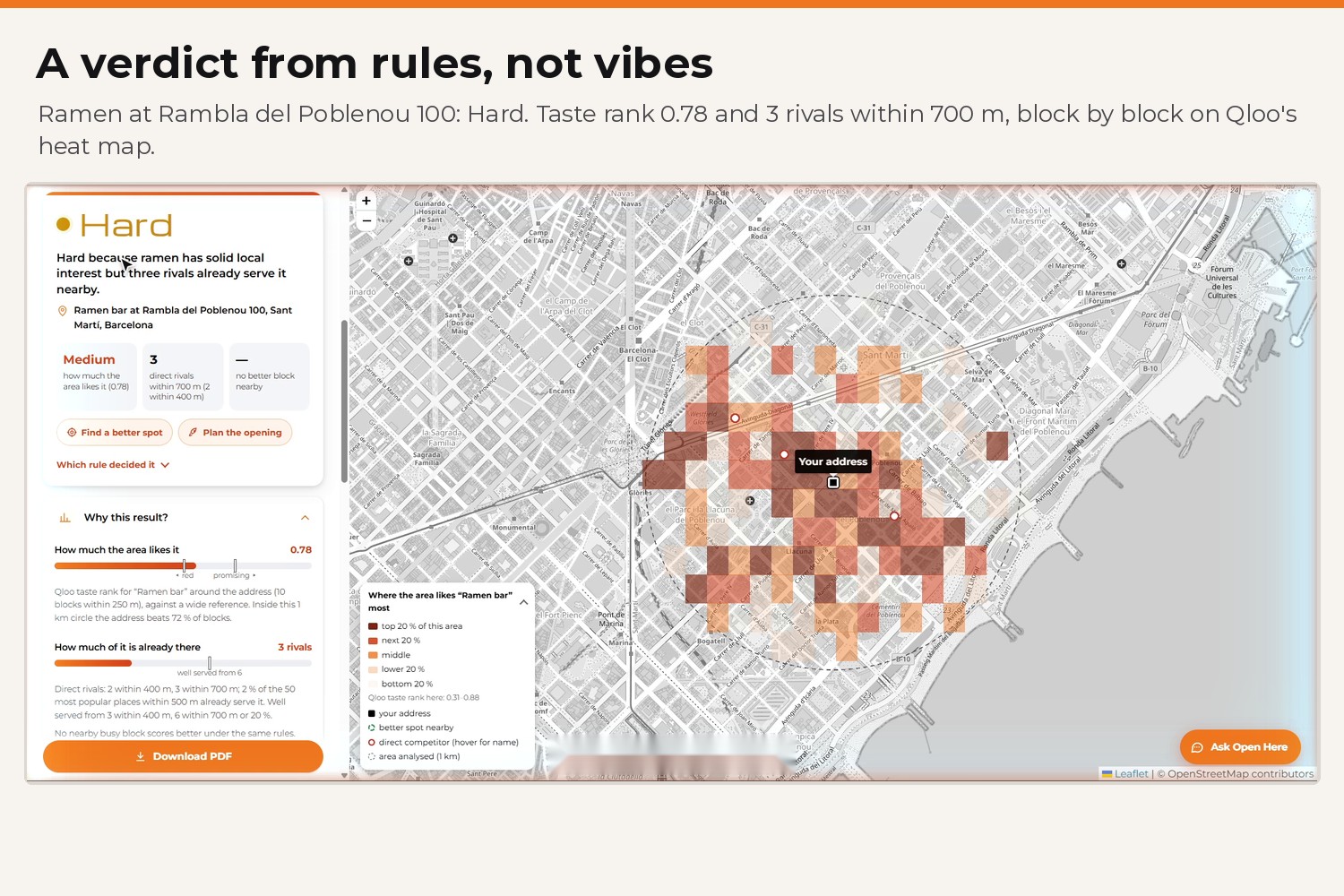
The verdict comes from rules on Qloo signals; the rule that fired is one click away.
-
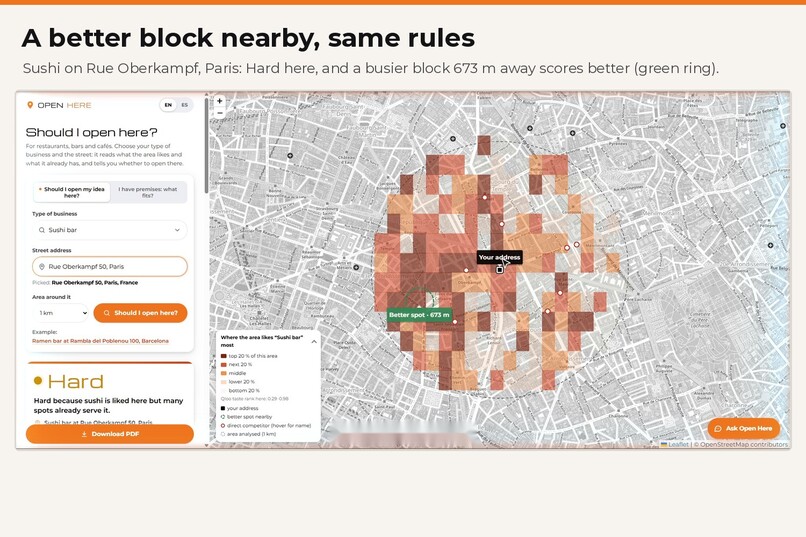
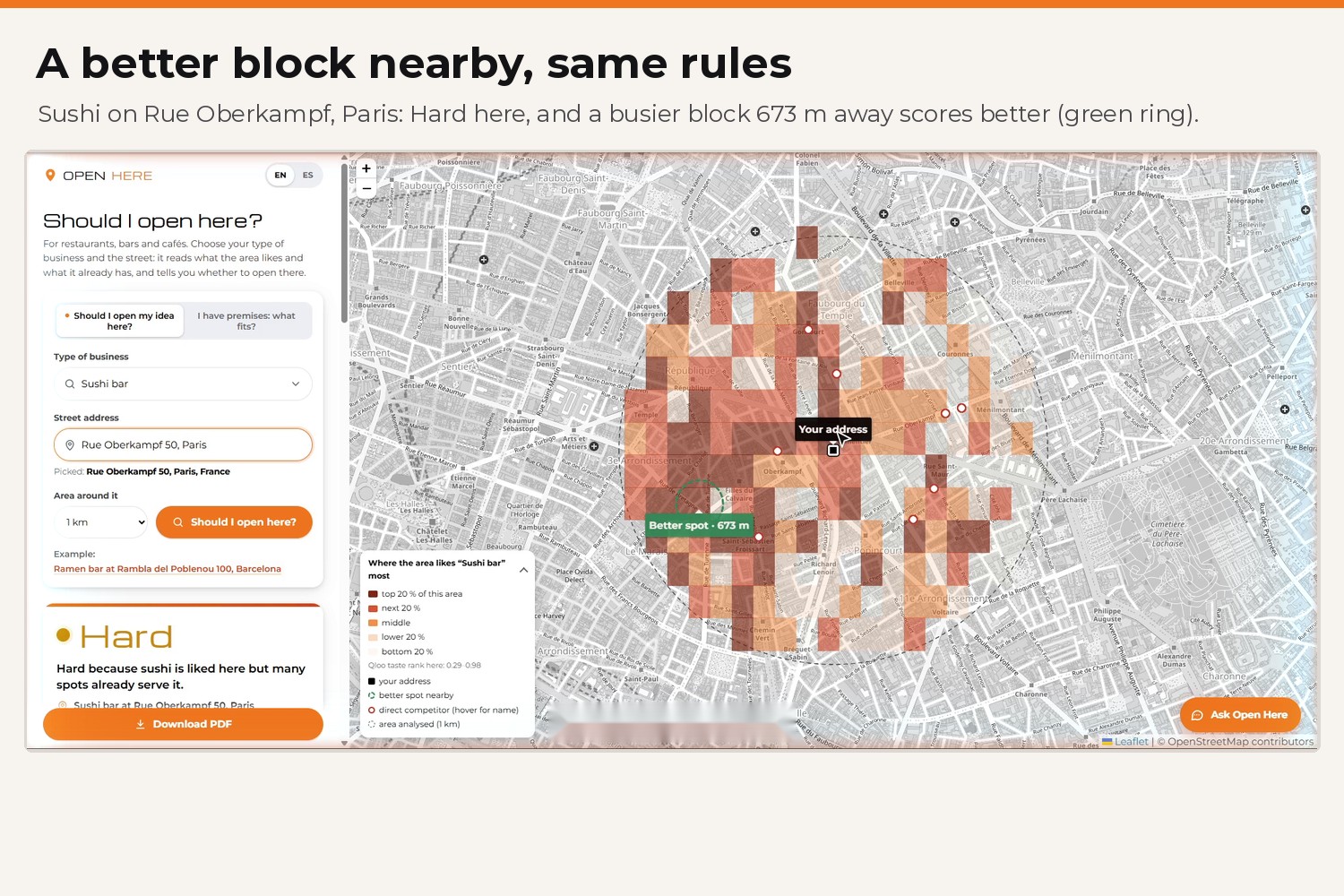
A better block nearby, judged with the same rules (green ring).
-
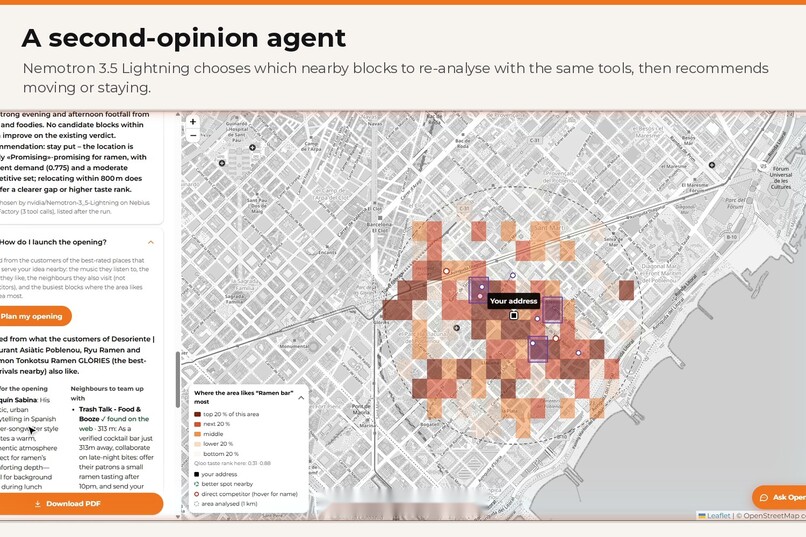
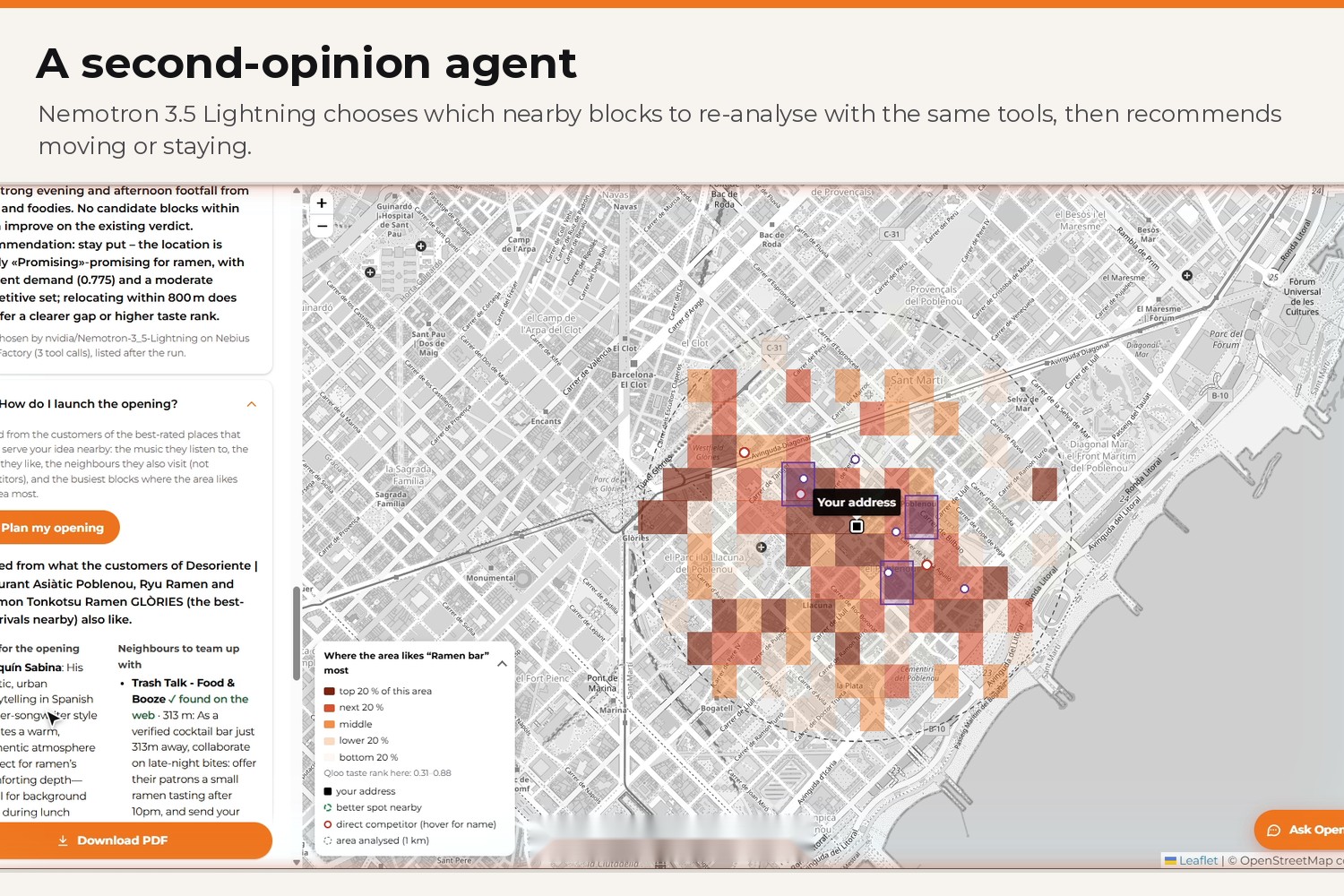
The second-opinion agent: Nemotron chooses which blocks to re-analyse, every step listed with its time.
-
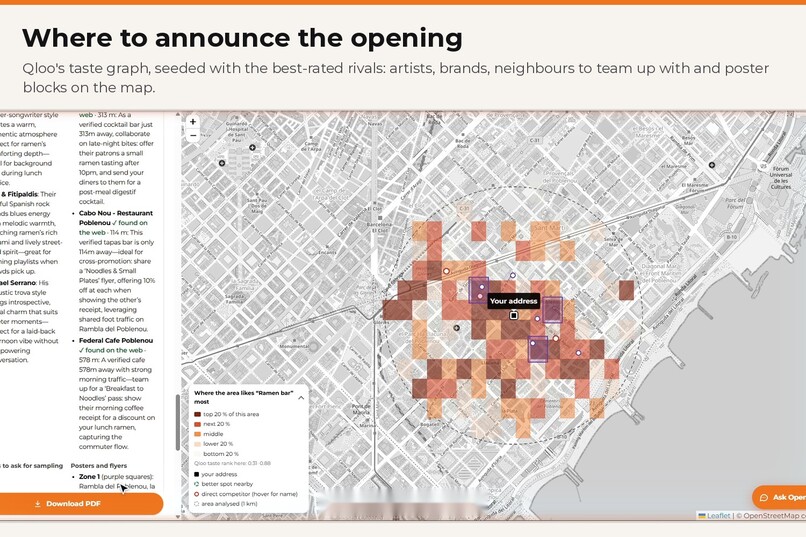
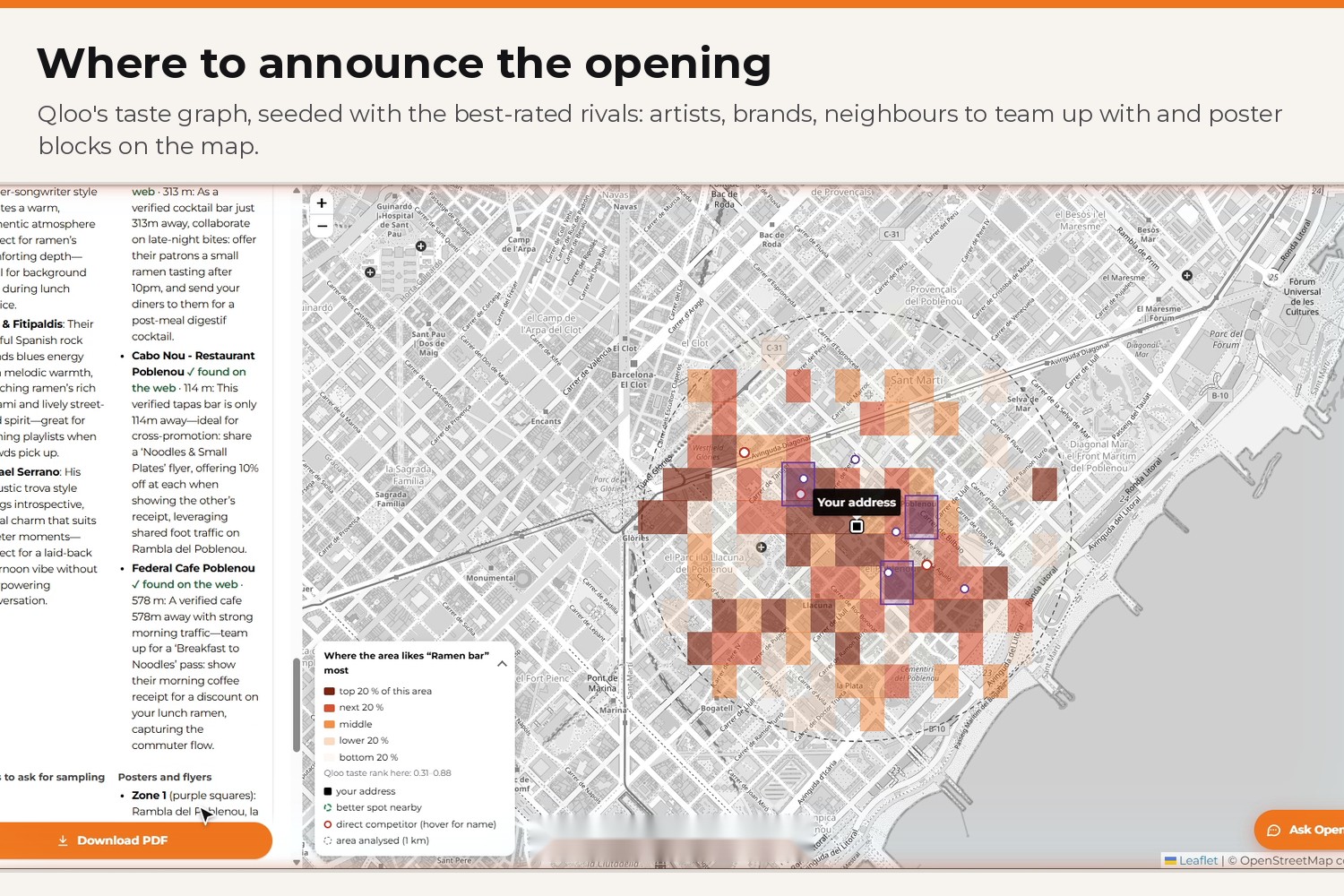
Launch plan from Qloo's taste graph: artists, brands, neighbours and poster blocks, each checked on the web.
-
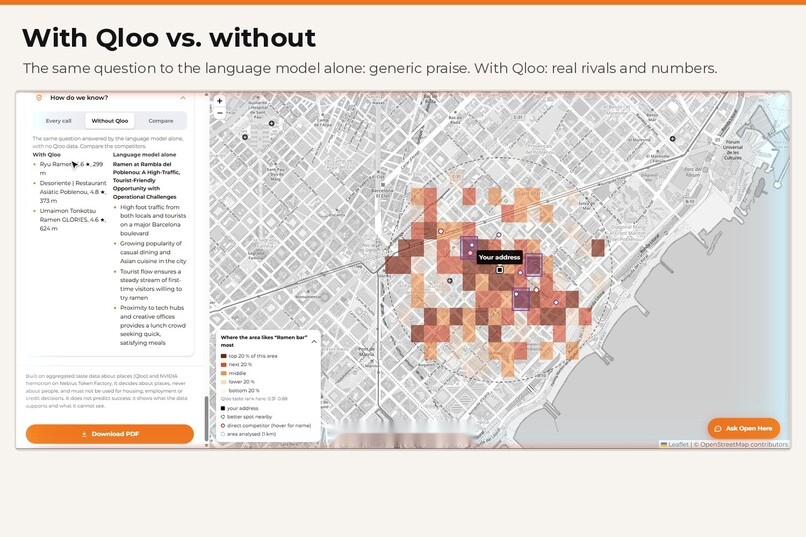
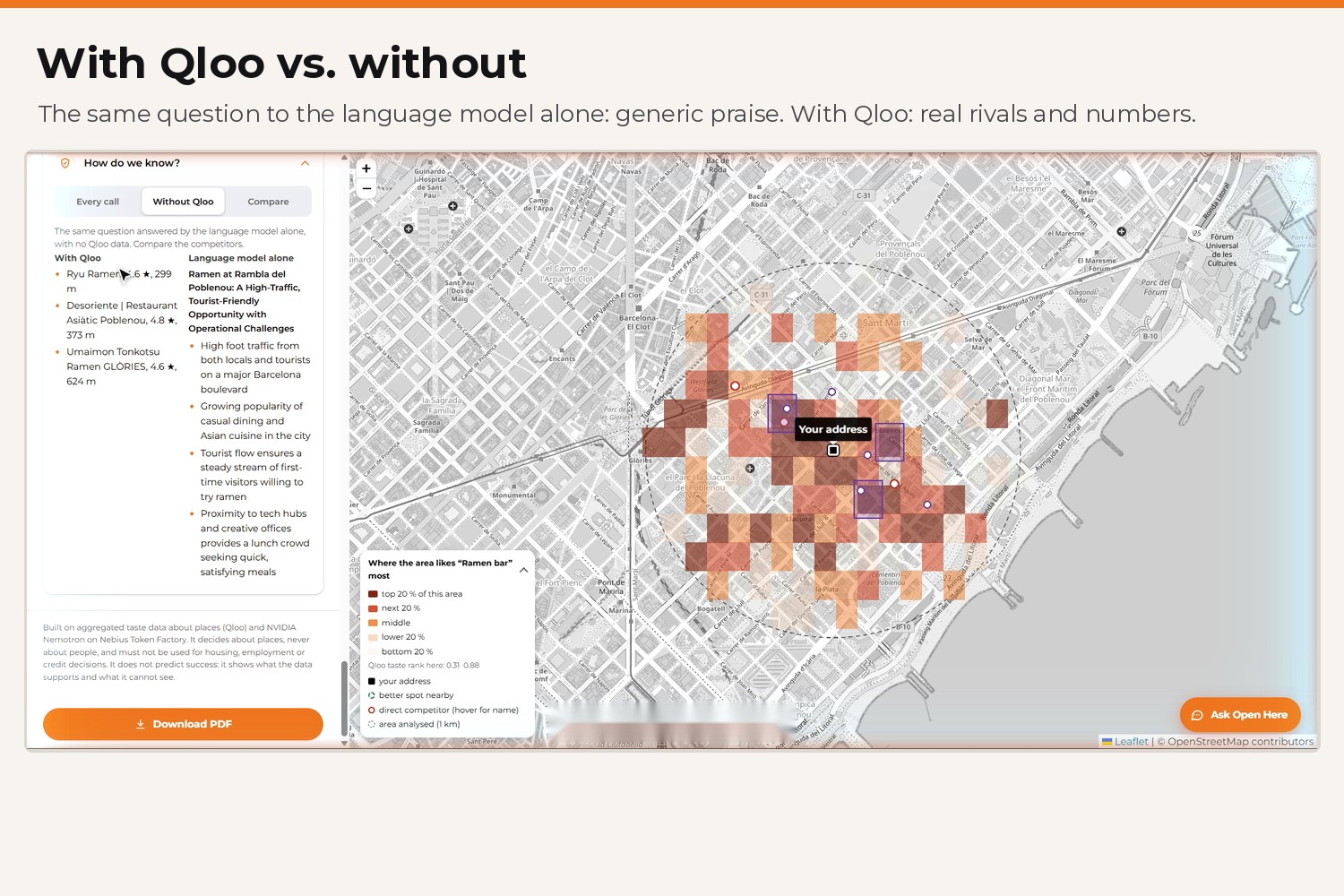
With Qloo vs. without: the same model alone invents; with Qloo it counts real rivals.
-
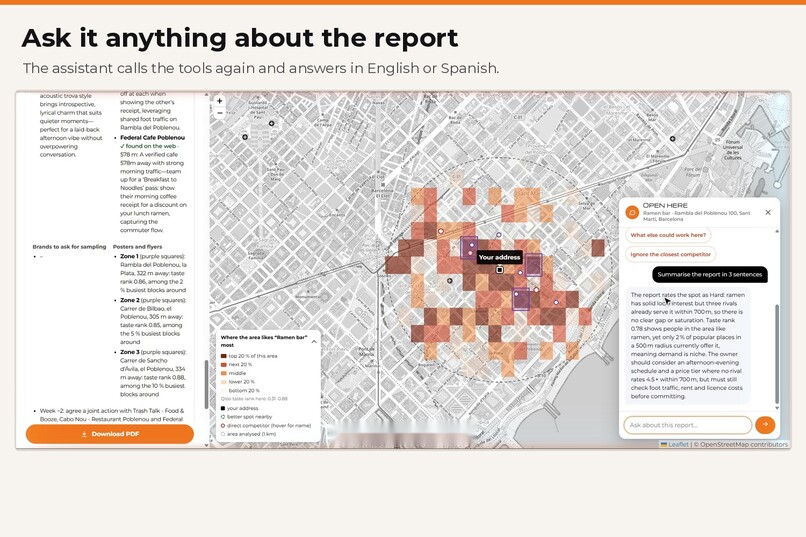
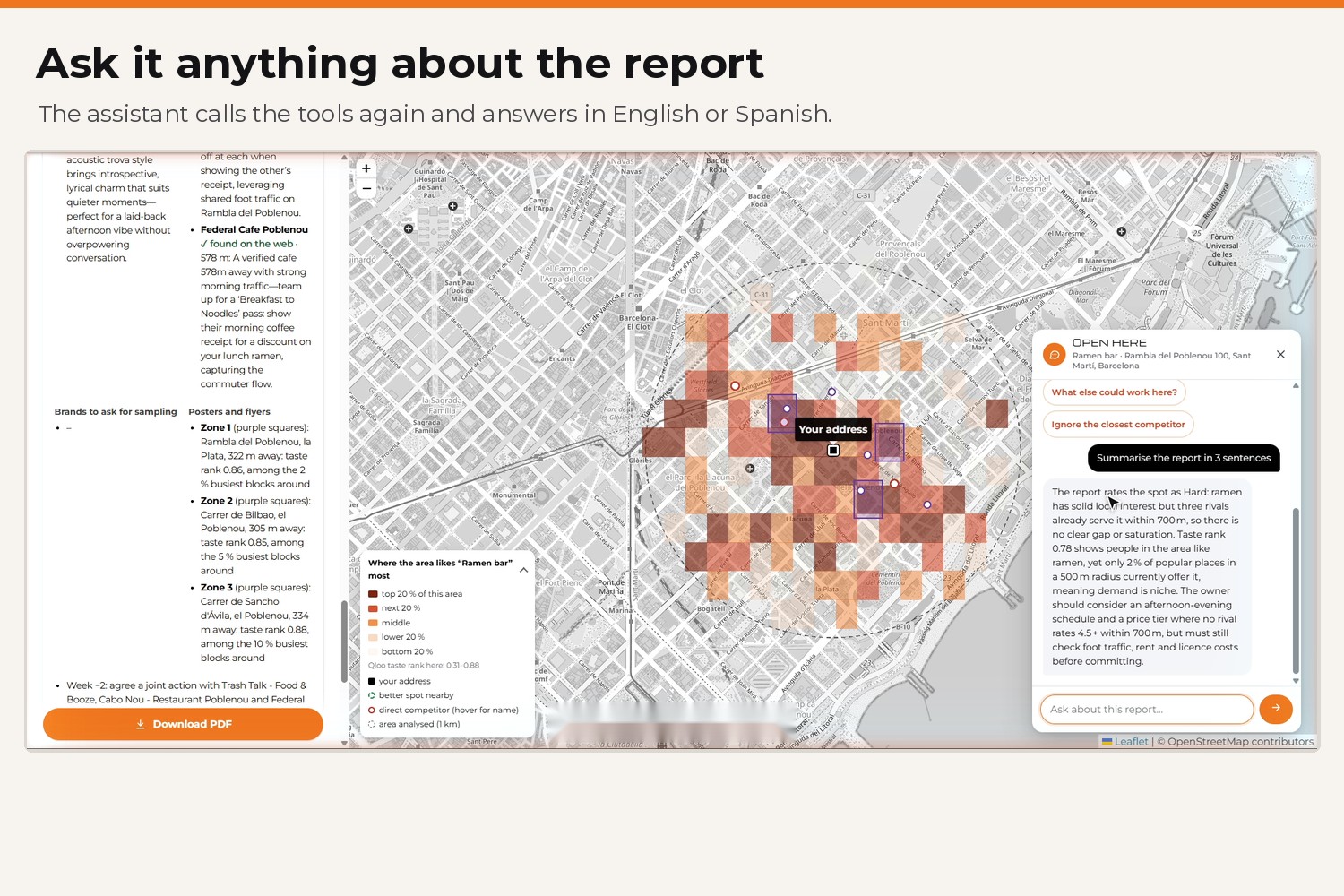
Ask it anything: the assistant calls the tools again, in English or Spanish.
-
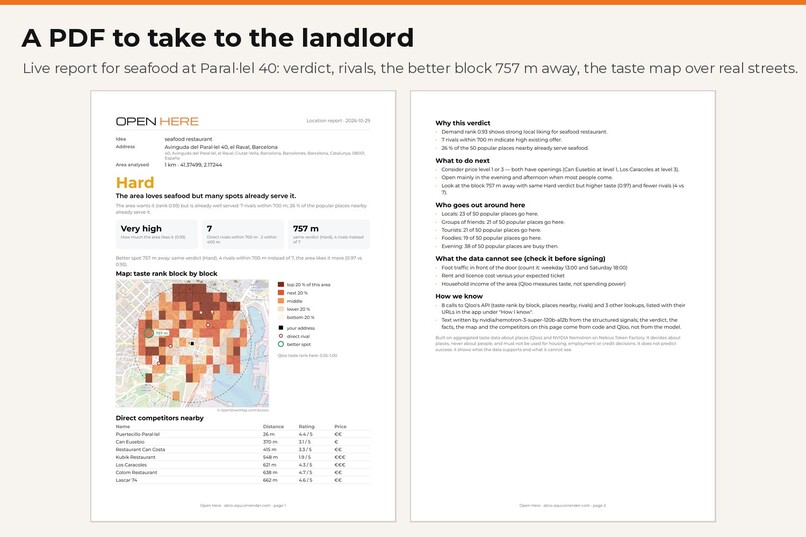
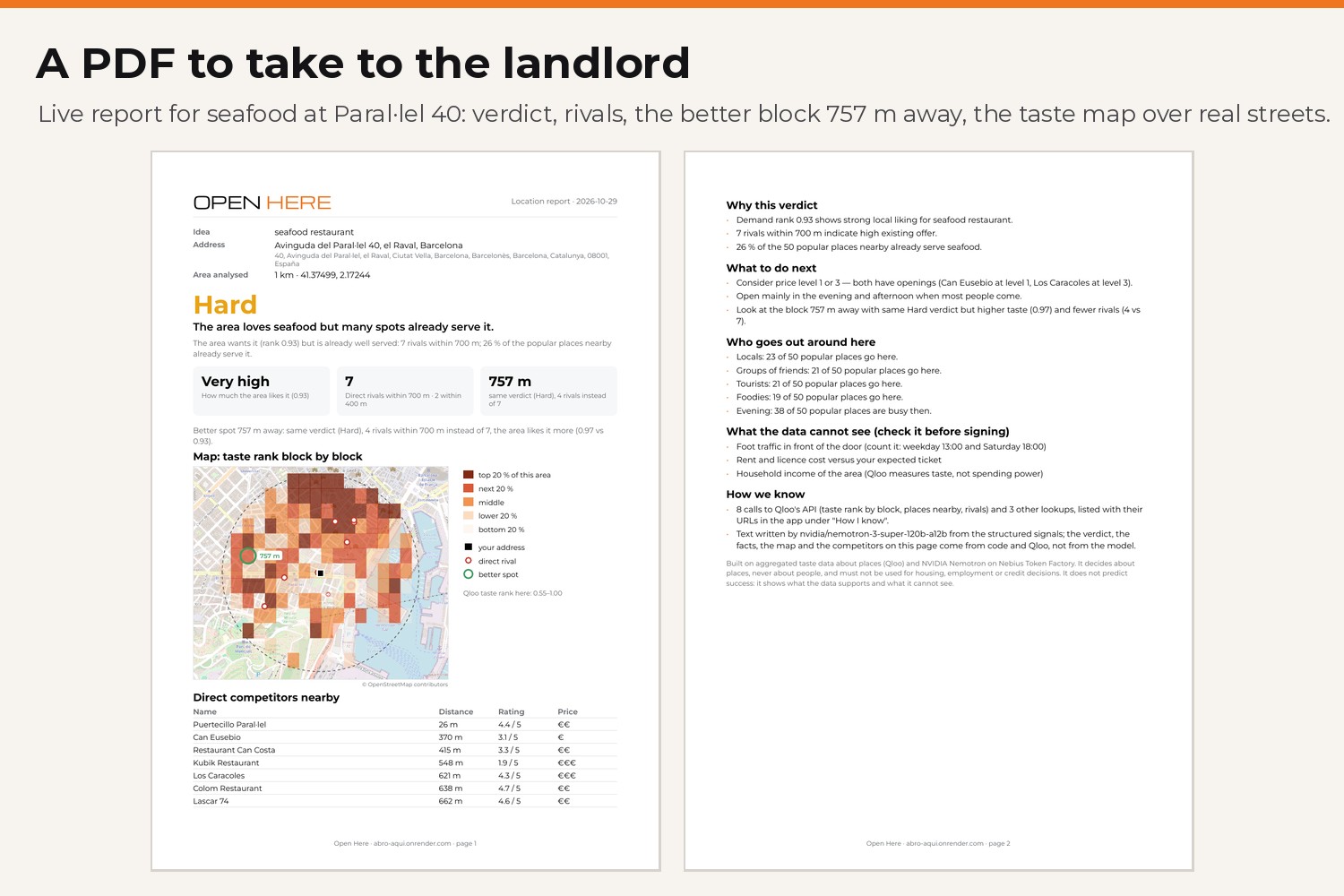
A PDF to take to the landlord: verdict, rivals, the better block and the taste map over real streets.
The problem, in one number
Opening a ~100 m² restaurant in Barcelona's Eixample costs at least 400,000 € before the first customer walks in (Ara, 23 Sep 2025). Most owners pick the street by gut feeling, a friend's opinion and a walk around the block. Big chains pay location-intelligence firms for this decision; the owner of one shop can't. We know two that got it wrong: a seafood restaurant on Avinguda del Paral·lel that closed after ten years, and a waffle-and-ice-cream shop at Gran Via and Entença.
Open Here answers the question before the lease is signed: should I open my restaurant here? Type a concept and a street address. You get a verdict with the rule behind it, a taste heat map block by block, the real rivals, a better block nearby, a launch plan and a PDF. The result card also shows what you are about to commit (your rent × months + fit-out, in your currency), next to what the street says.
- Qloo decides, the model explains. Every verdict comes from deterministic rules on Qloo signals. Nemotron (on Nebius) writes the reasons and runs the agents; it never picks the verdict, and code drops any number or name no Qloo call returned.
- Checked against reality: both Barcelona closures come out Hard with the right reasons; ramen in Brooklyn comes out Promising; ramen in Sants, Not here. All live on the demo.
- Try it: https://abro-aqui.onrender.com · code (MIT): https://github.com/mktaisales-glitch/abro-aqui · video: https://youtu.be/k79EogpIQZ4
The part only Qloo can do: the opening night
The non-obvious use is the launch plan. Open Here takes the best-rated rivals around the address, seeds Qloo's taste graph with their entity ids (signal.interests.entities) and asks what their customers also like: the artists to book for the opening night, the brands to ask for a sampling, the neighbouring places (not competitors) to team up with, and the busiest blocks where the concept is liked most, for posters. Cross-domain taste, from the people who already eat on that street, turned into a 4-week plan. The model only chooses among Qloo's candidates; every partner is checked on the live web before it is shown, and anything the model invents is dropped.
Why it only works with Qloo
Ask the same model (Nemotron 3 Super) about a seafood restaurant at Avinguda del Paral·lel 40 without Qloo and it answers: "Opening a seafood restaurant at Avinguda del Paral·lel 40 is promising due to high foot traffic and tourism density." With Qloo it says Hard: the area loves seafood (taste rank 0.93) but Puertecillo (4.4★) is 26 m away, 7 seafood restaurants sit within 700 m and 13 of the 50 most popular places nearby already serve it. The "Without Qloo" tab on every result shows this gap live, for any address.
Six Qloo calls, each doing a job code cannot do alone: /v2/tags to turn the concept into genre and category tags; the urn:heatmap insight for taste block by block; urn:entity:place within 700 m for rivals, within 1.5 km to judge alternative blocks with the same rules, within 500 m (no tags, top 50) for the area's profile and the share that already serves the concept; and the artist, brand and place insights above for the launch plan. Every signal is aggregated and about places, never people.
The agents
- Second opinion: one goal ("find me a better spot"). Code computes the candidate blocks; Nemotron 3.5 Lightning gets the goal, the current verdict and the tools, chooses which blocks to re-analyse with the same rules and in which order, and recommends moving or staying. The page lists each step with its time.
- "What if…?" chat: "What if I ignore Puertecillo?", "What if I move 300 m?". It calls the tools again and recomputes, in English or Spanish.
- "I have a place: what fits?": the same rules for 15 restaurant, bar and café concepts at one address, ranked.
What you get for one concept
A verdict (Not here / Hard / Promising / No data) with the rule that fired; two gauges (how much the area likes it, how much of it is already there); the taste heat map and a better spot nearby when a busy block scores better under the same rules ("same verdict (Hard), 3 rivals within 700 m instead of 7, the area likes it more (0.97 vs 0.93)"); direct competitors within 700 m with rating, price level and distance; the gap nobody nearby offers, and what Qloo cannot measure there, said plainly; who goes out around here and when; what Qloo cannot see (foot traffic, rent, income), asked back to the owner, so there is no automatic green; "How I know", every Qloo, geocoding, Tavily and model call behind the report; and a PDF report with the map over OpenStreetMap streets, built from the analysis in memory.
Live on the public demo: ramen at 200 Schermerhorn Street, Brooklyn comes out Promising (taste rank 0.92, one rival within 700 m: "People here really want ramen but almost no one serves it"); ramen at Carrer de Sants 100, Barcelona comes out Not here (0.57). Paral·lel 40: Hard, and a busy block about 390 m away has the same verdict with more taste (0.97 vs 0.93) and 3 rivals instead of 7; the page says exactly that. Gran Via 400: Hard, 7 ice-cream shops within 700 m, and the report says plainly that Qloo has no waffle data there instead of inventing a gap.
Who pays, and when
The verdict is free: it is how an owner finds us the week they start looking, and it costs us cents. Money changes hands at two later moments, where the decision is big and the buyer is identified:
- The owner, before signing: a full due-diligence report on a shortlist of addresses (verdict, rivals, better block, launch plan, PDF), priced against the size of the decision, not against a SaaS seat. A few hundred euros is nothing next to a 400,000 € opening, and the report is the natural first step into the services that follow it: fit-out, licences, financing and insurance, where we can refer or partner.
- The commercial real-estate agency and the franchise chain: dozens of spaces or candidate sites a month; a verdict, a better block nearby and a launch plan attached to every listing, as a monthly subscription. This is the recurring use. Nothing is validated with customers yet. The next step is five owners and two agencies in Barcelona with a real report in hand, and the prices will come from those conversations.
How it is built
/v2/tagsresolves each part of the concept into a genre tag (the heat map only answers togenre:place:restaurant:*) and a category or specialty-dish tag (competitors); candidates are scored by word overlap, so "seafood restaurant" does not resolve to "seafood donburi"; if a tag returns no data and is not used within 5 km, we fall back to the next candidate.- The
urn:heatmapinsight gives, per block,affinity_rank(demand against a wide reference, averaged within 250 m) andaffinity/popularity(ranks inside the 1.5 km circle), used as context and to keep the better spot on busy blocks, never to decide. - The verdict is deterministic and specified in
specs/01-verdict.md, which documents how we corrected our first reading of the heat map. The LLM explains; it never decides. - Spec-driven: eight spec files, 57 tests (51 run on a public clone), offline replay of recorded Qloo responses. Keys stay on the server; e-mails, phones and ID numbers are removed before any model or search call.
Responsible use
The agent decides about places, never people. Customer-identity labels that touch protected attributes are filtered out of the audience panel. In the launch plan no place is excluded for who its customers are. Thin-data areas get "No data" rather than a guess, and we document that this favours data-rich areas. It is not for housing, employment or credit decisions. It says what it cannot see.
What's next
Interviews with five owners and two agencies in Barcelona, with a real report in hand, before setting prices; a backtest on openings and closures with known outcomes, counted as it comes out.
Try it
- Live demo: https://abro-aqui.onrender.com (free plan: the first visit after a quiet spell can take up to a minute)
- Code (MIT): https://github.com/mktaisales-glitch/abro-aqui
- Video: https://youtu.be/k79EogpIQZ4
Built With
- express.js
- javascript
- leaflet.js
- nebius-token-factory
- node.js
- nvidia-nemotron
- openstreetmap
- pdfkit
- qloo
- render
- sqlite
- tavily
- zod

Log in or sign up for Devpost to join the conversation.