
Inspiration
Across Europe, urban aquatic ecosystems are increasingly monitored by high-tech sensors, citizen science mobile apps, and predictive ecological models. Yet, when an environmental health hazard emerges in a local river or lake, hospital emergency rooms are completely unaware of it.
Consider a motivating scenario from our pilot city of Coimbra, Portugal: a teenager goes kayaking in the Mondego River during an active cyanobacterial bloom. Hours later, she arrives at the emergency room with severe, burning rashes on her arms and torso. The attending clinician evaluates ordinary atopic dermatitis or contact allergies—completely blind to the fact that municipal sondes detected toxic microcystin scum upstream just hours earlier.
Environmental scientists and hospital emergency departments operate in separate data silos. We were inspired to build OAH-Bridge to bridge this semantic chasm: transforming raw environmental surveillance into standardized, machine-actionable clinical context before outbreaks spread.
What it does
OAH-Bridge is an operational Semantic Decision Layer (SLS) that connects heterogeneous environmental surveillance to clinical encounter workflows using open international healthcare standards:
- Heterogeneous Evidence Ingestion: Ingests multi-parameter probe telemetry (Chlorophyll-a, Microcystin-LR, water temperature, dissolved oxygen), geotagged citizen science reports, ecological models (such as DipteraCAST), and simulated laboratory assays.
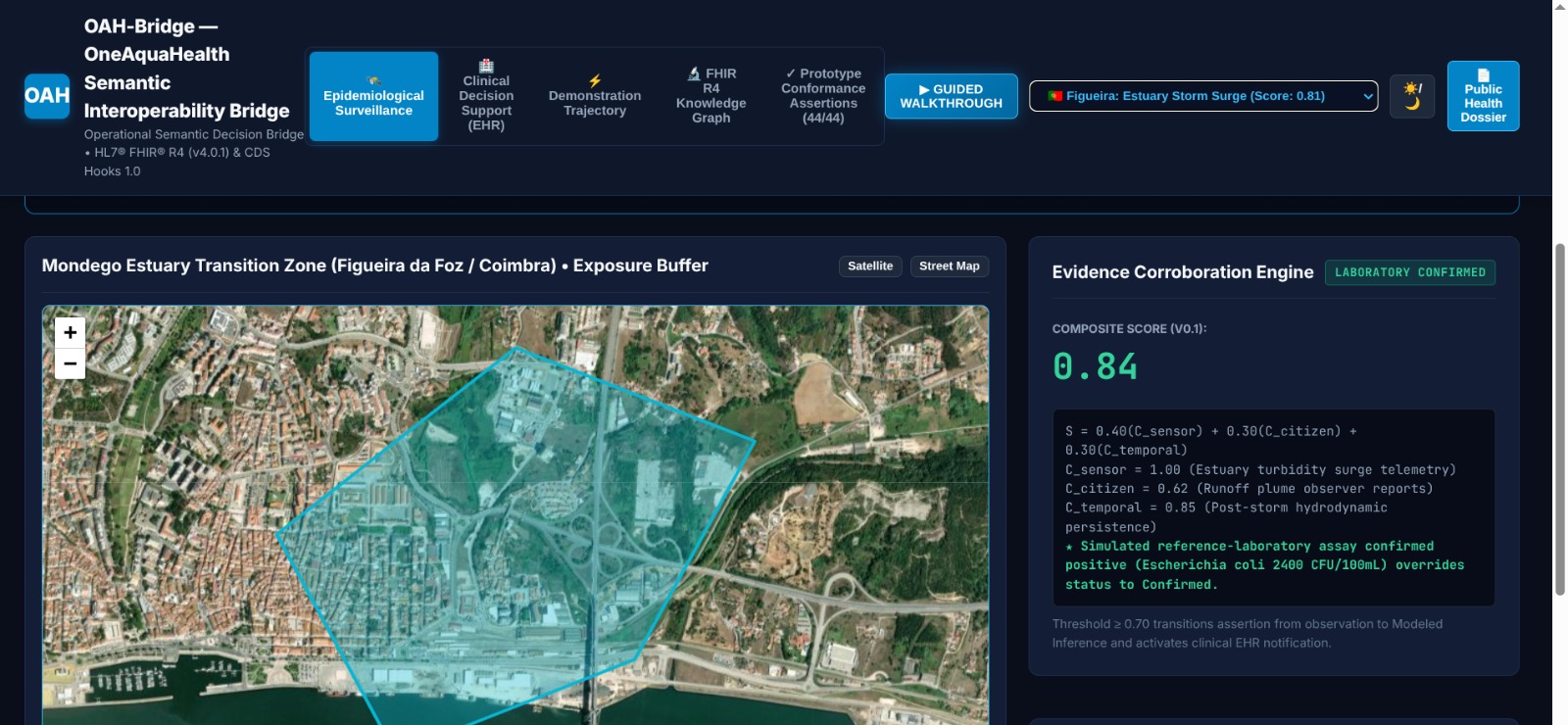
- Deterministic Corroboration Engine: Computes a transparent composite evidence-support score using calibrated prototype weights:
$$S = 0.40 \cdot C_{\text{sensor}} + 0.30 \cdot C_{\text{citizen}} + 0.30 \cdot C_{\text{temporal}}$$
and assigns an explicit epistemic status (
observed$\rightarrow$inferred$\rightarrow$confirmed). - Definitional Exposure Cohorts: Evaluates spatial exposure buffers (e.g., 600m river reach polygons) using point-in-polygon raycasting, modeling the exposed population via FHIR
Group (actual = false). This establishes a definitional cohort without tracking or storing individual patient identities. - Standardized Clinical Mapping: Formally maps environmental health risks to pinned SNOMED CT® International Edition (Release 20260301) concepts (e.g.,
40275004 | Contact dermatitis |,416113008 | Disorder characterized by fever |, and69776003 | Acute gastroenteritis |). - Actionable Clinical & Public Health Workflows:
- Dispatches municipal public health warnings (
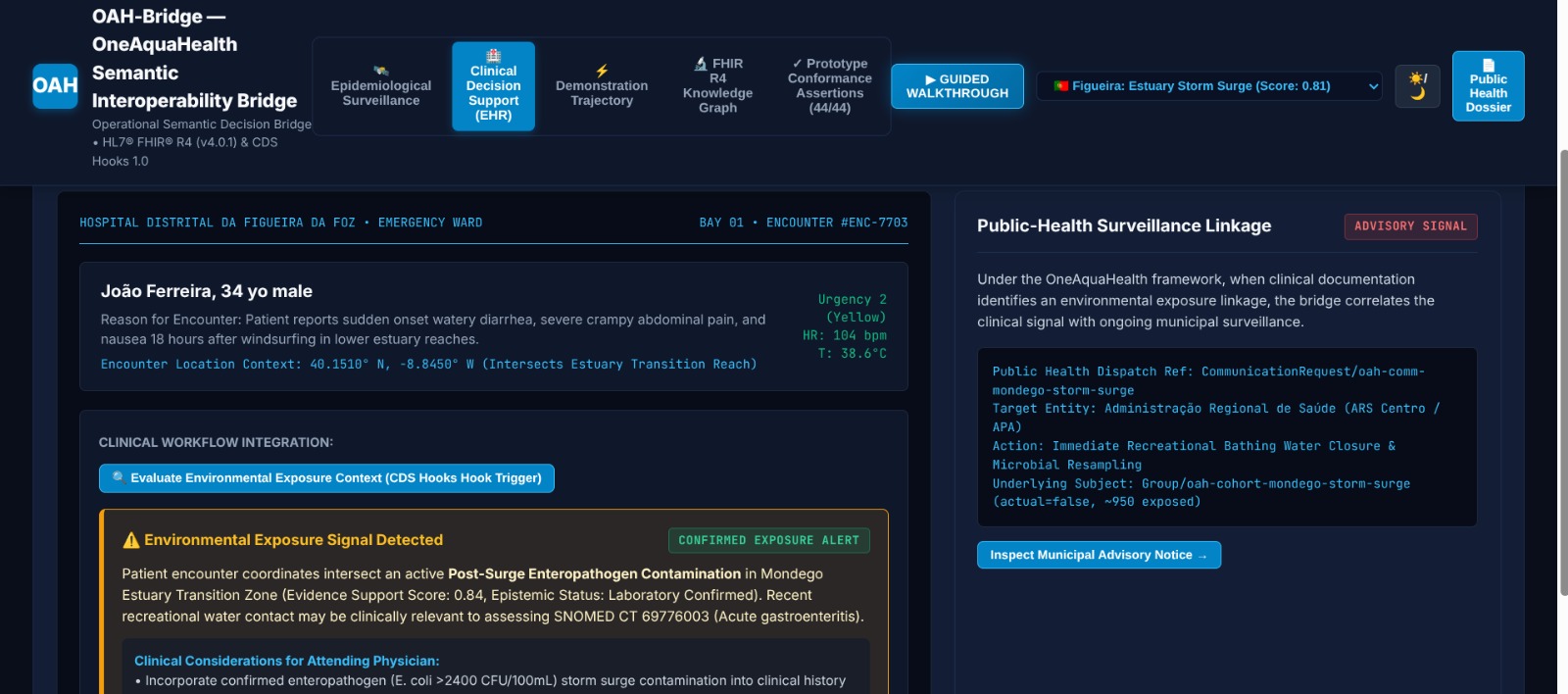
CommunicationRequest) for dock signage and field inspections. - Surfaces non-diagnostic exposure awareness cards directly into hospital EHR triage via CDS Hooks 1.0 (
patient-view) without diagnosing or prescribing medical treatments.
- Dispatches municipal public health warnings (
The platform is calibrated across three real OneAquaHealth European research pilot cities: Coimbra, Portugal (toxic cyanobacteria), Toulouse, France (diptera vector proliferation), and Figueira da Foz, Portugal (estuarine enteropathogen contamination).
How we built it
We engineered OAH-Bridge as a modular, standards-first Python and web platform:
- Semantic Decision Engine (
engine/): Developed Python modules for deterministic evidence scoring (scoring.py), GIS point-in-polygon spatial analysis (spatial.py), and dynamic multi-city scenarios (scenarios.py). - Pure FHIR R4 Composer (
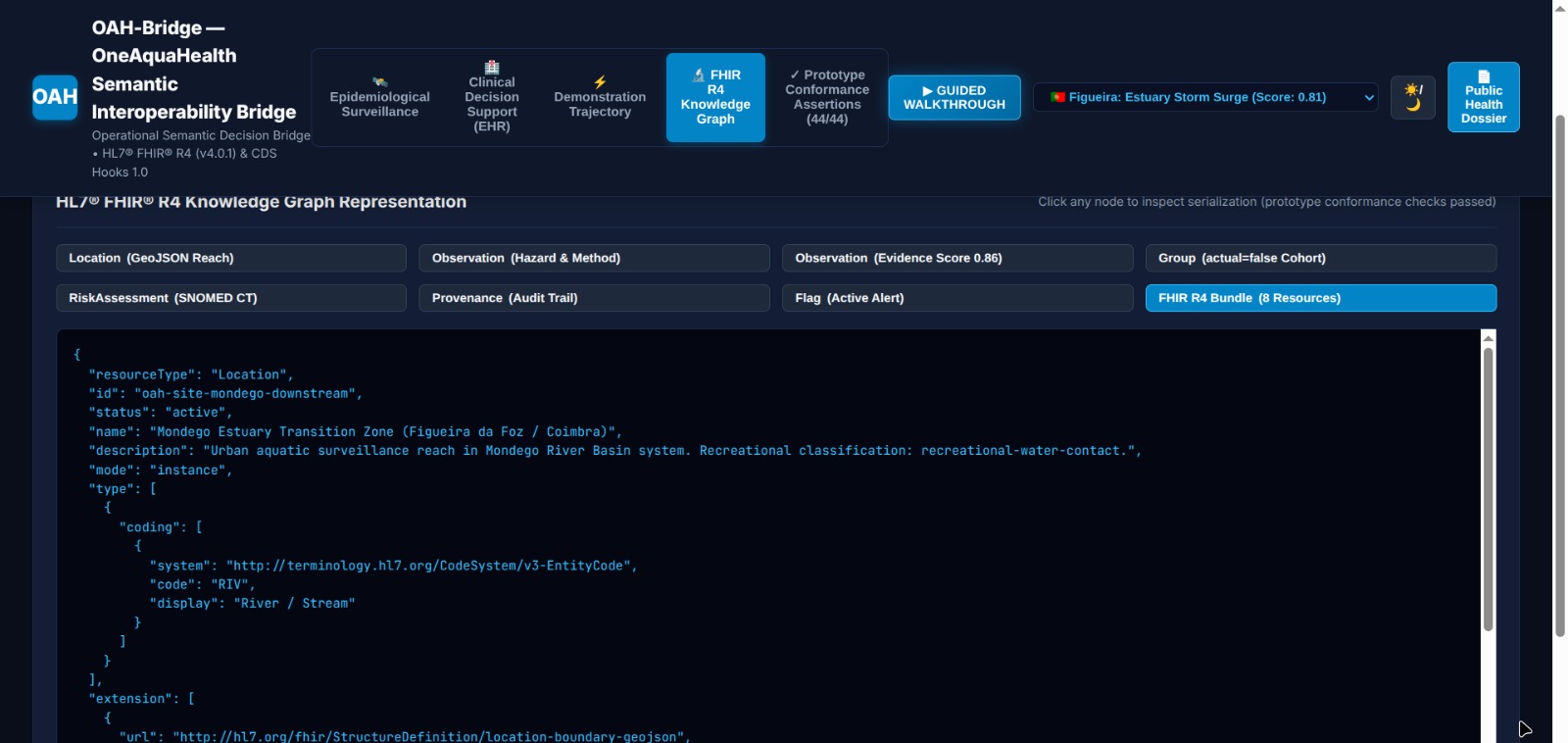
engine/composer.py): Constructs pure 8-resource HL7® FHIR® R4 Bundles (Location,Observation,Group,RiskAssessment,Provenance,Flag,CommunicationRequest). - REST & CDS Hooks Reference Server (
api/server.py): Implements standard FHIR R4 resource endpoints, custom OAH search parameters (?oah-hazard=...,?oah-location=...), and the official CDS Hooks 1.0 discovery and execution services. - Standards & Terminology Suite (
conformance/): Authored 7 canonical CodeSystems, 6 ValueSets, 5 StructureDefinitions, a FHIR CapabilityStatement, and a validated SNOMED CT terminology manifest. - Automated Validation Harness (
validator/): Built a self-hosted 6-tier validation pipeline executing 44 programmatic assertions across structural schema, profile constraints, code membership, terminology resolution, and reference graph integrity. - Interactive Decision Console (
web/): Designed an intuitive UI featuring high-resolution satellite GIS maps, live telemetry HUDs, multi-scenario switching, and a step-by-step▶ GUIDED WALKTHROUGHpresenter bar.
Challenges we ran into
- Avoiding Semantic Slot Misuse in FHIR R4:
Early on, it was tempting to place epistemic certainty (observed vs. inferred vs. confirmed) into
Observation.method. However, the official HL7 FHIR R4 specification strictly definesObservation.methodas the physical or algorithmic ascertainment mechanism (e.g., in-situ probe vs. grab sample). Conflating measurement technique with truth certainty breaks semantic queries. We resolved this by creating the canonical extensionoah-evidence-statuswith a bound CodeSystem, keeping FHIR semantics pure. - Preserving Patient Privacy by Design:
Transmitting patient GPS coordinates to external environmental surveillance systems would violate GDPR and medical confidentiality. We inverted the architecture: environmental hazard polygons are published as definitional cohorts (
Group actual=false), and spatial intersection evaluation occurs strictly within the hospital's private EHR firewall via CDS Hooks. Zero patient data ever leaves the hospital. - Respecting Clinical Boundaries: Environmental systems must never attempt to diagnose disease or prescribe medications. We strictly constrained our CDS Hook to provide non-diagnostic environmental exposure context—prompting clinicians to inquire about recreational water contact without prescribing treatments.
Accomplishments that we're proud of
- 100% Automated Test Pass Rate: Built a comprehensive test suite of 25 unit and integration tests passing with a 100% success rate in ~1.03s.
- 44/44 Prototype Conformance Assertions: Successfully verified structural elements, CodeSystem membership, SNOMED concept resolution, and reference integrity across all scenarios.
- Deep Alignment with Upstream OneAquaHealth: Positioned OAH-Bridge as an operational Semantic Decision Layer complementing the official HL7 Europe OneAquaHealth Implementation Guide (
hl7-eu/oah). - Interactive Guided Walkthrough: Created an interactive 7-step presentation chain that allows judges to inspect the translation from raw sensor telemetry to hospital EHR alerts with a single click.
What we learned
- HL7® FHIR® R4 and CDS Hooks 1.0 Specifications: Deepened our mastery of FHIR resource relationships,
Observation.componentstructures, and asynchronous CDS Hook lifecycle states. - Terminology Precision with SNOMED CT®: Learned the critical informatics distinction between terminology server preferred terms (e.g., Disorder characterized by fever) and scenario-specific display labels (Acute febrile illness), ensuring exact terminology manifest resolution.
- One Health Interoperability: Gained a profound appreciation for how standard semantic models can unite ecologists, municipal authorities, and healthcare providers to protect community health.
What's next for OneAquaHealth-Bridge (OAH-Bridge)
- Real-Time Ingestion Adapters: Connect the ingestion engine to live OGC SensorThings APIs and municipal IoT telemetry streams (such as Portugal's SNIRH/APA and France's Eaufrance).
- Direct Integration with OneAquaHealth Citizen App: Implement live REST webhooks to ingest real-time geotagged photo reports directly from citizen scientists.
- Clinical EHR Pilot Sandbox: Deploy the CDS Hooks service into sandbox environments of European EHR systems (such as openEHR and HL7 Europe pilot testbeds) to measure clinical workflow impact in emergency departments.
- Upstream Ballot Alignment: Continuously synchronize profiles with the evolving ballot specifications of the official HL7 Europe OneAquaHealth Implementation Guide.

Log in or sign up for Devpost to join the conversation.