Inspiration
Finding the right job can be difficult, especially for undergraduate students, graduates, freshers, interns, and candidates who are just starting their careers. Job seekers often need to search across multiple websites, repeatedly enter the same information, upload their resume again and again, and sometimes struggle to find opportunities near their location.
This inspired me to build Job in One Click — a modern job-search platform designed to make job discovery and applications faster, simpler, and more accessible.
The main idea is simple:
Create your profile and resume once, discover suitable jobs, and apply in one click.
Eligible candidates can search and apply for opportunities from anywhere, while location-based search helps them discover relevant jobs near their current location or preferred city.
What the Project Does
Job in One Click allows users to:
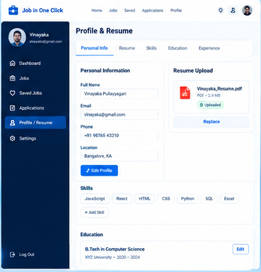
- Create and manage a job profile.
- Upload and save a resume.
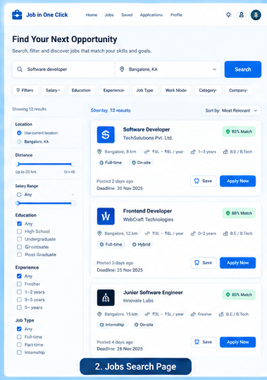
- Search jobs using keywords.
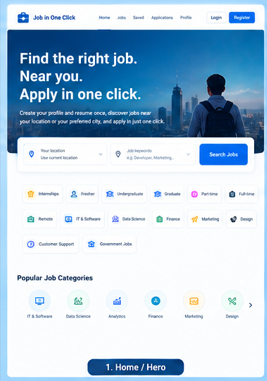
- Discover jobs using GPS or a manually selected city.
- Filter jobs by salary, education, experience, job type, category, company, work mode, and distance.
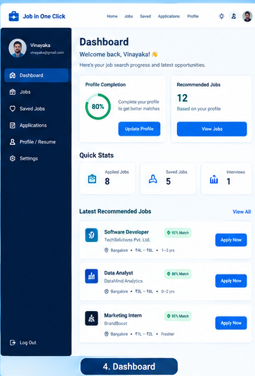
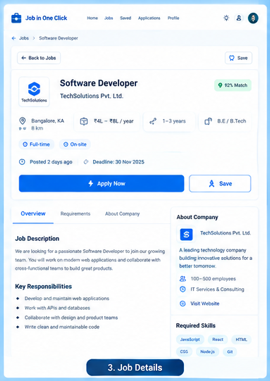
- View a job-match percentage.
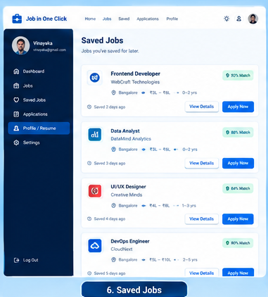
- Save interesting opportunities.
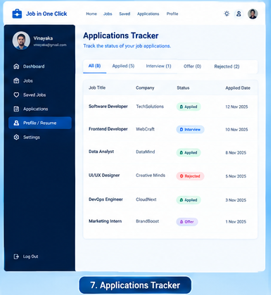
- Track submitted applications.
- Apply through a One-Click Apply feature when supported.
- Redirect safely to an employer's official application page for external applications.
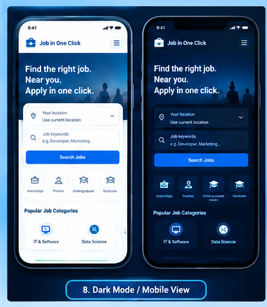
- Use the platform on desktop, tablet, and mobile devices.
- Switch between light mode and dark mode.
The platform includes opportunities for:
- Internships
- Freshers
- Undergraduate students
- Graduates
- Part-time jobs
- Full-time jobs
- Remote jobs
- IT & Software
- Data Science
- Analytics
- Finance
- Marketing
- Design
- Customer Support
- Government Jobs
Every job card provides important information such as the job title, company, location, distance, salary, required experience, education, posted date, application deadline, match percentage, Save button, and Apply Now button.
How I Built It
I built the project using modern web technologies with a clean, responsive, mobile-first interface.
The frontend was created using:
- HTML5 for the application structure.
- CSS3 for responsive layouts, animations, accessibility, light mode, and dark mode.
- JavaScript for job searching, filtering, saved jobs, application tracking, profile management, location features, job matching, and One-Click Apply interactions.
- Browser Local Storage to demonstrate persistent user profiles, saved jobs, settings, and application information in the prototype.
- Geolocation API to request GPS permission and support distance-based job discovery.
The platform contains dedicated pages for:
- Dashboard
- Jobs
- Job Details
- Saved Jobs
- Applications Tracker
- Profile & Resume
- Login / Register
- Settings
I also designed the application flow so that One-Click Apply never falsely reports that an application has been submitted.
For applications supported directly by the platform, the user's stored profile and resume can be used after confirmation. For jobs hosted on external websites, the user is redirected to the employer's official application portal, where information can only be prefilled when it is technically and legally supported.
Job Matching
The project demonstrates a simple job-matching concept based on factors such as skills, education, experience, location, and user preferences.
A simplified matching idea can be represented as:
$$ \text{Match Score} = w_sS + w_eE + w_xX + w_lL + w_pP $$
where:
- (S) = skill compatibility
- (E) = education compatibility
- (X) = experience compatibility
- (L) = location compatibility
- (P) = preference compatibility
- (w) values represent the weight given to each factor
The resulting score is displayed as a percentage so users can quickly identify jobs that are more relevant to their profile.
What I Learned
While building Job in One Click, I learned how different parts of a real job platform need to work together instead of operating as isolated features.
I improved my understanding of:
- Responsive web development.
- Mobile-first UI/UX design.
- JavaScript-based filtering and searching.
- Browser geolocation.
- User profile management.
- Resume upload workflows.
- Local data persistence.
- Job matching logic.
- Application tracking.
- Accessible interface design.
- Dark-mode implementation.
- Designing safe and transparent application experiences.
I also learned that a good job platform should not simply show hundreds of vacancies. It should help users understand which opportunities are relevant to them and what happens after they press Apply.
Challenges I Faced
One of the biggest challenges was designing the One-Click Apply experience responsibly.
Different employers use different application systems, so it would be incorrect to claim that every application can automatically be submitted. I solved this by separating jobs into two application types:
- Supported applications, where the user's saved information can be used directly.
- External applications, where the candidate is redirected to the employer's official website.
Another challenge was combining several filters such as location, distance, salary, education, experience, job type, work mode, and category without making the interface complicated.
I addressed this by keeping the main search experience simple while providing detailed filters when users need more control.
Creating a responsive design for both desktop and mobile screens was also challenging because job cards contain a large amount of information. I designed the cards so that the most important information remains clear and readable even on smaller devices.
Future Improvements
In the future, Job in One Click could be expanded with:
- Real employer and recruiter accounts.
- Secure backend authentication.
- Cloud resume storage.
- Real-time job APIs.
- AI-powered resume analysis.
- Advanced job recommendation models.
- Resume-to-job skill-gap analysis.
- Email and push notifications.
- Interview scheduling.
- Recruiter dashboards.
- Government-job notifications.
- Application analytics.
- Verified employer profiles.
- Automatic duplicate-job detection.
An AI-based recommendation system could eventually learn from user behaviour and improve job recommendations over time.
Impact
The goal of Job in One Click is to reduce the amount of repetitive work involved in searching and applying for jobs.
Instead of repeatedly creating accounts and entering the same details, candidates can maintain one reusable professional profile and focus on opportunities that actually match their skills, experience, education, and preferred location.
Find the right job. Near you. Apply in one click.
Made with ❤️ by Pullayyagari Vinayaka

Log in or sign up for Devpost to join the conversation.