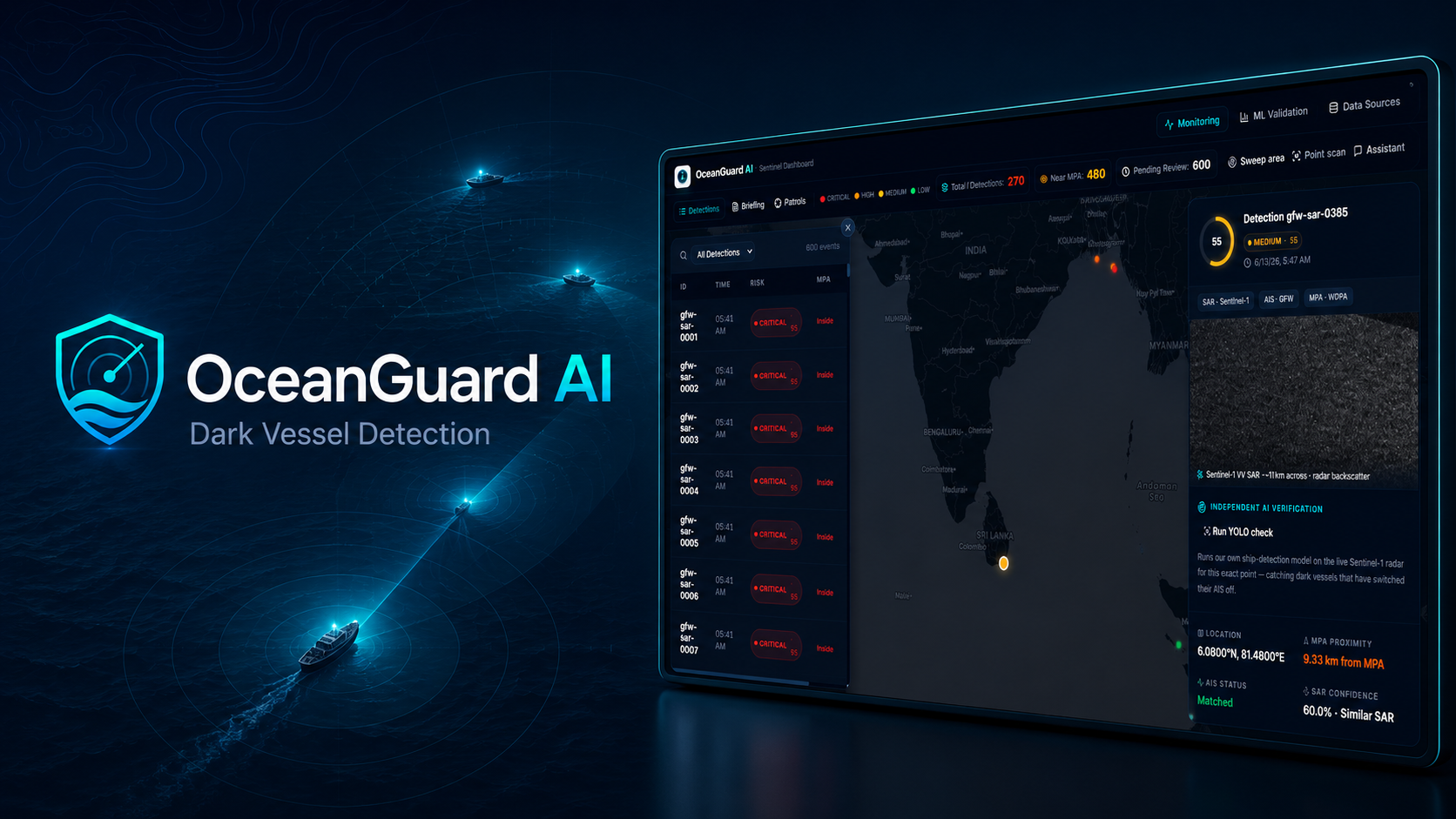
OceanGuard AI
About the Project
OceanGuard AI is a satellite-AI platform that helps detect possible dark-vessel risk near protected marine areas.
The system combines Sentinel-1 SAR imagery, a trained YOLO vessel-detection model, AIS evidence comparison, marine protected-area checks, risk scoring, and AI-generated evidence cards to support faster human review.
OceanGuard does not automatically accuse vessels. It is designed as a decision-support system that turns complex satellite and maritime signals into clear, review-ready evidence for analysts, conservation teams, and patrol officers.
Inspiration
We were inspired by a serious ocean-monitoring problem: the ocean is too large to watch manually, and some vessels can become invisible to public tracking systems when AIS is switched off.
At the same time, marine protected areas need faster review workflows because suspicious activity can disappear before humans finish checking the data.
This project connects strongly with SDG 14: Life Below Water, because protecting marine resources requires better visibility, faster triage, and responsible use of technology.
The Challenge
OceanGuard focuses on three main problems:
- Ships go dark: Vessels may switch off AIS, making them harder to track using public vessel data.
- Too many contacts to check: Satellite systems can produce many detections, but human teams cannot inspect every contact manually.
- Protected areas go unwatched: Marine reserves need faster prioritization so risky detections are reviewed before the vessel is gone.
What We Built
We built a working OceanGuard AI prototype with:
- A YOLO-based vessel detector trained for SAR vessel-like object detection.
- A Sentinel-1 SAR pipeline for satellite-based vessel detection.
- An AIS comparison layer to identify possible AIS-off tracking gaps.
- A marine protected-area risk layer to check whether detections are inside or near protected waters.
- A risk scoring engine to prioritize detections.
- A FastAPI backend with agent endpoints for briefing, patrol recommendations, narration, and Q&A.
- A web dashboard that shows detections, risk levels, evidence cards, and analyst review actions.
- A GCP deployment setup using Cloud Run, Secret Manager, and GitHub Actions.
A simplified risk score can be represented as:
$$ Risk = w_1(SAR\ Confidence) + w_2(AIS\ Gap) + w_3(MPA\ Proximity) + w_4(Activity\ Context) $$
This helps OceanGuard rank detections so human reviewers can focus on the most important cases first.
How It Works
Sentinel-1 SAR imagery
        ↓
SAR preprocessing
        ↓
YOLO vessel detector
        ↓
Detection coordinates
        ↓
AIS evidence comparison
        ↓
Protected-area check
        ↓
Risk scoring
        ↓
AI evidence writer
        ↓
Evidence card
        ↓
Human analyst review
Built With
- actions
- ai
- api
- areas
- artifact
- cloud
- colab
- compose
- css
- database
- docker
- earth
- engine
- fastapi
- fishing
- gemini
- generative
- github
- hrsid
- images
- leaflet.js
- on
- openstreetmap
- overpass
- platform
- protected
- pydantic
- pyproj
- python
- pythongoogle
- pytorch
- rasterio
- react
- rechartsglobal
- registry
- run
- sar
- satellite
- sdkreact
- shapely
- tailwind
- typescript
- ultralytics
- via
- vite
- watch
- world
- xview3-sar
- yolo11


Log in or sign up for Devpost to join the conversation.