-
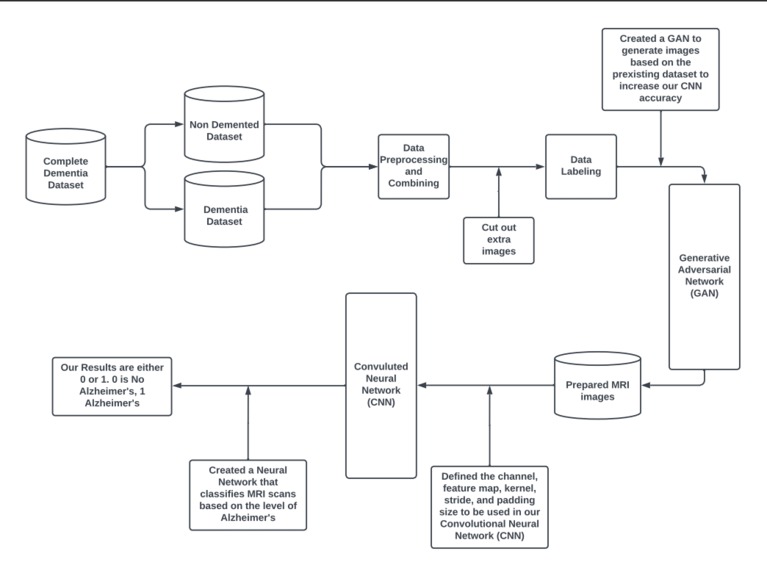
Flowchart
-
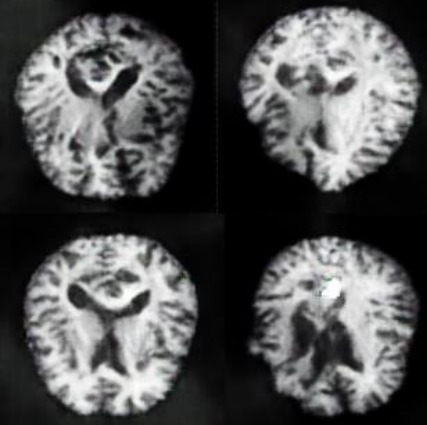
GAN-generated images
Inspiration
Our team, having a background in biology, wanted to do something to create an impact within the medical field. Since one of our team member's grandfathers suffers from severe dementia, we wanted to contribute to improving the accuracy of the niche.
What it does
The project produces synthetic images to add to an already existing dataset of MRI scans. With this, we use the SSMI index to select the "best" images of all the synthetic data. By applying these images to a CNN we made, we tested how the validation accuracy changed.
How we built it
We built it using PyTorch.
Challenges we ran into
We ran into a lot of challenges - First of all, we weren't even sure that the project was going to work which caused a lot of mental challenges for us: After spending a few days creating the project and seeing the GAN-generated images after a few epochs, we were certain that it wasn't going to work. However, we continued improving the code to improve the model and were able to get very good looking images by only 230 epochs.
Accomplishments that we're proud of
We're proud of how the synthetic data looks - Although you can visibly see the difference between some images generated by our GAN and the non-augmented images in our dataset, both forms are very similar to each other.
What we learned
We learnt a LOT about GANs. Only having a background in predictive analysis in ML, learning GANs felt a little confusing at first.
What's next for Novel Approach To Improving Accuracy for Alzheimer's
We really want to continue working on the project by conducting more experiments where we vary variables such as the number of synthetic images in the dataset and the non-augmented images in the dataset to see the changes in the validation accuracy in our CNN.

Log in or sign up for Devpost to join the conversation.