-
-
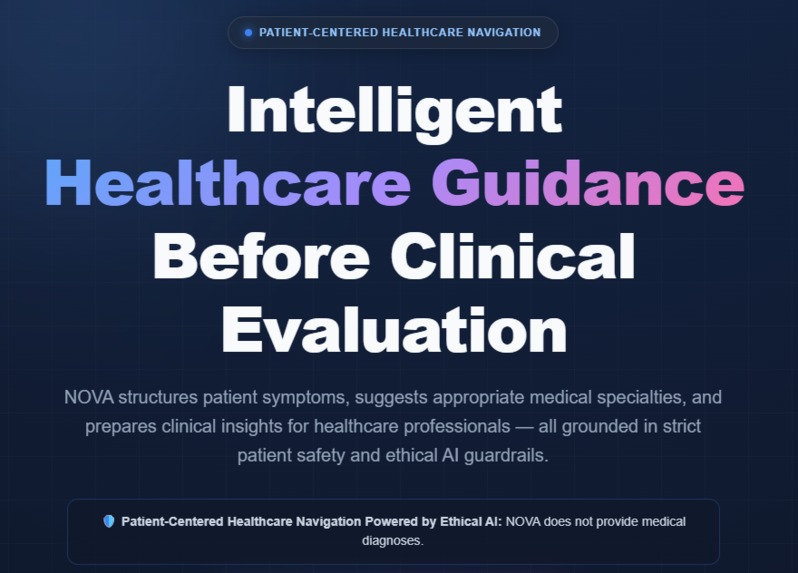
Cover Screen
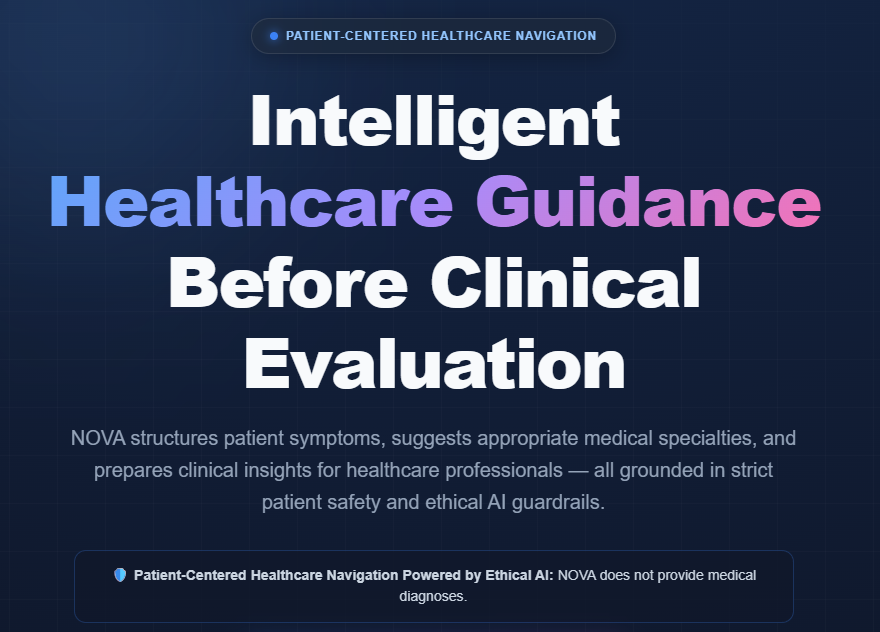
This is the story of how an academic elective at Villanova University transformed into a real-world humanitarian solution through the Build with Gemini XPRIZE.
The Spark: From Classroom to Competition
The journey began in the summer of 2026. As the instructor for a graduate-level elective on Artificial Intelligence and Clinical Decision Support Systems (CDSS), I received notice of the XPRIZE competition just days before the semester started. Recognizing a unique opportunity for Project-Based Learning, I registered the entire class for the competition.
The mission was clear: build a high-impact healthcare intelligence platform that solved a major systemic problem—the "Navigation Gap"—while intentionally remaining within the non-diagnostic boundary to avoid classification as Software as a Medical Device (SaMD).
The Team: Interdisciplinary Potential
The project was built by a diverse group of 10 graduate students: two from Computer Science and eight from Biomedical Engineering. Remarkably, none of these students had prior experience in healthcare informatics, AI, or low-code implementations.
To bridge the gap between academic theory and industry reality, we established a deep collaboration:
- Industry Partners: COCO Tech AI and Parker Apex actively participated in nearly every class, providing infrastructure and market insights.
- Technical Mentorship: We incorporated Fabian Jimenez a senior full-stack developer to guide the students in moving from prompt engineering to a functional software architecture.
- Clinical Engineering: The eight bioengineering students leveraged their medical knowledge to design Prompt_Root, a clinical-grade prompt system that became the "hardest part" and most valuable asset of the system.
The Mission: Navigation, Not Diagnosis
We set out to create NOVA (Navigational Optimization & Virtual Anamnesis). Its purpose was to replace confusing, static intake forms with an empathetic, AI-driven conversation. By focusing on reducing "Time to Identification" and "Time to Decision," the team built a system that could accurately route patients to the right specialist without ever crossing into medical diagnosis.
The Pivot: A Real-World Disaster Response
Halfway through the semester, the project's stakes were raised. Two major earthquakes hit Venezuela, creating a humanitarian crisis. Leveraging my role as chair of the Healthcare Technology Foundation, we immediately activated a disaster response.
The students worked tirelessly to redefine and redesign NOVA to serve as a primary point of contact for refugees and displaced persons. We developed a "Layer 0" disease-burden prior system, allowing the AI to automatically elevate its suspicion for crisis-related conditions like crush injuries and waterborne illnesses specifically for the Venezuelan context.
The Outcome: A Shipped Prototype
In just one summer semester, this interdisciplinary team of students—who started with no AI background—built a functional working prototype.
- Technical Achievement: They delivered a "Model 2" backend using Gemini 2.5 Flash, capable of conducting structured clinical interviews and producing PICOT-formatted summaries.
- Interoperability: The system was integrated with Parker Health’s HIPAA-compliant EHR and prepared for deployment in Venezuela [User Context, 201, 326].
- Ethical Innovation: They developed the Navigational Ethical Value (NEV) and Navigational Risk Force (NRF) computational frameworks to ensure the AI always prioritizes patient safety over commercial interests.
NOVA is no longer just a classroom assignment; it is a shipped, deployable solution born from a unique fusion of academic rigor, industry partnership, and an urgent humanitarian call to action.
Built With
- fastapi
- firestore
- geminiapi
- google-cloud
- googleaistudio
- python


Log in or sign up for Devpost to join the conversation.