-
-
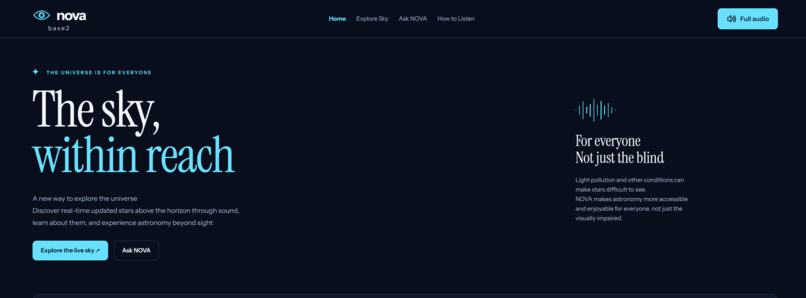
Landing Page (Website)
-
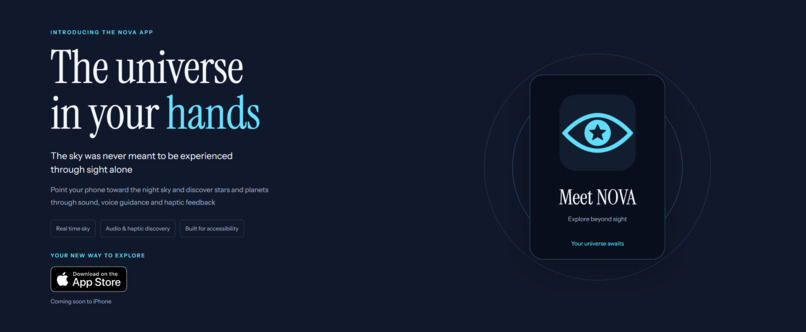
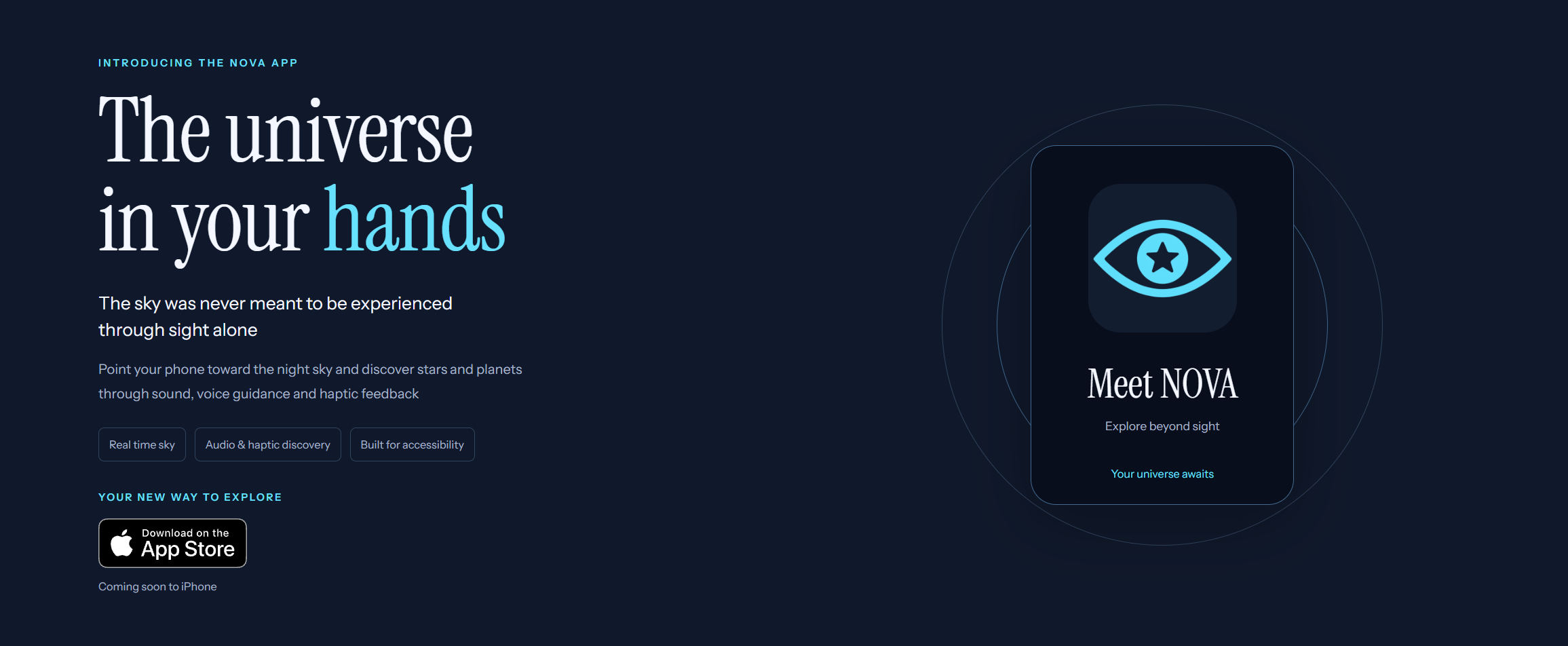
App Advertisement (Website)
-
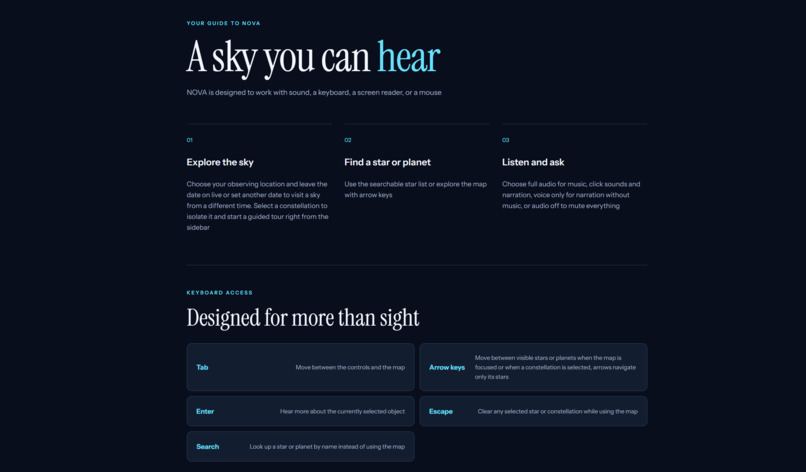
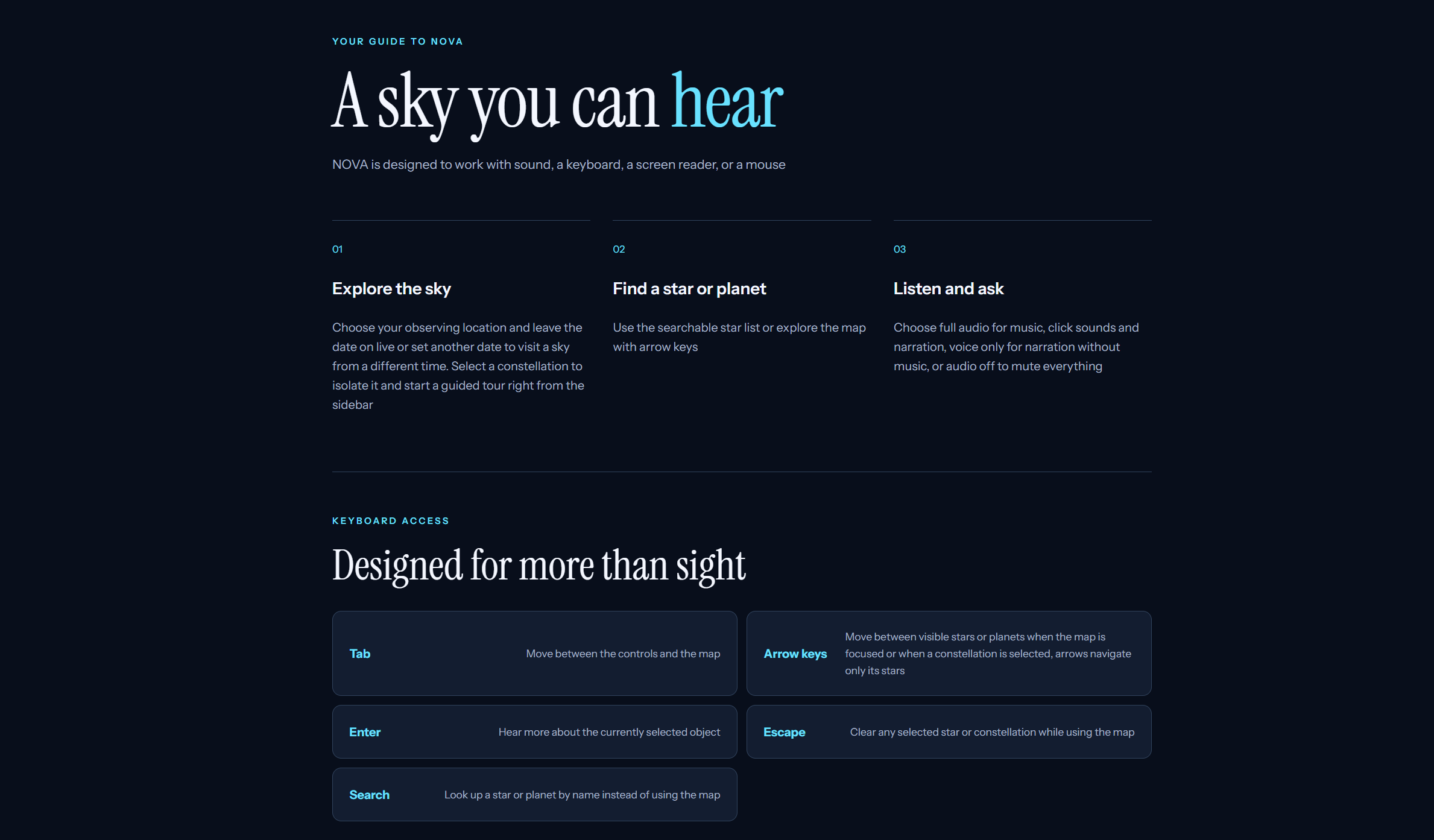
Guide To NOVA Page (Website)
-
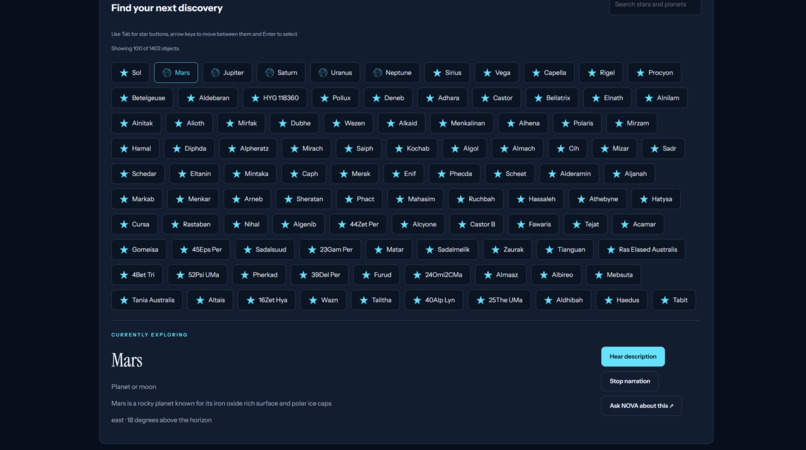
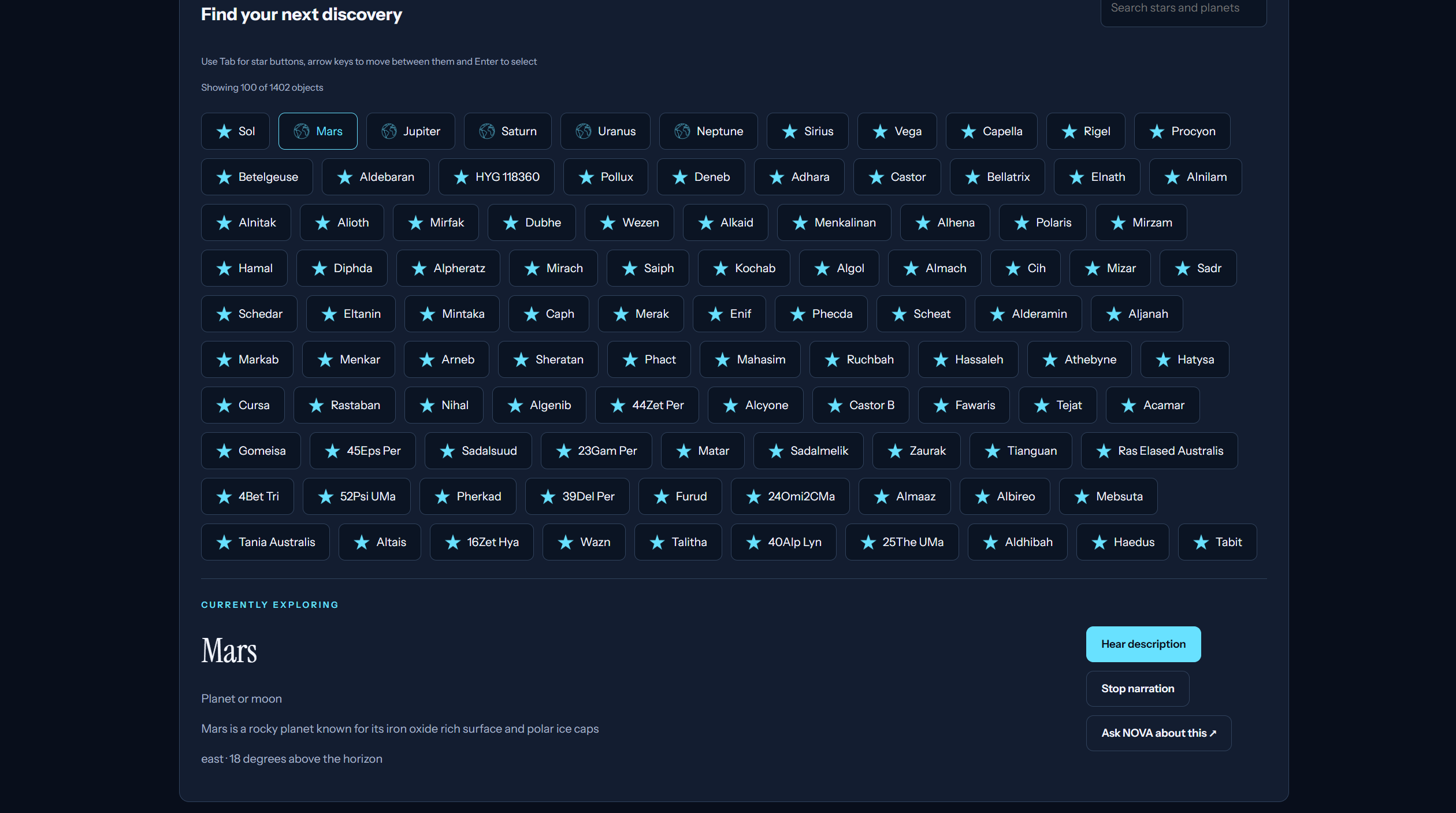
Star & Planet Catalog (Website)
-
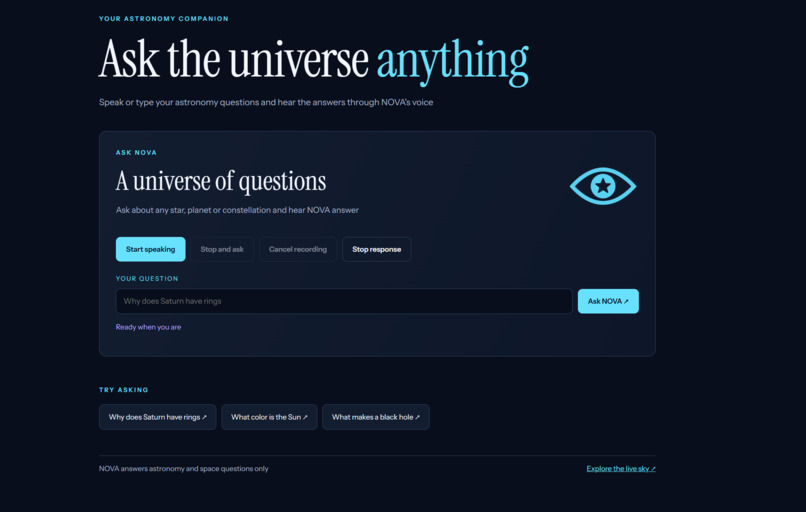
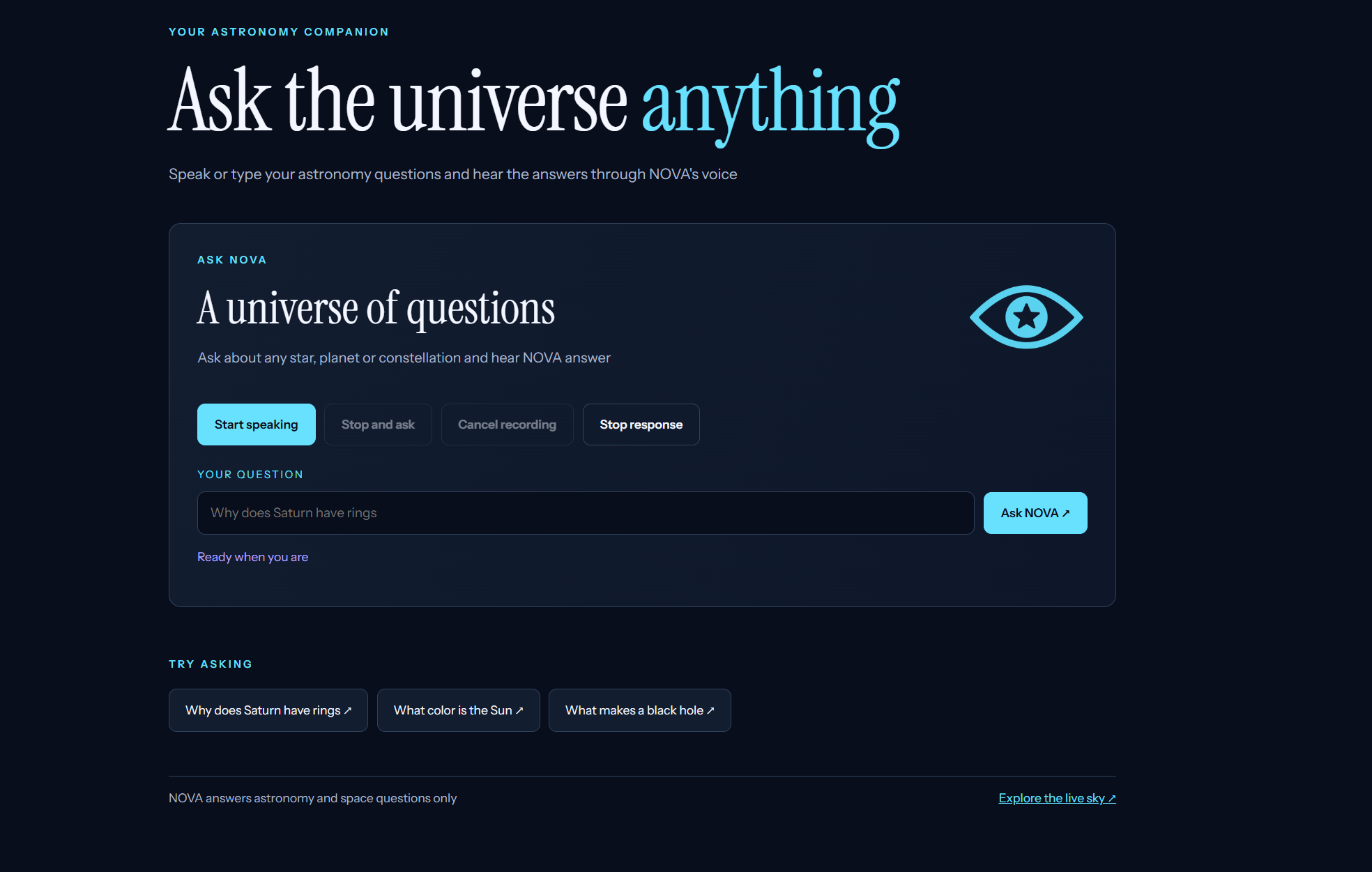
Ask NOVA Page (Website)
-
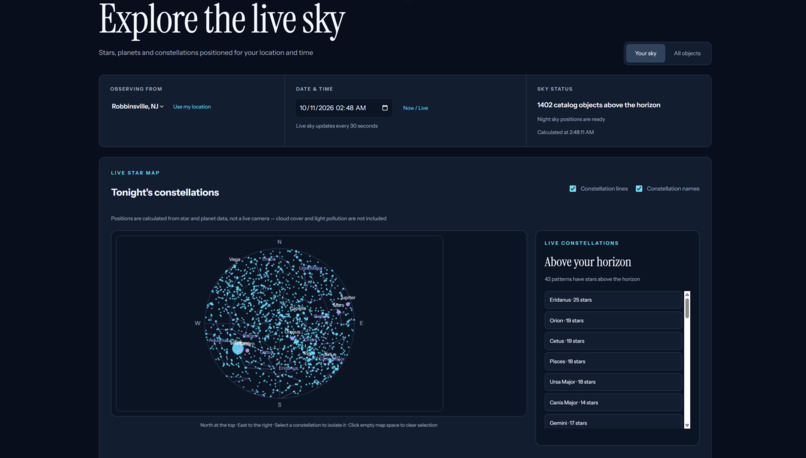
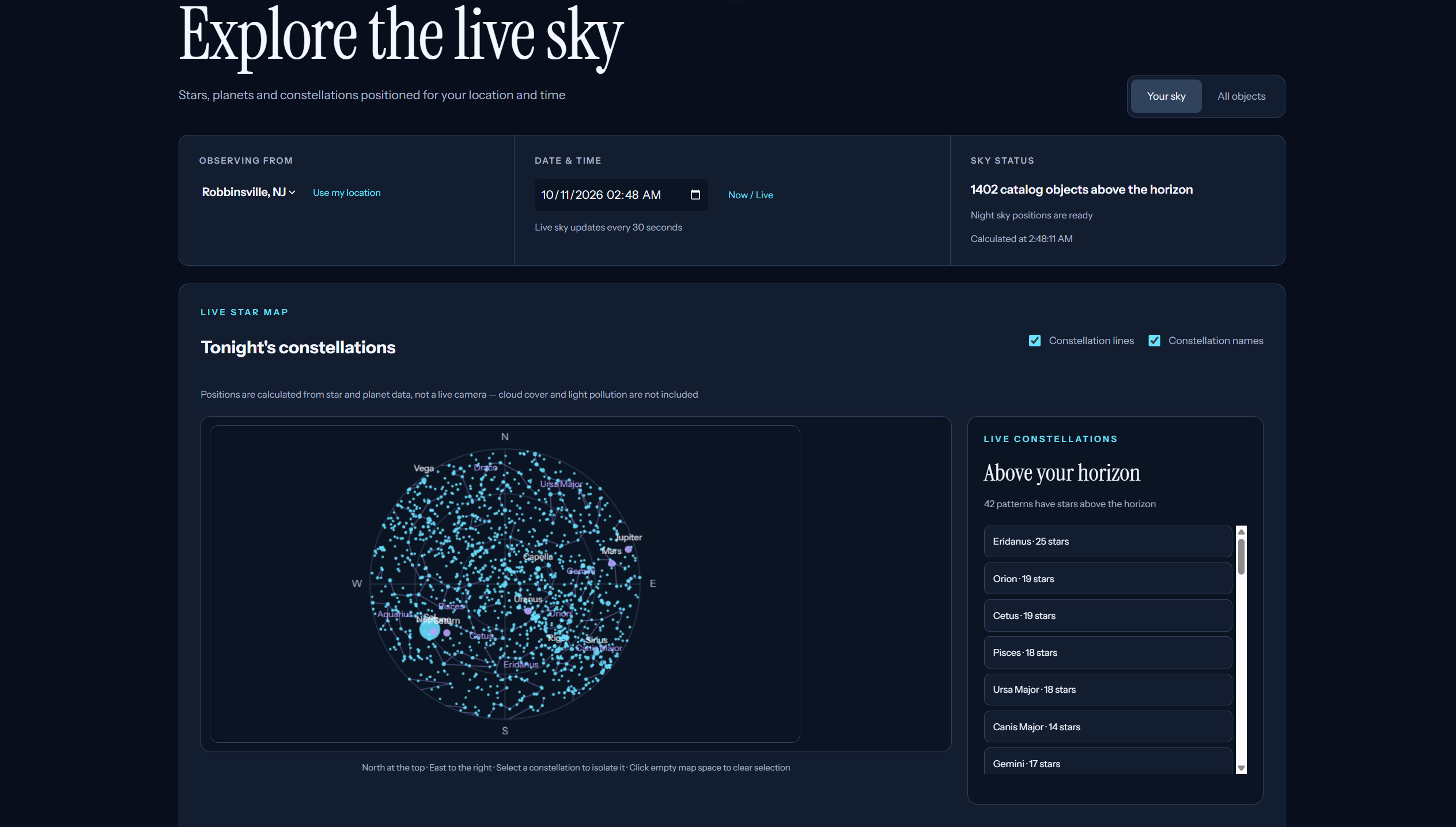
Constellation Map (Website)
-
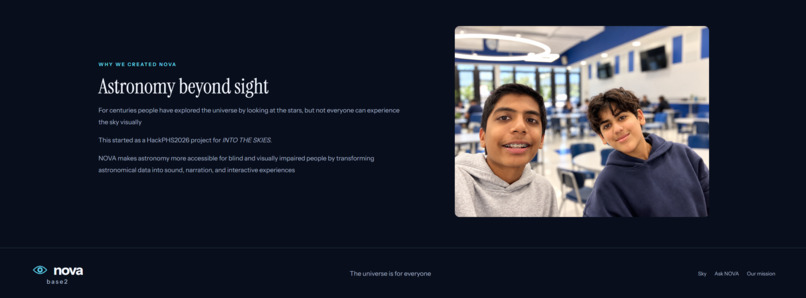
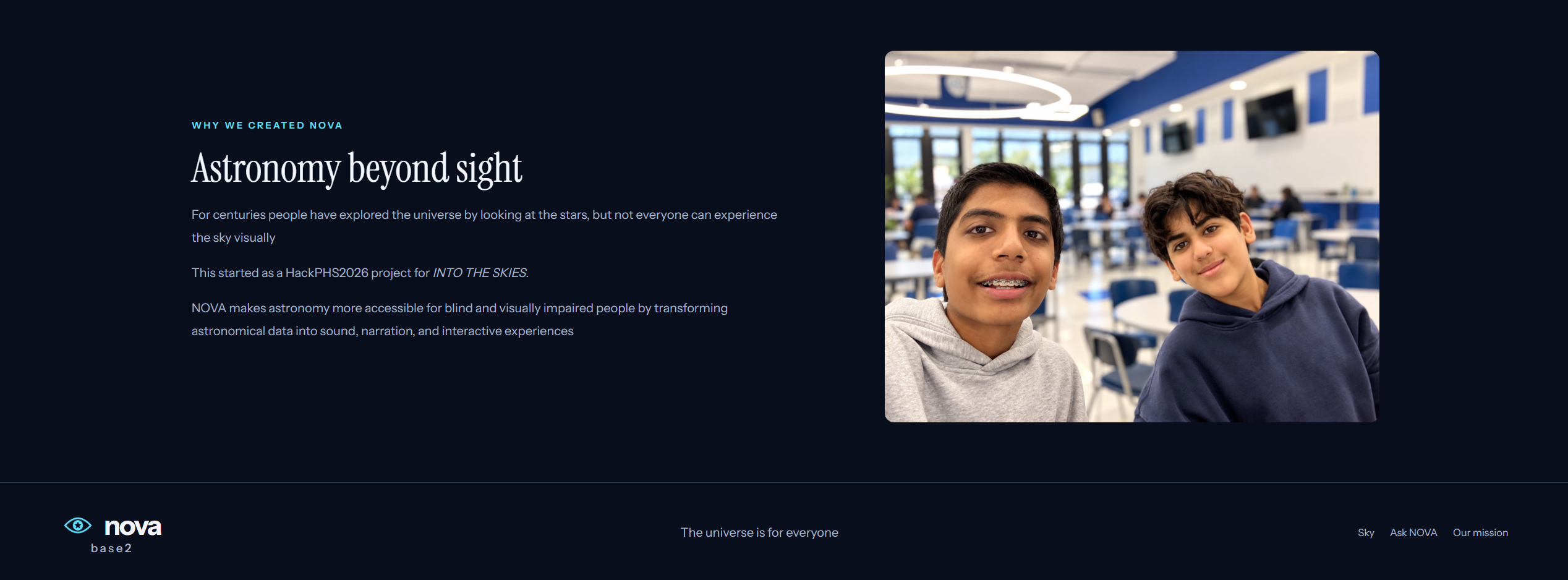
About Us (Website)
-
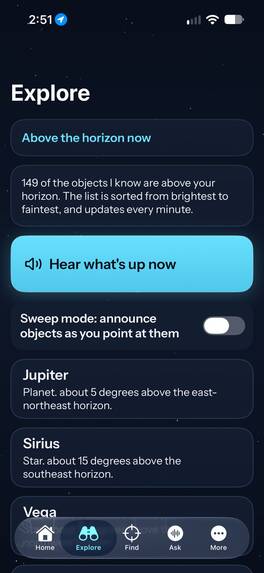
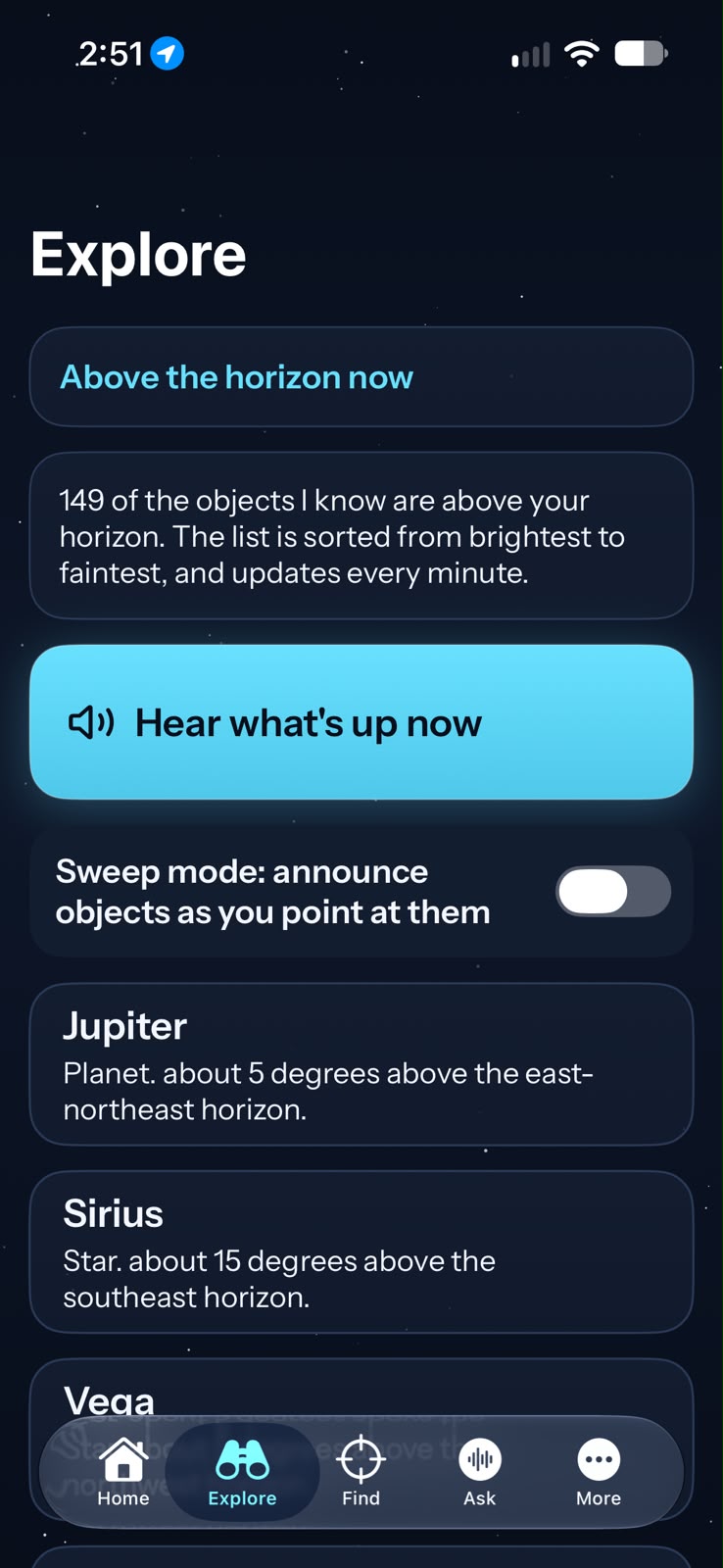
Explore Page (App)
-
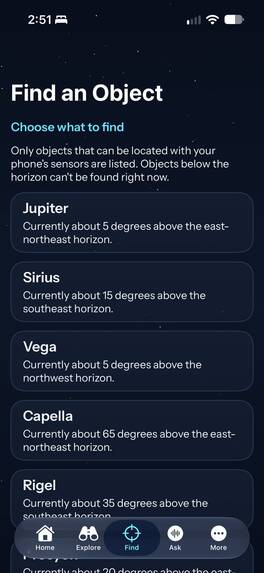
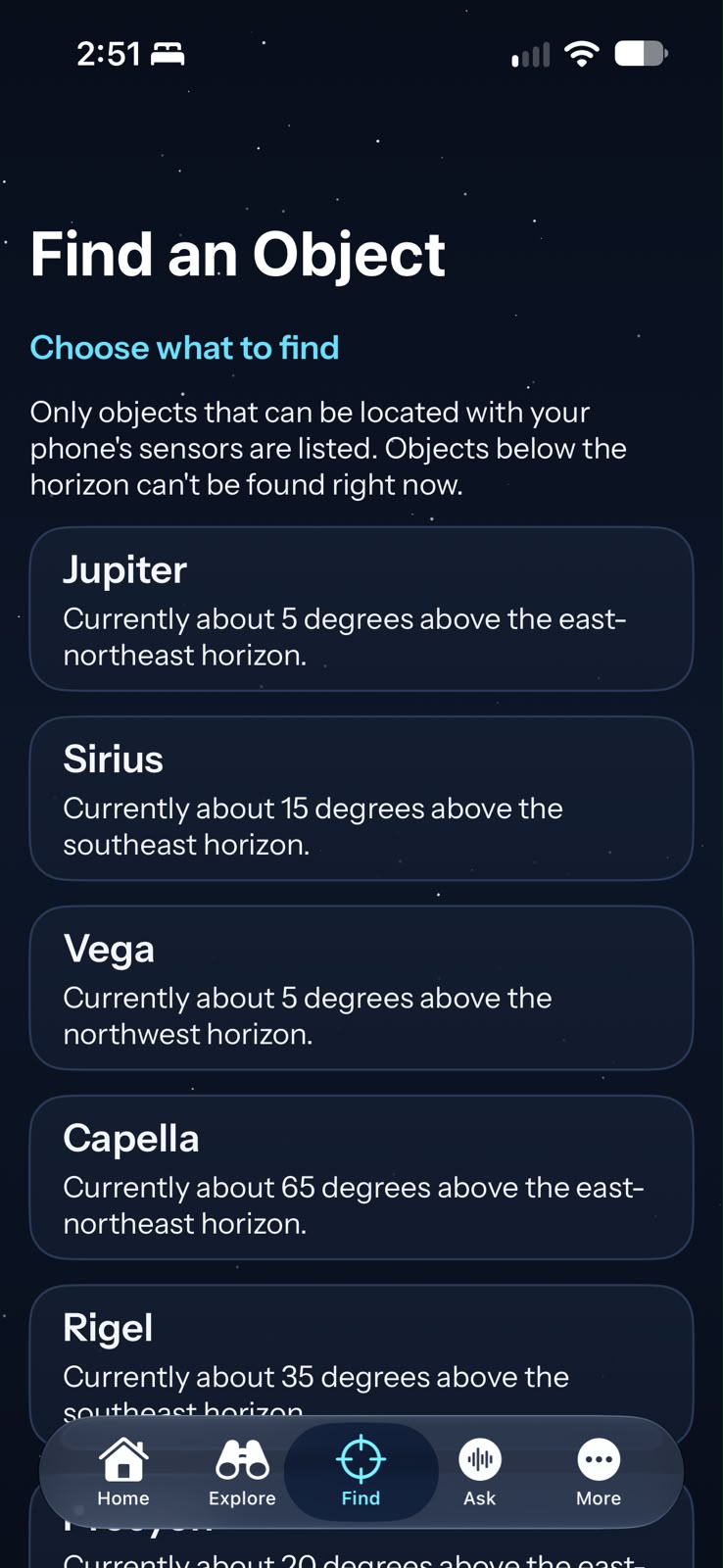
Find Stars And Planets Menu Page (App)
-
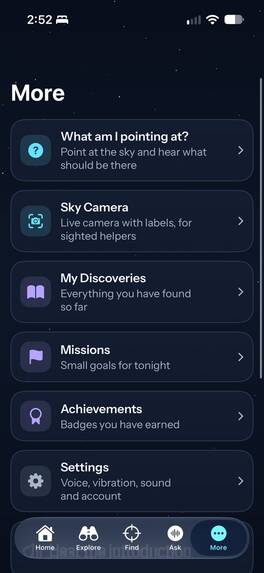
Settings Page (App)
-
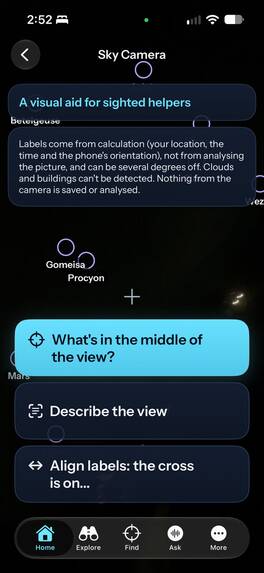
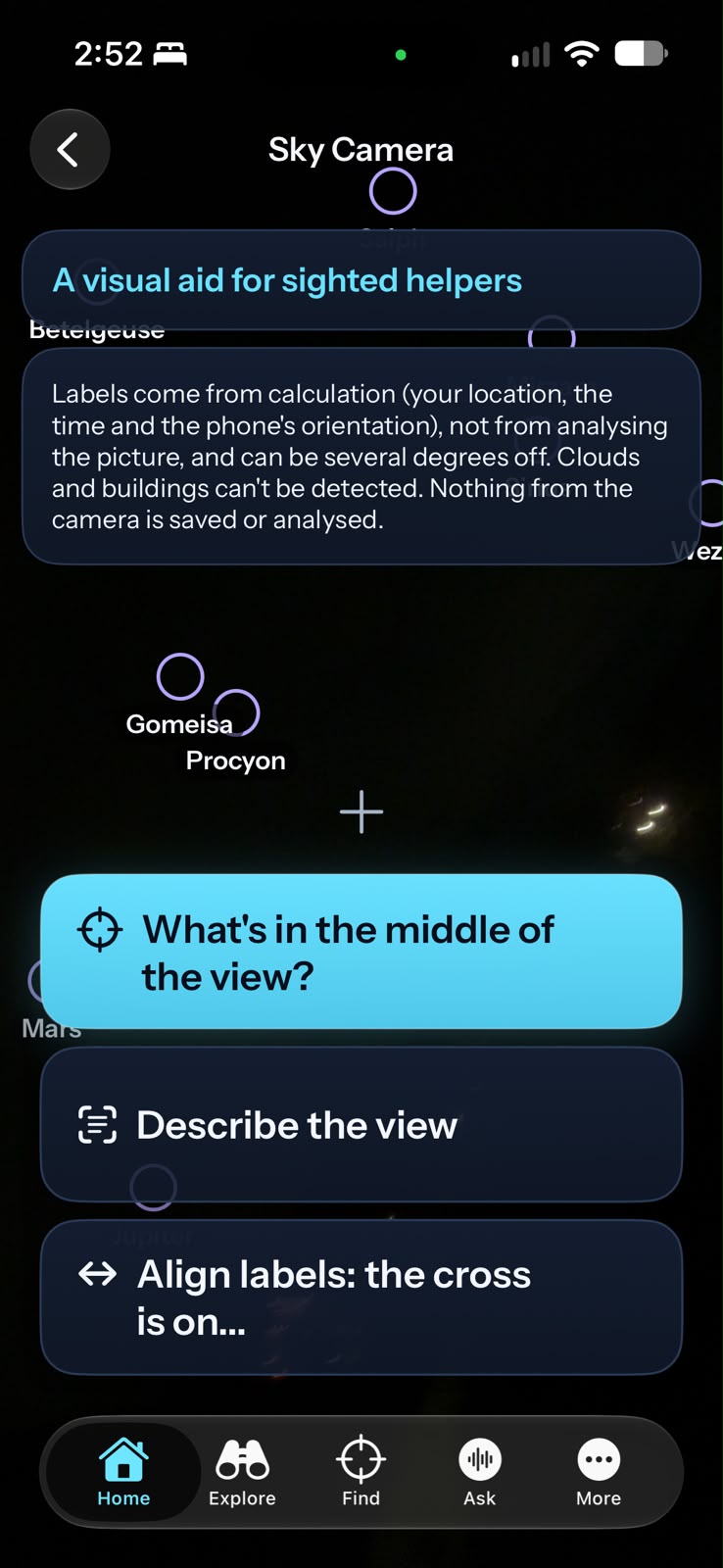
Sky Camera Page (App)
-
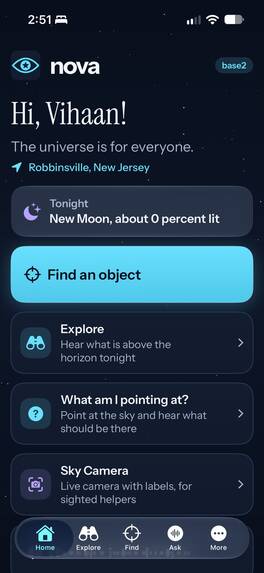
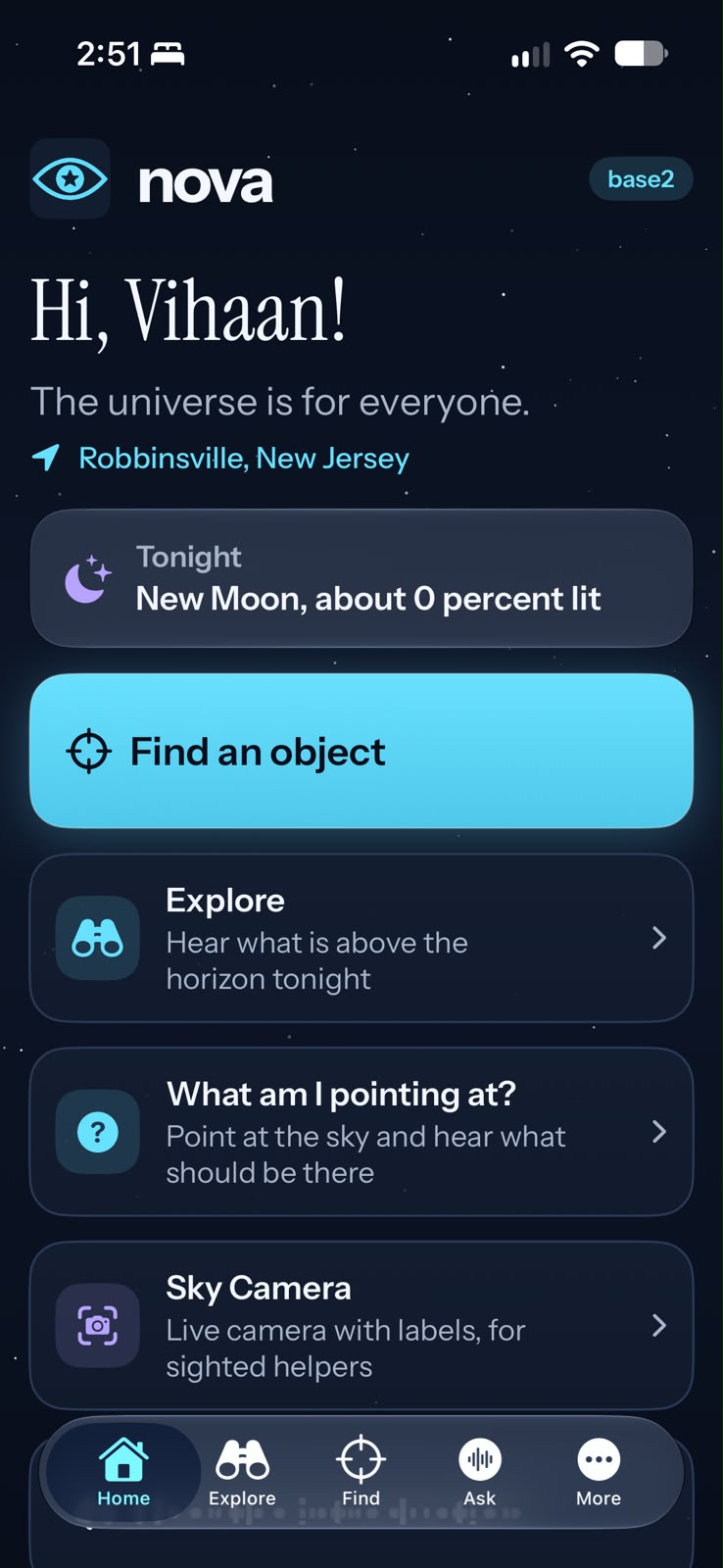
Landing Page For App (App)
-
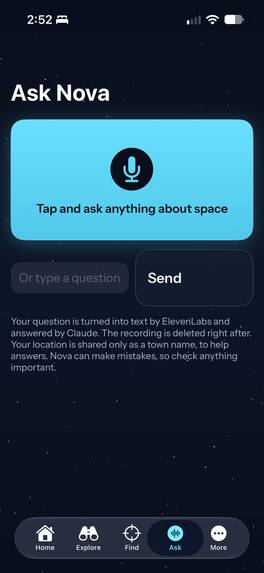
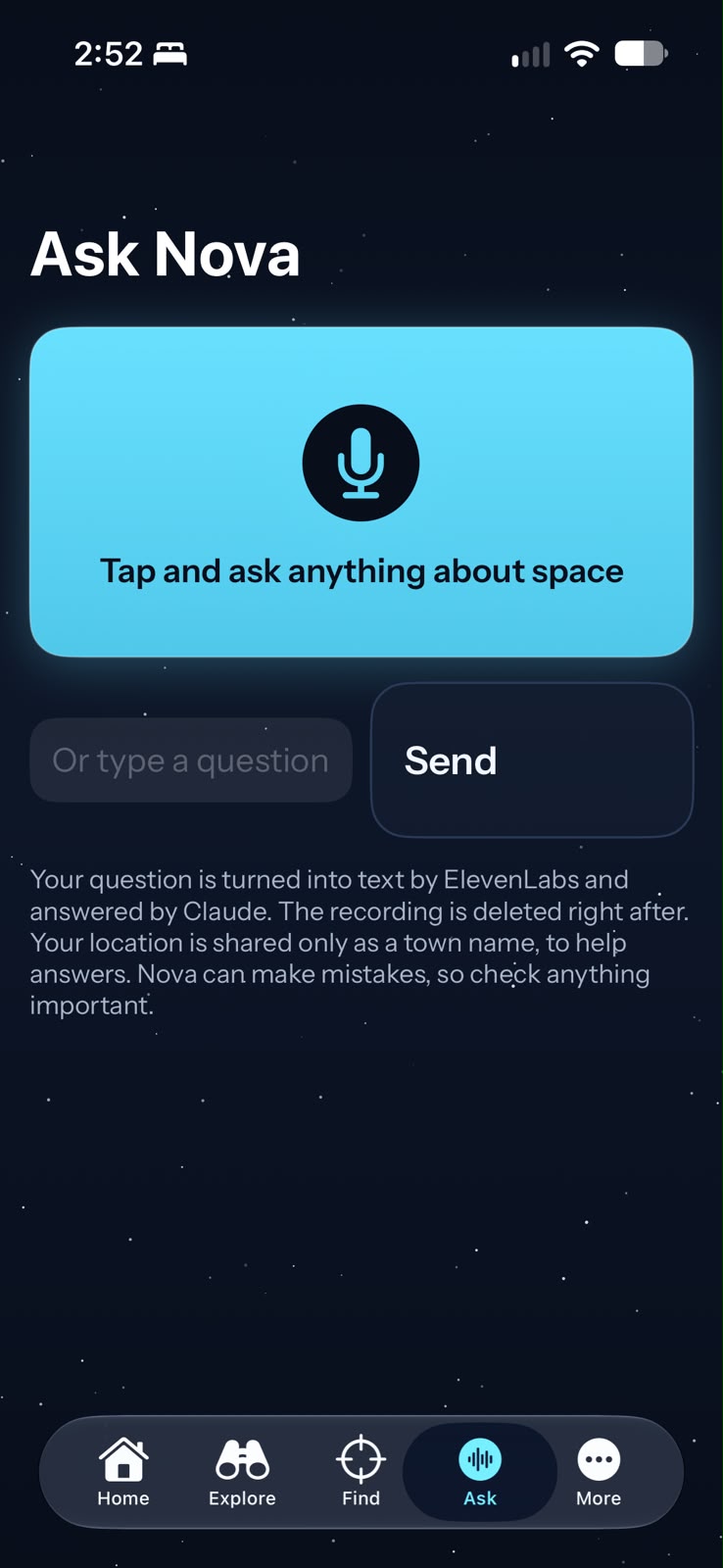
Ask NOVA Page (App)
-
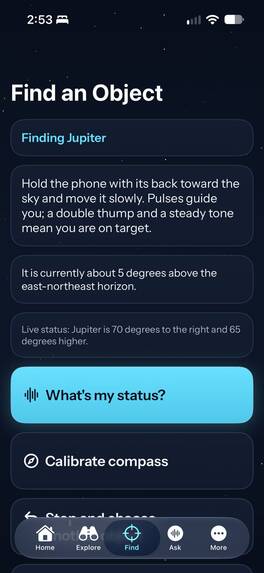
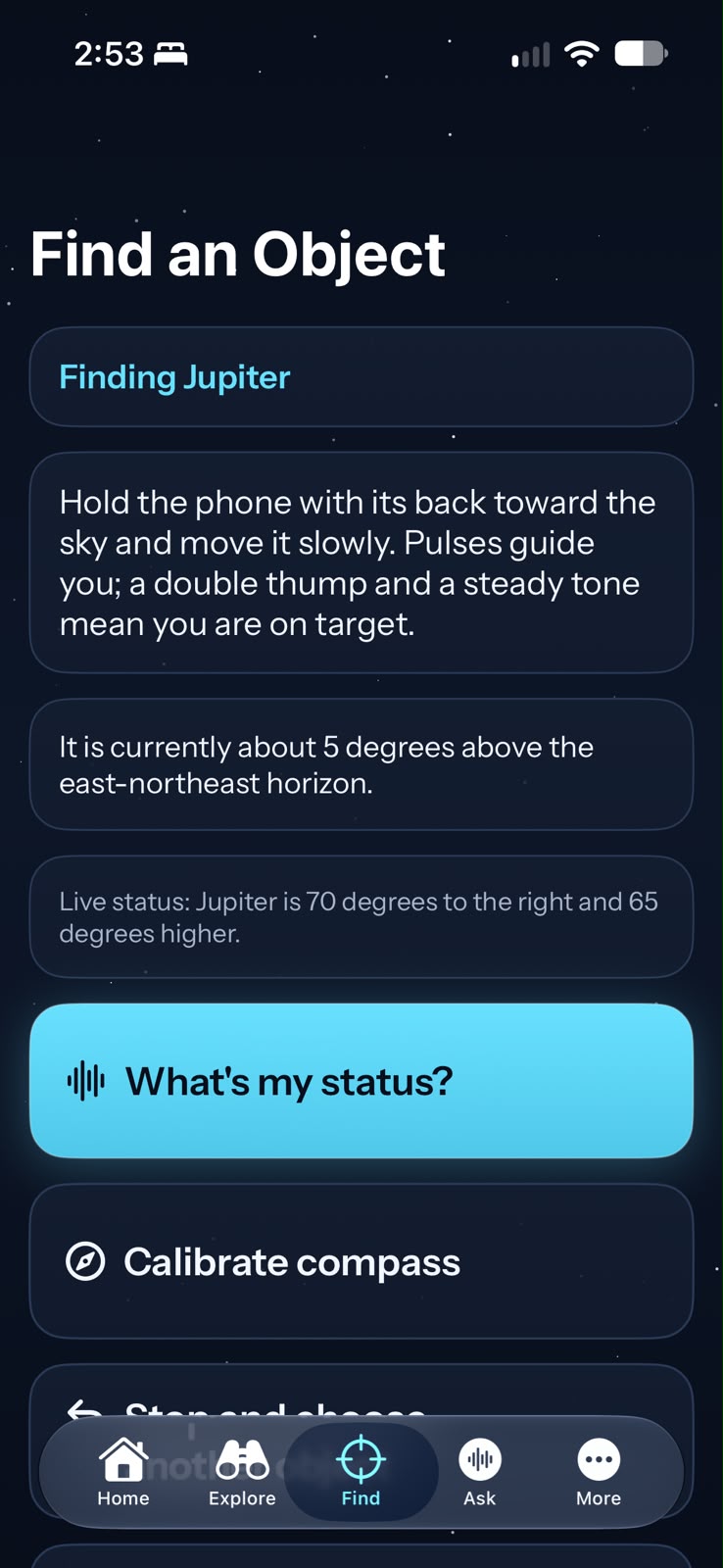
Find An Actual Planet In The Sky Page (App)
-
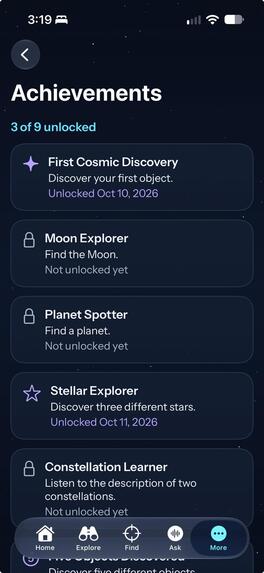
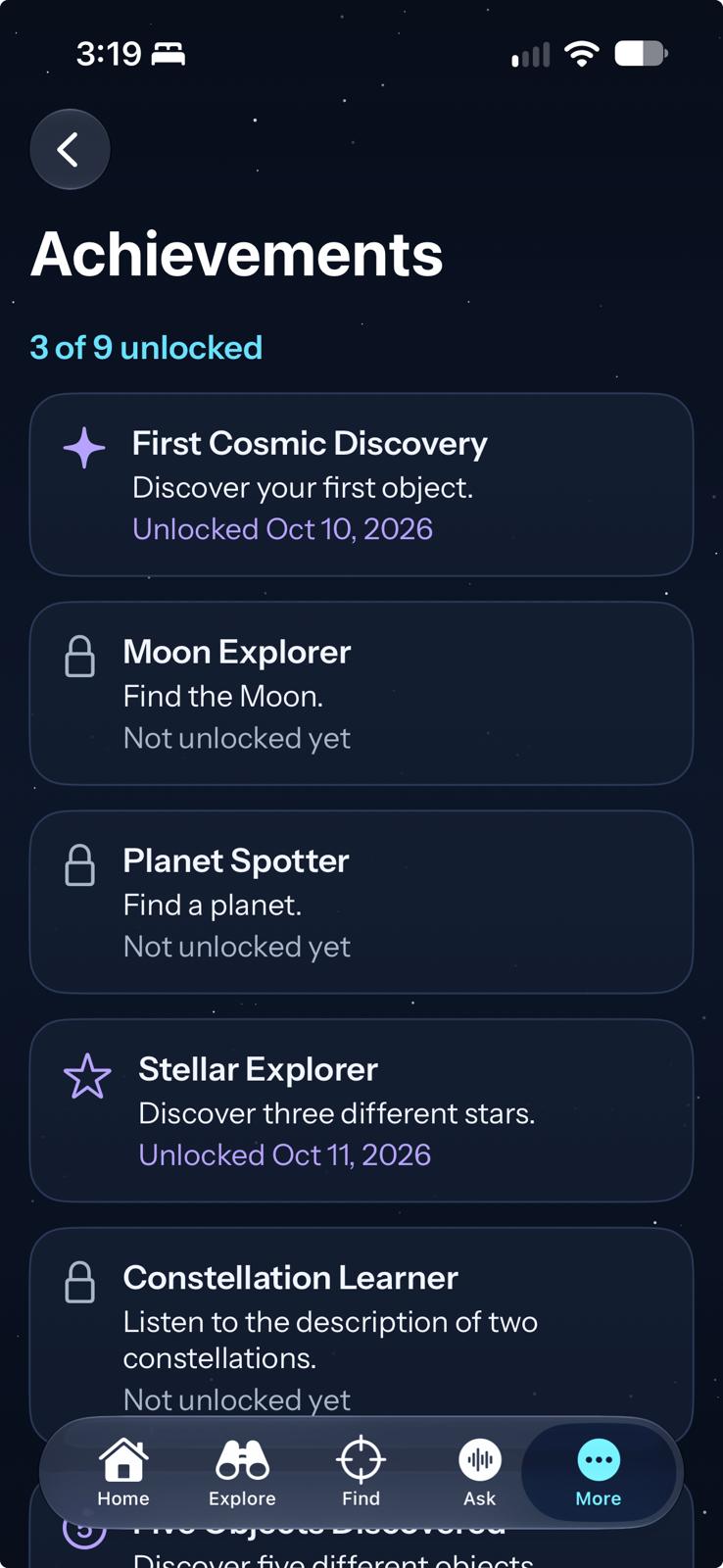
Achievements (App)
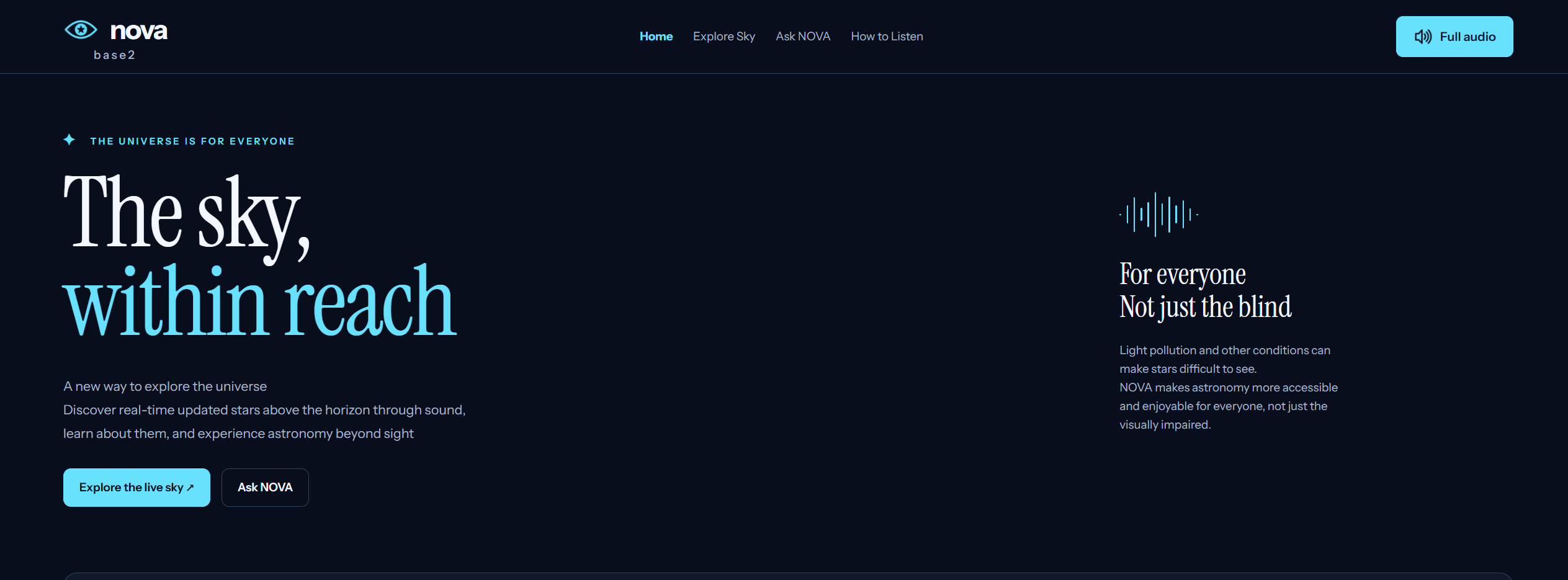
NOVA - The Universe Is for Everyone
Inspiration
Imagine looking up at the night sky but not being able to see the stars.
For people with visual impairments, light pollution, or other limitations, experiencing astronomy can be difficult. Most astronomy apps rely heavily on visuals, whether it's a star map, telescope image, or augmented reality view.
We started thinking: Why should exploring the universe depend on being able to see it?
That question inspired us to create NOVA, an astronomy experience designed around sound, voice guidance, and touch. Our goal was to make astronomy accessible to everyone, regardless of their ability to see the night sky.
What It Does
NOVA consists of two connected ideas: an interactive website and an iPhone app that offer different ways to explore the universe.
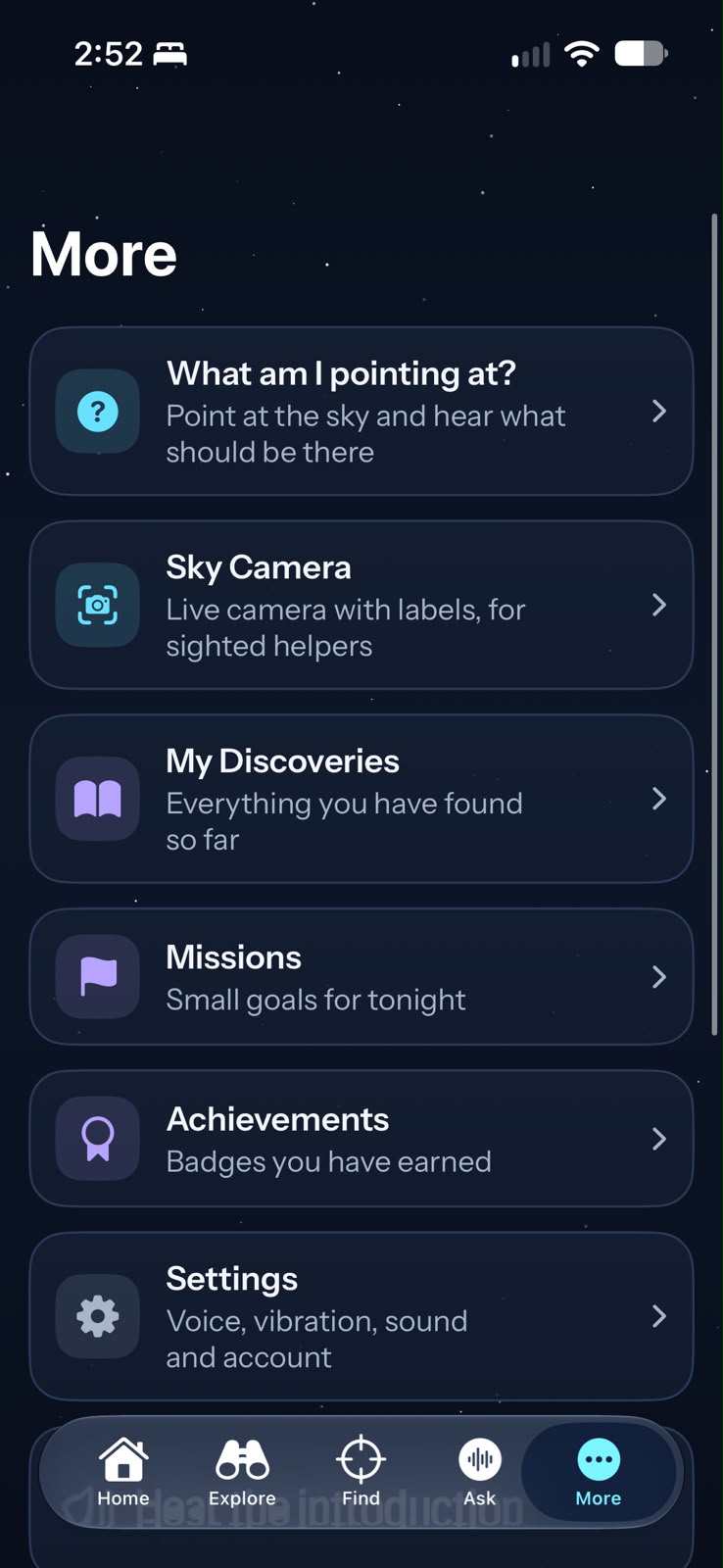
Our iPhone app allows users to discover stars, planets, and constellations by pointing their phone toward the sky. Using the phone's location and motion sensors, NOVA estimates where the user is pointing and provides spoken guidance and haptic feedback to help them find astronomical objects.
Our website offers another way to explore astronomy, with features including:
- Live Sky Map: Calculates the positions of stars, planets, and constellations based on the user's location and time
- Guided Constellation Tours: Lets users select a constellation and explore its stars through narration
- Ask NOVA: An astronomy-focused AI assistant that answers questions through text and speech
- Audio Accessibility: Three audio modes, keyboard controls, and spoken descriptions that make exploration less dependent on visuals
NOVA isn't a live camera feed of the sky. It uses real astronomical data to calculate where objects should appear, meaning users can still explore the universe even when they cannot physically see the stars.
How We Built It
We divided our project into two main parts: the website and the iPhone app.
For the website, we used Python and Flask for the backend and HTML, CSS, and JavaScript for the interface. We integrated Skyfield, the HYG star catalog, Stellarium constellation data, and JPL ephemerides to calculate astronomical positions.
We used OpenRouter to power Ask NOVA and ElevenLabs for speech recognition and natural-sounding narration.
For the iPhone app, we used Swift and SwiftUI, along with Apple's location and motion frameworks. These allow NOVA to estimate the phone's orientation and provide directional guidance through audio and vibrations.
We also designed NOVA with a consistent visual identity, using a dark, space-inspired interface and accessible controls.
Challenges We Faced
One of our biggest challenges was making astronomy information accurate and interactive. We had to work with star catalogs, celestial coordinates, and real-time positioning to display the sky based on a user's location.
Another challenge was integrating AI reliably. Sometimes the AI returned unrelated information or its own instructions instead of answering astronomy questions. We worked on improving our astronomy guardrails and adding fallback descriptions based on actual star data.
Audio was also surprisingly difficult. We wanted background music, sound effects, and narration to work together without interfering with one another. Keeping audio consistent while navigating between pages required multiple changes to our JavaScript.
For the iPhone app, we had to account for limitations in compass and motion-sensor accuracy, especially when trying to guide someone toward a specific object in the sky.
Finally, deploying NOVA introduced another challenge: getting our Python backend, external APIs, and custom domain working together.
Each problem pushed us to rethink parts of our design and improve how the different components worked together.
What We Learned
Before building NOVA, we hadn't fully realized how much accessibility could influence the way an application is designed.
We learned how to work with astronomical data, integrate multiple APIs, build a Python backend, develop with Swift, and connect hardware sensors (from the phone) to meaningful user interactions.
More importantly, we learned that accessibility shouldn't just be an extra feature added at the end of a project. It should be part of the design from the beginning.
What's Next
We want to continue improving NOVA by making its directional guidance more accurate, expanding its astronomy database, and improving the experience based on feedback from real users, especially people with visual impairments.
We also hope to develop more interactive audio-based experiences, allowing people to explore constellations and learn about the universe in ways that don't require sight.
Ultimately, we want NOVA to become more than just a hackathon project. We want it to be a tool that helps more people experience the wonder of space.
Because the universe is for everyone. :)
Built With
- avfoundation
- core
- css
- database
- elevenlabs
- ephemerides
- flask
- github
- html
- hyg
- javascript
- jpl
- location
- motion
- numpy
- openrouter
- python
- skyfield
- stellarium
- swift
- swiftui


Log in or sign up for Devpost to join the conversation.