-
-
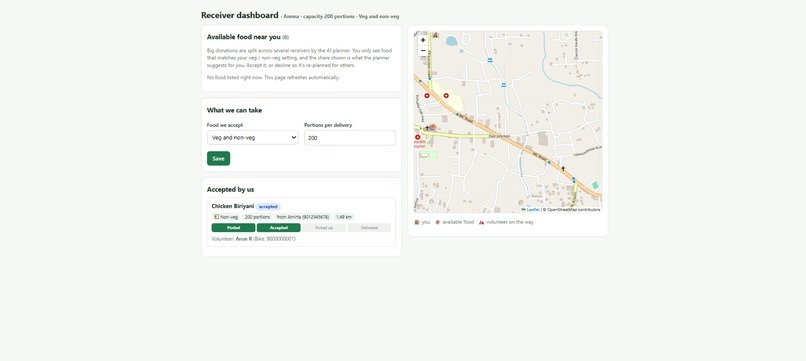
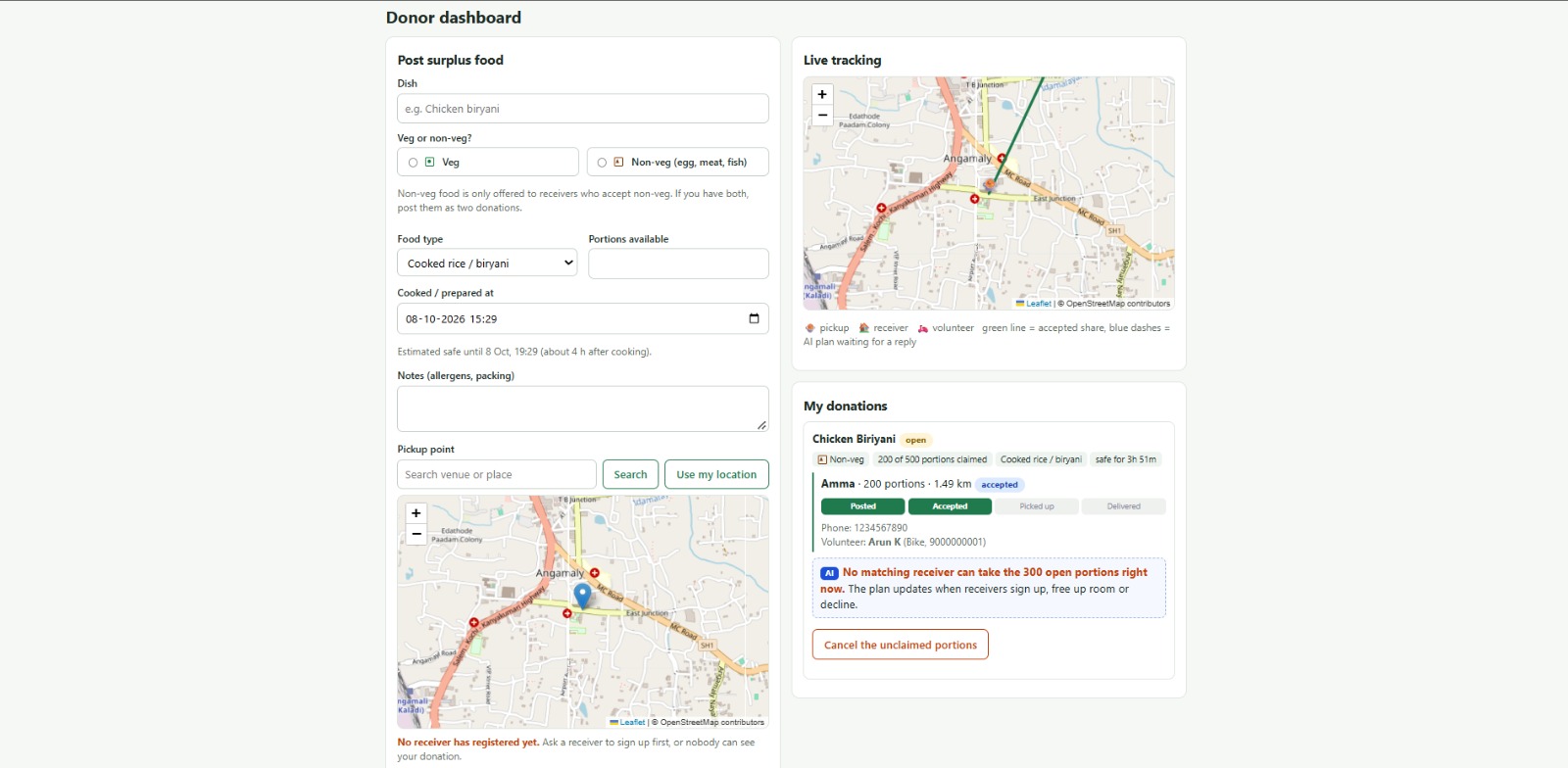
donor dashboard
-
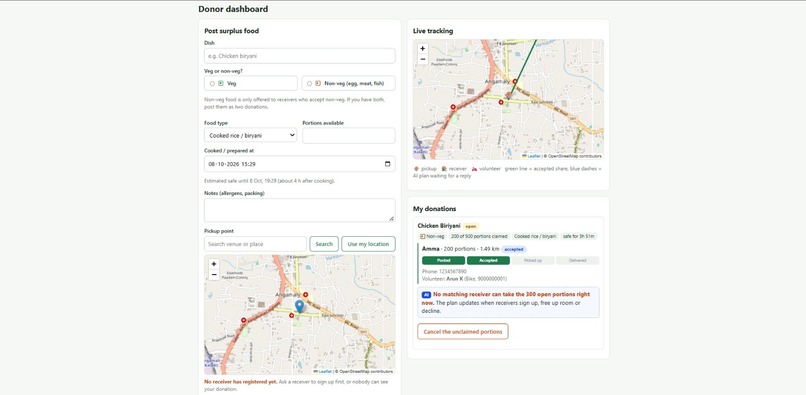
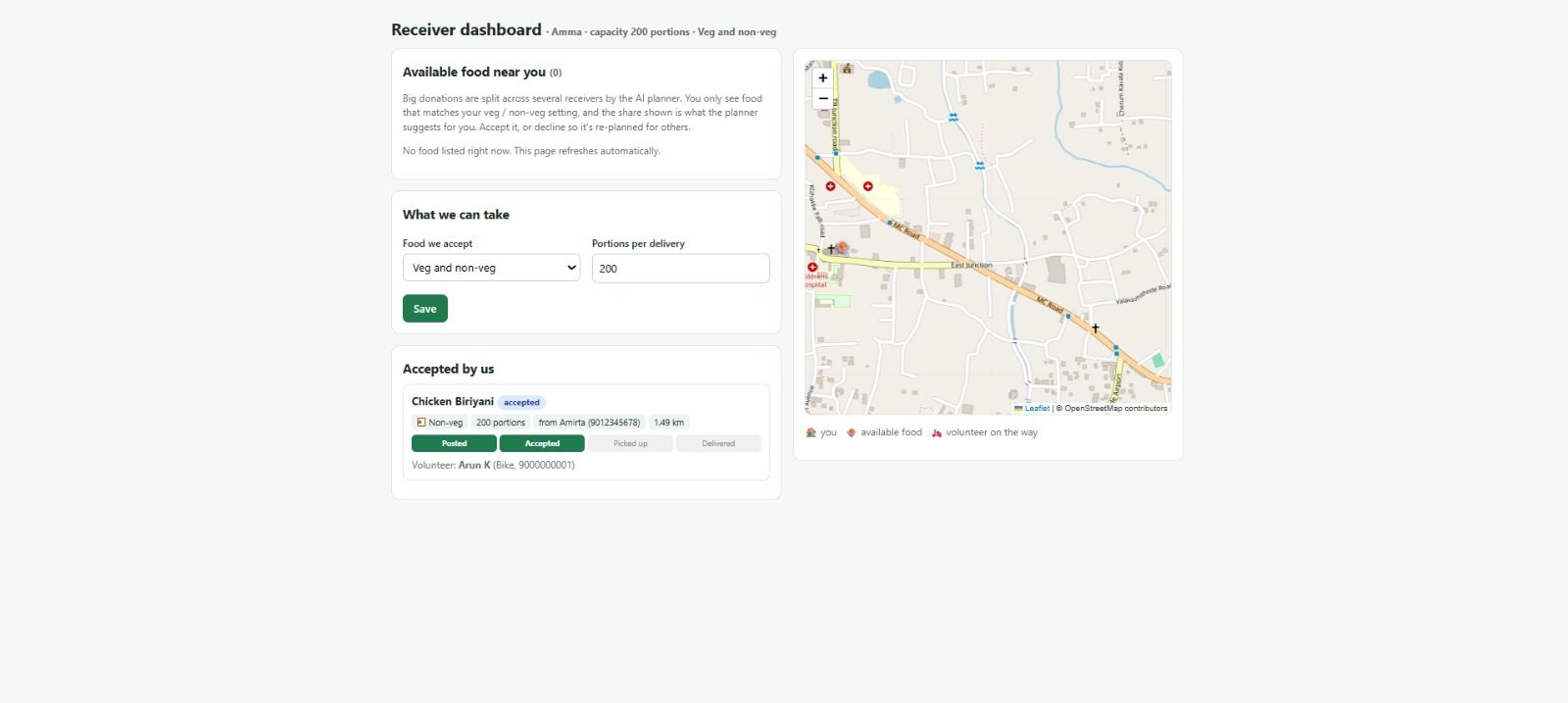
receiver dashboard
Inspiration
Inspiration
Food waste and food shortage can exist in the same city at the same time. Large events, weddings, restaurants, and caterers can have surplus food while shelters, orphanages, and community kitchens nearby may need it.
We wanted to build something that does more than simply list food donations. The goal was to create a system that can help move surplus food from where it exists to where it is needed, before it becomes unusable.
What we built
FoodBridge is a surplus food redistribution platform connecting donors, receivers, and volunteers.
A donor can register, post available food, specify the food category, quantity, cooking time, and pickup location. The system estimates a safe food window based on the food category.
Receivers can register their location and capacity. Available donations are automatically ranked using a matching score based on distance, remaining safe time, and receiver capacity.
Once a receiver accepts a donation, the system automatically assigns the nearest available volunteer. The volunteer can then move the donation through the pickup and delivery stages.
We also integrated Leaflet, OpenStreetMap, Nominatim, and OSRM to provide map-based location selection, place search, road routes, distance, and estimated travel time.
How we built it
The project was built with Python, Flask, SQLite, HTML, CSS, and JavaScript. The frontend uses Leaflet for interactive maps, while OpenStreetMap provides map data and Nominatim provides location search. OSRM is used for road routing.
The intelligent part of the current prototype is deliberately lightweight and explainable. A rule-based freshness estimator calculates an estimated safe-until time for different food categories, while a matching algorithm scores donations using distance, time remaining, and capacity.
This architecture also gives us a clear path toward future AI improvements, such as predicting surplus from event data or using computer vision to estimate food type and quantity from images.
What we learned
We learned that building an autonomous real-world system is not just about adding AI. The important part is connecting multiple decisions into one workflow: food availability → freshness → matching → acceptance → volunteer assignment → routing → delivery.
We also learned the importance of making automated decisions explainable. Instead of producing an unexplained recommendation, FoodBridge shows why a donation is ranked highly and provides distance and remaining safe time.
Challenges
One of our biggest challenges was designing a matching system that balances multiple factors. A donation that is very close may not be the best option if it has very little time remaining or exceeds the receiver's capacity.
Another challenge was integrating real-world maps and routing into the application while keeping the system simple enough for a HackDay prototype.
Food safety was also an important consideration. We intentionally treat the freshness calculation as an estimate, not as a replacement for official food-safety requirements. A production version would need proper verification and compliance with applicable food-safety regulations.
What's next
The next step is to make FoodBridge more autonomous by adding real AI models for surplus prediction, food image analysis, demand forecasting, smarter volunteer assignment, and dynamic replanning.
Our vision is to turn FoodBridge into a system where surplus food doesn't just get posted — it automatically finds the most suitable destination and the most efficient way to get there.

Log in or sign up for Devpost to join the conversation.