-
-
Scenario 2
-
Scenario 1
Inspiration
The inspiration for Nexus Health is the critical healthcare gap faced by rural and underserved communities in India. Access to timely medical advice is often blocked by a shortage of doctors, long travel distances, and language barriers. We were motivated to create a reliable first point of contact that could help people in these areas understand the urgency of their health issues, guiding them toward the right level of care with a tool that is safe, trustworthy, and aware of the unique challenges of rural healthcare.
What it does
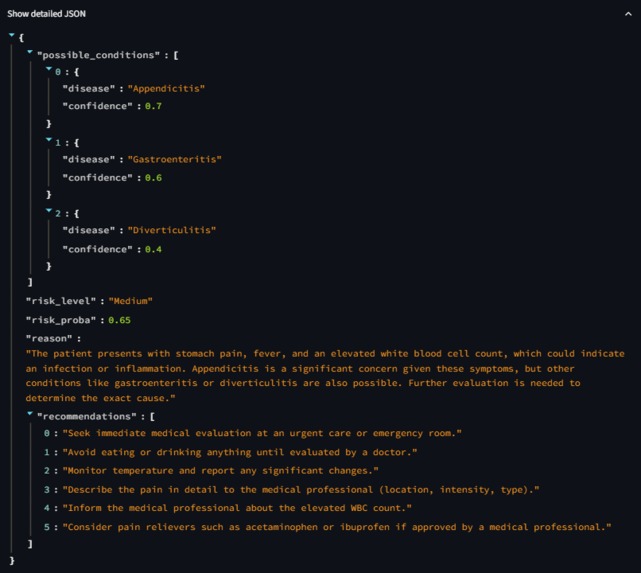
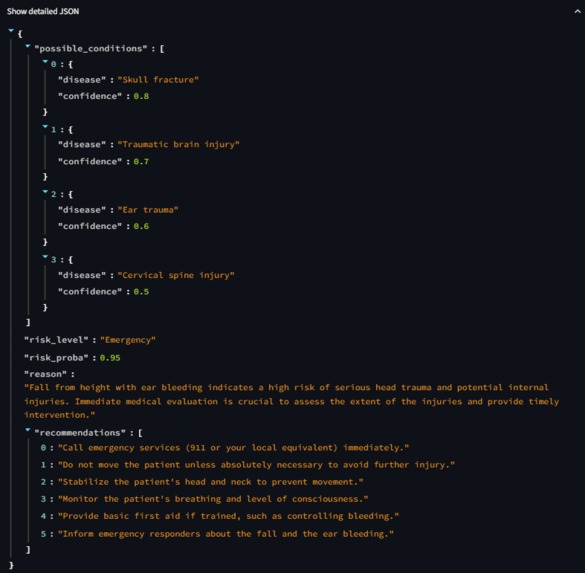
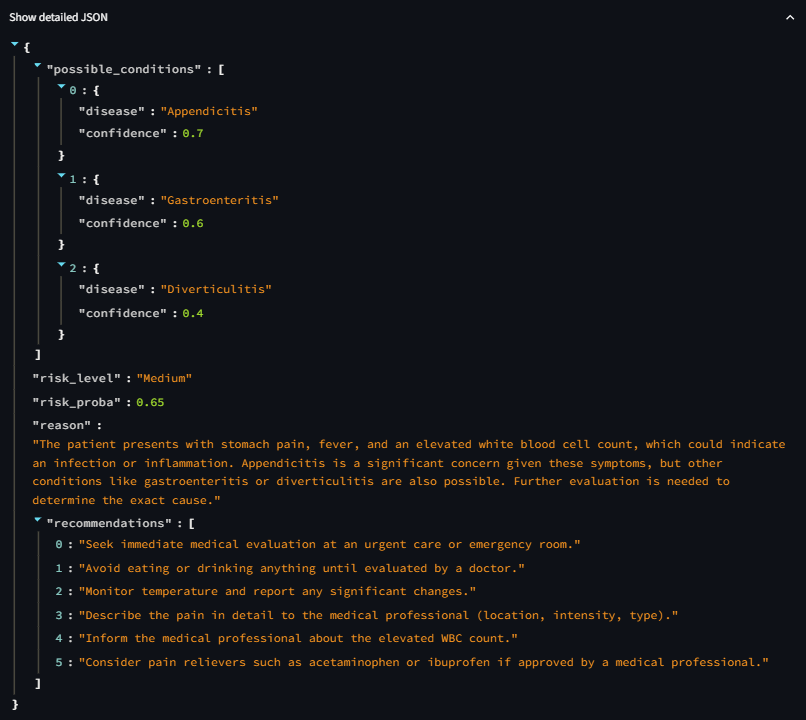
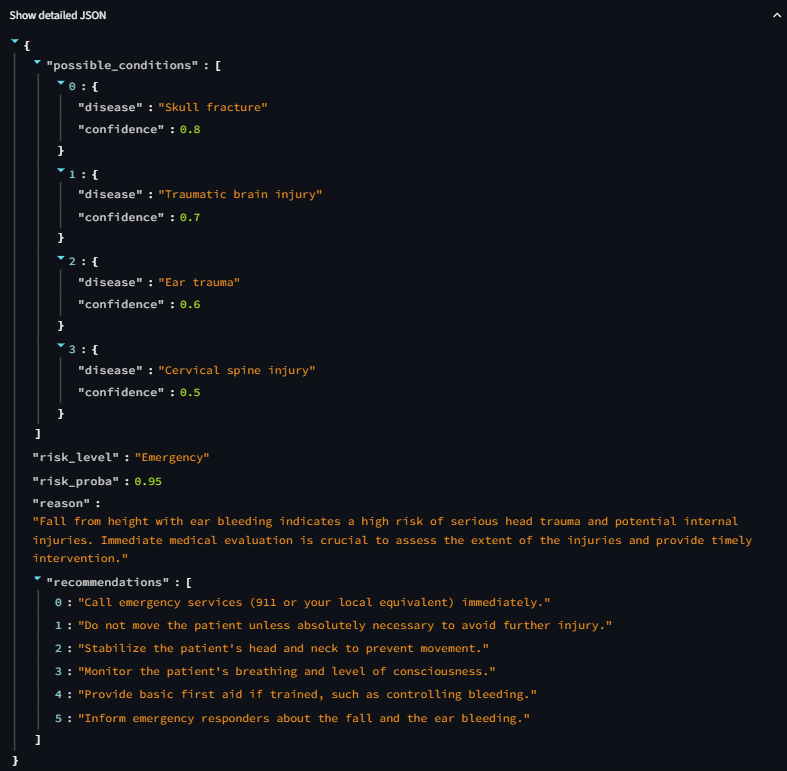
Nexus Health is a multimodal AI health assistant that provides instant, safe, and context-aware medical triage for rural users. A user can describe their symptoms using text or by uploading a medical report. The system analyzes this information and generates a comprehensive assessment, including a risk level, a list of possible conditions with confidence scores, a clinical reason, and actionable recommendations. For urgent cases, it also provides a list of the nearest healthcare facilities using the user's pincode.
How we built it
Nexus Health is built on a safety-first hybrid architecture using a modern, full-stack Python environment.
Frontend: The user interface is a clean and responsive web application built with Streamlit.
Backend & AI: The core logic is written in Python. We engineered a deterministic safety layer that first scans all inputs for "red-flag" emergency keywords. If no emergency is found, a generative AI (Google's Gemini), managed via the LangChain framework, performs a nuanced assessment.
Data & Services: The system uses MongoDB for data persistence (with a local JSON fallback), Google Maps and OpenStreetMap for facility recommendations, and OCR libraries for report processing.
Challenges we ran into
Our primary challenge was ensuring patient safety while using a powerful but non-deterministic generative AI. We solved this by designing our safety-first architecture, where a hardcoded, rule-based engine acts as a crucial guardrail, guaranteeing that clear emergencies are always caught immediately. Another challenge was building a reliable location service, which we addressed by creating a robust fallback system that switches from the Google Maps API to the free OpenStreetMap API, ensuring high availability.
Accomplishments that we're proud of
We are most proud of building a system that is not only technologically advanced but also responsible and effective. In our pilot evaluation, our system achieved a perfect 100% recall for emergency cases, a critical benchmark for any triage tool. Furthermore, our hybrid approach proved superior to both rule-only and LLM-only baselines, achieving 85% overall accuracy and significantly reducing the rate of over-triage from 90% in the rule-based system to just 5%.
What we learned
This project taught us that in modern AI development, the most valuable contribution is often not training a model from scratch but skillfully architecting a complete and safe system around a powerful pre-trained model. We learned the critical importance of a safety-first design philosophy in high-stakes domains like healthcare and the power of a modular, resilient architecture with robust fallback mechanisms.
What's next for Nexus Health
The next step for Nexus Health is to conduct a formal clinical validation study by testing the system's recommendations against those of qualified physicians on a large, real-world dataset. We also plan to enhance the system with native multilingual and dialect support and explore integrations with point-of-care medical devices to ingest real-time health data, further improving its accuracy and impact.
Built With
- dotenv
- fpdf
- google-gemini
- google-maps
- json
- langchain
- mongodb
- ocr
- openstreetmap
- pymongo
- pymupdf
- python
- streamlit
- tesseract


Log in or sign up for Devpost to join the conversation.