Inspiration
Dementia care often relies on periodic clinical assessments and caregiver observations, which can make continuous monitoring difficult, especially for elderly people in rural and underserved regions.
We were inspired by a simple question:
What if cognitive engagement and monitoring could become part of an elderly person's everyday routine instead of being limited to occasional clinical visits?
This led us to create NEUROMORPH, an AI-powered cognitive care platform designed to combine cognitive activities, memory assistance, caregiver support, safety monitoring, and longitudinal tracking in one accessible platform.
Our focus is particularly on the challenges faced by elderly users and caregivers in the North Eastern Region (NER), including accessibility, connectivity, geographic barriers, and diverse language and cultural needs.
What it does
NEUROMORPH combines cognitive engagement, monitoring, and caregiver support into a unified platform.
Core capabilities
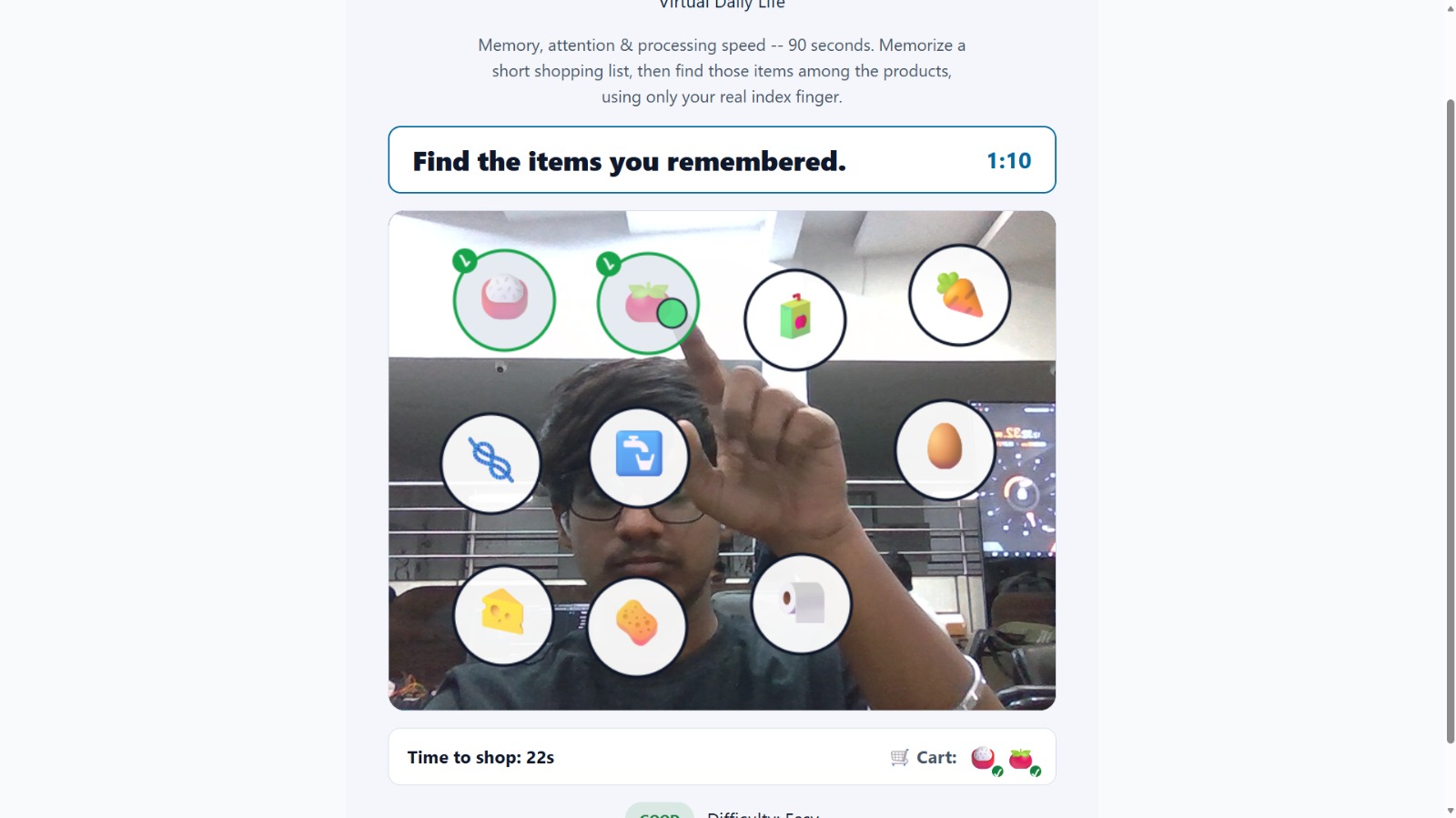
- Adaptive Cognitive Games for memory, attention, pattern recognition, reaction, and other cognitive activities.
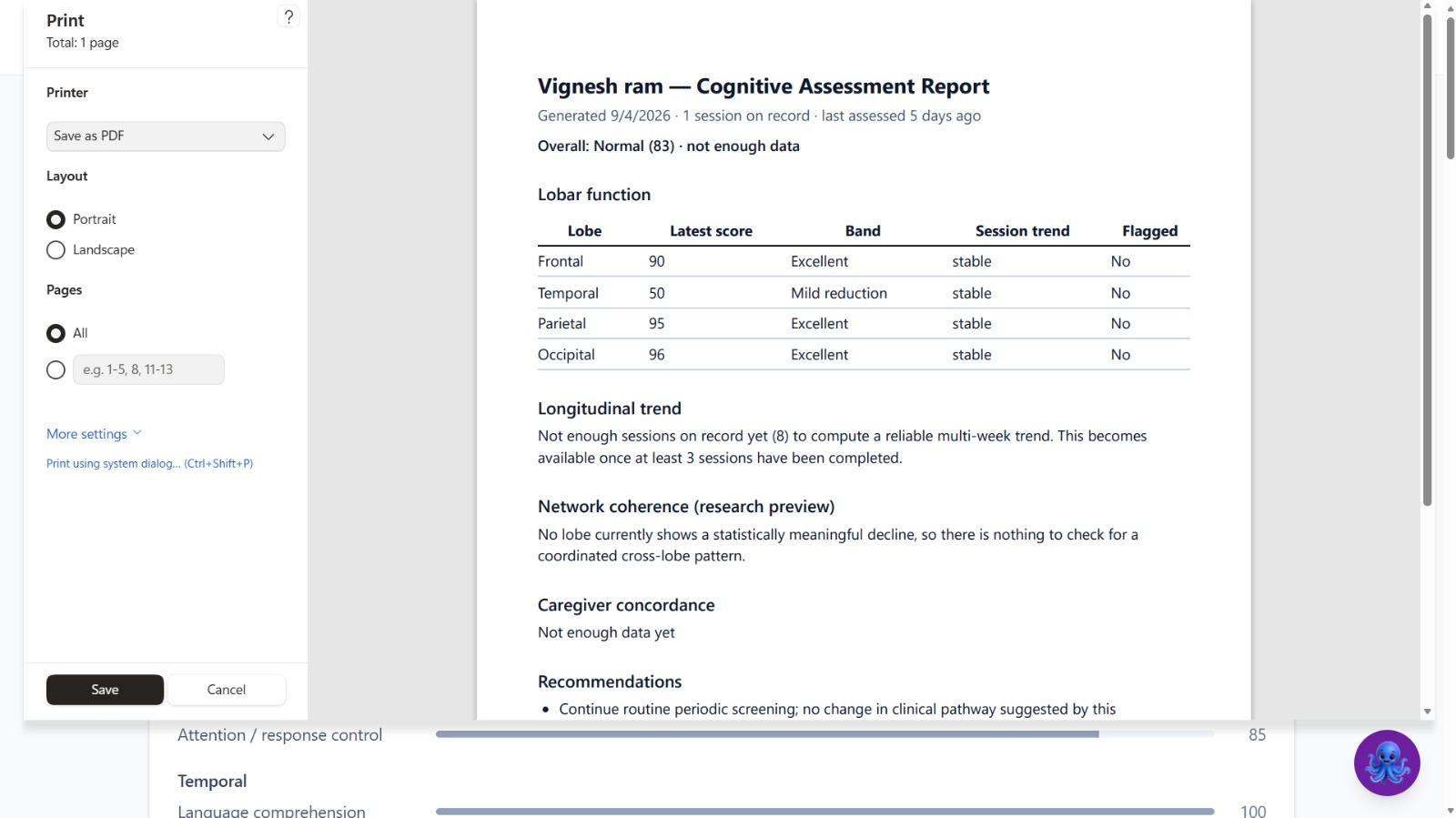
- AI-Based Cognitive Analysis to analyze activity performance and track changes across cognitive domains.
- Memory Assistance for medication, hydration, appointments, and daily routine reminders.
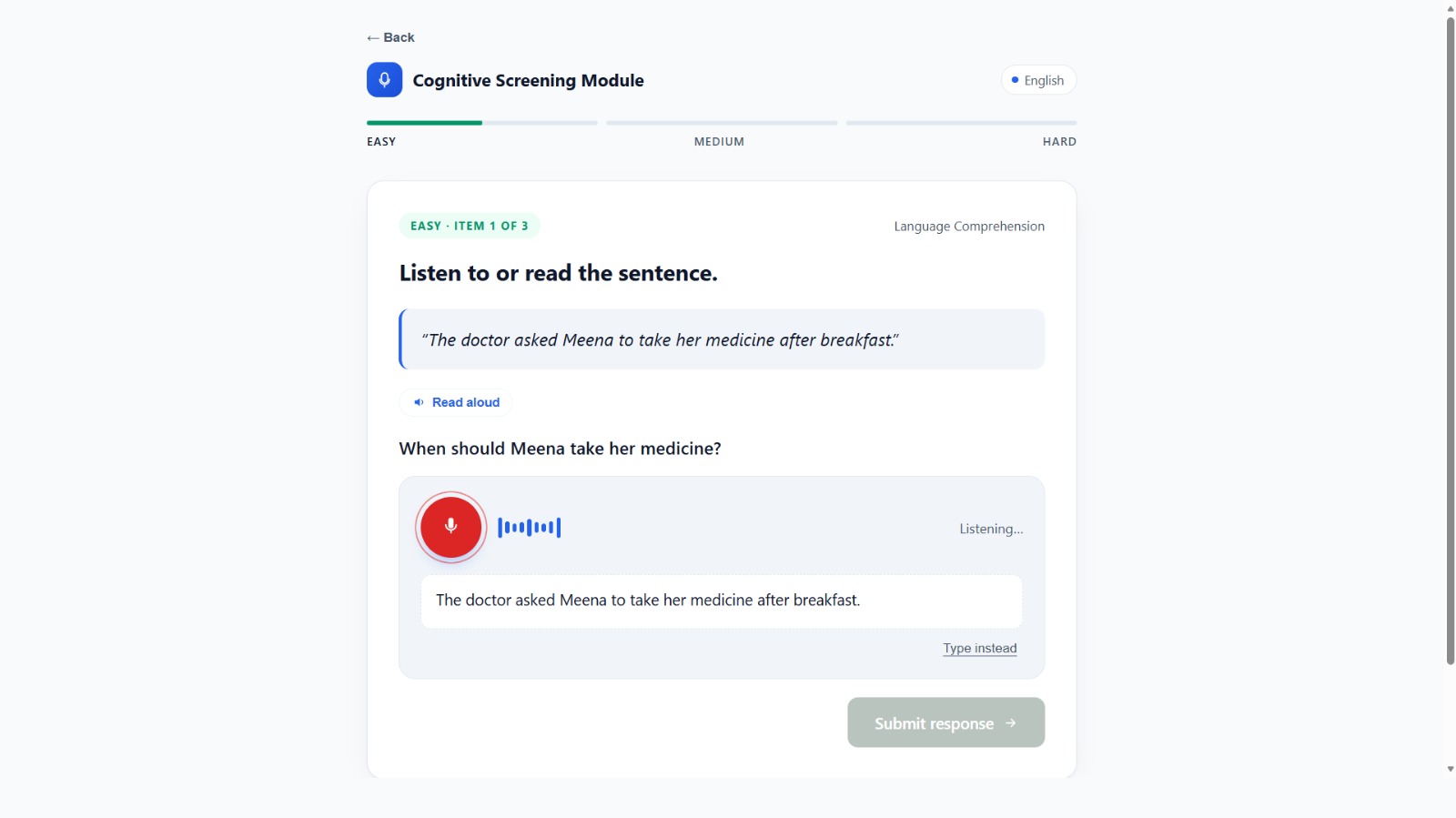
- Voice Assistance for more accessible interaction.
- GPS Safety Monitoring with location tracking and geofencing support for elderly users vulnerable to wandering.
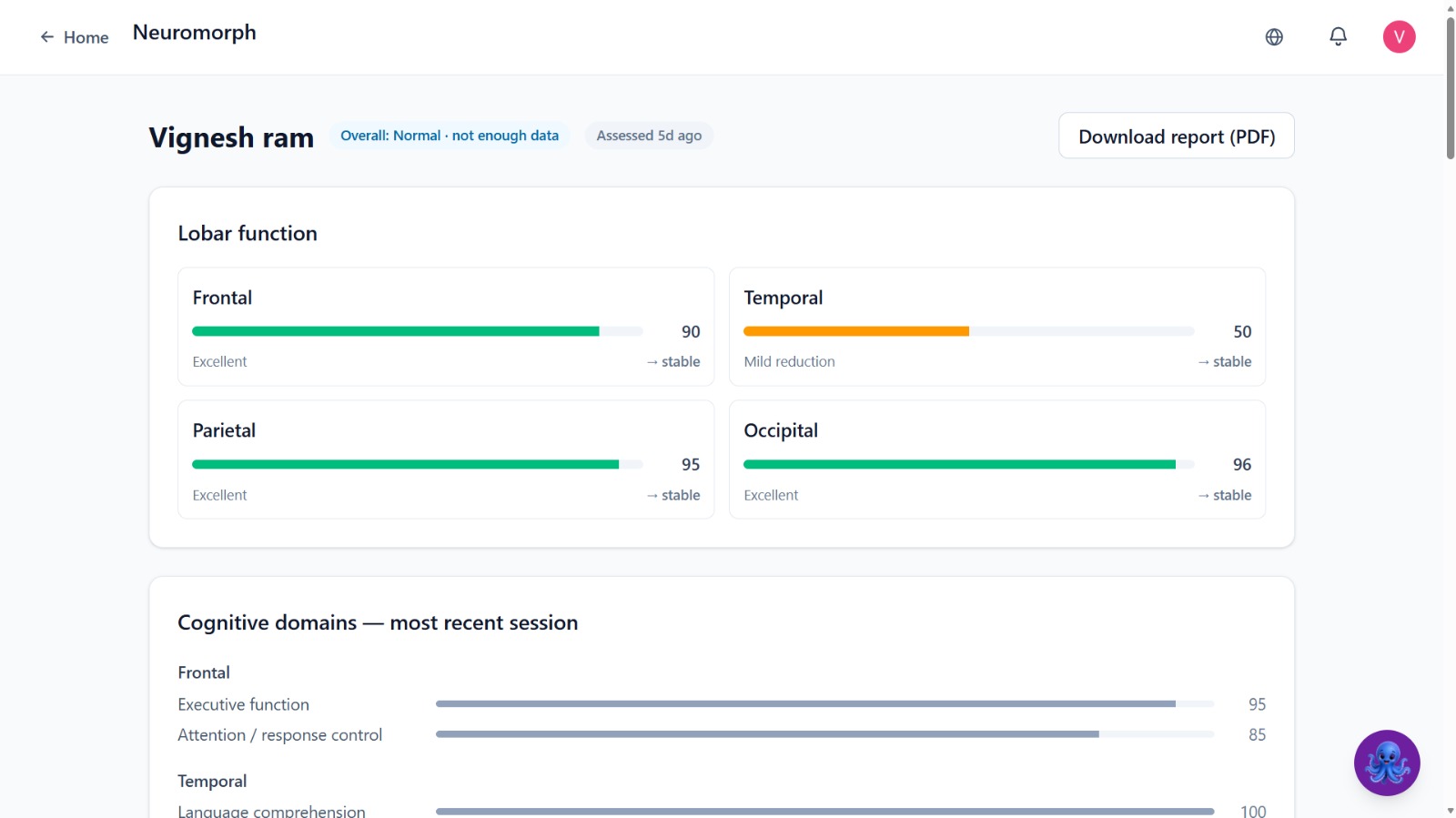
- Caregiver Dashboard for progress, activity, behavioural observations, and safety alerts.
- Offline-First Support for environments with limited or unreliable connectivity.
- Multilingual and Cultural Support for diverse users and regional communities.
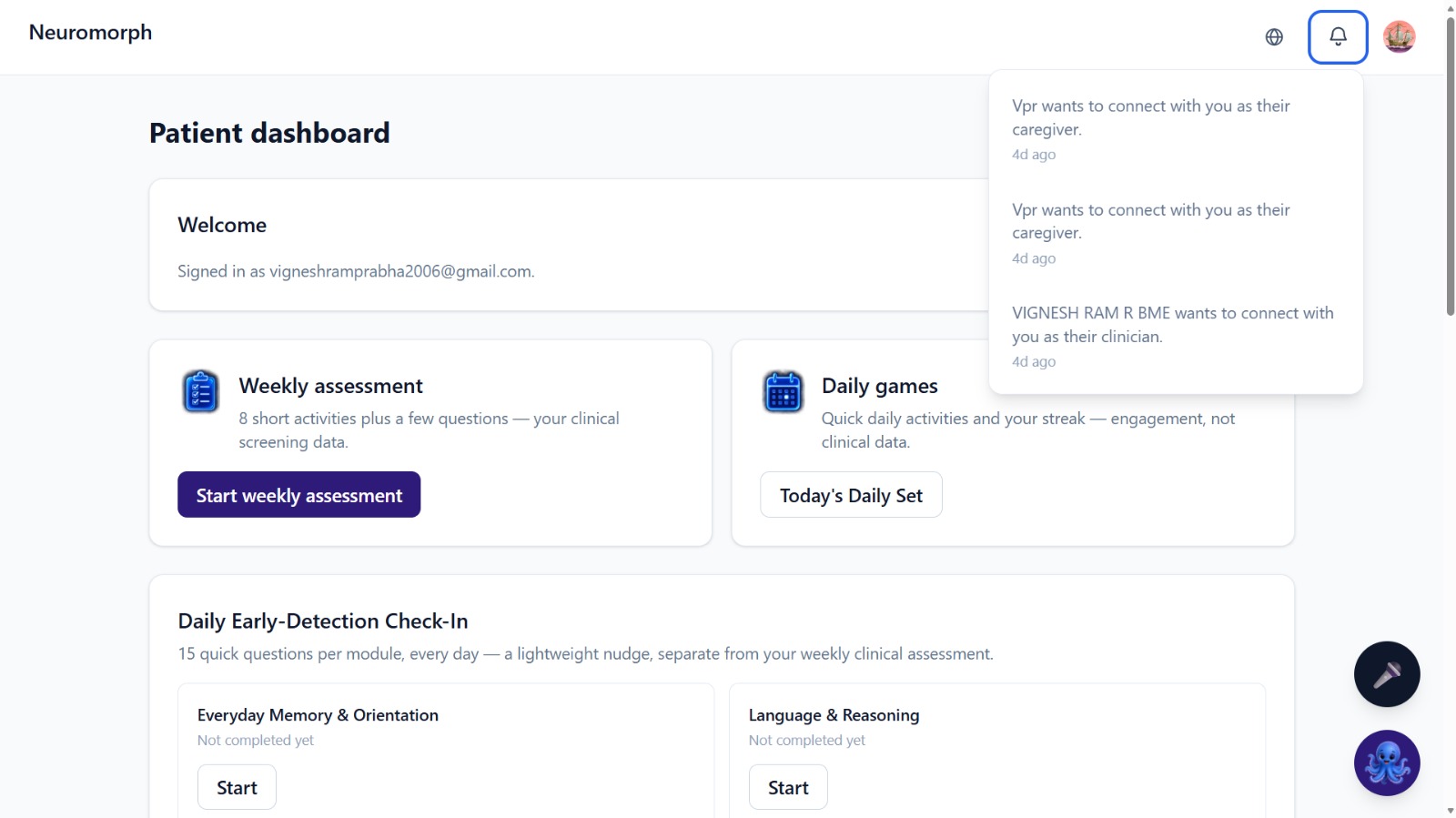
The platform connects three important stakeholders:
Elderly User → Caregiver → Healthcare Professional
Instead of relying only on periodic assessments, NEUROMORPH is designed to support continuous cognitive engagement and longitudinal performance tracking.
How we built it
We designed NEUROMORPH as a modular healthcare platform with a continuous data and feedback workflow:
Data Collection → Processing & Scoring → Cognitive Analysis → Cognitive Insights → Caregiver Dashboard → Continuous Tracking
The proposed technical architecture includes:
- Patient cognitive activities and daily interactions
- Weekly cognitive assessments
- Caregiver check-ins and contextual information
- Data validation and preprocessing
- Feature extraction from task performance
- Cognitive-domain mapping
- Performance and trend analysis
- Cognitive and daily-momentum scoring
- Caregiver-oriented reports and insights
The platform architecture also incorporates role-based access, secure data handling, offline synchronization, GPS tracking, speech-based interaction, and cloud-ready scalability.
We designed the system around an elderly-friendly interface so that cognitive activities remain simple and accessible while the caregiver receives a more structured view of progress and safety.
Challenges we ran into
One of our biggest challenges was bringing several healthcare-support functions together without making the platform unnecessarily complicated.
We had to consider:
- Designing interactions suitable for elderly users
- Converting cognitive activity performance into meaningful metrics
- Combining multiple cognitive domains
- Supporting caregiver involvement
- Designing for low-connectivity environments
- Integrating GPS-based safety support
- Supporting multilingual and culturally relevant interaction
- Maintaining secure access to sensitive patient information
- Keeping the architecture modular enough to scale
Another challenge was communicating cognitive performance without overwhelming caregivers with raw data. This motivated our approach of presenting trends, domain-level insights, progress indicators, and caregiver-oriented summaries.
Accomplishments that we're proud of
We are proud to have developed a unified concept that brings together capabilities that are often considered separately:
Cognitive Training + Adaptive AI + Memory Assistance + Caregiver Monitoring + GPS Safety + Offline Accessibility
We also developed a complete technical architecture covering data collection, processing, cognitive analysis, scoring, caregiver insights, security, and scalability.
Our prototype concept includes cognitive games, clinical assessment workflows, speech analysis, analytics, caregiver monitoring, and progress visualization.
Most importantly, we designed the solution around the realities of underserved environments rather than assuming continuous connectivity and easy access to specialized care.
What we learned
Building NEUROMORPH taught us that healthcare innovation is not only about adding AI or more technology.
We learned that the user, caregiver, clinical context, and environment must all influence the design.
We learned the importance of:
- Designing technology that elderly users can comfortably interact with
- Considering connectivity limitations from the beginning
- Combining automated analysis with human oversight
- Tracking changes longitudinally rather than relying only on individual assessments
- Presenting complex information in a simple form for caregivers
- Treating privacy and secure access as core architectural requirements
- Designing for language and cultural diversity
We also learned that healthcare AI requires careful validation. Cognitive scores and analytical insights should support monitoring and clinical workflows rather than being presented as independently validated medical diagnoses without appropriate clinical evidence.
What's next for NEUROMORPH – AI Cognitive Care Platform
Our next goal is to move from the current prototype and concept architecture toward broader validation and real-world deployment.
Future development directions include:
- Integration with wearable health-monitoring devices
- Passive behavioural pattern tracking
- Expanded AI-assisted cognitive trend analysis
- Additional Indian regional languages
- Hospital and telemedicine integration
- Community-based cognitive assessment
- Smarter caregiver recommendation systems
- Predictive risk alerts based on behavioural trends
- Larger-scale testing with elderly users and caregivers
- Clinical validation of cognitive assessment and scoring methods
Our long-term vision is to create an accessible cognitive-care ecosystem connecting elderly users, caregivers, and healthcare professionals, particularly in communities where specialized cognitive healthcare may be difficult to access.
NEUROMORPH — Engage. Train. Track. Connect.

Log in or sign up for Devpost to join the conversation.