NestNote — Graph-Powered Airbnb Local Guide & Digital Welcome Book (Relate by Neo4j)
Inspiration
Every short-term rental stay starts with the exact same friction: hosts spend hours every week answering repetitive texts about Wi-Fi passwords, smart lock codes, and restaurant recommendations, while guests are handed static PDFs or laminated binders that treat every traveler identically. A solo traveler looking for late-night jazz and natural wine receives the exact same generic neighborhood list as a family with two toddlers trying to survive a rainy afternoon.
We realized local travel recommendations are fundamentally a connected context problem—matching physical proximity, group constraints, personal vibes, and verified past-guest experiences. This makes Relate by Neo4j the ideal graph engine to bring static welcome books to life, turning scattered house manuals and local tips into hyper-personalized, explainable guest experiences.
What it does
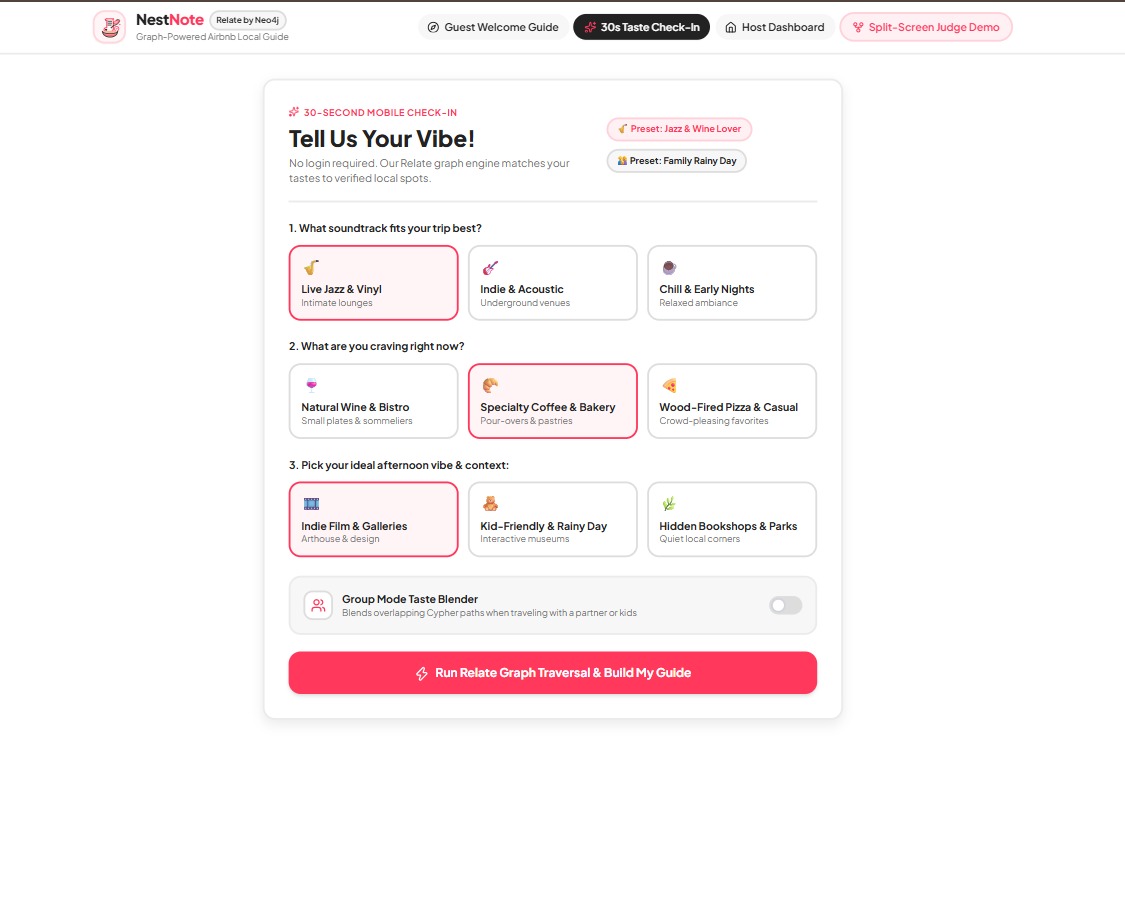
NestNote is an embedded, graph-powered Airbnb local guide and digital welcome book built on Relate by Neo4j:
- 30-Second Taste Check-In: Guests open a magic link or scan a table QR code (zero app download or login required) to select their trip soundtrack, food cravings, and afternoon vibe. It includes a Group Mode Taste Blender to seamlessly merge preferences when traveling with a partner or kids.
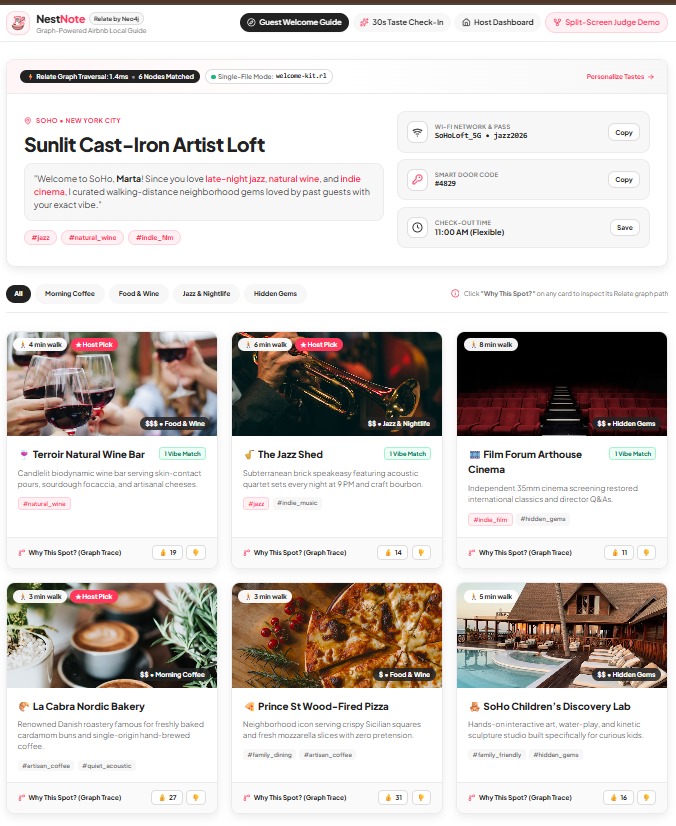
- Sub-2ms Graph-Matched Guide: Our embedded Relate knowledge graph (
welcome-kit.rl) traverses multi-hop Cypher paths in ~1.4ms to rank walking-distance spots tailored to the guest's exact vibe profile, paired with one-tap copyable essentials (Wi-Fi network & password, smart door code, check-out time). - Explainable "Why This Spot?" Graph Traces: Every recommendation features an inspectable Cypher path drawer showing why it matched (e.g., walking distance, shared
(:VibeTag)nodes,[:SUITABLE_FOR]constraints, or Host Secret Gem boosts). - Grounded AI House Concierge: A slide-up chat assistant grounded directly in property node metadata and house rules to instantly answer questions about Wi-Fi, quiet hours, amenities, and graph-matched nightlife.
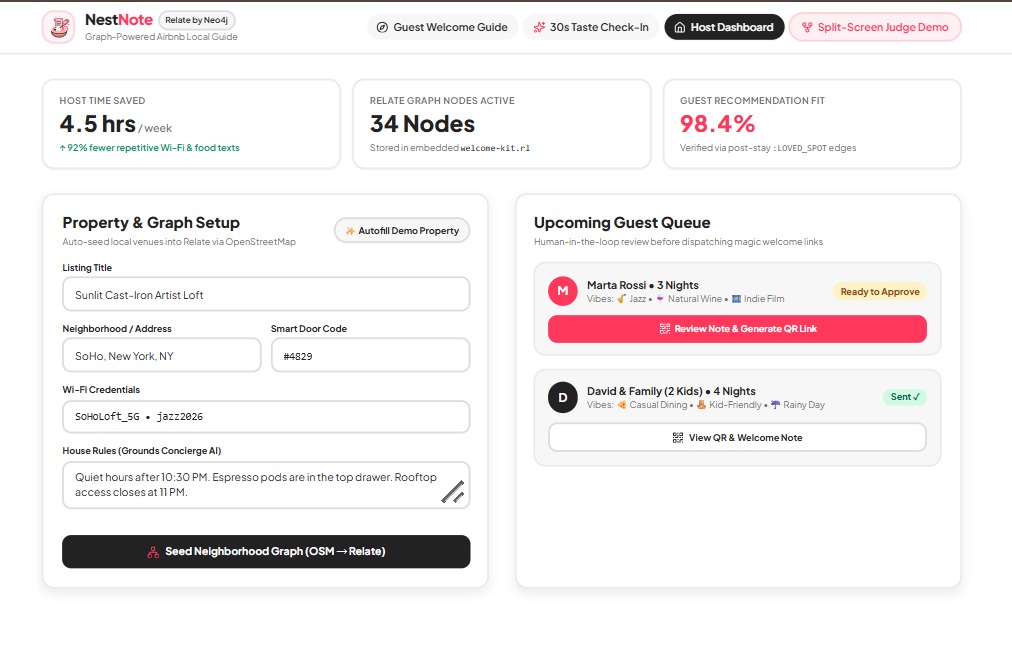
- Host Dashboard & Human-in-the-Loop Approval: Hosts can auto-seed nearby venues from OpenStreetMap straight into their Relate graph file, review and edit AI-drafted welcome notes, generate shareable QR links, and track ROI time-saved metrics.
- Live Post-Stay Learning: Guests upvote or downvote spots during their stay, committing real-time
(:Guest)-[:LOVED_SPOT]edges back into the graph to continuously refine recommendations for future travelers.
How we built it
- Graph Engine (Relate by Neo4j): Stored the neighborhood knowledge graph using Relate's single-file embedded format (
./server/data/welcome-kit.rl). This eliminated external database server overhead while keeping graph state lightweight, portable, and persistent. - Graph Schema & Cypher Traversals: Modeled
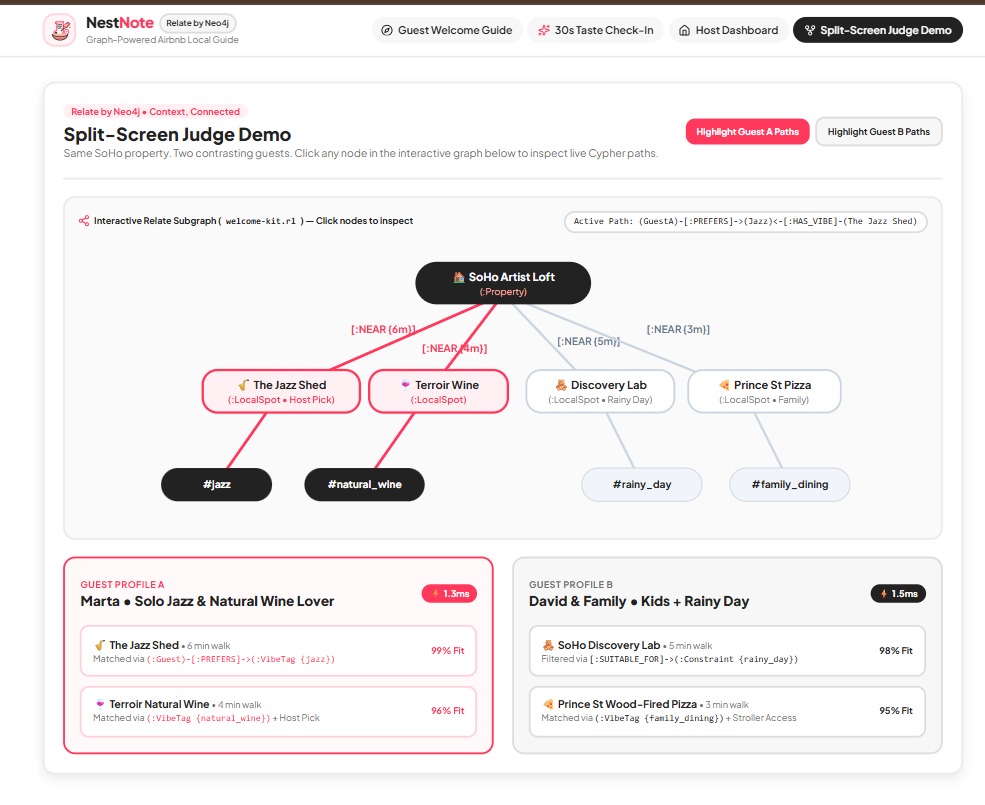
(:Property),(:LocalSpot),(:VibeTag),(:Constraint), and(:Guest)nodes connected via[:NEAR {walkMins, isHostPick}],[:HAS_VIBE],[:SUITABLE_FOR],[:PREFERS], and[:LOVED_SPOT]relationships, queried through multi-hop Cypher paths. - Frontend Architecture: Developed a responsive web interface utilizing Tailwind CSS, Plus Jakarta Sans typography, and Lucide icons. Built custom inline SVG graph visualizers and a Split-Screen Judge Demo to showcase how the graph dynamically adapts for contrasting guest personas at the exact same listing.
Challenges we ran into
- Balancing Automation with Host Control: Hosts require efficiency without risking hallucinated rules or off-brand messages. We resolved this by grounding the House Concierge strictly in property-node data and incorporating a human-in-the-loop approval step before welcome links are sent.
- Designing Group & Context Blending in Cypher: When a family travels on a rainy day, recommendations cannot rely on simple keyword matching—they must satisfy contextual constraints like
#rainy_dayor#stroller_friendly. Structuring(:Constraint)nodes alongside weighted scoring (vibeMatches * 10 + isHostPick * 5 + lovedCount * 0.2) kept multi-constraint filtering fast and accurate. - Making Graph Traversals Consumer-Friendly: Raw Cypher queries can feel abstract. Designing the interactive "Why This Spot?" node-and-edge visualizer bridged the gap between backend graph logic and clear, consumer-facing explainability.
Accomplishments that we're proud of
- Zero-Server Portability with Relate: Packaged a complete hyper-local recommendation engine, house manual, and learning feedback loop into a single portable
.rlfile with sub-2ms query performance. - End-to-End Dual Experience: Delivered both an intuitive guest guide and a practical host workflow (OSM auto-seeding, editable AI welcome notes, QR generation, and time-saved analytics) in a unified product.
- Interactive Subgraph Explorer: Created a live visual playground for judges and hosts to toggle between contrasting guest personas and watch active Cypher graph paths re-route in real time.
What we learned
- Embedded Graphs Empower Edge & Hospitality Apps: Operating Relate in single-file mode demonstrates that graph databases are not limited to massive data centers—they are lightweight enough to run per-property or per-agent with zero infrastructure friction.
- Explainability Builds Guest Trust: Showing guests why a local venue was recommended—through walking distance, host picks, and past guest endorsements—makes suggestions feel like authentic insider tips rather than sponsored ads.
What's next for NestNote
- PMS & Smart Lock Integration: Syncing directly with Airbnb/PMS webhooks and smart lock APIs (August, Schlage) to automatically issue time-bound door codes and personalized welcome links upon booking.
- Cross-Property Graph Federation: Sharing anonymized
(:LocalSpot)and[:LOVED_SPOT]subgraphs across neighboring properties via Neo4j Aura so new hosts inherit community-verified neighborhood graphs from day one. - Real-Time Weather & Event Edges: Dynamically updating
[:SUITABLE_FOR]path weights using live weather feeds and local venue calendars so recommendations adapt automatically hour by hour.
Built With
- ai-concierge
- cypher
- html5
- javascript
- knowledge-graph
- lucide-icons
- neo4j
- openstreetmap
- relate-by-neo4j
- svg
- tailwindcss
