-
-
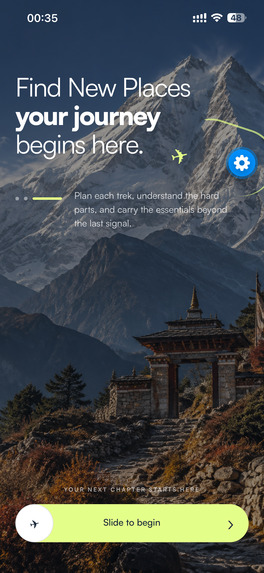
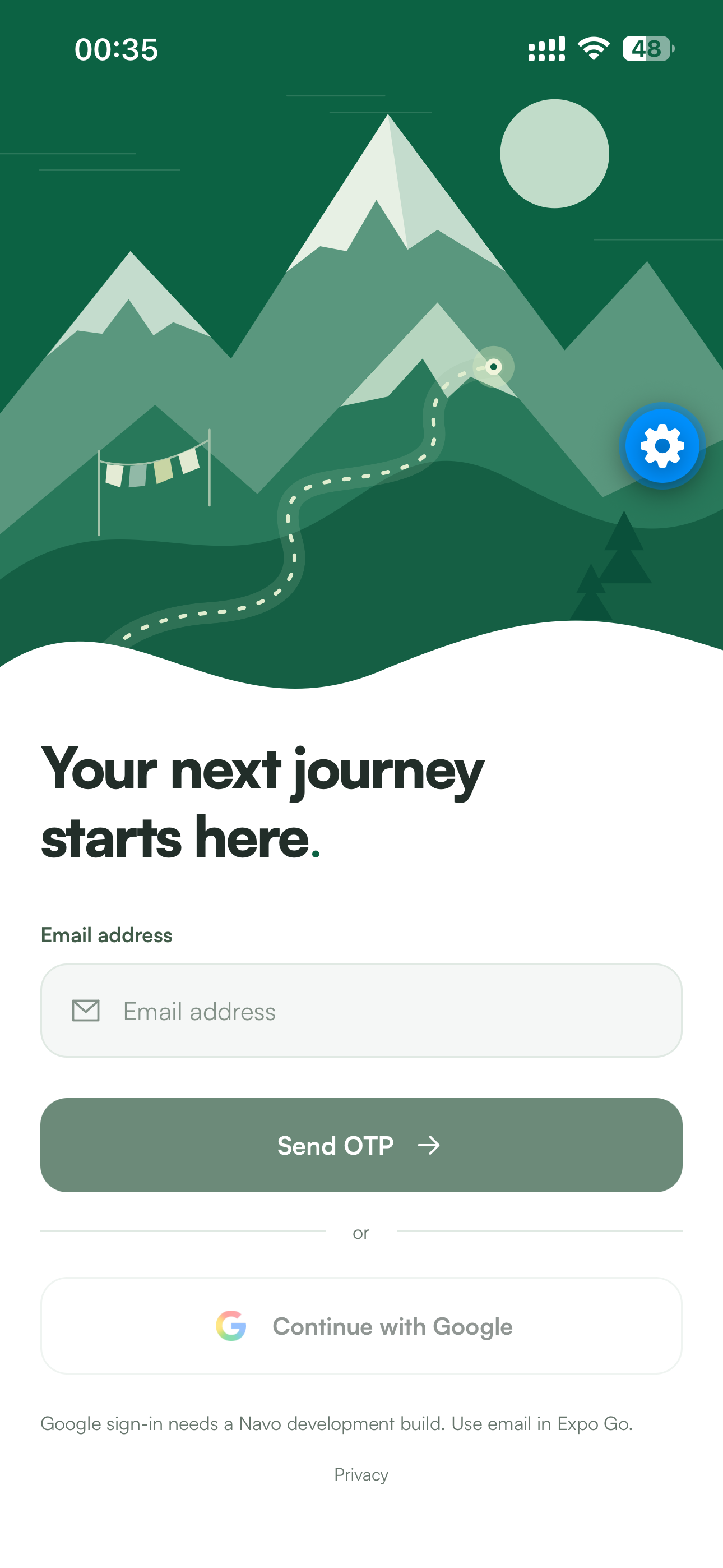
Navo welcomes hikers with a simple introduction to planning a journey through Nepal.
-
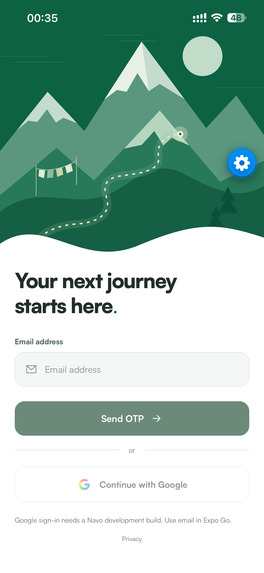
Sign in with email to keep your trek plans and preparation in one place.
-
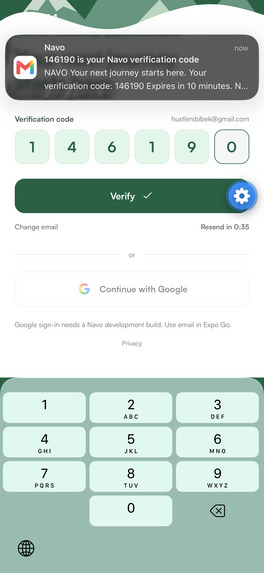
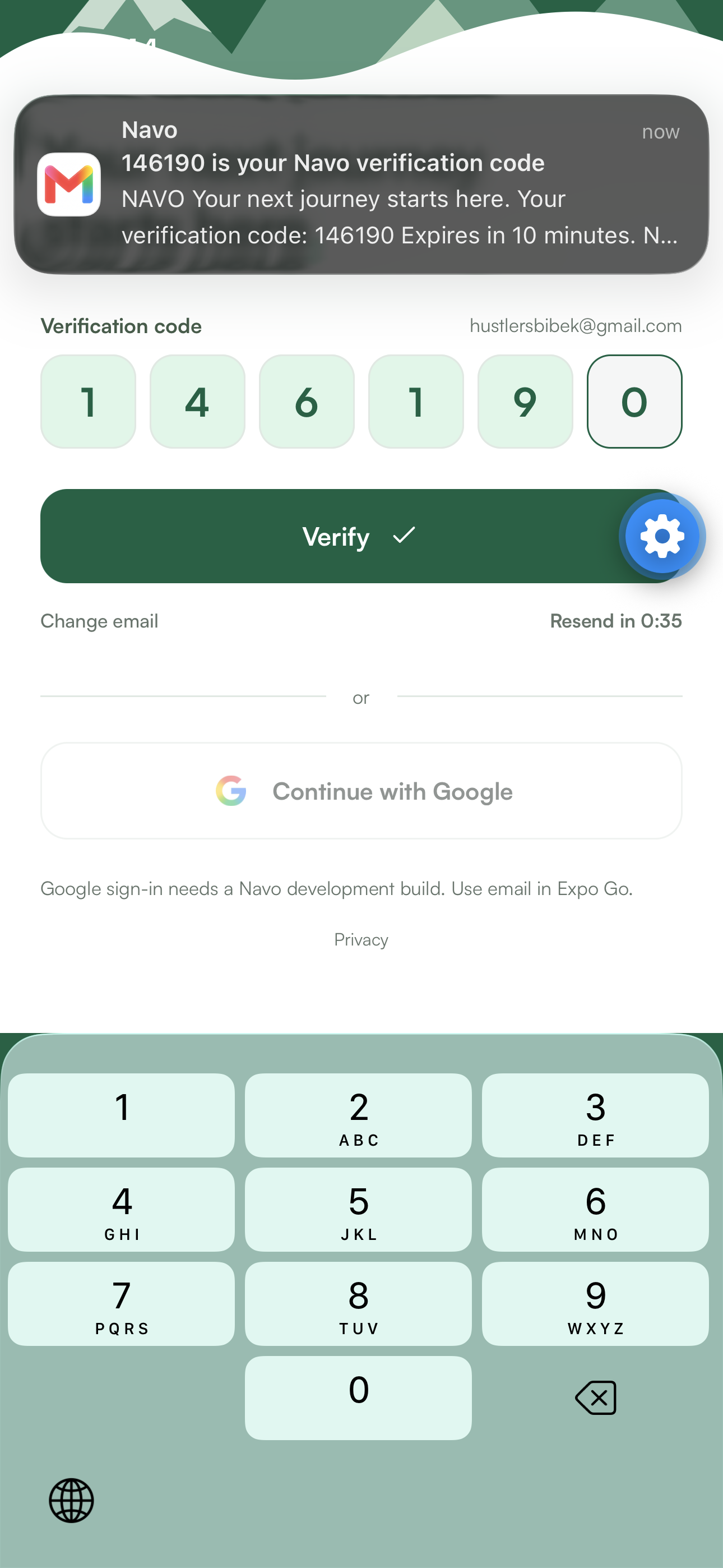
Email verification helps you securely access your Navo account.
-
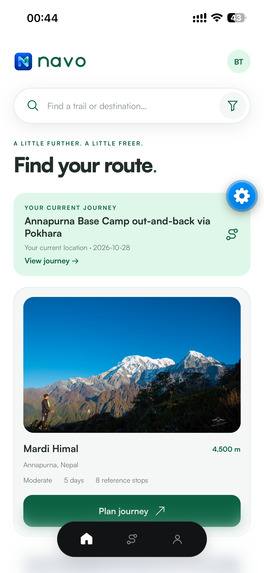
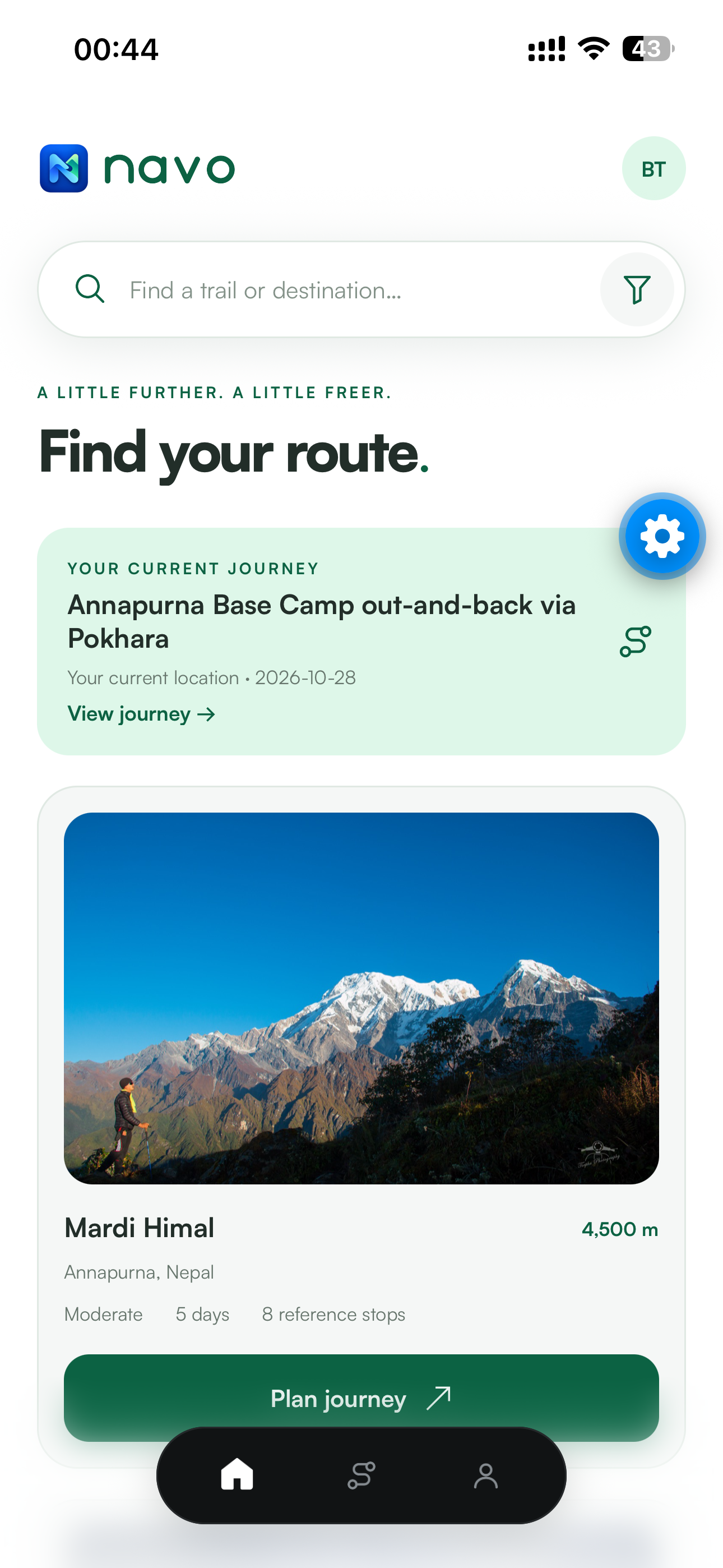
Discover destinations and continue a journey you have already started.
-
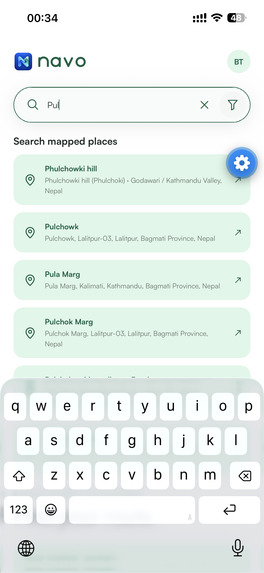
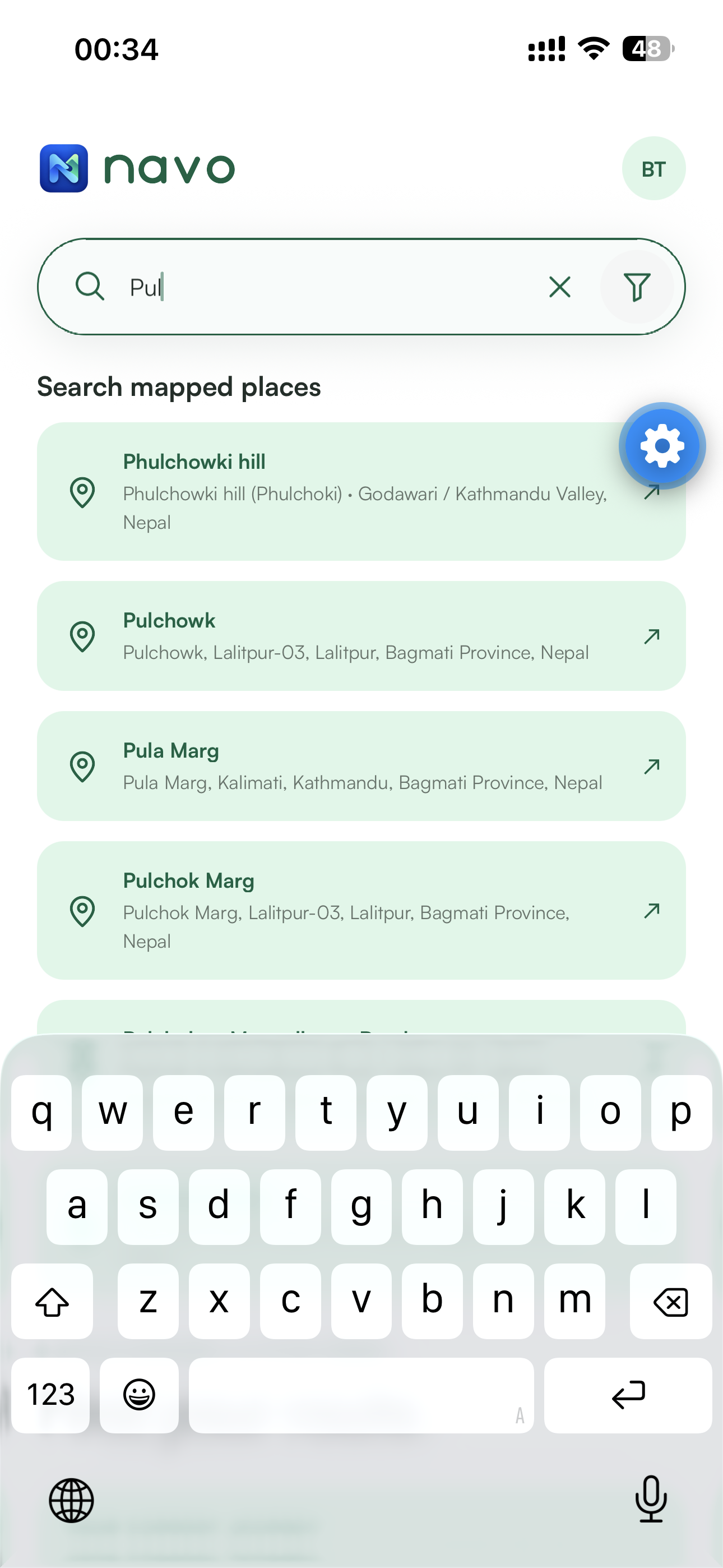
Search mapped places and compare suggestions as you type.
-
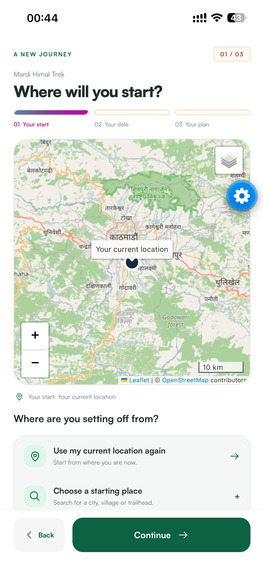
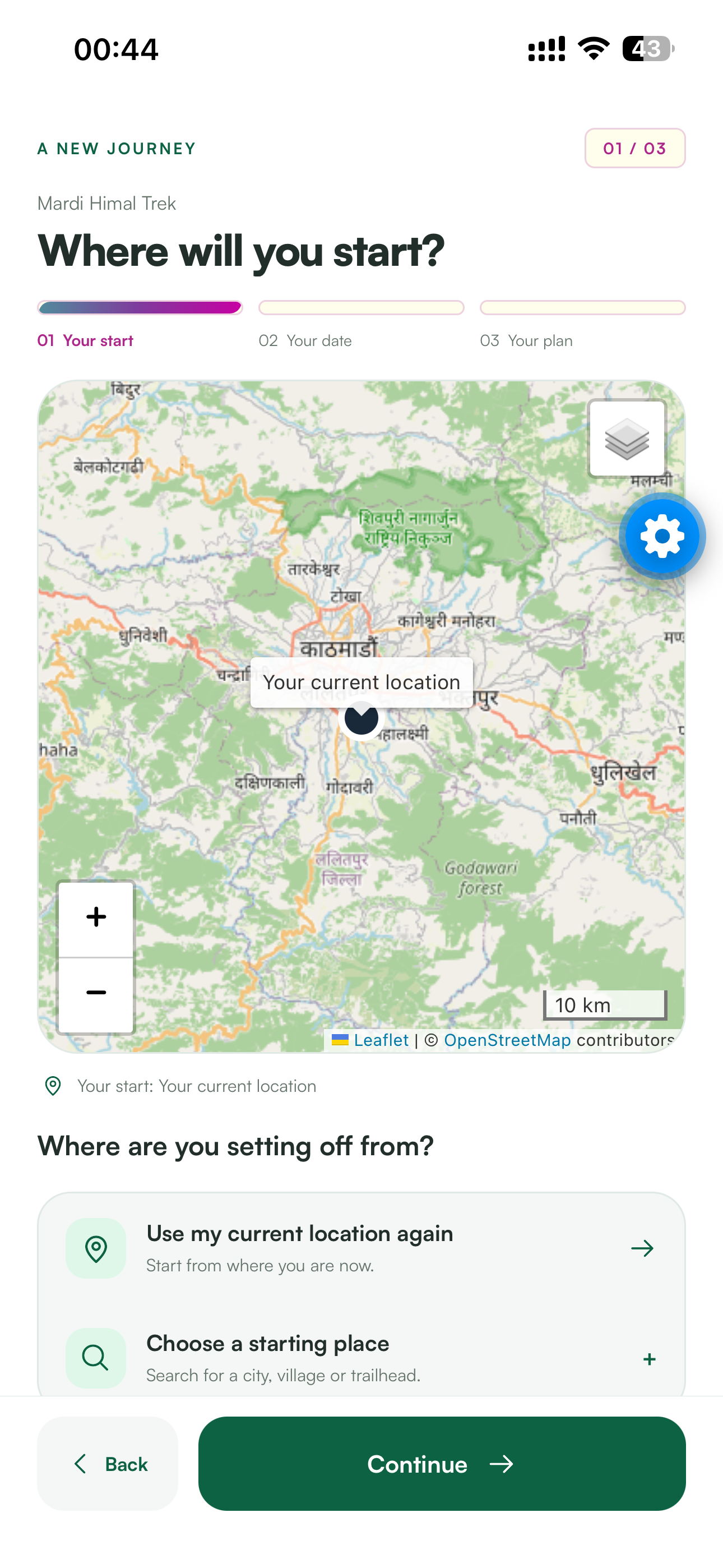
Choose your starting point on the map or search for a city or trailhead.
-
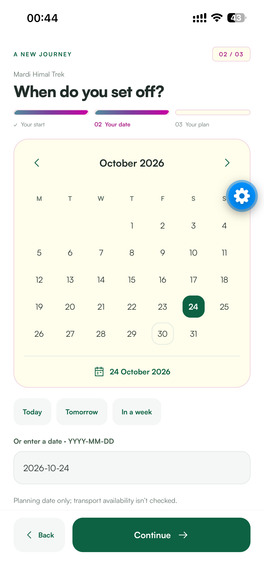
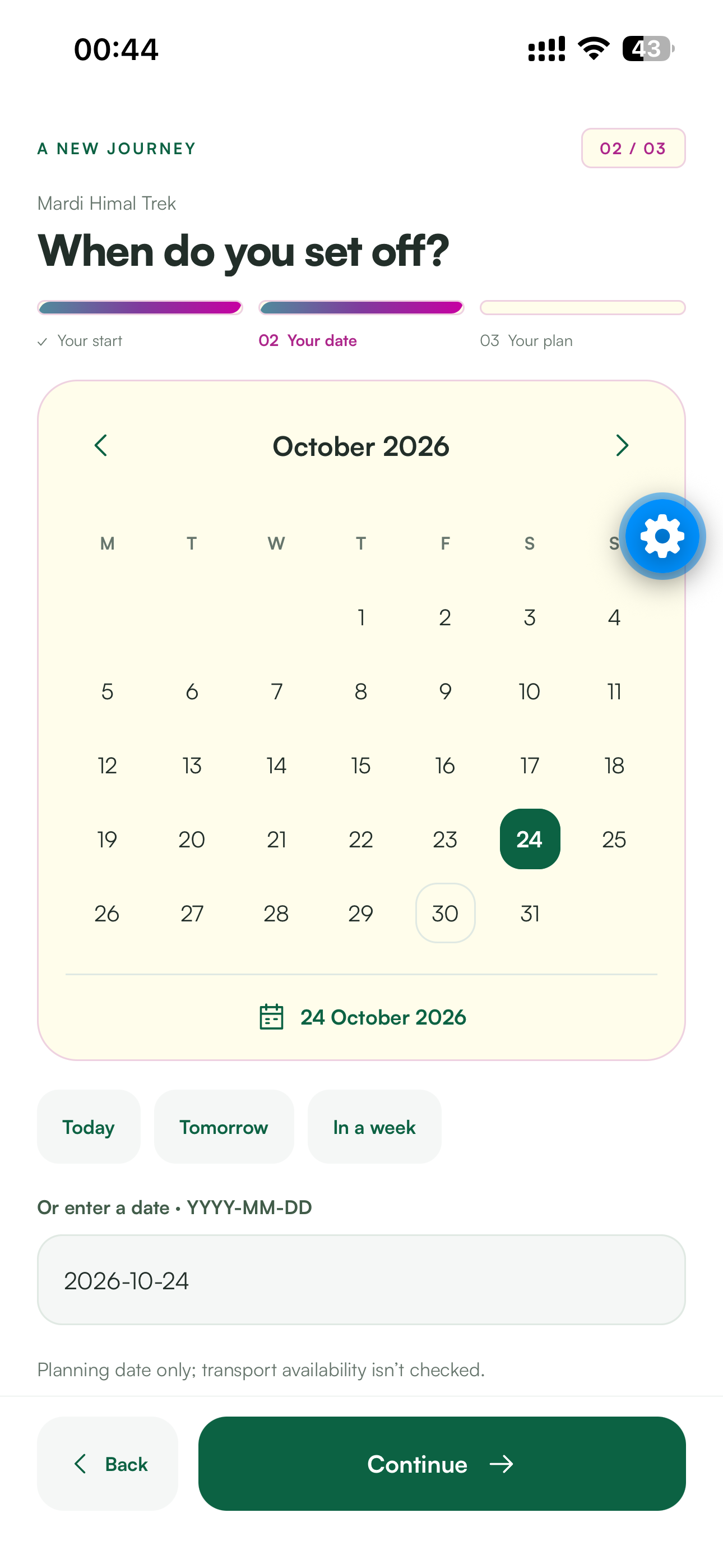
Pick a departure date that works for your trek.
-
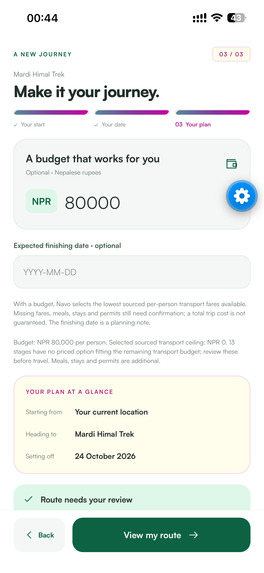
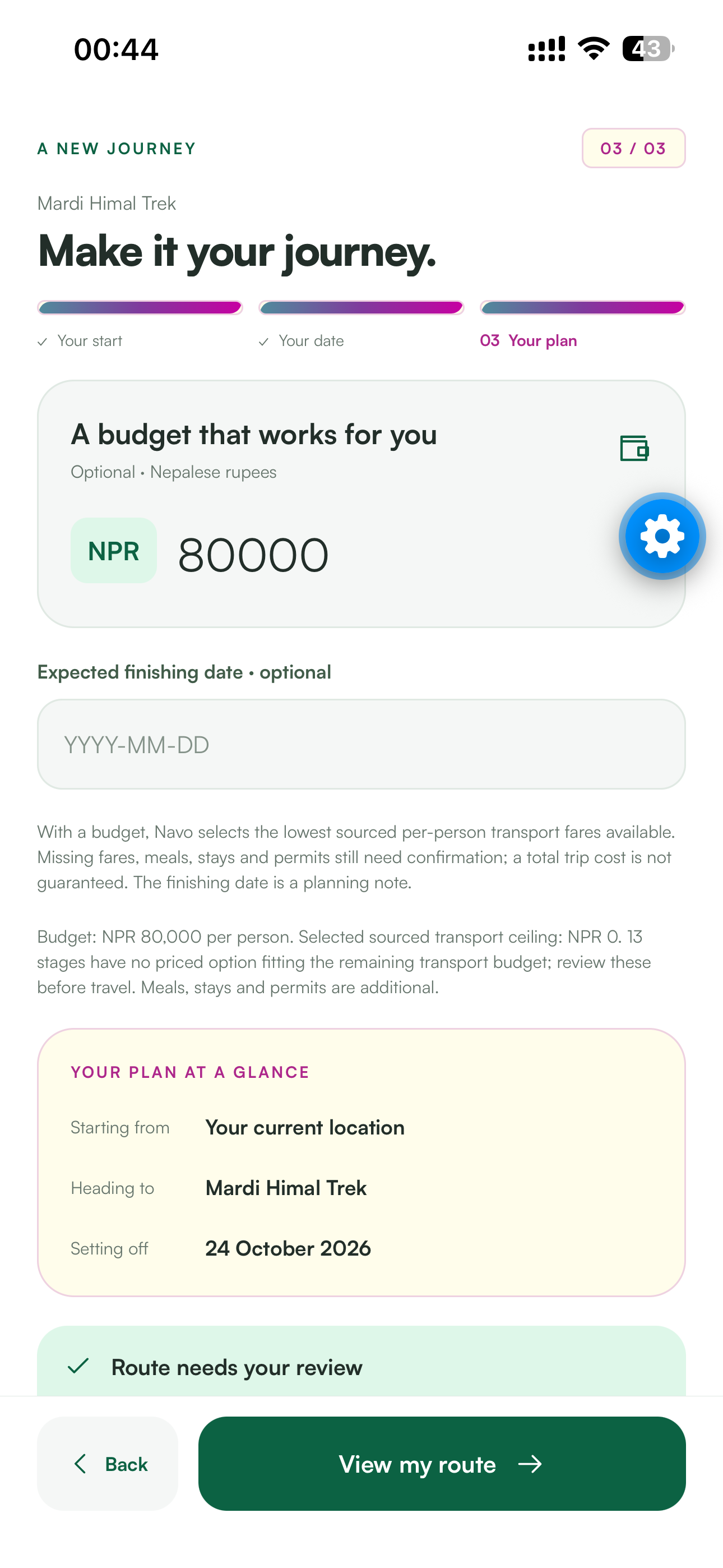
Set a personal budget and review your journey before opening the proposed route.
-
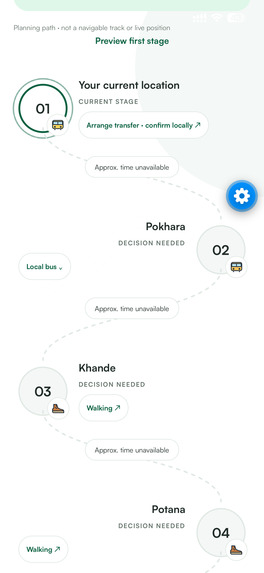
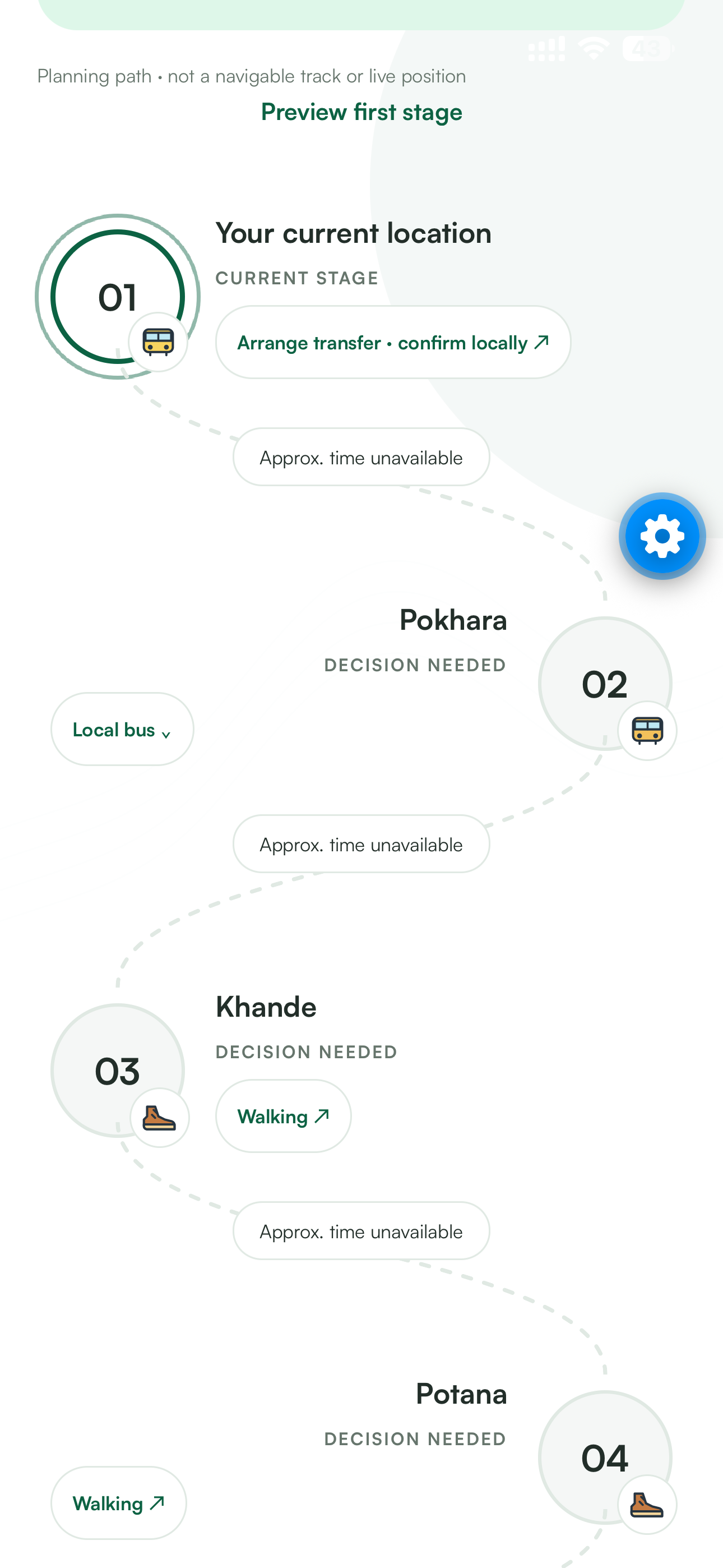
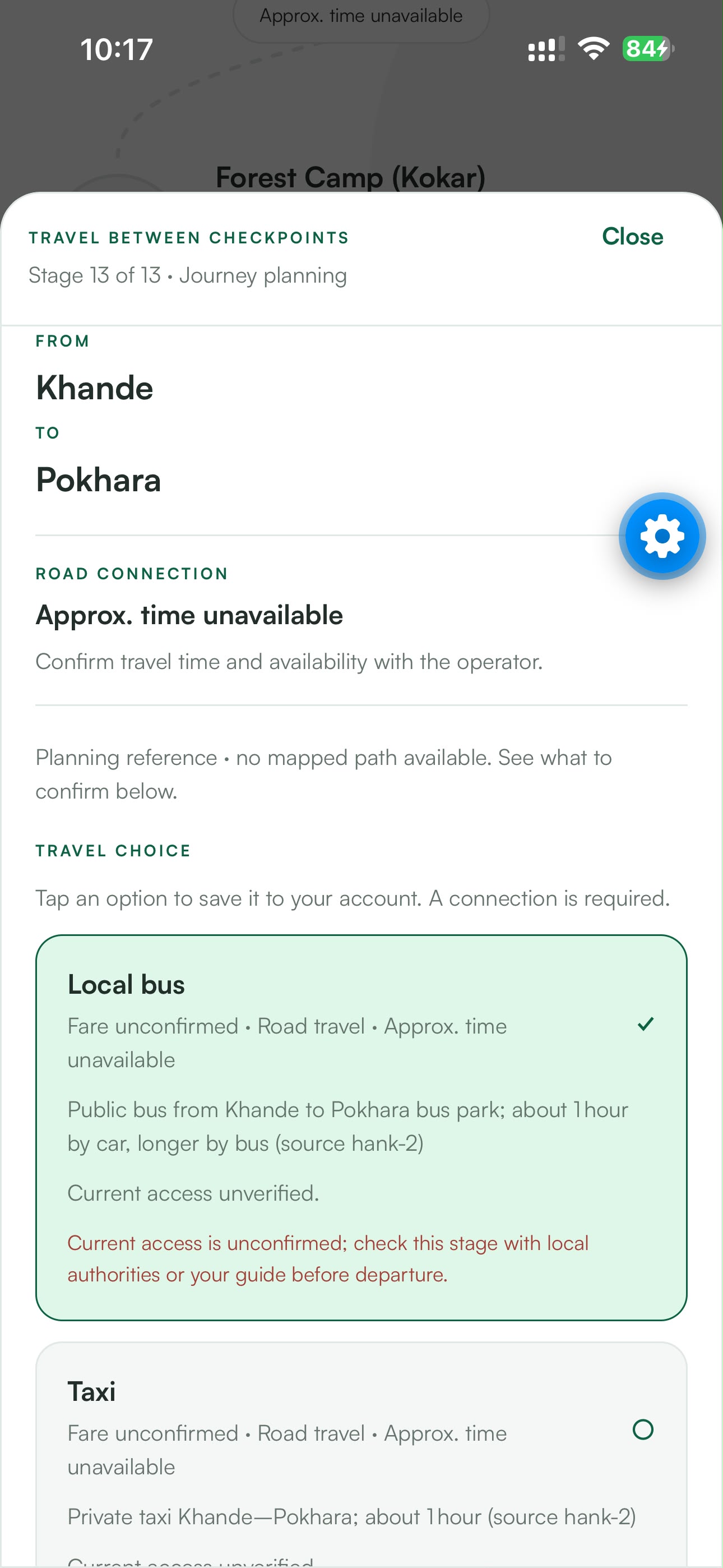
Explore each planning stage and see where transport, timing, or trail decisions still need confirmation.
-
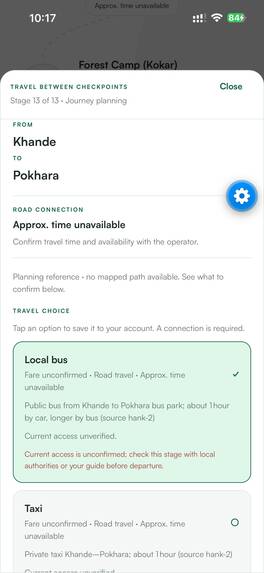
User can edit which travel option they want and see the information in detail.
-
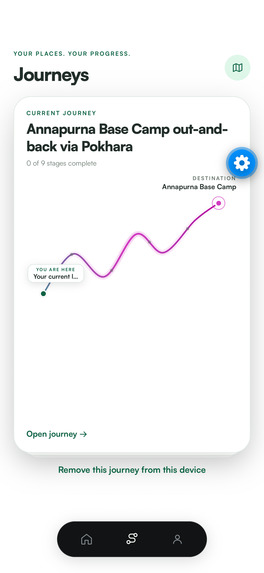
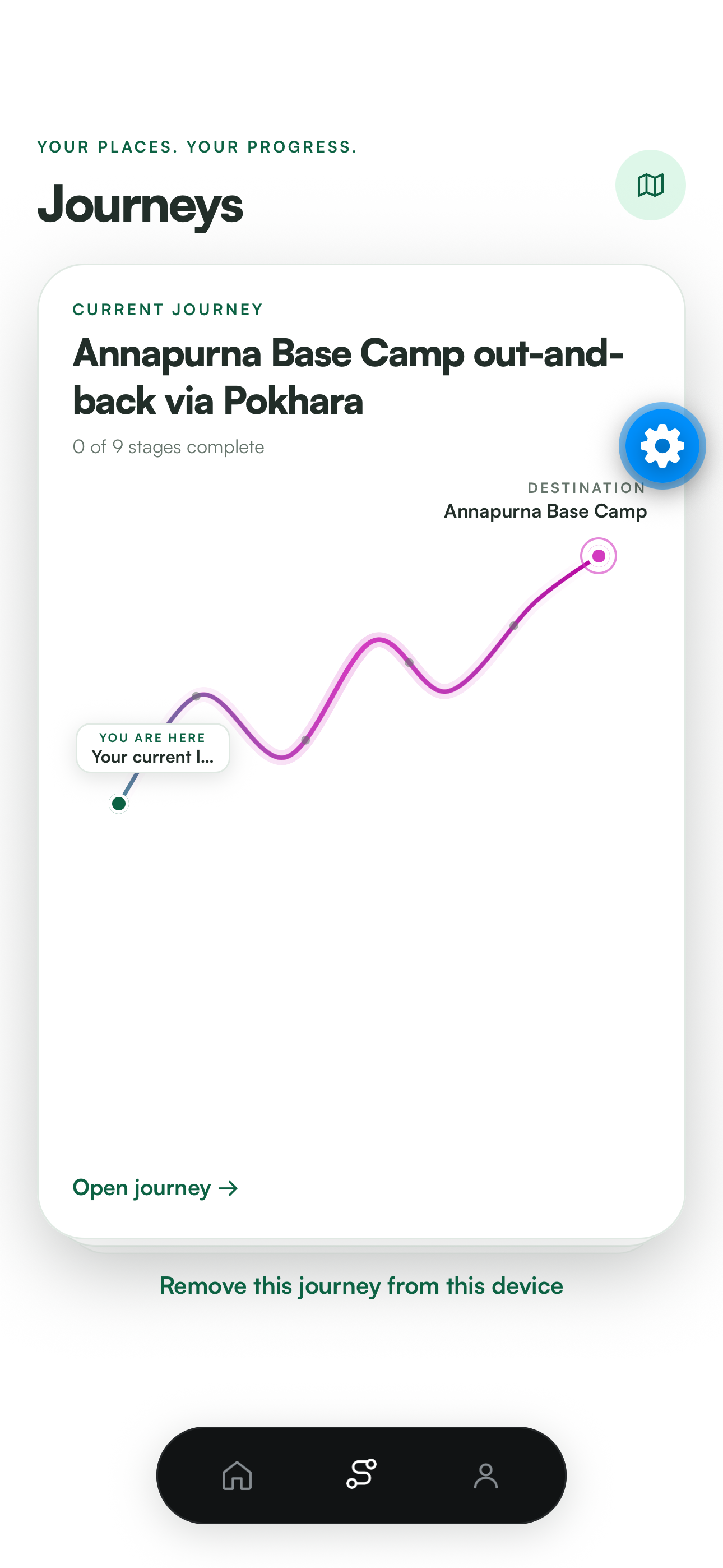
Reopen a saved journey and track which preparation stages are complete.
-
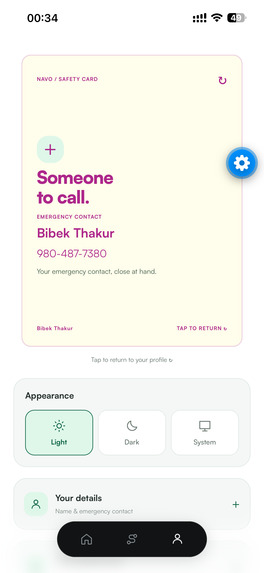
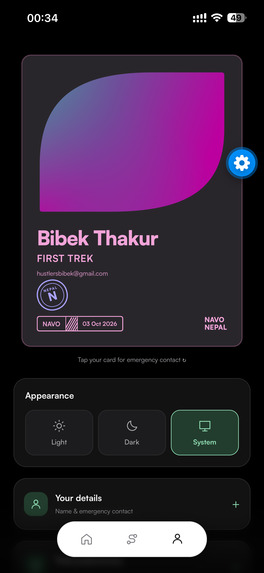
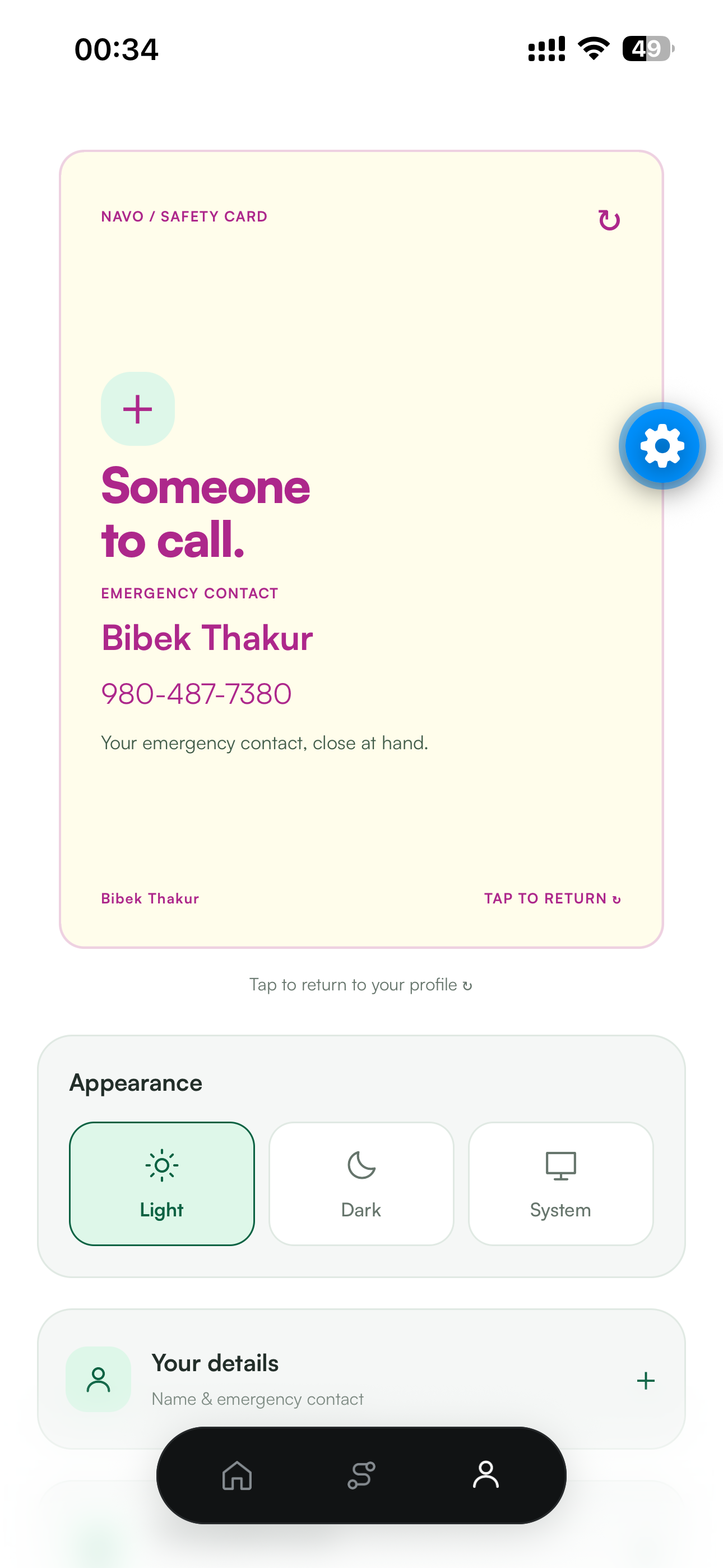
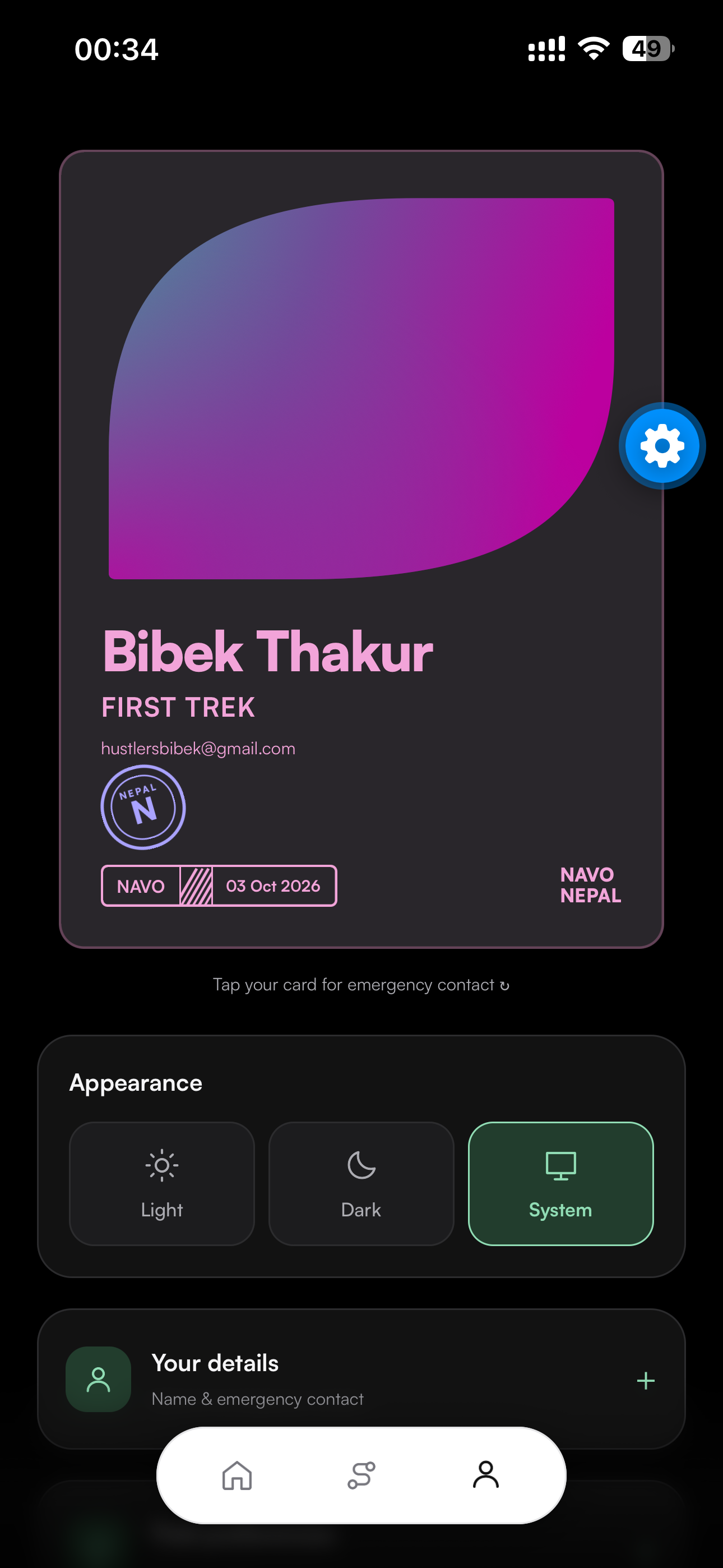
Keep an emergency contact accessible from your Navo safety card.
-
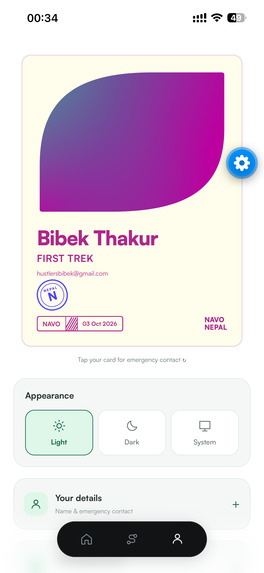
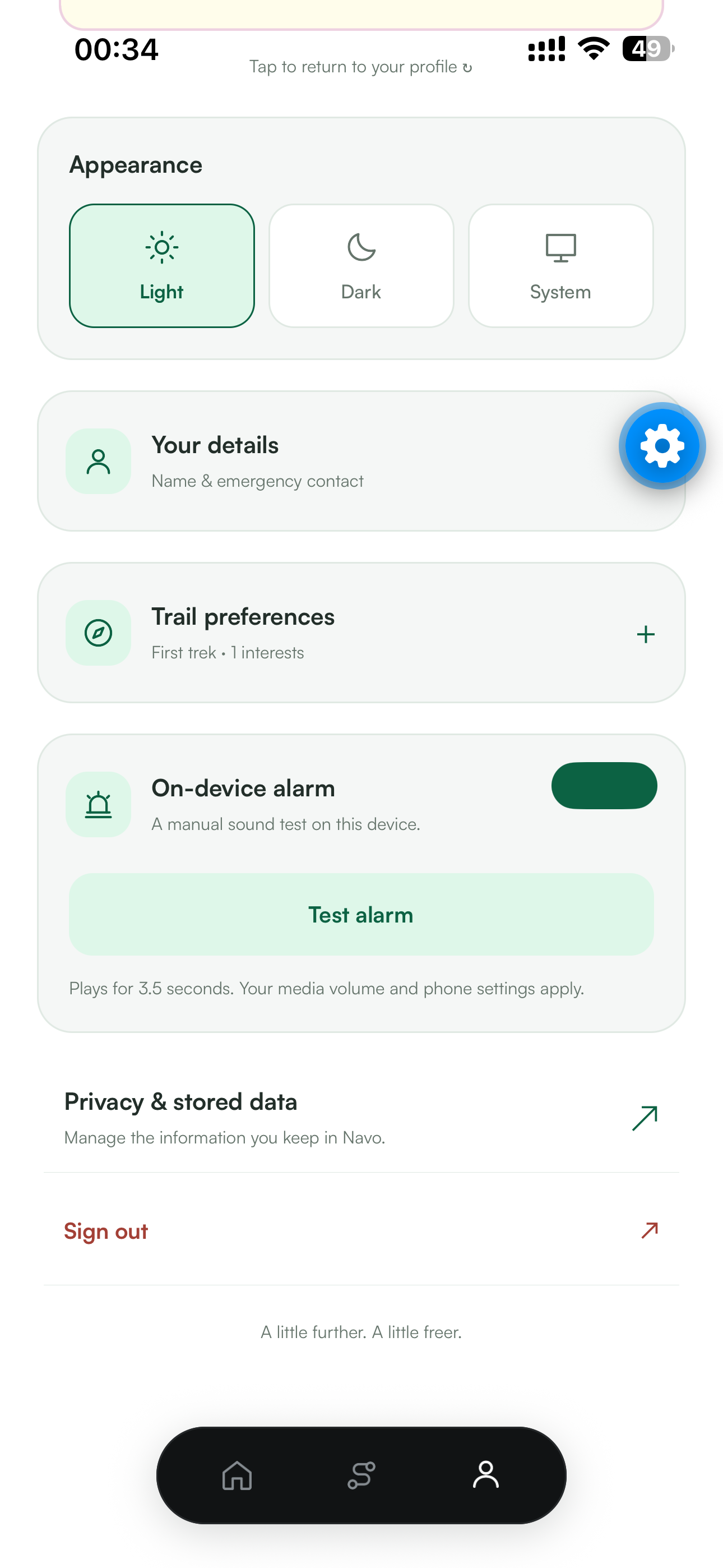
Switch between light, dark, and system appearance.
-
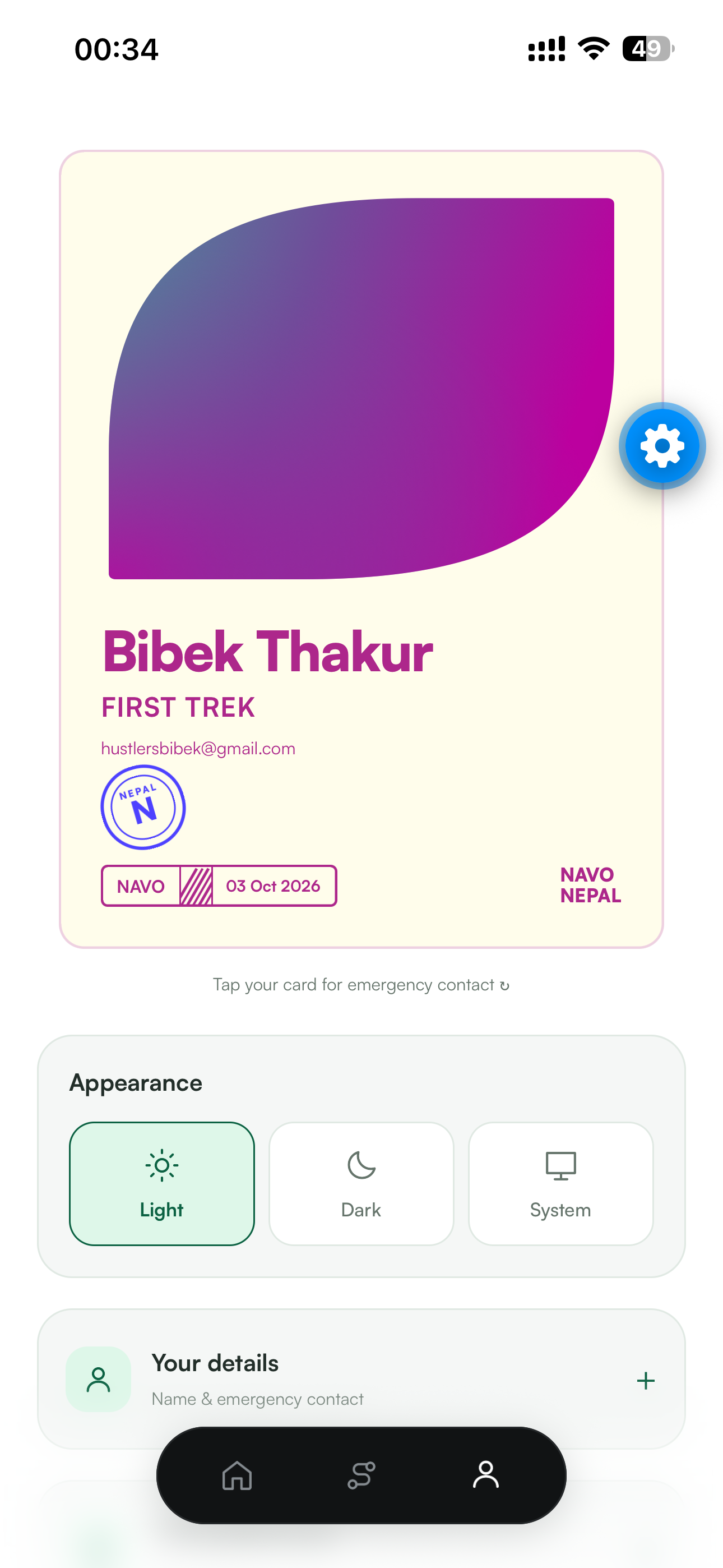
Keep your profile, trek preferences, and personal details together.
-
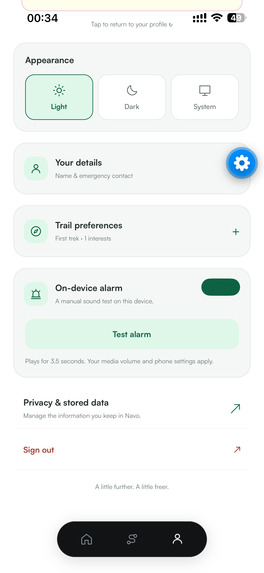
Manage preferences, the on-device alarm, privacy, and stored data.
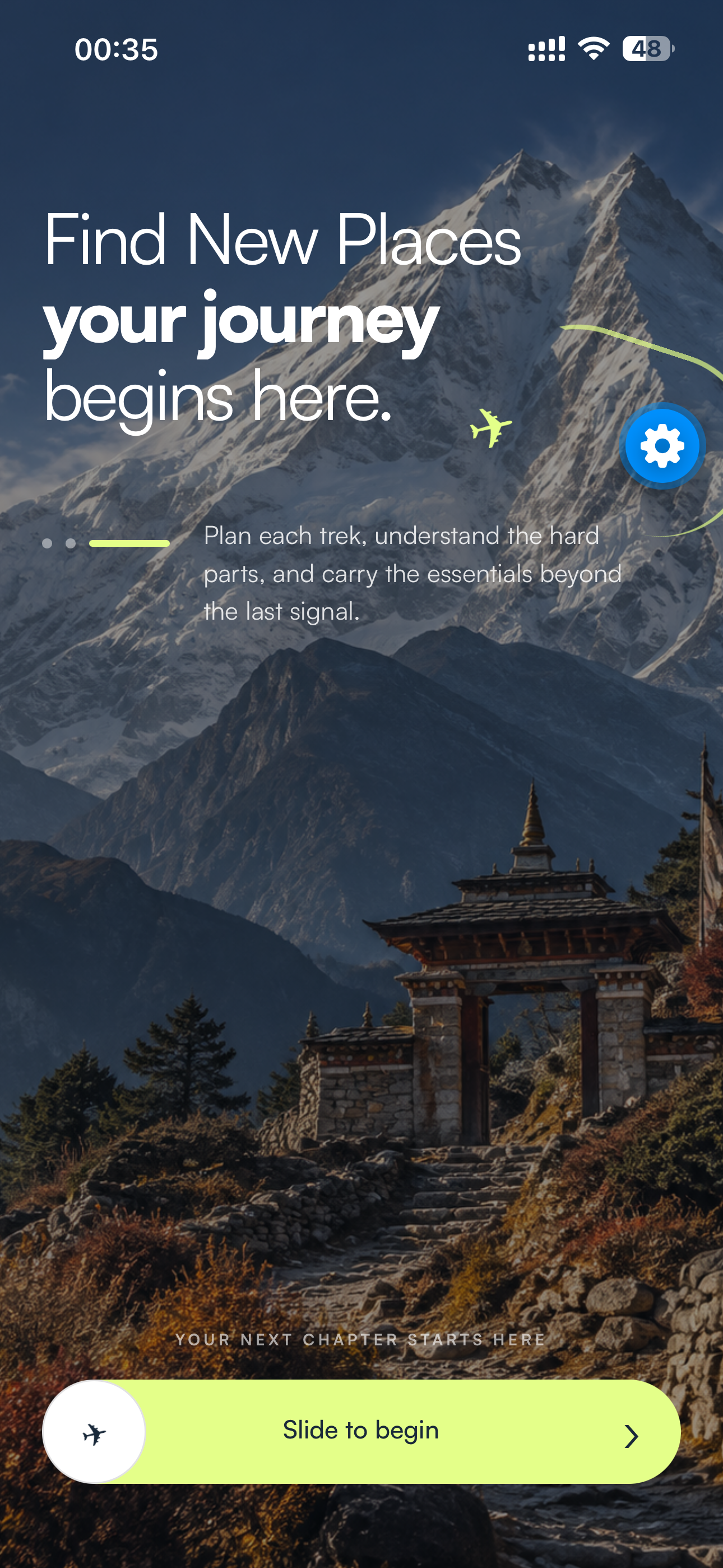
Navo: Explore the journey. Know the risks.
Inspiration
Nepal has some of the most beautiful trekking destinations in the world, but planning a trek here can be surprisingly complicated.
You might find a route on Google Maps, read a trekking blog written three years ago, check the weather somewhere else, and then message a local guide to find out whether the road is even open. Transport schedules, permit requirements, costs, and trail conditions are scattered across different sources. Sometimes those sources contradict each other.
We kept coming back to a simple question: What if planning a trek felt less like searching through ten websites and more like talking to someone who knew how to help, but was also willing to admit what they didn't know?
That's why we built Navo.
We didn't want to create another AI chatbot that generates beautiful itineraries with questionable details. We wanted to build something that helps people explore Nepal while understanding the actual decisions, uncertainties, and risks involved in getting there.
Our guiding principle became simple: A useful AI travel planner should know when not to be confident.
What it does
Navo is a mobile-first, AI-powered trekking and journey planner built around exploring Nepal.
A traveler can choose a destination, starting location, travel dates, and budget. Navo researches the journey and breaks it down into manageable stages, from reaching the trailhead to understanding the trek itself.
Instead of returning a generic day-by-day itinerary, Navo helps travelers understand:
- Getting there: Available transport options, including buses, flights, and other connections where applicable, with approximate travel times.
- Planning the journey: Routes organized into stages, with distances, elevation information, and important stops.
- Budgeting: Estimated expenses to help travelers understand what their trip might cost.
- Permits and requirements: Relevant government permits and details that need to be confirmed.
- Travel conditions: Relevant news, potential disruptions, and warnings that could affect the journey.
- Managing plans: Saving itineraries, revisiting preparation notes, and reviewing different travel options.
The interesting part is what happens after the AI generates a plan.
Navo uses NVIDIA Nemotron through Nebius Token Factory to research and propose a journey. But we don't automatically assume the generated itinerary is correct.
A separate validation layer examines the proposed stages for inconsistencies and missing information. If something doesn't add up, Navo can ask the model to revise the plan. If important problems remain unresolved, the app surfaces them instead of quietly presenting the result as trustworthy.
A real example is the Langtang Valley Trek.
In August 2026, severe flooding in Nepal's Rasuwa district damaged roads and bridges, disrupting the usual approach toward Langtang. A conventional AI itinerary might still suggest the familiar route from Kathmandu through Syabrubesi without accounting for those disruptions.
Navo is designed to catch situations like this through its research and warning workflow.
When relevant reports are found, travelers can be warned about affected access routes, see the supporting sources, and understand that conditions must be confirmed before departure. An affected road doesn't necessarily mean the entire trek is closed, and we don't want the app to confuse those two things.
That's the difference we're trying to make: not just helping someone decide where to go, but helping them understand what they should check before going.
Navo's waypoints are currently approximate planning references, not surveyed GPS tracks or turn-by-turn navigation instructions.
How we built it
We built Navo using Expo, React Native, and Expo Router for the mobile experience, with Python and FastAPI powering the backend.
For AI, we integrated NVIDIA Nemotron through Nebius Token Factory. The backend manages research, structured responses, validation, and model interactions while keeping API credentials away from the mobile client.
One of our main architectural decisions was to separate generating a plan from checking whether that plan makes sense.
Our workflow follows four steps:
1. Generate: Nemotron researches the destination and proposes a structured journey based on the traveler's preferences.
2. Validate: Independent software checks inspect destination coverage, continuity between stages, and route information such as distances and elevation.
3. Revise: If validation finds problems, the model receives feedback and gets another opportunity to correct the itinerary. We limit these attempts to avoid unnecessary generation and endless revision loops.
4. Review: The traveler receives the proposed journey along with relevant warnings, source information, and details that still need confirmation.
We also thought carefully about how to handle information gathered from the web. A news report, a price estimate, and an officially confirmed requirement are not the same kind of evidence. Our goal is to preserve those distinctions in both the data and the user experience.
The result is an architecture where the AI handles research and reasoning, software rules provide independent checks, and the traveler remains responsible for the final decision.
Challenges we ran into
The hardest part wasn't getting an AI model to produce an itinerary. It was deciding when that itinerary was reliable enough to show someone.
During local testing, Nemotron often generated useful travel information, but we found structured journeys with inconsistencies between stages. Some problems remained even after asking the model to revise its answer.
That forced us to make an important product decision: Should we show a complete-looking itinerary even when we know something is wrong?
We decided not to.
Rather than hide failed checks or treat every model response as successful, we made validation failures part of the experience.
Another challenge was working with real-world information that changes constantly. In Nepal, a road can be damaged by flooding, a transport connection can become unavailable, and an old travel article can remain online long after conditions have changed.
Finding information is only half the problem. Understanding its relevance, reliability, and freshness is the other half.
We also had to consider the cost of repeated research and model calls. Searching too broadly, processing too many sources, or repeatedly regenerating a complicated journey can make the system unnecessarily expensive. We worked on bounding the revision process and focusing validation on the information that matters most.
These challenges shaped Navo into something different from the travel assistant we initially imagined.
Accomplishments that we're proud of
We're proud that we built an end-to-end mobile planning experience connecting a real AI model, backend services, structured journey generation, and independent validation.
But the accomplishment that matters most to us is smaller and less visible.
We built a system that can say, "This part of the plan doesn't check out."
That might sound simple, but it changes how the product behaves.
Instead of treating a generated answer as the final result, Navo treats it as a proposal that must survive additional checks.
We also made the journey easier to inspect. Rather than leaving travelers with a long block of AI-generated text, we organize information into stages and decisions they can review individually.
And we're proud that we resisted presenting approximate waypoints as verified trail navigation. It would have been easy to make the app appear more capable than it currently is. We chose to be clear about that limitation.
For a product intended to help people travel through real mountains, we think that matters.
What we learned
Building Navo changed the way we think about useful AI.
At the beginning, we focused on how much information Nemotron could gather and how detailed an itinerary it could generate. As development continued, we realized the more important question was whether travelers could understand and trust the information they were being given.
A model can produce a convincing answer and still miss a broken connection between two journey stages. It can find a travel article without knowing whether its advice remains accurate. And asking it to try again doesn't guarantee the next answer will be correct.
We learned that generation and verification need to be treated as separate responsibilities.
We also learned that uncertainty shouldn't be hidden behind polished UI. A sourced report, a calculated estimate, and a confirmed fact should not look interchangeable.
Perhaps our biggest lesson was that a responsible AI system doesn't need to have every answer. It needs to help people understand which answers are supported, which are approximate, and which still require human confirmation.
That principle now guides how we think about Navo.
What's next for Navo
We want Navo to grow from an AI journey planner into a practical companion for exploring Nepal.
Our next priority is improving the quality of the information behind each plan. That means integrating verified trail tracks where available, collecting recent reports from hikers and local guides, and improving how we identify and communicate route disruptions.
We also want to introduce community-contributed photos and short videos, more detailed permit guidance for different traveler types, and transport and accommodation cost estimates with visible sources and update dates.
Over time, we'd like travelers to be able to compare routes, adjust journey stages, and benefit from the experiences of people who have recently completed the same trek.
But before expanding too far, we want to test Navo with real hikers and guides. The mountains are not the place to discover that an itinerary looked correct only because nobody checked it.
Our goal isn't to make AI replace local knowledge. It's to make that knowledge easier to find, understand, and use.
We started Navo because exploring Nepal should feel exciting, not overwhelming. We want people to spend less time piecing together uncertain information and more time preparing for journeys they can approach with confidence.
Built With
- authentication
- cloud
- factory
- fastapi
- firebase
- firestore
- nebius
- nemotron
- nvidia
- open-meteo
- openstreetmap
- python
- react
- react-native-maps
- token
- typescript


Log in or sign up for Devpost to join the conversation.