-
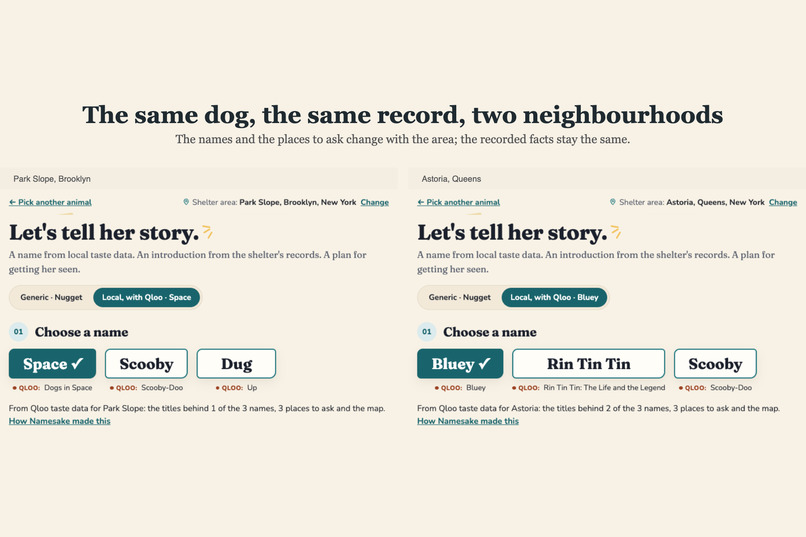
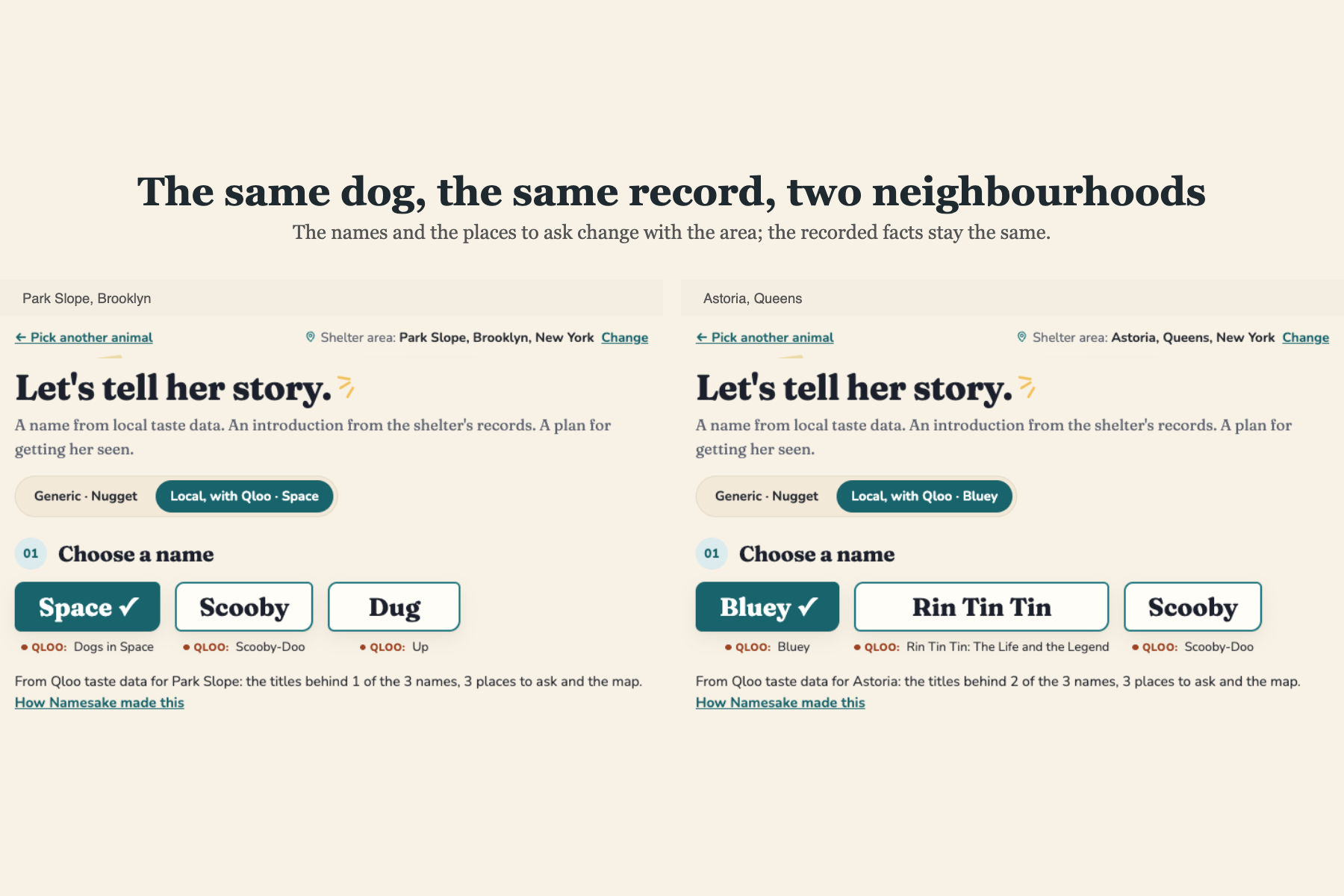
The same dog in Park Slope and Astoria: each area gets its own names, each labelled with the Qloo title it comes from.
-
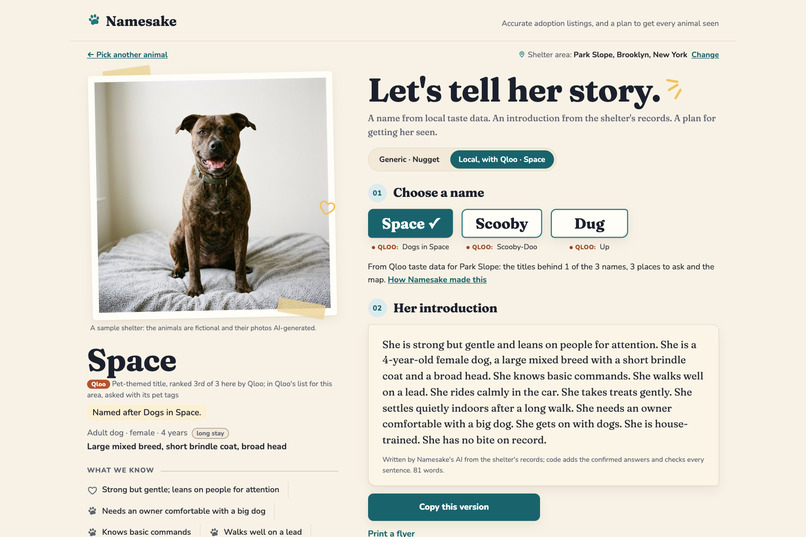
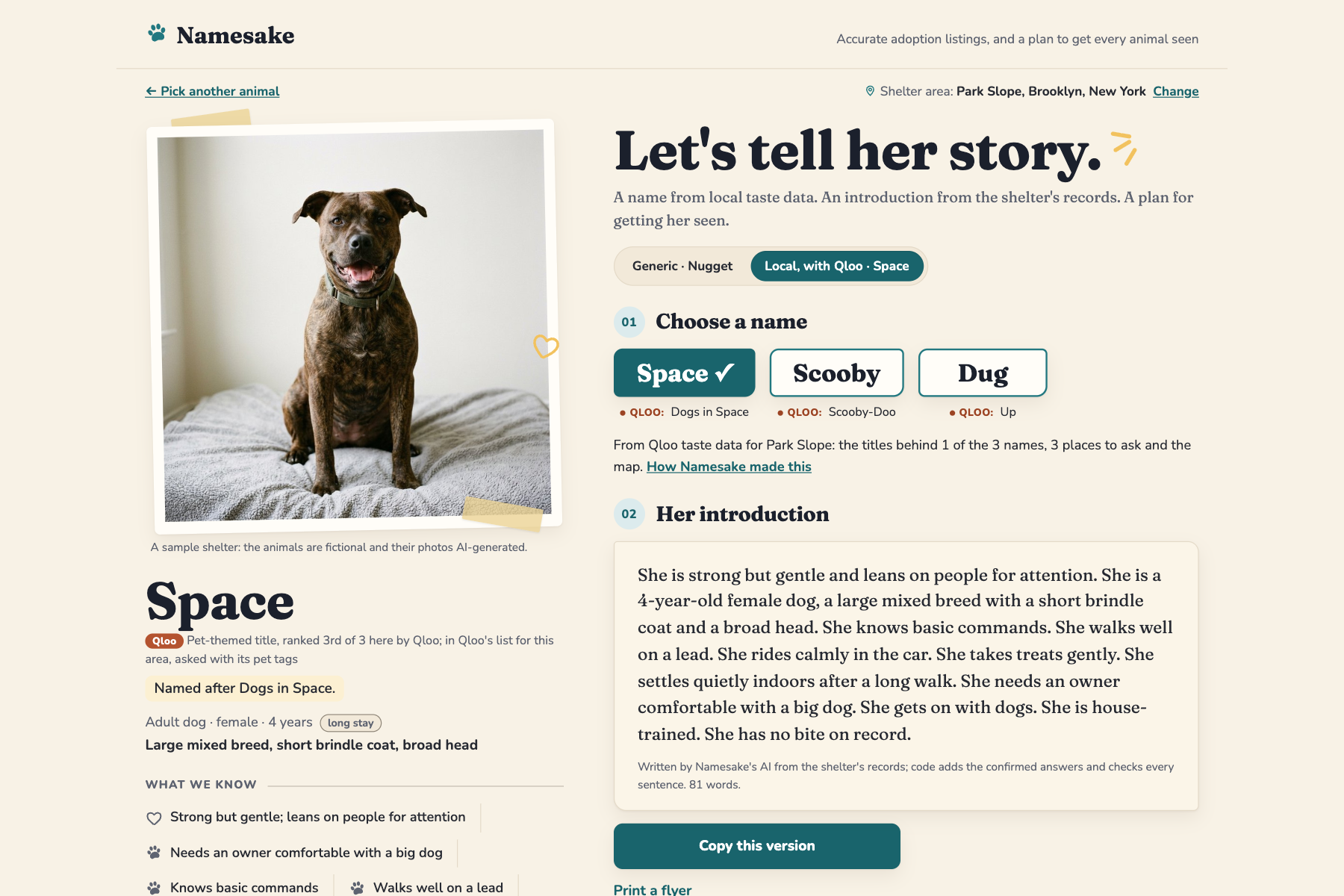
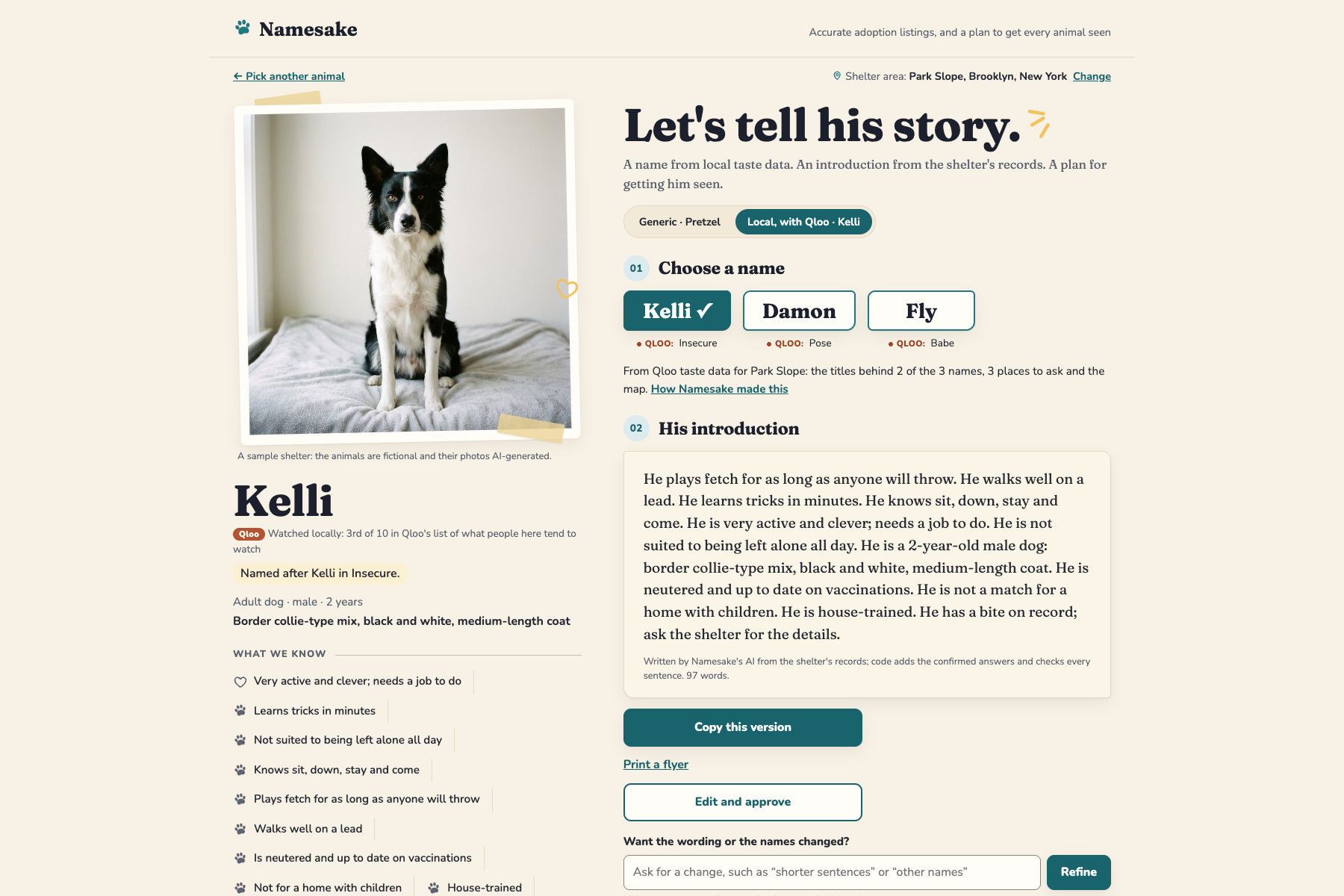
The result: name options labelled with their Qloo titles, a Generic / Local toggle, and a listing written only from recorded facts.
-
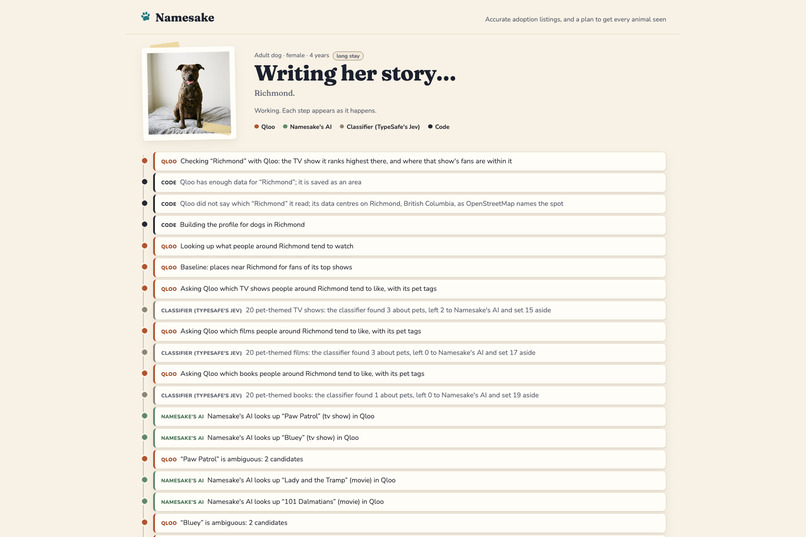
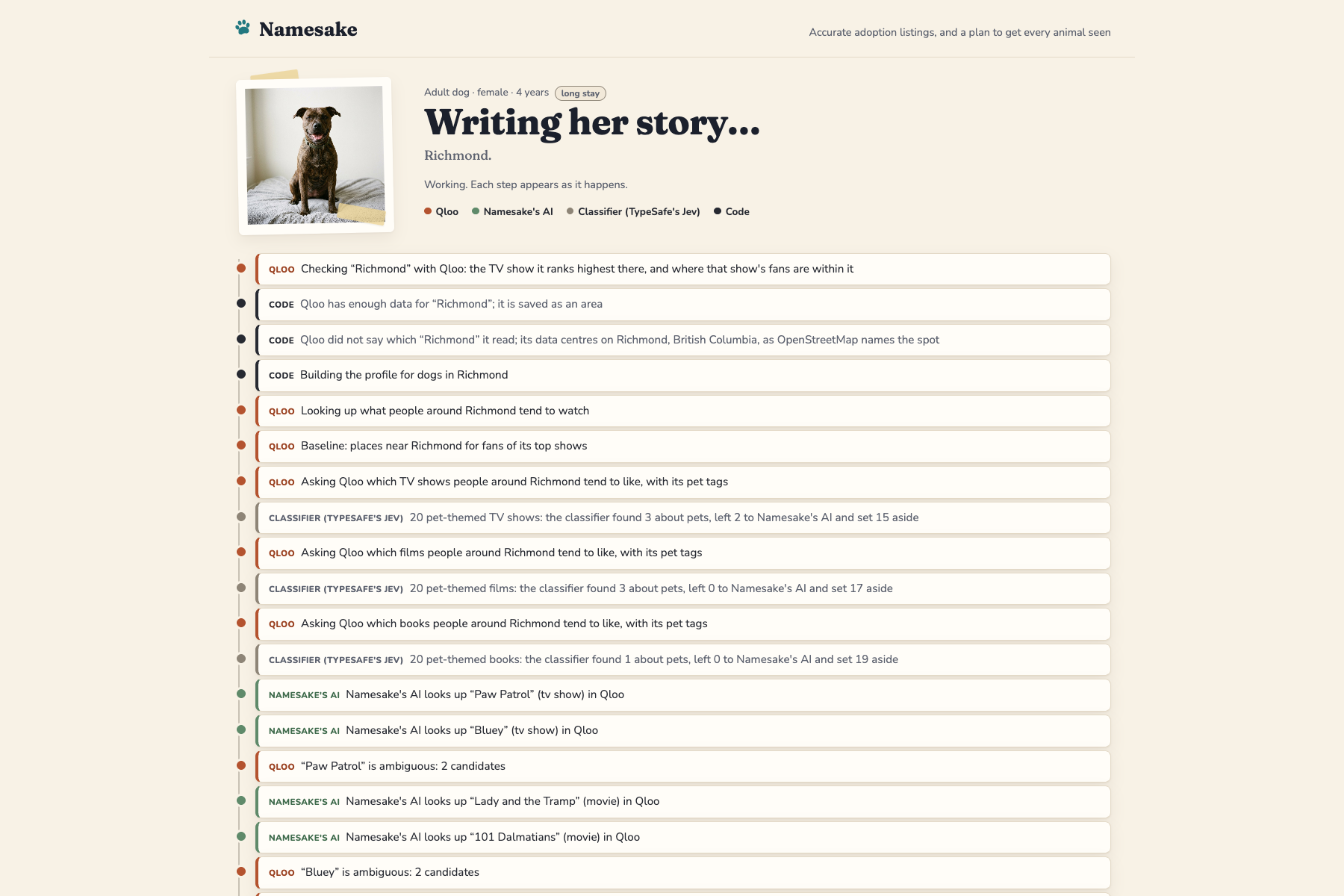
Namesake's AI at work on a typed area: Qloo's lists, the classifier, titles it looks up, ambiguities settled; each step says who did it.
-
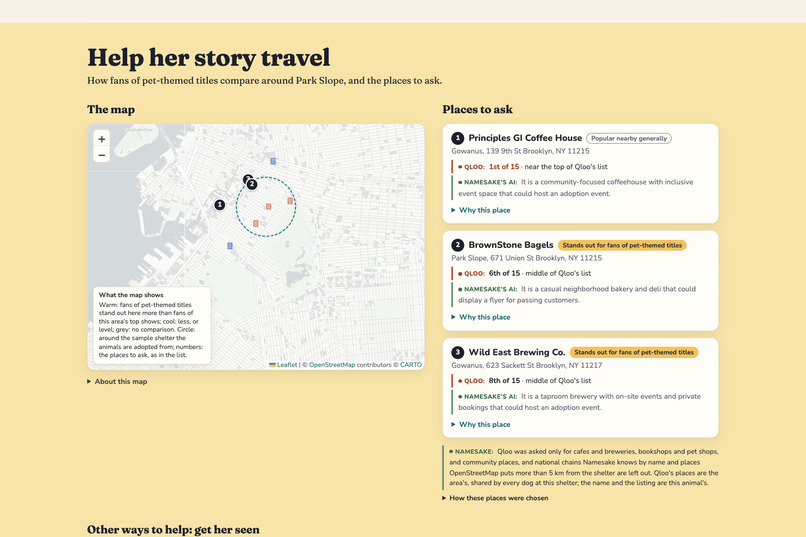
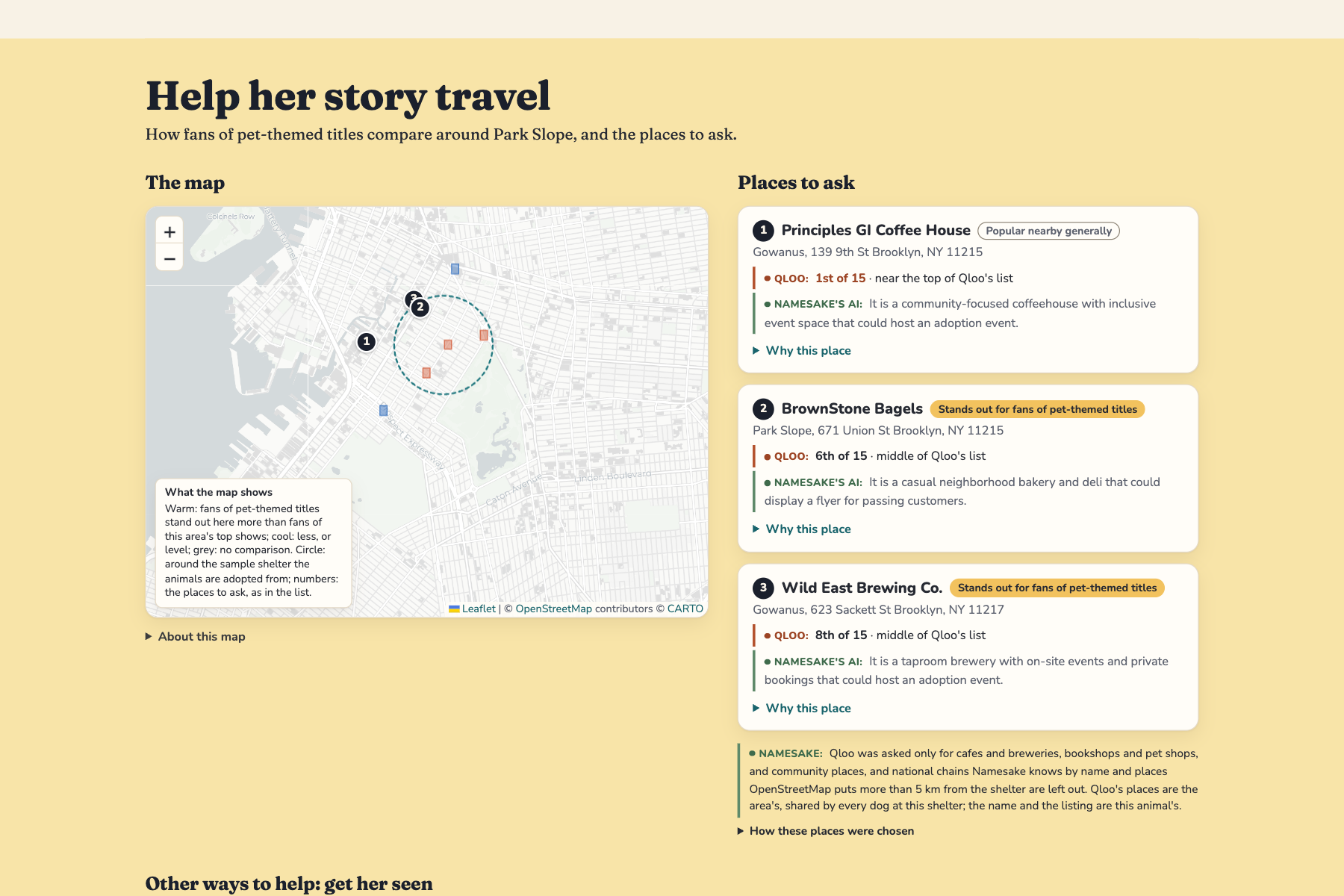
Places to ask, each with Qloo's rank and why Namesake's AI picked it; the map compares pet-title fans with fans of top local shows.
-
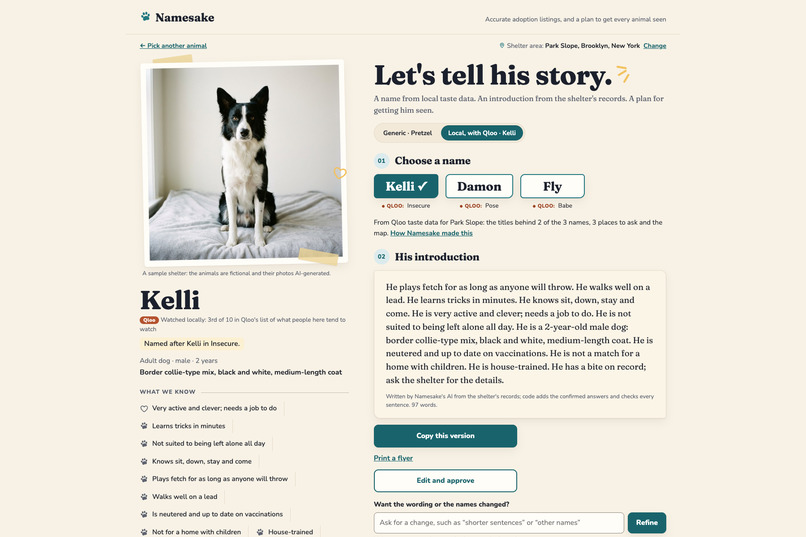
A dog with a bite on record: the listing states it plainly and is written from the record only; each name is labelled with its Qloo title.
-
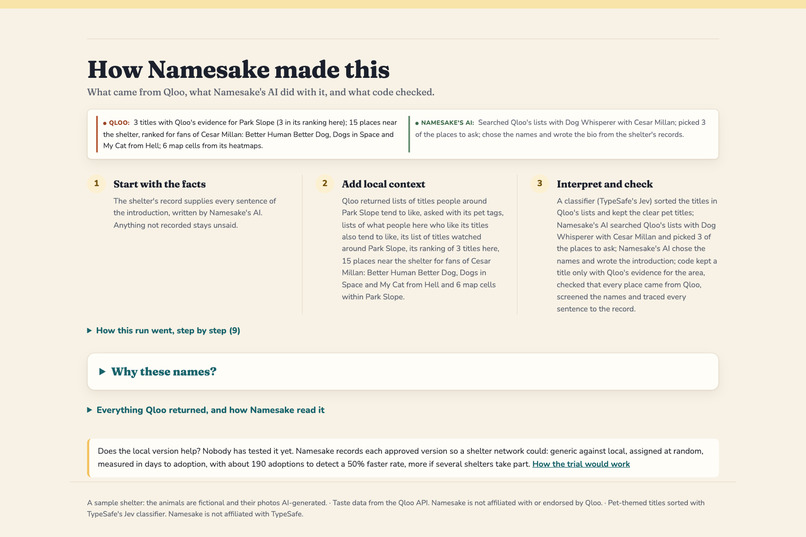
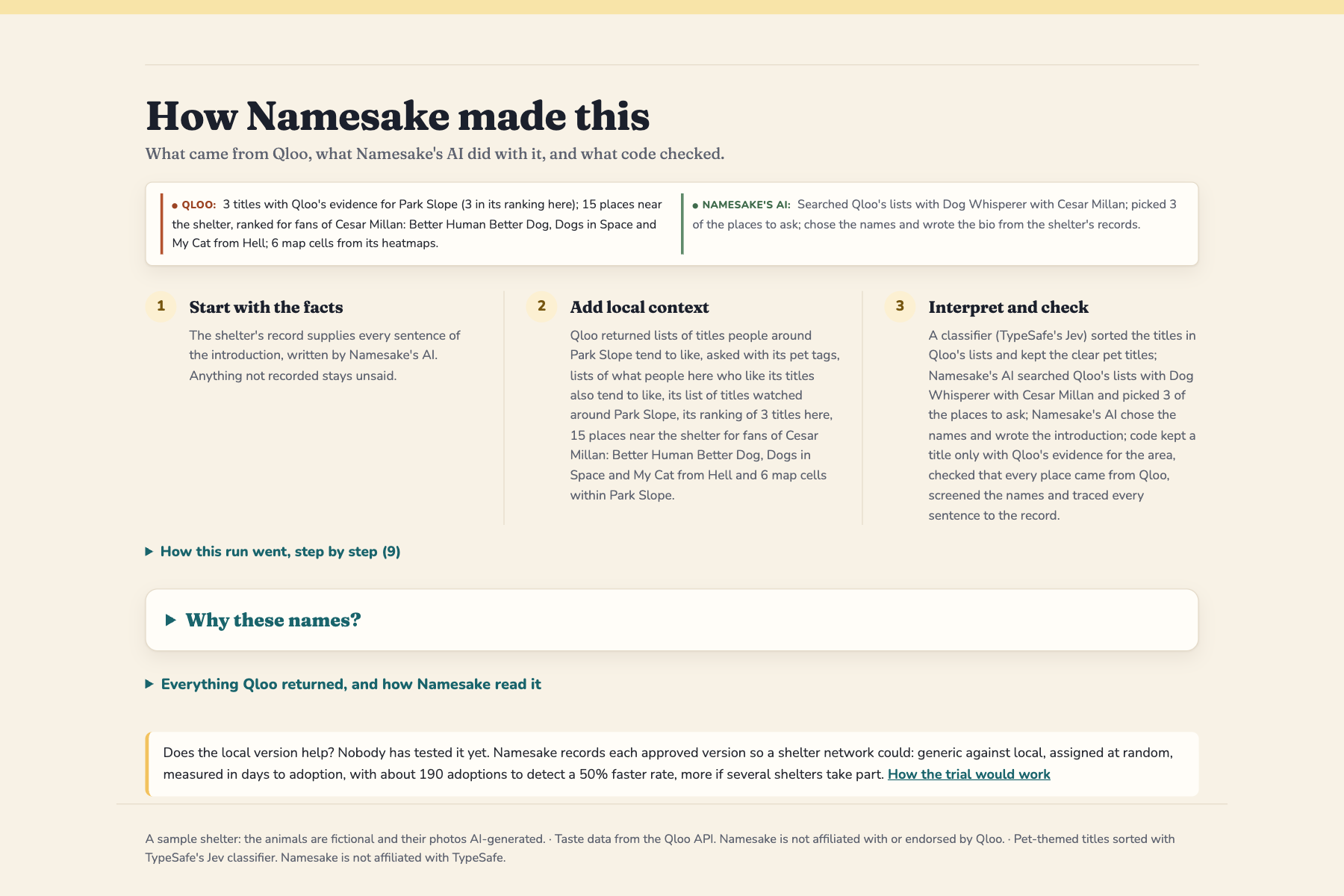
How Namesake made this: what Qloo returned, kept apart from what Namesake's AI did with it and what code checked.
-
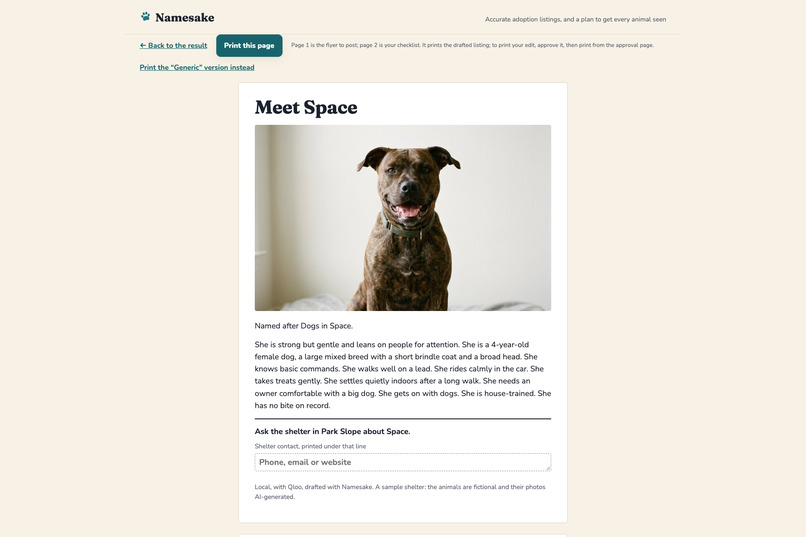
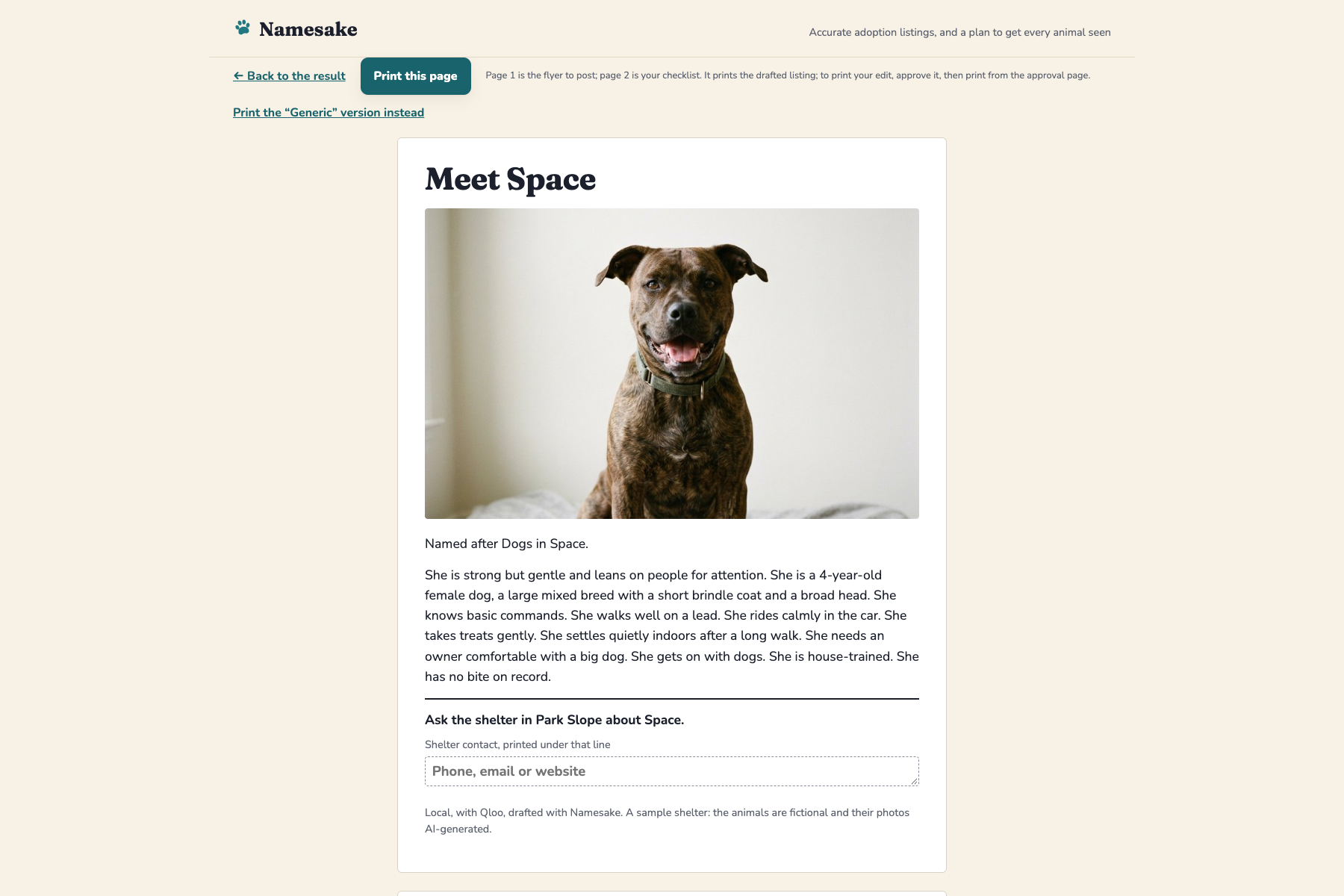
Print a flyer: the listing, the name's Qloo title and a contact line to fill in; page 2 is the checklist of places to ask.
-
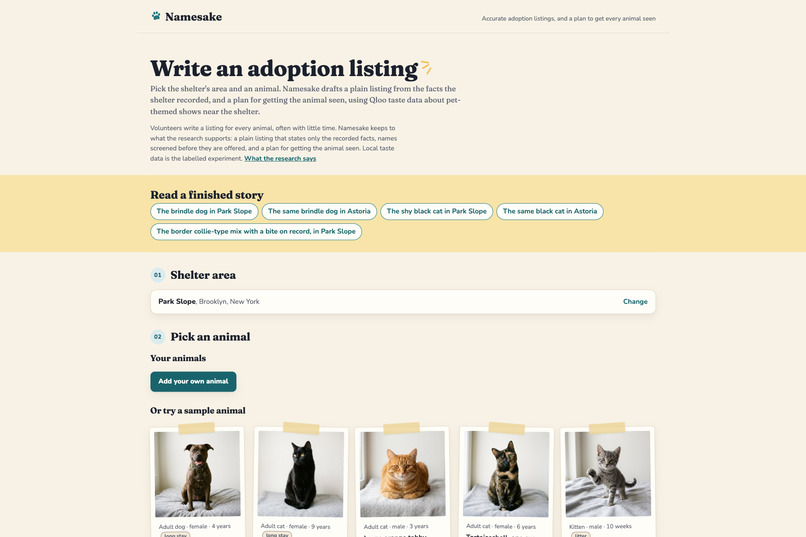
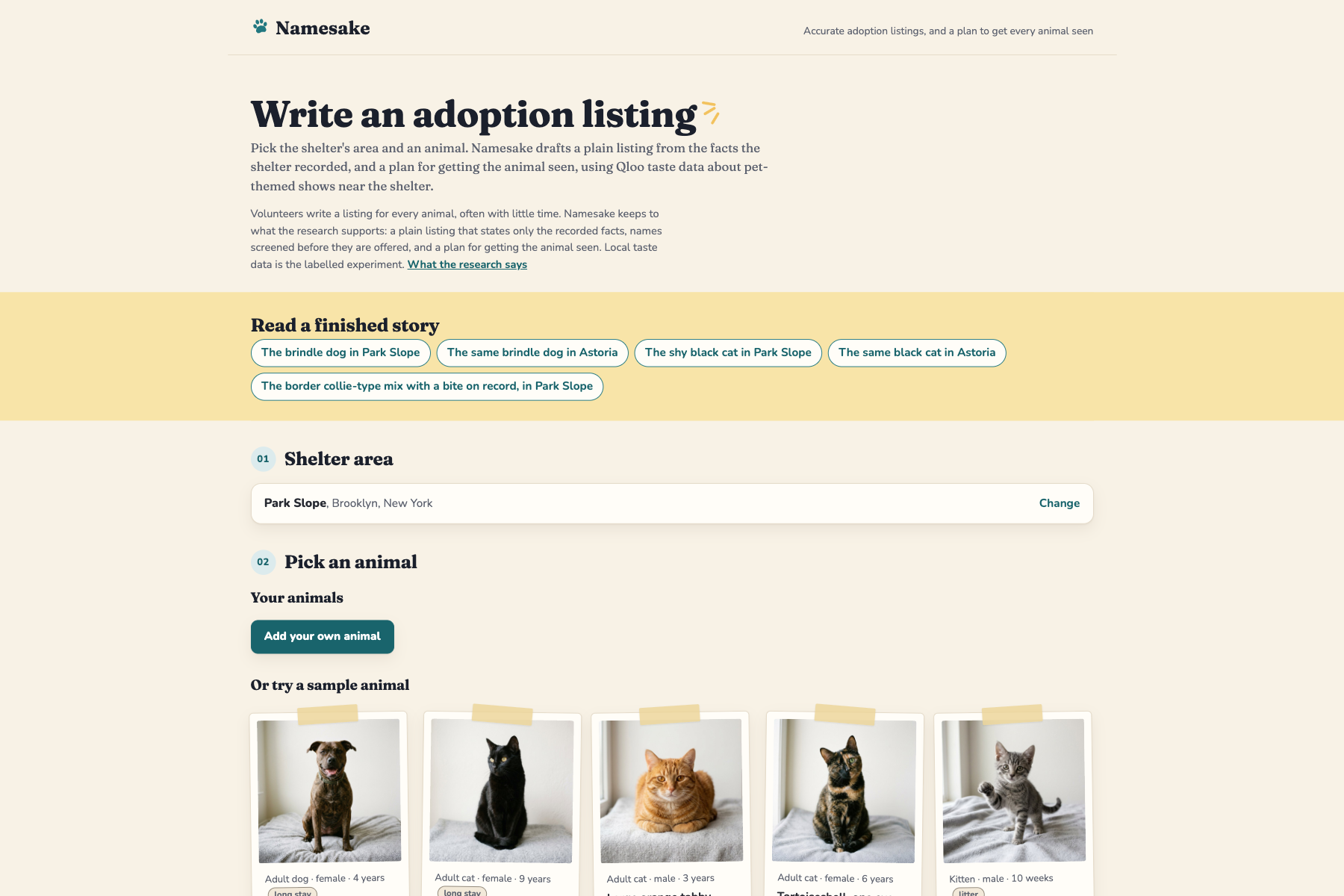
Start: pick a shelter area and an animal, add your own, or open one of five finished stories. Photos are AI-generated.
How to try it
Nothing to install, sign up for or pay: the demo runs on my Qloo key and my model accounts, with the everyday usage caps raised far above their defaults for judging. Open https://namesake.bogdansabau.eu.
- Read a finished story (instant). The start page links five precomputed results: the brindle dog in Park Slope (the one in the gallery) and the same dog in Astoria, where the names change with the area; the shy black cat in both; and the border collie-type mix with a bite on record, which the listing states. Each one's own step log is under "How Namesake made this".
- Run one live (about a minute). The twelve animals' results in the four preset areas, Park Slope, Astoria, Austin and Barcelona, are precomputed and open at once, so to watch the AI work, add an animal of your own in one of them and open it: the area's Qloo work is saved and shared, and the page streams the listing run, with the lookalike titles the AI looks up in Qloo and the checks on its answer. Refine on any result is a live run too.
- Type a new shelter area (a few minutes, since Qloo calls are spaced 2 seconds apart): open the "Shelter area" bar with Change, type the area, then pick an animal and start the run. This is the full run: the page streams Qloo's lists for the area, the titles the AI proposes and looks up in Qloo, the places found, and the checks on its answer. A name Qloo can't settle shows its candidates as buttons, or asks for the city or state when they can't be told apart; an area with too little data is refused with a message.
- On the result, switch between the Generic and the Local, with Qloo versions, open "How Namesake made this" and "Everything Qloo returned, and how Namesake read it" to see what Qloo returned apart from how Namesake read it, type a Refine request such as "other names", then expand "Edit and approve", or follow "Print a flyer".
- An animal you add is kept for 7 days after your last visit, in a workspace tied to your browser, with no account. The same data the screens show is served as JSON:
/api/startfor the start screen and/api/results/dog-02@park-slopefor a result.
Inspiration
US shelters and rescues took in about 5.8 million dogs and cats in 2025, and volunteers write a listing for every animal, usually in a hurry, and AI bio writers are already everywhere. None of them has evidence that it helps, and one is known for inventing backstories.
So before writing any code, I read the research. No controlled study shows that a name speeds up adoption. The clearest risk is overselling: adopters who found a dog harder than expected had about ten times the odds of returning it. The strongest associations, though only observational, are with being seen, in person and through foster carers' own networks. And nobody had tested whether local taste data helps at all.
That set the goal: listings that stick to the facts, carefully screened names, and Qloo used for what it can plausibly do, which is finding the pet-themed titles people near a shelter tend to like, and the places their fans favor.
What it does
A volunteer picks an animal and the shelter's area. In about a minute for an area it already knows (a few minutes for a new one), Namesake's AI produces:
- a listing written only from the shelter's recorded facts, with a bite history always stated (one of the five finished examples has one)
- name options from Qloo taste data: pet-themed shows, films and books that Qloo ranks or lists near the shelter, shows the area watches anyway, and titles with a lookalike animal that Namesake's AI finds in Qloo, each name labeled with what Qloo returned and screened for villains, violent or tragic characters (famous animals that die in their story among them), aggression and weapon words, words that put an animal down, real people and references coded to a race, religion or political identity
- a plan to get the animal seen: local places that fans of those titles favor, with listed national chains, theme parks and places mapped more than 5 km from the shelter left out, on a map, plus foster networks, outings (or a quiet meeting when the record says busy places are hard) and timing
A Generic / Local toggle shows the listing with and without Qloo, so you can see exactly what Qloo adds; when Qloo's data for the area doesn't back a name's title, the button says With Qloo instead of Local. Qloo's data is behind the local names, the places to ask, and the map: without Qloo, Namesake still writes the generic listing, but with no local names, no places, and no taste layer on the map. A Why drawer keeps what Qloo returned separate from how the app read it. Refine, edit, approve, copy, or print a flyer.
How we built it
Two PydanticAI agents do the open-ended work. One finds pet-themed titles popular in the area, settles which Bluey is meant, ranks them, and asks Qloo for places their fans go. The other writes the listing and the names. The model chooses the Qloo calls: which titles of its own to try, which title and which of TV shows, films or books to search the area's lists with, which of Qloo's candidates an ambiguous name means, which places suit an adoption event, and which lookalike titles to check for each animal. It reads each answer and adapts. Code sends the kept titles with the strongest Qloo evidence as the venue signals and fixes the kinds of place asked for, and a title the model proposes for the area is kept only with Qloo's evidence for it whenever any title has that evidence (otherwise the AI's own stay, and the page says so); a lookalike title need only be found in Qloo, and the resemblance is labeled as the AI's reading. Plain code makes the fixed Qloo calls and checks everything the agents return: every title and place must be one Qloo returned, every bio sentence must trace to the recorded facts, and every name must pass the screen. A draft that fails gets one repair round, then falls back to a template.
It's FastAPI and Jinja, Leaflet for the map, SQLite caching every Qloo answer, and one Docker image on a VM. AI agents built and reviewed it under my direction: one wrote the code, and two or three other models reviewed every change before it merged.
Challenges we ran into
Most of them came from the data. Qloo's pet tags left almost nothing when used as filters, but worked well as signals. Names were ambiguous: 6 of 10 titles came back with several candidates, and a bare "Portland" resolves without saying which one. Popular isn't the same as pet-loving: 9 of the 15 venues Qloo returned near Park Slope for two pet-themed shows also came back for Yellowstone, so every place is now compared with what the neighborhood watches anyway. Name screening was subtler than expected: famous animals that die in their story, and reality shows whose "characters" are real people.
Accomplishments that we're proud of
- The Generic / Local toggle answers "would this work the same without Qloo?" on the result screen itself.
- What Qloo returned is never blended with the app's interpretation of it.
- The listing is held to the record by code, not by the model's good intentions.
- The claims stay within the evidence, and the app records what a real trial would need.
What we learned
Read the evidence first; it changed what I built. Qloo's signal is in order and comparison, not raw scores, which saturate near 1.0. Always check what the API actually heard, because Qloo quietly ignores parameters it doesn't recognize. An agent earns its place where the answers are ambiguous; everywhere else, plain code is cheaper and safer. And in this domain, the riskiest thing an AI writer can do is be warm and wrong.
What's next for Namesake
- Run the trial: randomize generic against local listings at intake and measure days to adoption, with returns as a safety check. About 190 adoptions would detect a 50% faster rate, and that number grows with more shelters, so it needs a network of rescues rather than one shelter.
- A cheap test before the trial: ask people who live near a shelter whether they recognize the titles Qloo picked for their area. If they don't, local names can't help, and the big trial isn't worth running.
- Paste straight into shelter software, where listings go out to the adoption sites.
Built With
- carto
- claude
- codex
- deepseek
- docker
- fastapi
- github-actions
- javascript
- leaflet.js
- muse-spark
- openstreetmap
- pydantic-ai
- python
- sqlite
- uv
