-
-
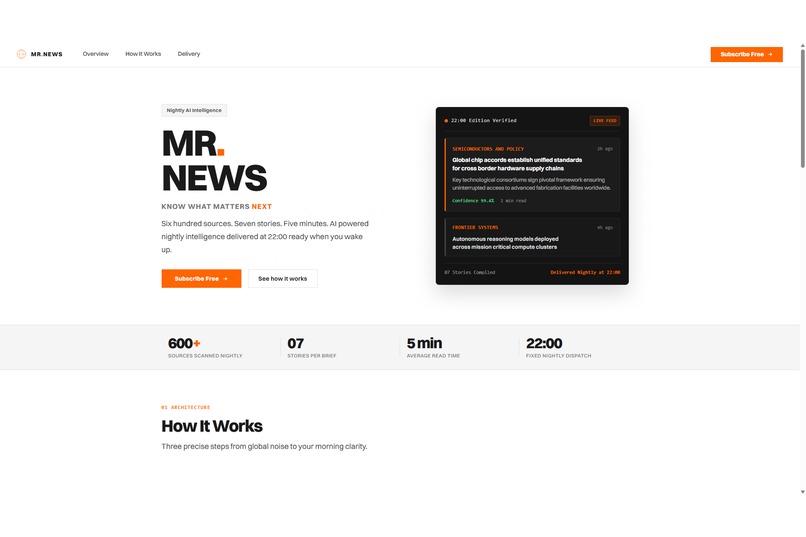
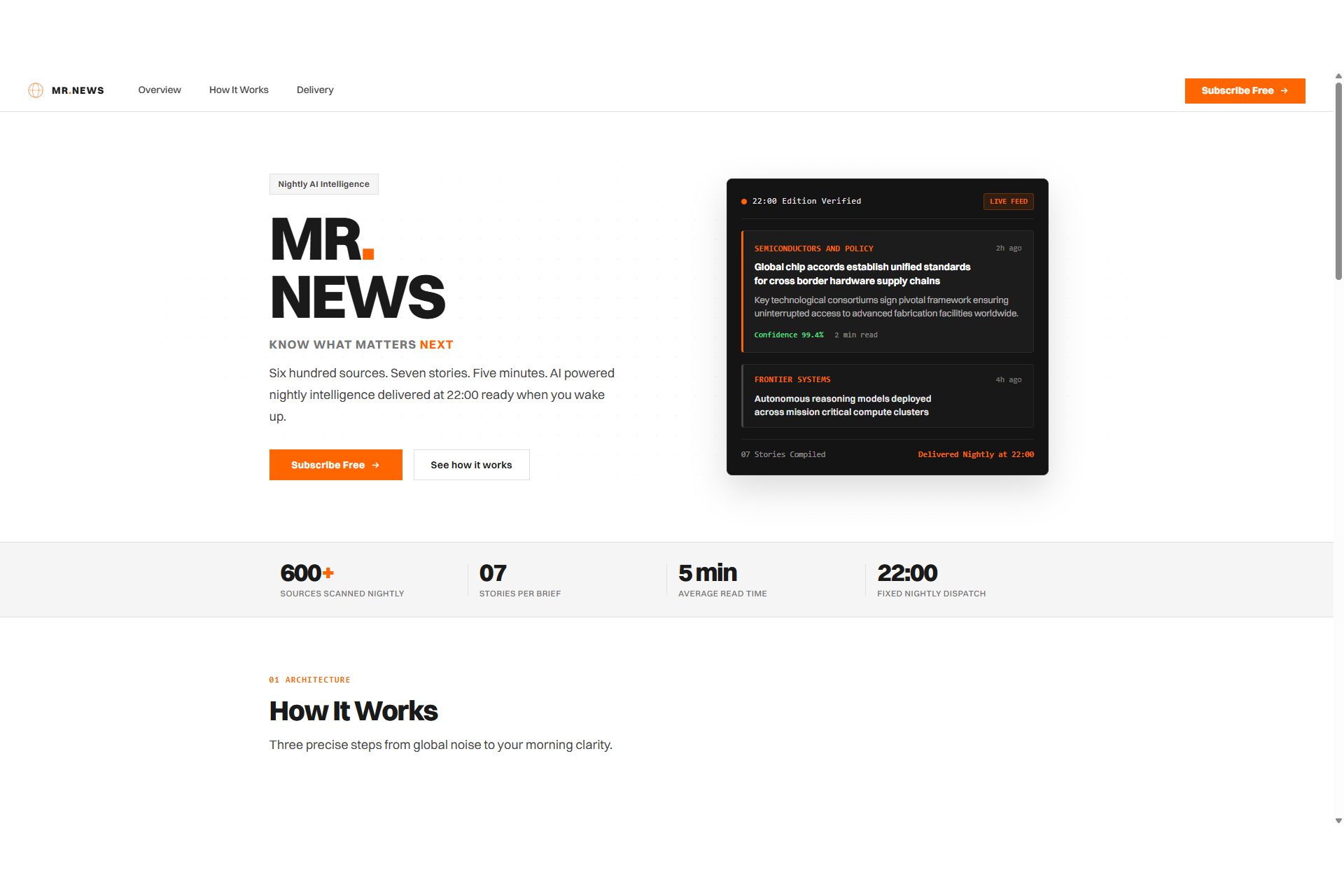
Our landing desk showing 600 sources scanned, the 22:00 dispatch dial, and our promise to distill the noise into seven stories.
-
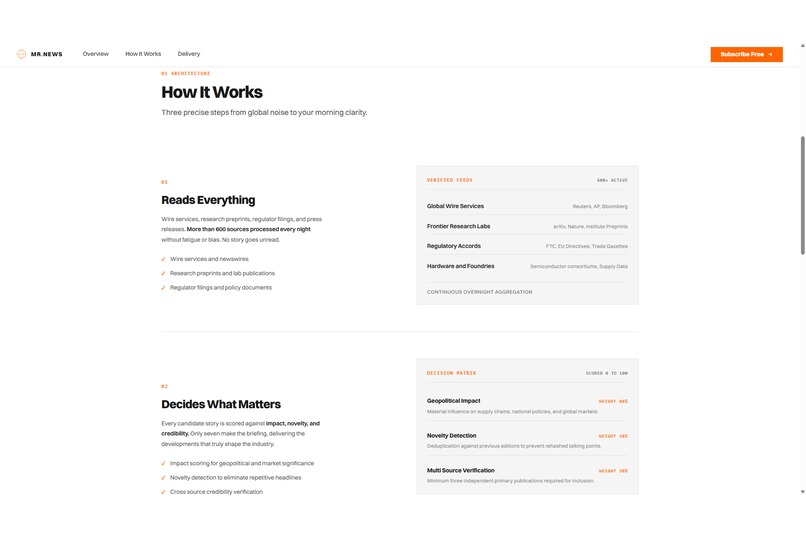
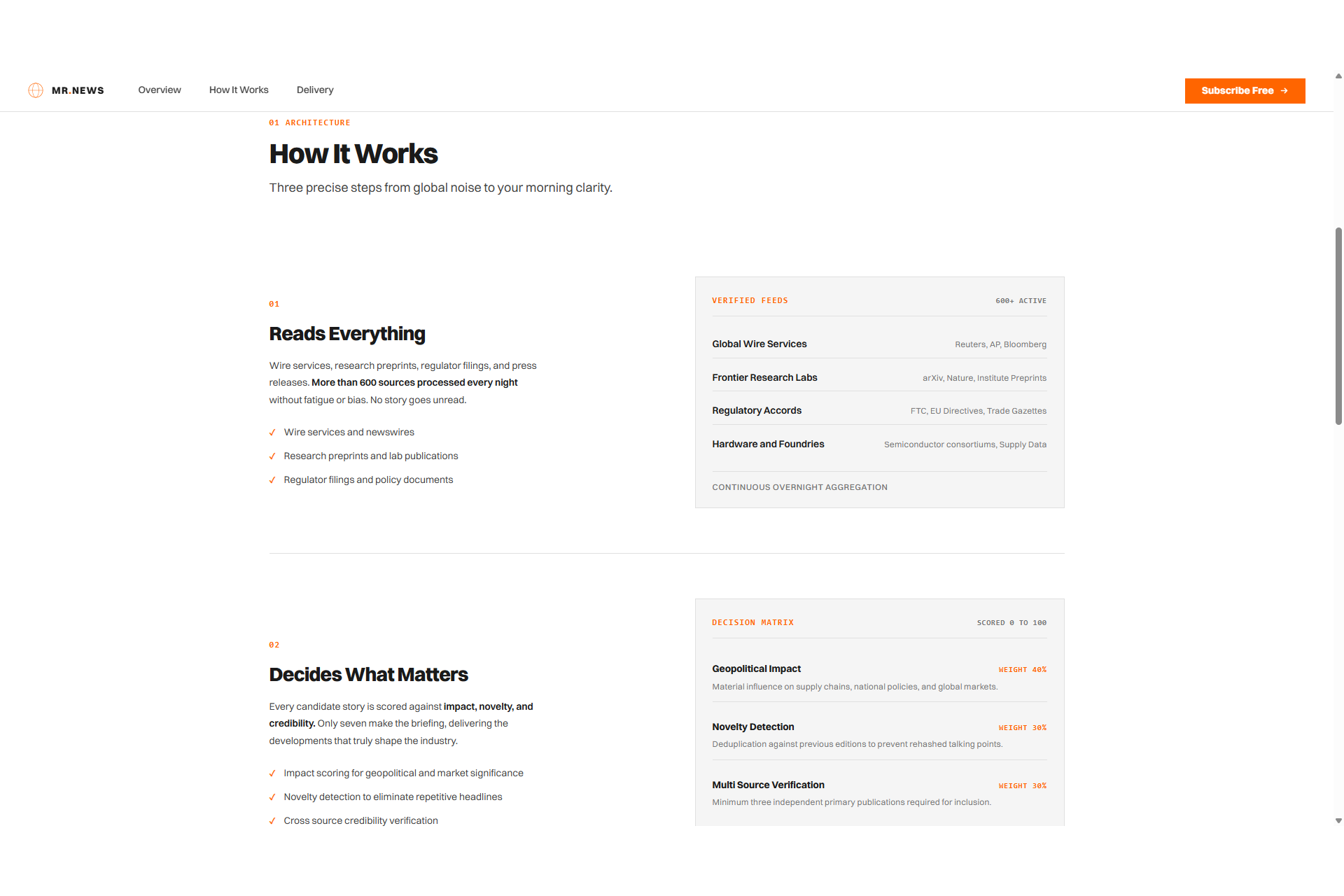
How our pipeline works by stripping duplicate news with math before Gemini synthesizes the most significant events of the day.
-
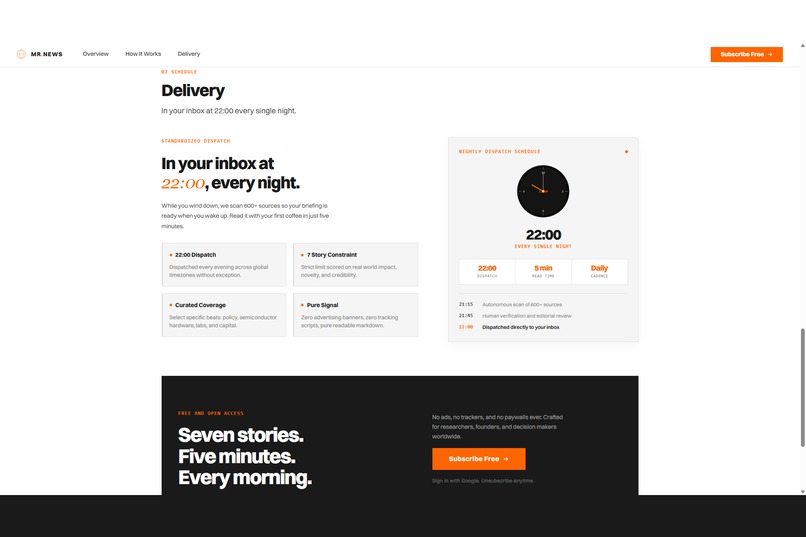
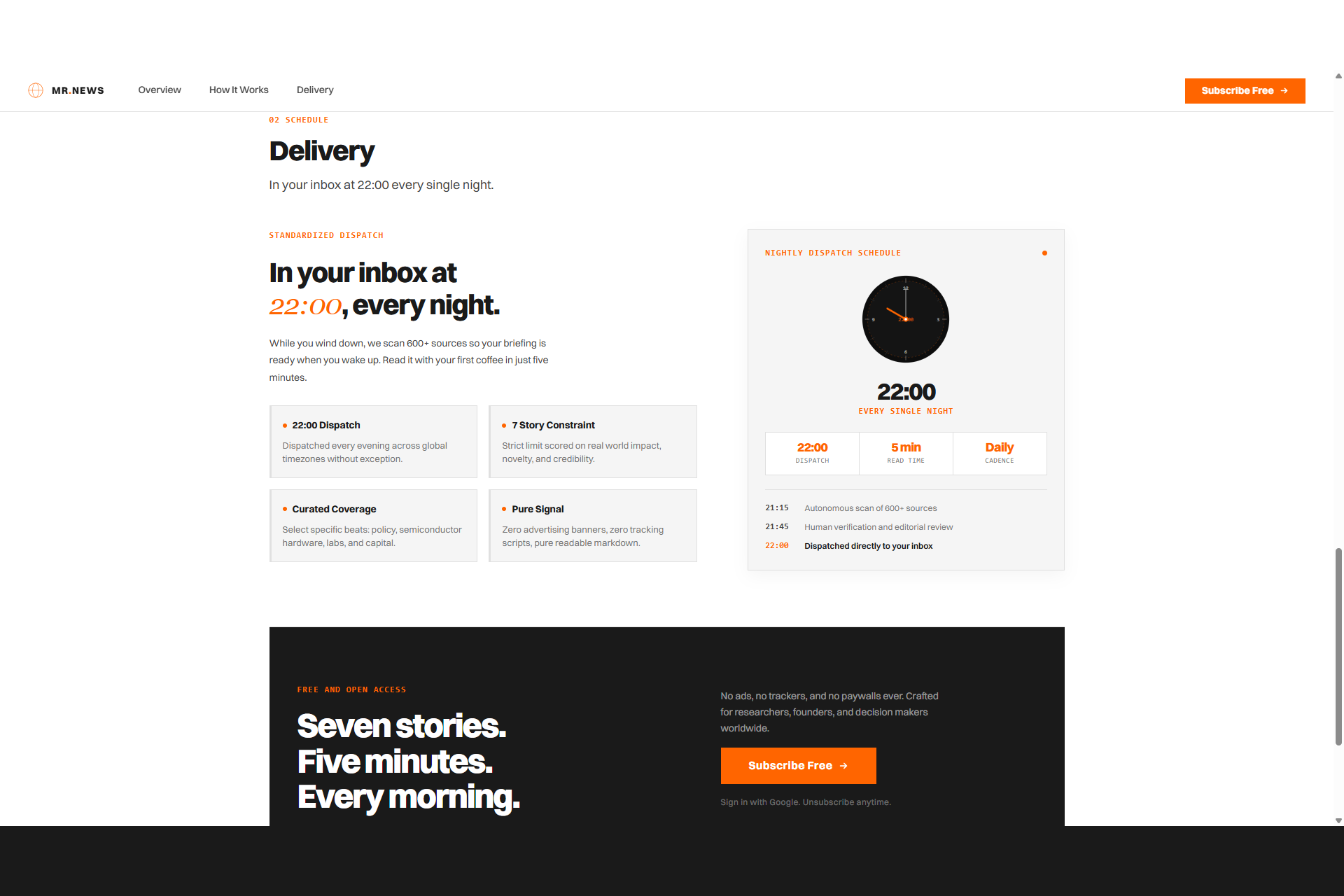
Our nightly delivery schedule with an analog dial counting down to the 22:00 inbox drop so readers always know when news arrives.
-
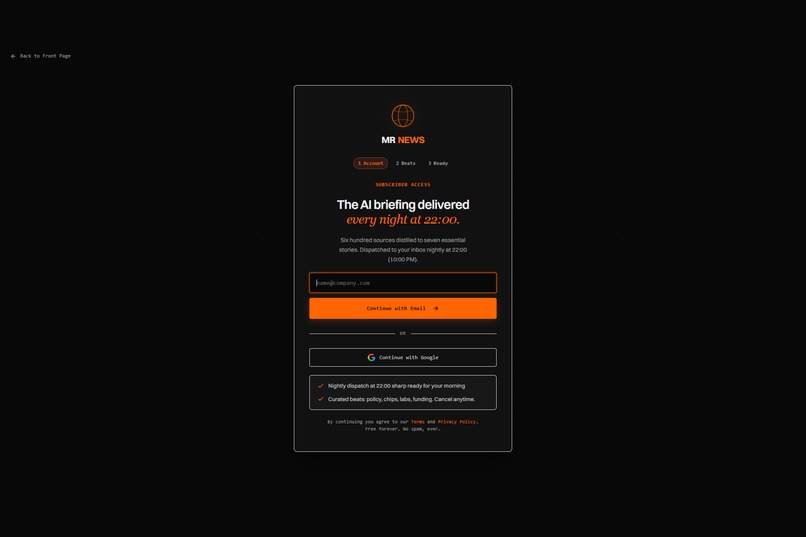
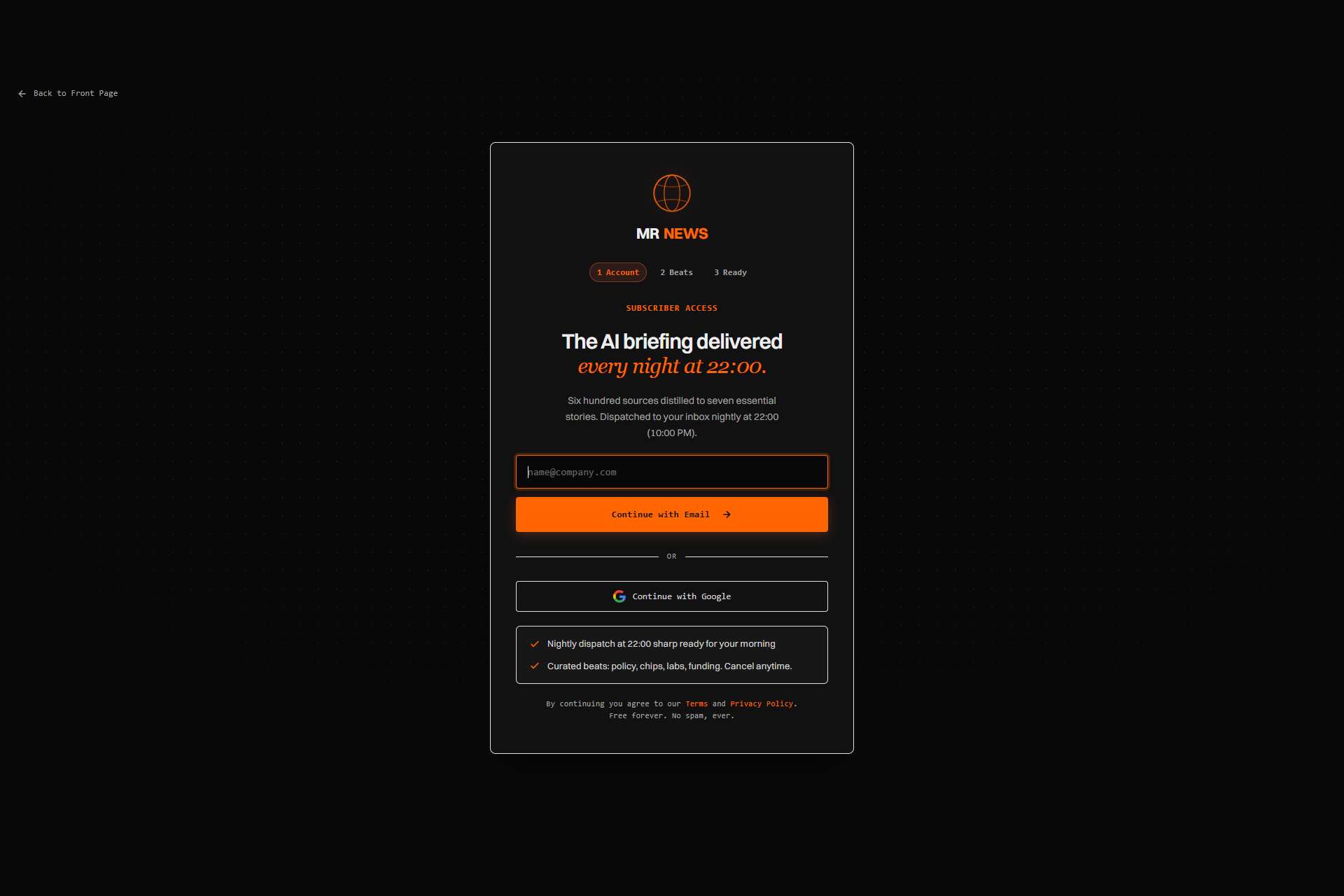
The subscriber portal allowing direct email subscription, passwordless reader access, zero trackers, and easy cancelation.
-
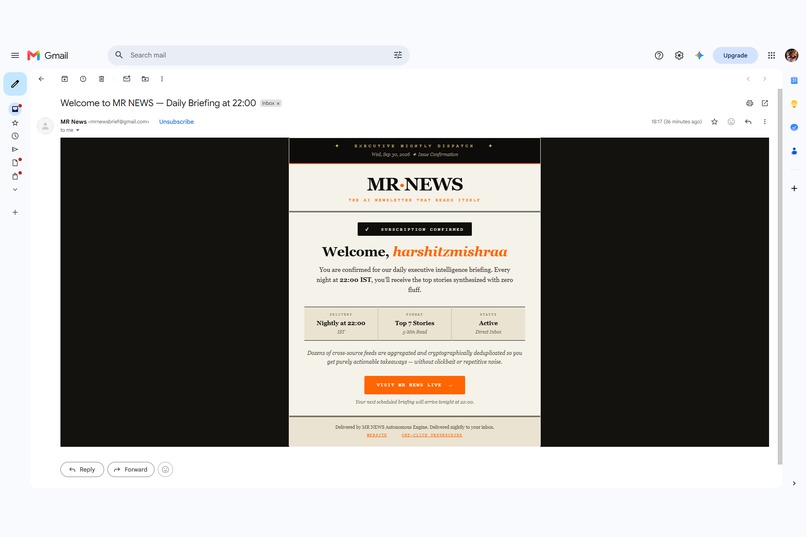
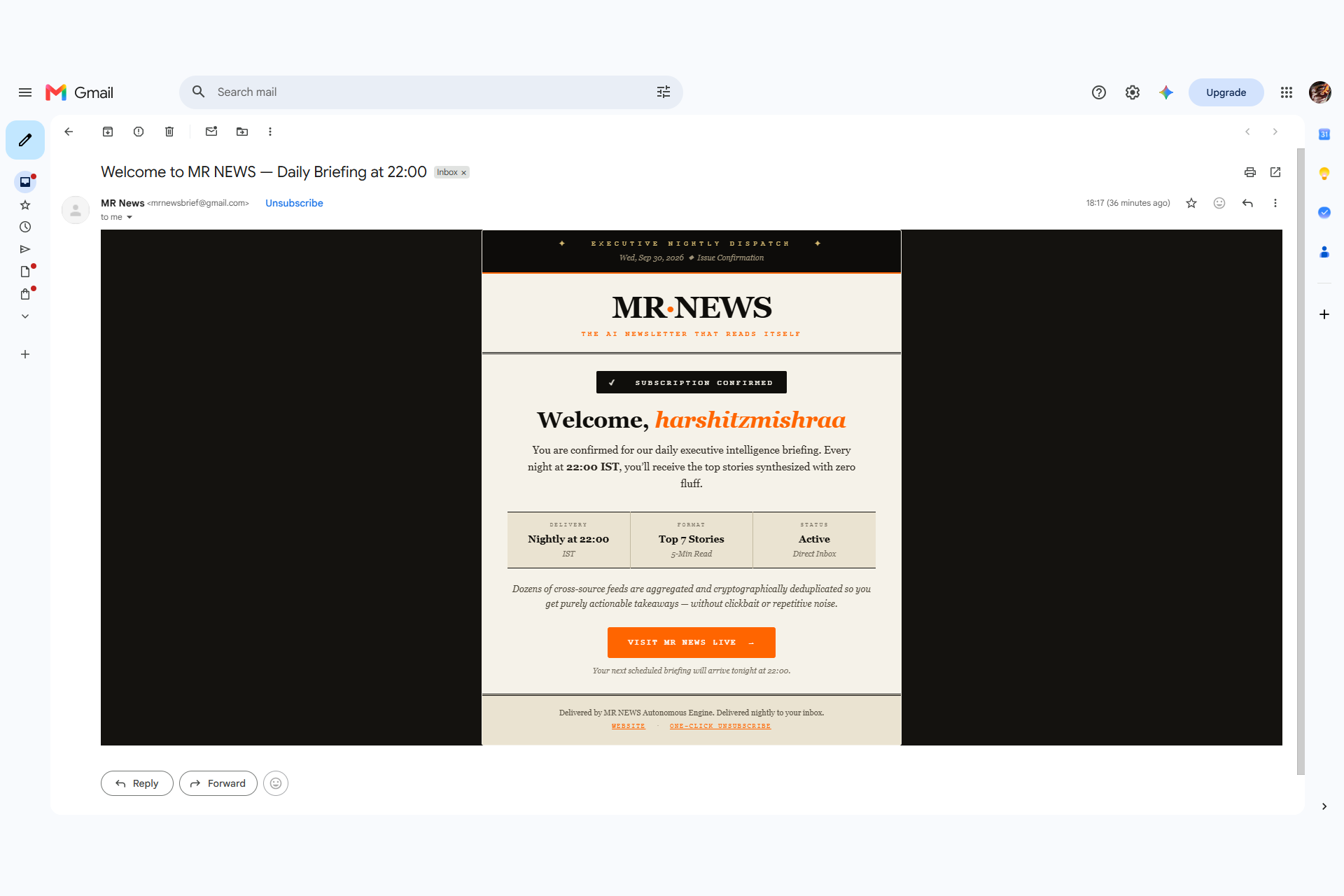
A look at our welcome confirmation email inside Gmail, complete with delivery confirmation and your personalized reader credentials.
-
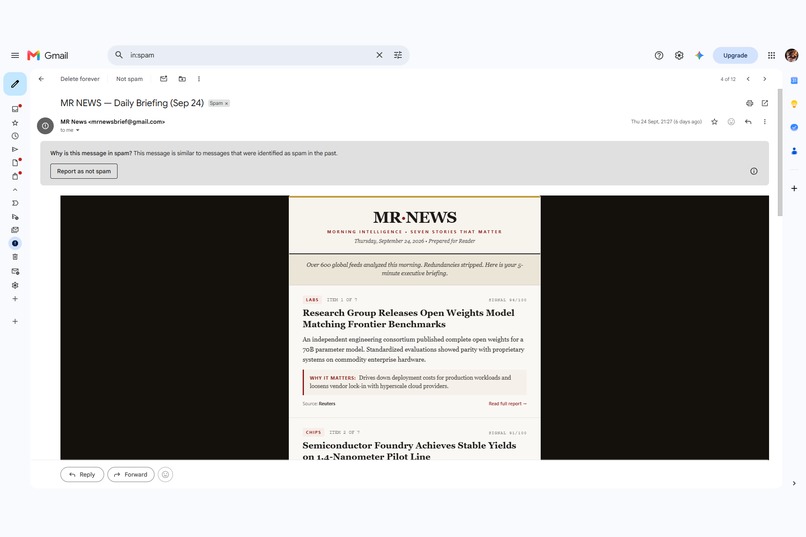
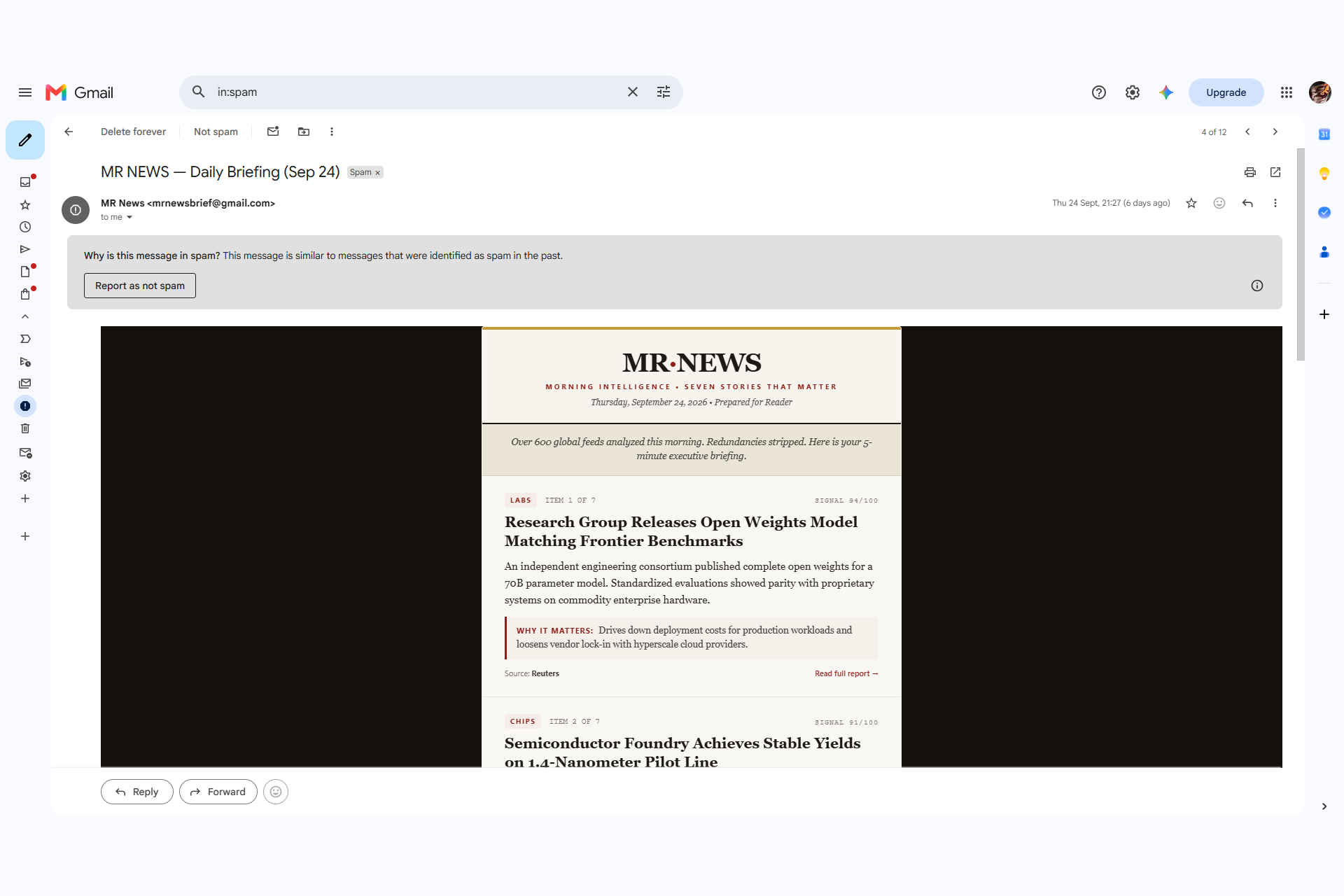
The actual nightly briefing in Gmail with two sentences of plain English facts followed by one sentence explaining why it matters.
INSPIRATION
We were completely burnt out from keeping up with the tech world. Every evening felt like the same exhausting ritual: opening fifty browser tabs across Reuters, TechCrunch, and Hacker News, only to realize forty of them were rehashed coverage of the exact same event. Between breathless AI hype, clickbait headlines, and endless doomscrolling, staying informed started feeling like a full time job.
We wanted our evenings back. We asked ourselves a simple question: what if we had a quiet, relentless editor working behind the scenes? Someone who reads through hundreds of stories, cuts through the noise, ignores the fluff, and gives us seven essential things we actually need to know before going to bed. That frustration is why we built MR NEWS.
WHAT IT DOES
MR NEWS is a personal nightly intelligence briefing that does the heavy reading for you. Every night at 22:00, it sends a single, beautifully formatted email straight to your inbox.
Here is what happens under the hood:
- It constantly monitors premier newsrooms including Reuters, Associated Press, BBC, Wall Street Journal, TechCrunch, Ars Technica, and MIT Technology Review.
- It runs incoming feeds through our deduplication engine to strip out repetitive stories and recycled wire reports before they touch an AI model.
- It hands the clean pool of stories to Google Gemini, which acts as our chief news editor. Gemini ranks the significance of each event, writes a two sentence plain English summary, explains why the story matters strategically, tags the vertical, and assigns an impact score from 60 to 99.
- It compiles everything into a clean dark mode briefing and delivers it through Resend so you can read it in under five minutes.
- It offers a web hub with a live archive, an analog SVG dispatch clock, and secure one click unsubscribe links that do not track you.
HOW WE BUILT IT
We wanted the stack to be lightweight, dependable, and blazingly fast.
- The Foundation: We built the web application using Next.js App Router, React 18, and TypeScript. We designed the interface by hand with pure CSS, focusing on a dark mode layout with subtle glowing accents and an interactive analog clock showing the nightly delivery time.
- The Editor: We integrated the Google Gemini API with the gemini 1.5 flash model. We spent hours dialing in strict schema prompts so Gemini never talks like a press release. It outputs structured data with concise summaries and zero fluff.
- The Math Behind Deduplication: Rather than throwing raw news straight at an expensive LLM, we built a filter using SHA256 hashes and token based Jaccard similarity. If two headlines from different outlets share substantial vocabulary, the similarity score flags them: $$\text{Similarity}(A, B) = \frac{|A \cap B|}{|A \cup B|}$$ When the overlap clears our threshold, we collapse them into one canonical story and avoid duplicate noise.
- Database and Storage: We used Supabase with PostgreSQL to store subscriber preferences, delivery history, and an archive of seen article hashes so yesterday's news never sneaks into tonight's briefing.
- Email Infrastructure: We send every issue through the Resend API using custom responsive HTML email templates built with nested tables, making sure it renders cleanly across Apple Mail, Gmail, and Outlook.
- Automation: Vercel Cron triggers our secure cron endpoint every night right on schedule.
CHALLENGES WE RAN INTO
Building this gave us a few sleepless moments:
- The headline duplicate headache: When major news drops, seven different outlets write seven different variations of the headline. Relying on basic keyword matching broke down immediately. We had to combine Jaccard set similarity with cross article context in Gemini so readers would never get two stories about the exact same acquisition or lawsuit.
- Taming the AI tone: Early test runs were way too verbose. Gemini kept writing paragraphs filled with buzzwords like game changing or revolutionized. Getting the model to produce tight, two sentence facts followed by one punchy sentence on strategic impact took a lot of prompt refinement and temperature tuning.
- Email rendering nightmares: Modern web CSS is practically useless inside email inboxes. Getting clean dark mode cards, badges, and typography to look crisp on both an iPhone and an old Outlook desktop client required rebuilding the email layout from scratch with pure inline styles.
- Unreliable feeds: External news feeds can crawl or fail without warning. If one feed hung, it would freeze the entire pipeline. We refactored everything around Promise.allSettled with strict per source timeouts so one unresponsive server never breaks the nightly drop.
ACCOMPLISHMENTS THAT WE ARE PROUD OF
- It genuinely changed our own daily routine. Reading the briefing takes five minutes, and you walk away feeling informed rather than drained.
- The hybrid filtering pipeline works like a charm. By catching duplicates with math first, we cut down our AI token costs and keep the briefing razor sharp.
- The visual design feels calm and deliberate. The glowing analog dial and terminal style statuses make it feel more like an intelligence console than an ordinary marketing newsletter.
- The entire flow runs autonomously from scraping to inbox delivery without needing anyone to manually hit send.
WHAT WE LEARNED
- Math should always do the heavy lifting before you call an AI. Simple algorithms like Jaccard similarity save real money and keep language models focused on what they do best: synthesis and reasoning.
- Good editorial tone is all about negative constraints. Telling the model what not to say matters far more than giving it open ended creative prompts.
- Building bulletproof email is an art form. We gained immense respect for email deliverability, cryptographic unsubscribe verification, and inbox rendering quirks.
WHAT IS NEXT FOR MR NEWS
- Custom topic dials: Letting readers slide their preferences up or down so hardware engineers get more chip coverage while founders get more funding and policy news.
- AI audio digests: Generating a quick three minute morning audio briefing using voice synthesis for people who prefer listening on their morning commute.
- Instant messaging delivery: Adding Telegram and WhatsApp channels for readers who prefer chatting over opening an email app.
- Global coverage: Adding regional feeds with real time translations for builders across Asia and Europe.
- Google authentication: Setting up complete Google OAuth login so subscribers can sign up and manage their delivery preferences with a single tap.
Built With
- algorithms
- artificial-intelligence
- cryptography
- css3
- google-cloud
- google-gemini-api
- html5
- javascript
- machine-learning
- natural-language-processing
- next.js
- node.js
- postgresql
- react
- sql
- supabase
- typescript
- vercel
- versioncontrol


Log in or sign up for Devpost to join the conversation.