-
Dashboard
Inspiration
Singapore becomes super-aged in 2026, and Age Well Neighbourhoods are being sited in senior-dense towns from this year. Yet nobody publishes whether the seniors in a given block can actually walk to an Active Ageing Centre (AAC). AIC says 8 in 10 can.We wanted to find the 1 in 5 who can't.
What it does
KampungRadius scores every subzone on how many residents aged 65+ live beyond a walking threshold from the nearest AAC, rolls that up to planning areas, ranks the worst gaps, and (in the sprint) will recommend where one new centre would cover the most unserved seniors. Gaps are reported in people, not kilometres.
How we built it
On Databricks Free Edition: Census 2020 population by subzone and age, URA subzone boundaries and MOH eldercare/Go-To-Point locations pulled from data.gov.sg into a Unity Catalog volume, cleaned into silver Delta tables, then a gold table of nearest-centre distances per subzone. An AI/BI dashboard and a Genie space sit on the gold table.
What we found so far
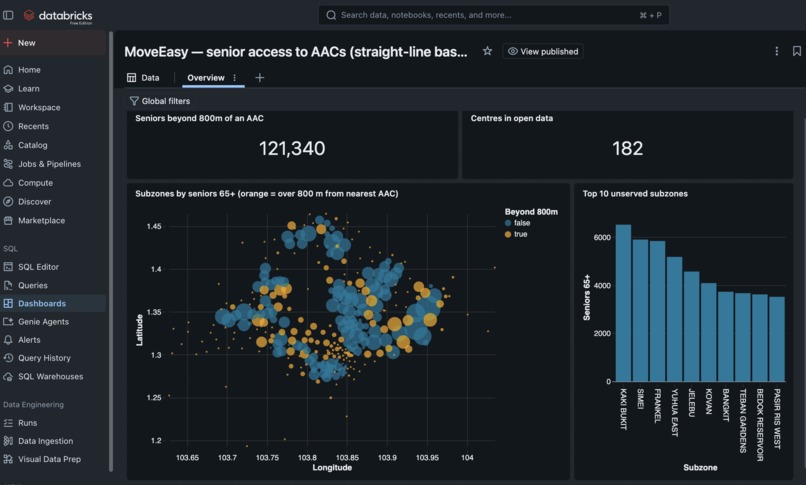
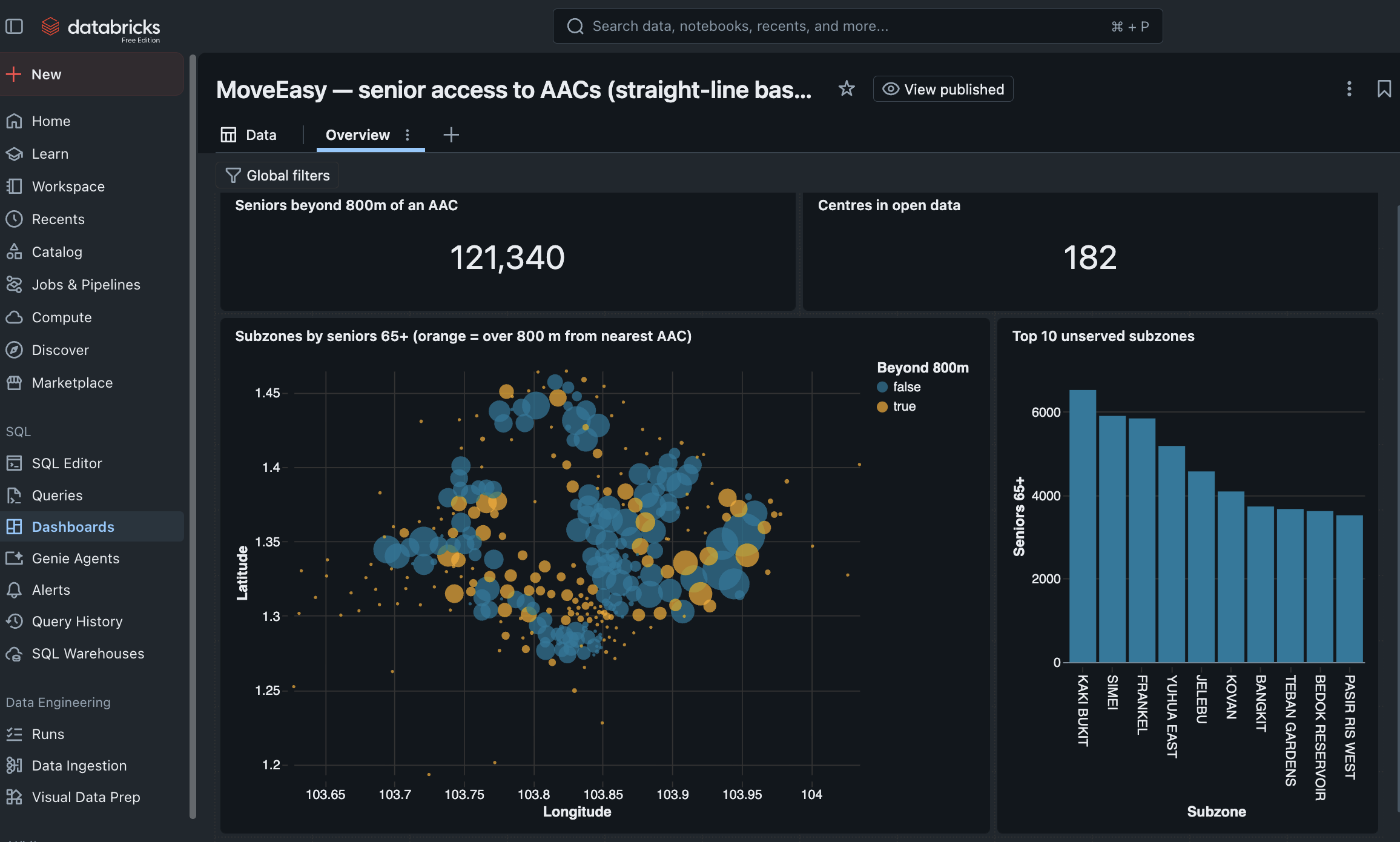
Straight-line baseline, 182 geocoded centres: 121,340 seniors (19.7%) live in subzones more than 800 m from an AAC — an independent estimate that lands on AIC's own 1-in-5 figure. The clearest gaps are landed estates such as Frankel and Kovan, where there are no void decks to host a centre.
Challenges
No open dataset holds the current AAC network. The MOH layer had 146 usable centres; we assembled 36 more by hand from MOH's Community Health Post list and geocoded them via OneMap. That gap is itself a finding, and the pipeline accepts an updated list on day one.
What's next
Population-weighted centroids from block-level data, walking time via OneMap routing instead of straight-line distance, public-transport access to polyclinics, a greedy site recommender, and a Databricks App with a choropleth map.

Log in or sign up for Devpost to join the conversation.