-
-
Moodling
-
Moodling Canvas
-
Moodling Creature
Inspiration
Many emotional tools ask people to label their feelings first. But in real life, emotions rarely arrive that clearly. They often show up as tension, hesitation, overstimulation, or a vague shift in energy before they can be named.
We were interested in a simple but powerful question:
What if emotion could be expressed before it was categorized?
That question became Moodling — a drawing-based emotional interface that helps users externalize subtle feelings through mark-making, then transforms those signals into living emotional companions.
What Moodling does
Moodling is a speculative emotional interface where users draw what they feel instead of choosing from preset labels.
The experience unfolds in three parts:
- Emotional Expression — users sketch their current emotional state through intuitive mark-making.
- System Interpretation — the system reads emotional signals from the drawing, such as rhythm, density, and movement, and generates a living form in response.
- Emotional Ecosystem — generated forms can be saved, revisited, and allowed to stay with the user as companions over time.
Rather than treating emotion as something to simply measure or log, Moodling makes it visible, interactive, and alive.
How we built it
We developed Moodling through Figma Design, Figma Make, and Figma Slides, using interaction prototyping and speculative storytelling together.
We first mapped the core journey of the product:
- Sketch feeling
- System interprets
- Emotion appears
- Companion stays
- Archive grows
From there, we designed and prototyped the main system layers:
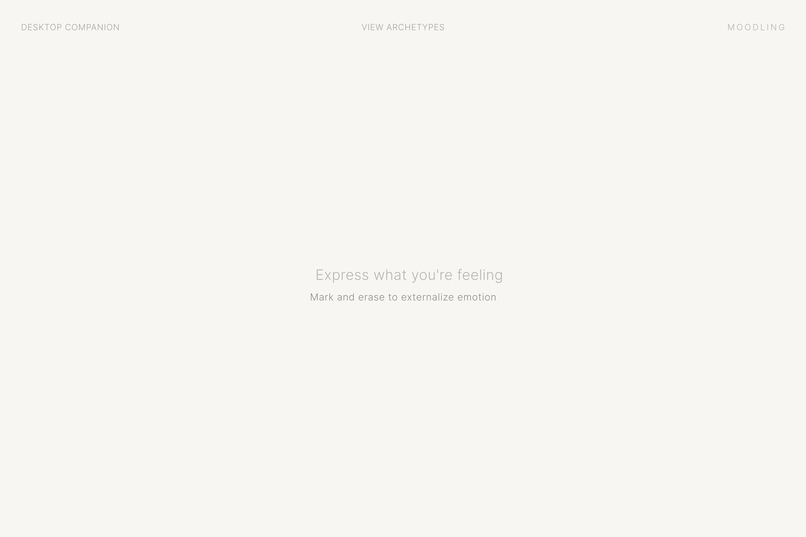
- a canvas-based drawing interface for emotional expression
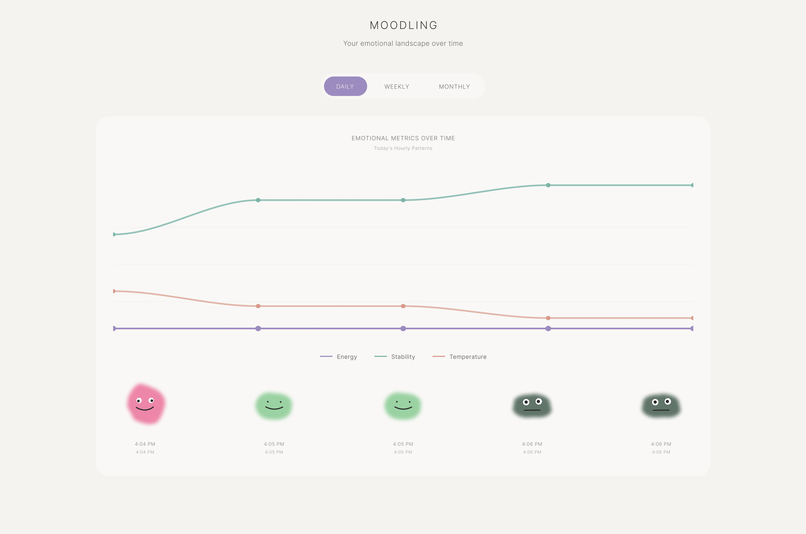
- a result screen where the system interprets marks and generates a companion
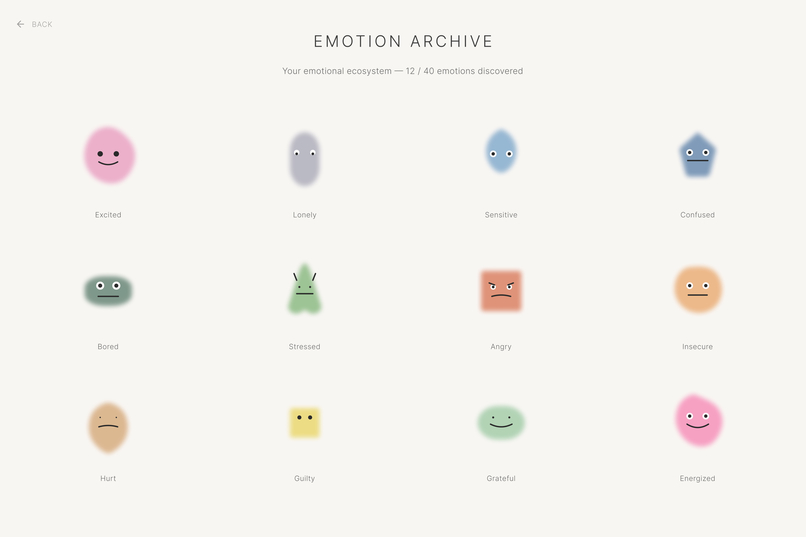
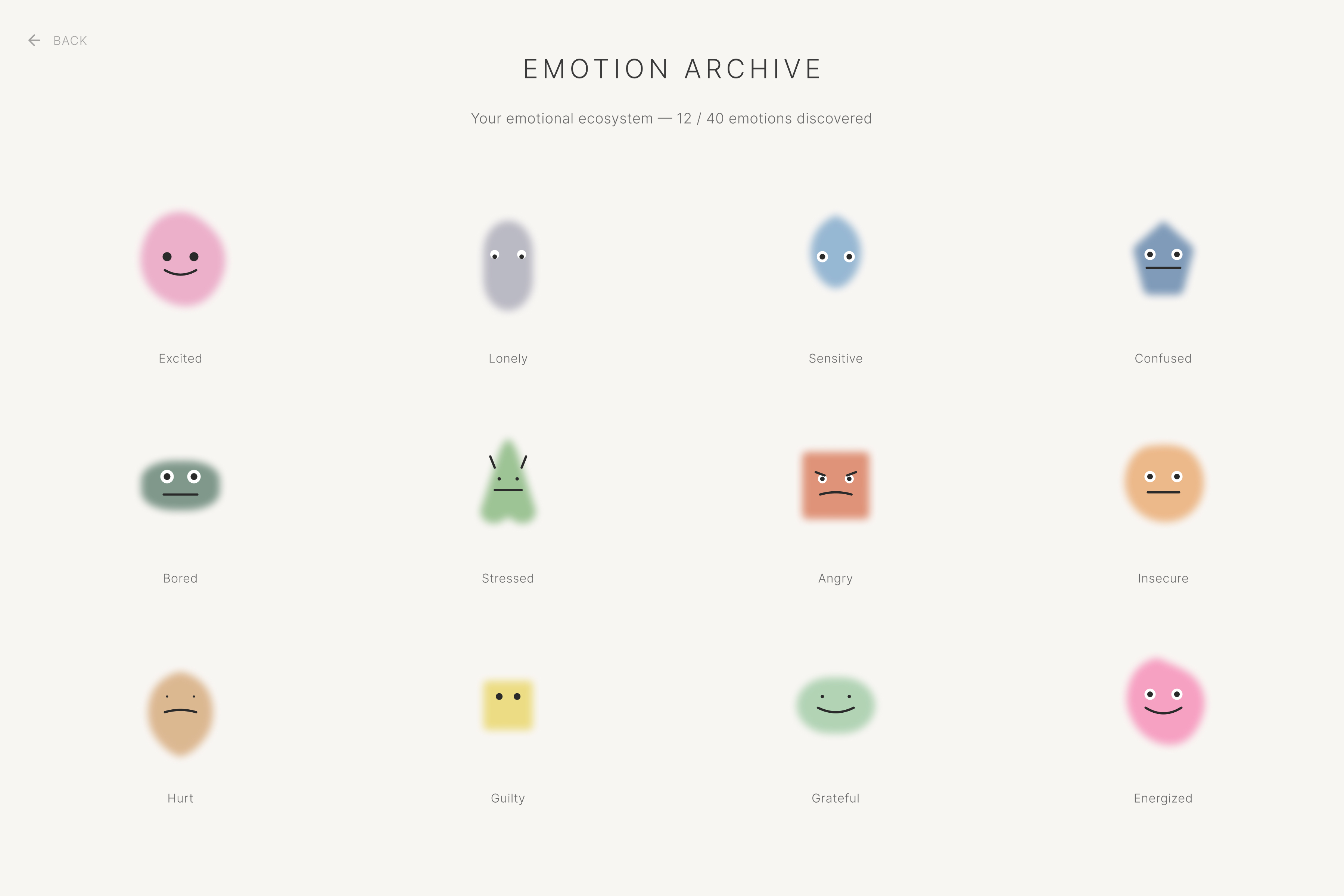
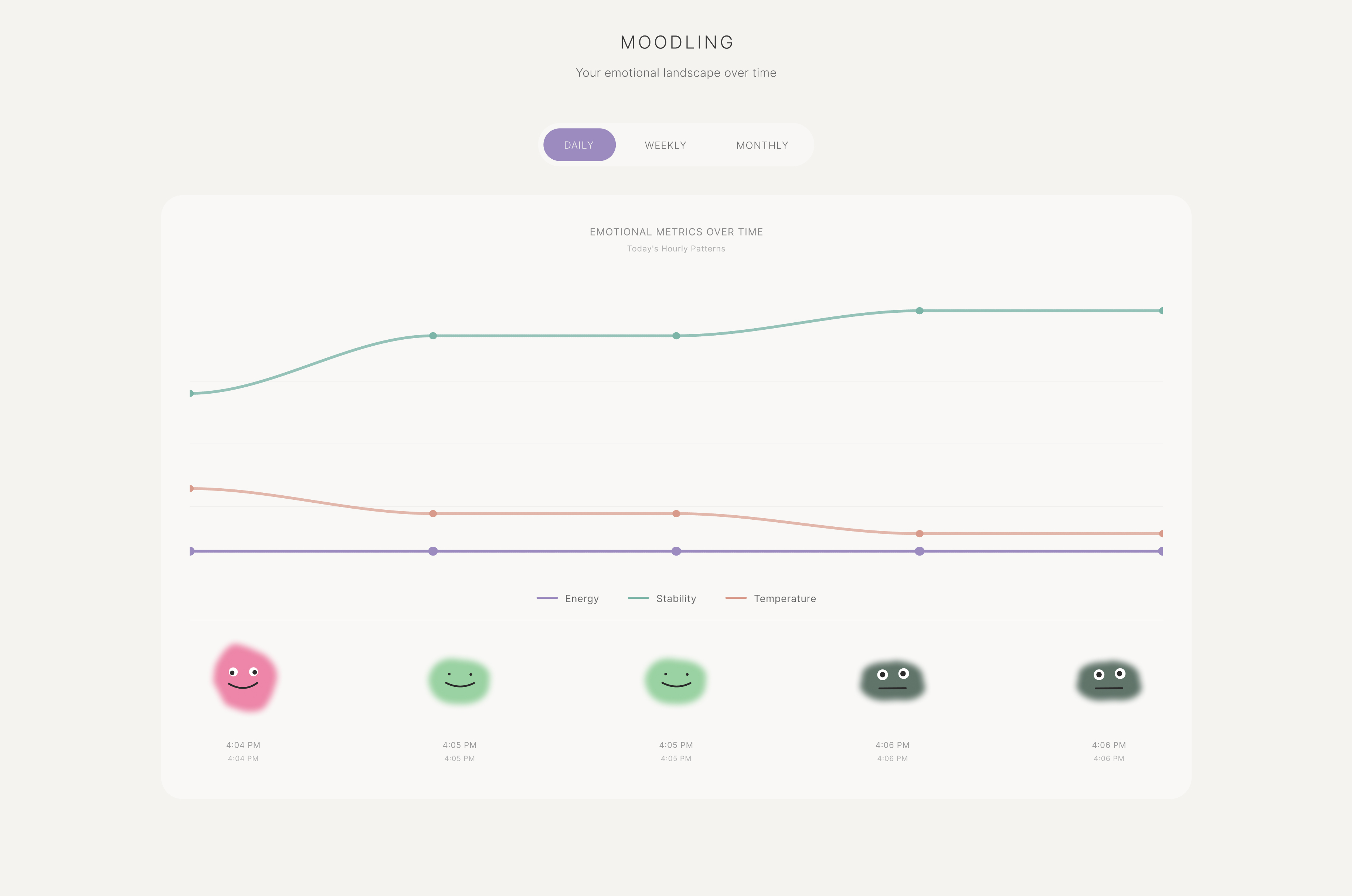
- an Emotion Archive that stores discovered emotional forms as a growing ecosystem
- a Desktop Companion layer that lets feelings remain present as a quiet visual companion
To communicate the emotional quality of the project, we also created a cinematic demo that combines speculative atmosphere with real product flow.
Challenges we ran into
1. Balancing poetry with clarity
Moodling is not a clinical mood tracker, but it also could not feel vague or purely artistic. We had to design an experience that remained emotionally expressive while still being understandable as a usable tool.
2. Avoiding label-first thinking
Many existing emotional products rely on dropdown moods, ratings, or explicit self-reporting. Our challenge was to design a flow where drawing itself could be the input, and where interpretation felt meaningful rather than arbitrary.
3. Making the companions feel coherent
The emotional creatures needed to feel distinct, expressive, and memorable — but still belong to one visual system. We spent time refining their shapes, colors, motion, and presence so they felt like part of one emotional language.
4. Prototyping “presence” across views
One of the hardest parts was designing how a feeling could move beyond a single result screen and remain present over time. We explored this through archive behaviors, companion customization, and desktop presence inside the Moodling workspace.
What we learned
This project taught us that emotional technology does not always need to begin with language, charts, or diagnosis. Sometimes expression itself can be the input.
We learned how interface design, motion, visual systems, and speculative storytelling can work together to make something as intangible as emotion feel perceptible and personal.
Most importantly, we learned that emotional awareness can be designed not only as a system of tracking, but also as a system of companionship.
Future directions
In the future, Moodling could expand into a richer emotional ecosystem with:
- more emotional forms and archetypes
- deeper archive patterns across time
- more adaptive companion behaviors
- broader desktop or environmental presence
- richer reflection tools based on accumulated emotional states
We imagine Moodling as part of a softer future for emotional technology — one where what we feel no longer stays hidden, but gradually takes form.
Built With
- adobe-illustrator
- capcut
- css
- figma
- html
- javascript
- make
- openai
- slides
- sora
- tailwindcss
- vimeo


Log in or sign up for Devpost to join the conversation.