-
-
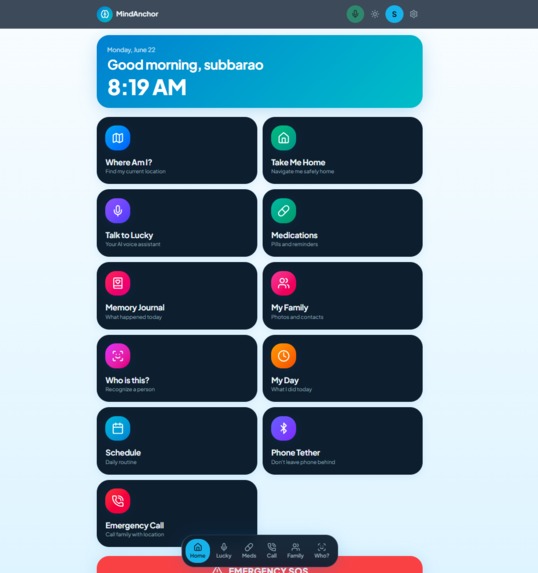
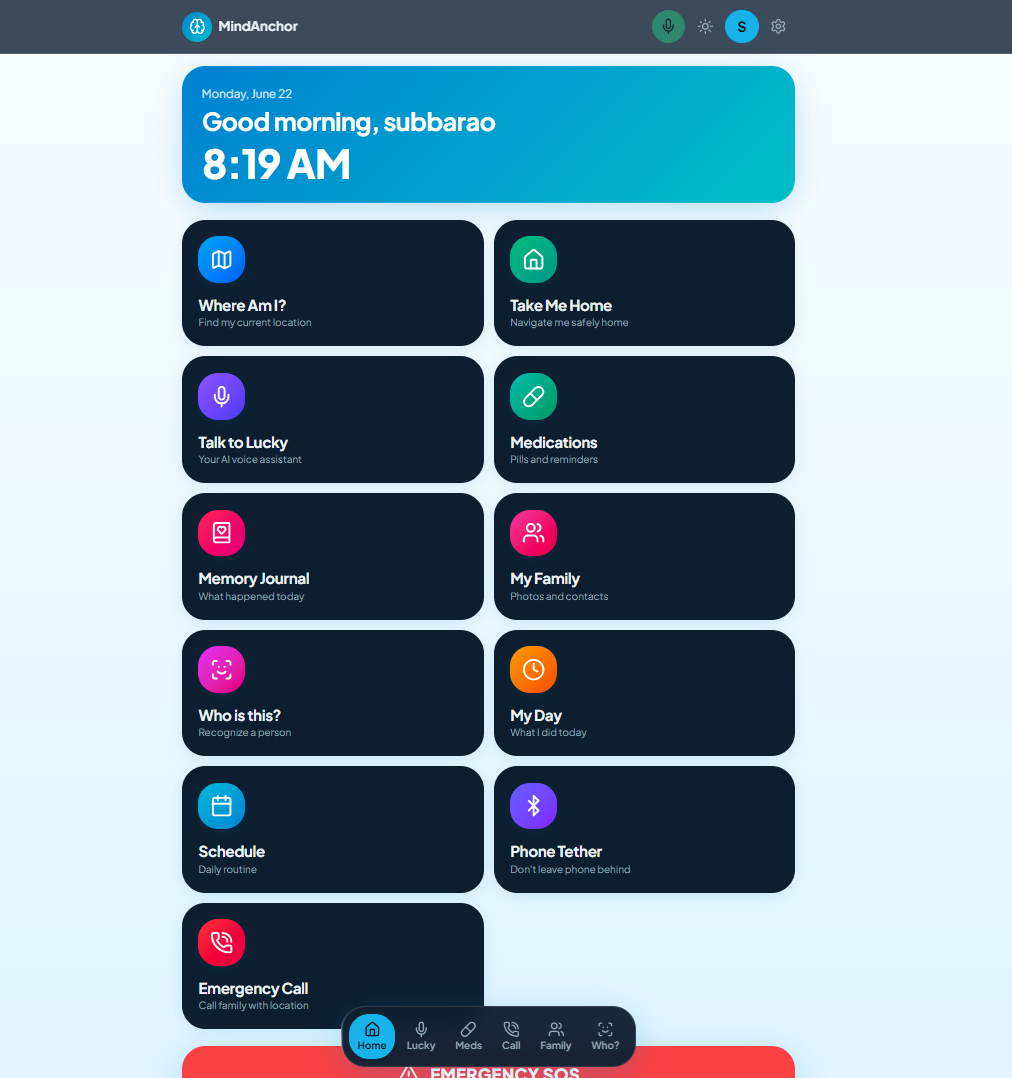
this is the home page of the app after sign in
Inspiration
Alzheimer's and dementia affect millions of people worldwide. Patients often forget where they are, what they were doing, whether they took their medication, or even how to return home safely. These challenges create stress not only for patients but also for caregivers and family members.
We wanted to create a solution that acts as a trusted digital companion — one that can remember when memory fails.
This inspired us to build MindAnchor, an AI-powered memory and safety assistant designed specifically for Alzheimer's patients.
What it does
MindAnchor functions as a second memory and safety companion.
The application includes:
Lucky AI Voice Companion Daily Memory Timeline Medication Management Personalized Voice Reminders "Where Am I?" Assistance "Take Me Home" Navigation Emergency SOS Support Caregiver Monitoring Dashboard Safe-Zone Monitoring Bluetooth Wearable Integration Phone Separation Detection AI Routine Learning Past Me → Future Me Memory Messages
One of the most innovative features is Lucky AI, an always-available voice companion.
Patients can simply say:
"Lucky, where am I?"
"Lucky, what was I doing?"
"Lucky, what should I do next?"
Lucky AI responds with personalized information based on the user's recent activities, routines, location, and memory timeline.
If a patient says:
"Lucky, I am lost."
or
"Lucky, where am I?"
the system automatically shares the patient's location with caregivers and family members and initiates emergency contact procedures.
Another unique feature is Past Me → Future Me, which allows users to record messages for themselves that the AI automatically delivers at the right time.
How we built it
The project was developed using AI-powered development platforms and modern cloud technologies.
The system combines:
Mobile application technologies Conversational AI Voice recognition Text-to-Speech Location intelligence Bluetooth wearable monitoring Real-time caregiver communication AI-generated memory timelines Context-aware reminder systems
Lucky AI continuously processes voice interactions, activity patterns, location history, medication schedules, and routine behaviors to provide personalized assistance.
Challenges we ran into
Building for Alzheimer's patients required solving several unique challenges.
Some of the biggest challenges included:
Designing a simple and accessible user interface for elderly users Creating reliable voice-first interactions Developing context-aware memory assistance Preventing false emergency alerts Implementing Bluetooth-based phone separation monitoring Balancing user privacy with caregiver visibility Designing AI responses that are supportive and trustworthy Ensuring caregivers remain involved in important decisions
Accomplishments that we're proud of
We are proud of creating a solution that addresses a real-world healthcare challenge faced by Alzheimer's and dementia patients.
Our biggest accomplishment is the development of Lucky AI, an always-available voice companion that helps patients remember daily activities, understand their surroundings, and receive immediate assistance when confused.
We are also proud of integrating multiple safety features into a single platform, including:
AI-powered memory assistance Context-aware voice interaction Medication management and reminders Caregiver monitoring dashboard Emergency SOS system Bluetooth wearable integration Phone separation detection Safe-zone monitoring Automatic caregiver alerts and emergency calling Past Me → Future Me personalized memory messages
Most importantly, we built a solution focused on preserving patient independence while keeping caregivers informed and involved.
Alzheimer's patients may forget usernames, passwords, or login procedures. To reduce confusion and improve usability, MindAnchor uses a persistent caregiver authentication system.
Once a caregiver or family member signs into the application and completes the initial setup, the account remains logged in permanently unless the caregiver intentionally signs out.
Features include:
One-time caregiver login and setup Persistent authentication across app restarts Automatic secure session restoration No repeated username or password entry for patients Reduced cognitive burden for Alzheimer's users Faster access to emergency and safety features
This design ensures that patients can immediately access Lucky AI, emergency assistance, medication reminders, memory timelines, and caregiver communication features without needing to remember login credentials.
By removing unnecessary login barriers, Mind Anchor becomes more accessible, reliable, and suitable for elderly users experiencing memory loss
What we learned
Through the development of MindAnchor, we learned how artificial intelligence can be used responsibly to improve quality of life for vulnerable populations.
We gained experience in:
Human-centered AI design Accessibility-focused application development Voice assistant technologies Speech-to-Text and Text-to-Speech systems Location intelligence and navigation services Healthcare safety workflows Emergency alert systems Bluetooth-based device monitoring Responsible AI practices
We also learned that healthcare technology should not replace caregivers but should support them by providing timely information, improving safety, and reducing stress for both patients and families.
What's next for Mind Anchor
Our vision is to evolve MindAnchor into a complete AI-powered companion for Alzheimer's and dementia care.
Future enhancements include:
Smartwatch integration for health monitoring Fall detection and automatic emergency alerts Advanced wandering prediction using AI Multi-language voice support Integration with healthcare providers and hospitals Personalized cognitive exercises and memory training Predictive routine analysis for early risk detection Family collaboration tools Real-time caregiver communication features Enhanced offline functionality for rural and low-connectivity areas
In the long term, we aim to make MindAnchor a trusted digital companion that helps millions of Alzheimer's patients stay safe, independent, and connected while giving caregivers greater peace of mind.
Our goal is simple: Empower patients, support caregivers, and use AI to make everyday life safer and more manageable.
Built With
- ai
- api
- app
- authentication
- bluetooth
- cloud
- database
- energy
- gemini
- gps
- lovable
- low
- maps
- mobile
- notifications
- postgresql
- progressive
- push
- react
- real-time
- responsive
- speech
- speech-to-text
- storage
- studio
- supabase
- system
- text-to-speech
- typescript
- ui
- web

Log in or sign up for Devpost to join the conversation.