Inspiration
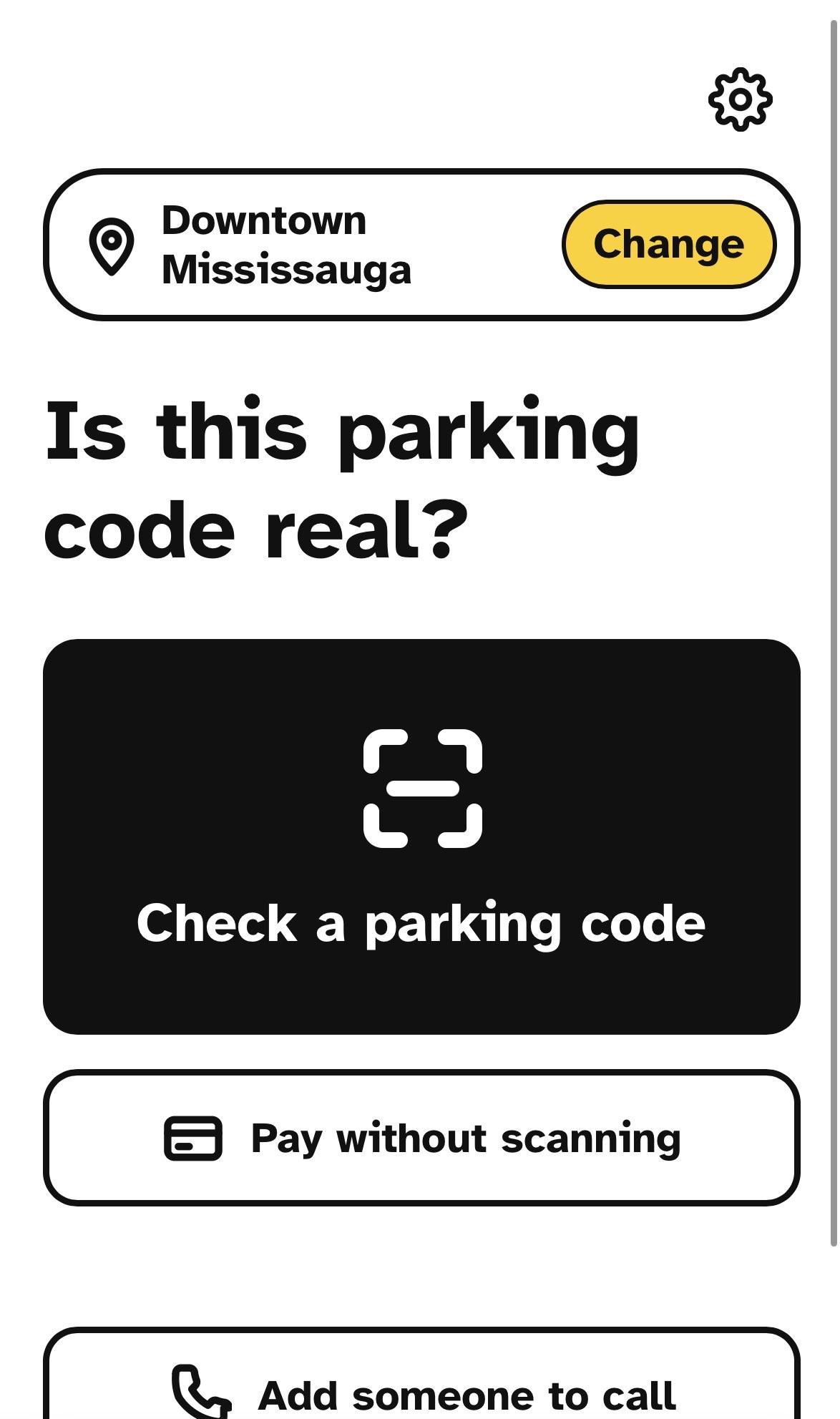
What it does*Meter Check* gives you a second opinion on any parking code.
- Scan the code. Meter Check reads it but never opens it.
- It checks where the code really goes. It compares the address with the real parking services for the town you're in: 125 Ontario cities, towns and parks and 26 parking services.
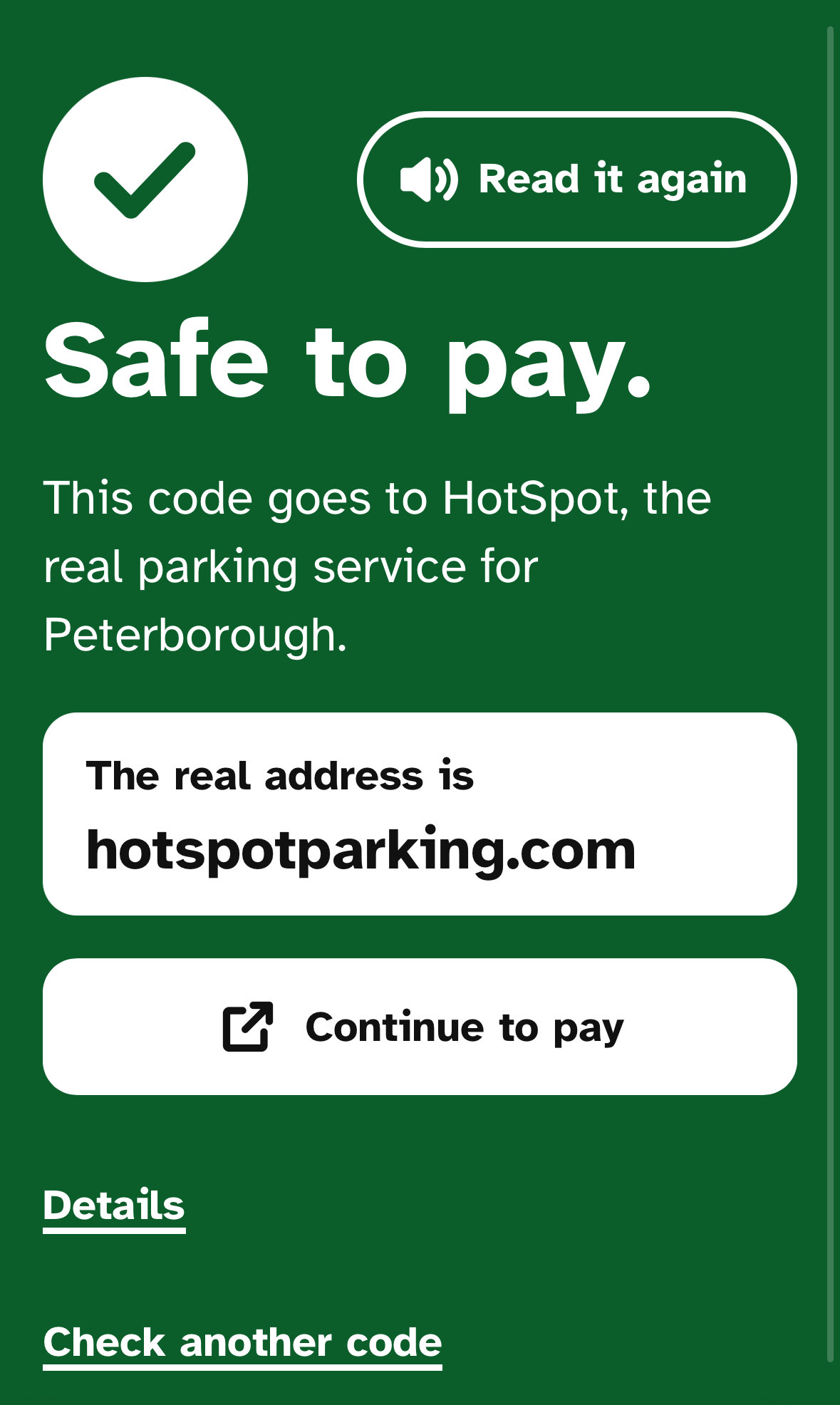
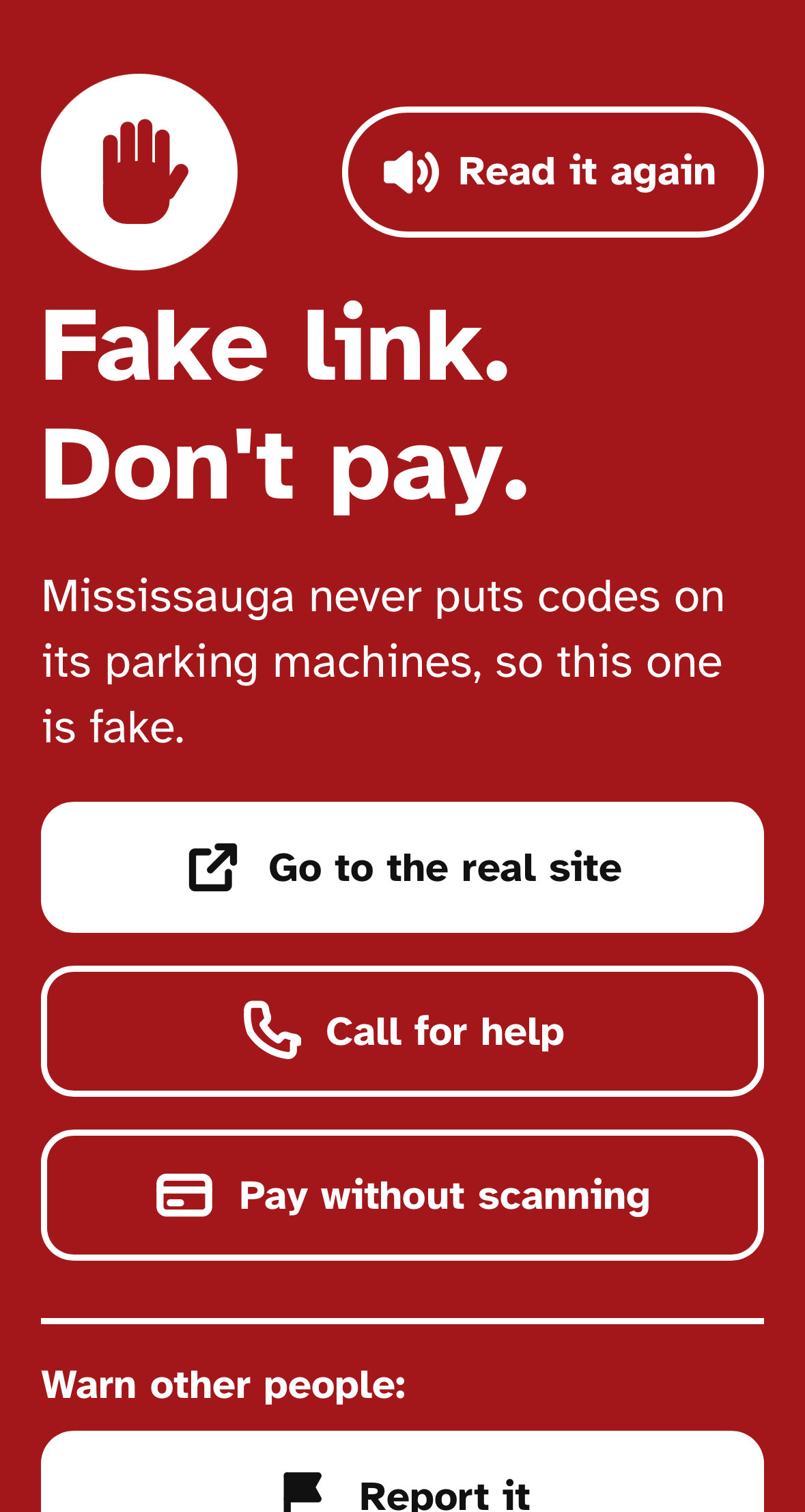
- You get one answer, in big words, read out loud:
| Answer | |
|---|---|
| 🟢 | Safe to pay. |
| 🔴 | Sketchy link. Don't pay. |
| ⚪ | Wrong town? Don't pay yet. |
| 🟡 | Not sure. Pay another way. |
Every answer comes with a safe next step:
- the real website, from our list (never from the code)
- the official parking app
- a number to call
One tap puts a fake code on a shared map, so the next driver is warned.
How we built it
1. A list, not a guess
For every town $t$ we built a set $A_t$: the web addresses that really take parking payments there. We gathered them from each town's and each company's own pages. If $h(c)$ is the website a code $c$ points to, the whole app follows one rule:
$$ \text{answer}(c)= \begin{cases} \text{Safe} & \text{if } h(c)\in A_t \text{ and every check passes}\[4pt] \text{Wrong town?} & \text{if } h(c)\in A_{t'} \text{ for another town } t'\neq t\[4pt] \text{Don't pay} & \text{if a check fails, or } h(c)\notin \bigcup_{t} A_t\[4pt] \text{Not sure} & \text{otherwise} \end{cases} $$
Green has to be earned. An address that isn't on the town's list can never be green:
$$ P\big(\text{Safe}\;\big|\;h(c)\notin A_t\big)=0 $$
2. Catching look-alikes
Scammers pick names one or two letters away from the real one. We measure how far apart two names are with edit distance (Levenshtein), the number of single-letter changes needed to turn one name into the other:
$$ D(i,j)=\min\begin{cases} D(i-1,j)+1 & \text{(delete)}\ D(i,j-1)+1 & \text{(insert)}\ D(i-1,j-1)+[a_i\neq b_j] & \text{(swap)} \end{cases} $$
When a name $a$ is within two letters of a real name $r$, it gets a look-alike score:
$$ s=\min!\left(1,\;\max!\left(0.65,\;1-\frac{D(a,r)}{\max(|a|,|r|)}\right)+e\right) $$
Here $e$ adds $0.15$ for bait words like "parking" or "pay", and $0.20$ for unusual endings. If $s \ge 0.6$, it's a fake.
A one-letter typo of a 14-letter name scores $1-\tfrac{1}{14}\approx 0.93$. A copycat name on a website less than 30 days old is also a fake.
3. Knowing where you are
Your phone's GPS gives a latitude $\varphi$ and a longitude $\lambda$. We measure distance on the Earth's surface with the haversine formula:
$$ d = 2R\arcsin\sqrt{\sin^2\frac{\Delta\varphi}{2}+\cos\varphi_1\cos\varphi_2\,\sin^2\frac{\Delta\lambda}{2}},\qquad R = 6\,371\,000\ \text{m} $$
GPS can be wrong indoors. So a real code from the town next door gets grey, not red, and one tap rechecks your location.
4. A map that protects privacy
Before a report is saved, its spot is rounded to four decimal places, about 11 metres:
$$ \tilde{\varphi}=\frac{\operatorname{round}!\left(10^{4}\,\varphi\right)}{10^{4}},\qquad 0.0001^\circ \times 111\ \tfrac{\text{km}}{\text{degree}} \approx 11\ \text{m} $$
Reports become one pin on the map when they're close in both space and time:
$$ d \le 300\ \text{m} \quad\text{and}\quad |\Delta t| \le 2\ \text{h} $$
The server checks every report again before saving it, so nobody can put a real company on the map.
5. Never opening the link
- Our server only knocks. It reads a website's headers and never loads the page.
- It follows at most 3 redirects, 3 seconds each, so a check never waits more than $3 \times 3 = 9$ seconds.
- It can only reach the public internet. Private networks are refused.
- Fake addresses are always shown as
fake-parking[.]com, so they can't be tapped.
6. Made for seniors
- Big text and one big button.
- Answers read out loud.
- Four colors and no jargon.
- No account. Settings stay on your phone.
The stack
- Next.js 16, React 19 and TypeScript
- Cloudflare Workers, with a Cloudflare D1 database for the report map
- Leaflet and OpenStreetMap for the map
- jsQR for reading codes in the browser
- 257 automated tests behind every answer
Challenges we ran into
- Nobody publishes a list of real parking addresses. We researched 125 places by hand and only use facts we could confirm.
- Scammers can use the same tools as real towns. Anyone can make a page on form and payment services like Jotform or Paymentus. So we trust those only at a town's exact address.
- GPS is often wrong indoors. We built the grey "Wrong town?" answer so the app doesn't call a real code fake by mistake.
- Phones only allow the camera on secure (https) pages. So we put the app live on its own domain early.
- A website can't open another company's app unless that company sets it up. So "Pay without scanning" goes to the app's store page, where Open is one tap away.
- Simple words are hard. Every sentence had to make sense to someone who has never heard the word "URL".
Accomplishments that we're proud of
- A clear answer in seconds, without ever opening the scanned link.
- 125 places and 26 parking services, each fact traced to an official page.
- One set of rules and 257 tests behind every answer.
- A live site anyone can try today: metercheck.ca.
What we learned
- Saying "not sure" is a safety feature. A wrong green is far worse than an honest yellow.
- Good data beats clever code. The list of real addresses mattered more than any single check.
- Designing for seniors makes it better for everyone. Big buttons and plain words help every tired driver.
Built With
- cloudflare
- cloudflare-d1
- cloudflare-workers
- css3
- eslint
- geolocation-api
- getusermedia
- html5
- javascript
- jsqr
- leaflet.js
- next.js
- node.js
- opennext
- openstreetmap
- pwa
- qrcode
- rdap
- react
- sqlite
- typescript
- vitest
- web-speech-api
- wrangler
