Many Pasts
See how the past connects across time, place, people, and ideas.
Inspiration
Many Pasts is an idea I have carried for a long time. I love history, but I am also a visual learner. Events make more sense to me when I can see their geography, chronology, environment, resources, and connections to other cultures.
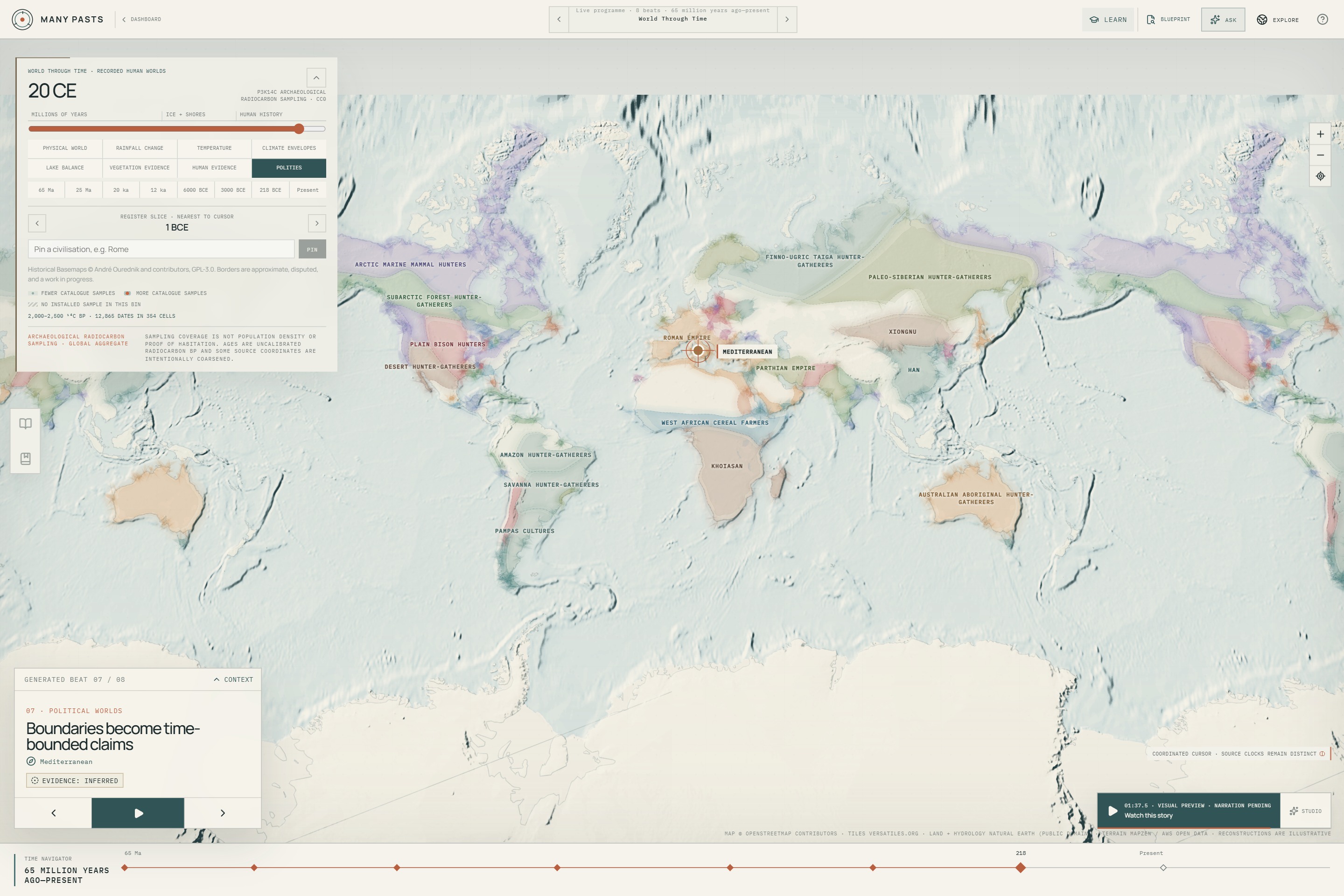
Traditional timelines reduce history to a sequence of dates, while maps often show only one frozen moment. I wanted to create something where people could watch landscapes change, follow movements, compare interpretations, and inspect the evidence behind a story.
At the centre is my idea for a historical ontology: people, places, civilizations, factions, events, objects, resources, languages, mythologies, environments, sources, and interpretations represented as connected entities. This allows the same knowledge to support maps, timelines, lessons, questions, and documentaries.
I discovered OpenAI Build Week only three days before the deadline. That finally prompted me to turn the idea into a working product.
What it does
Many Pasts is an AI-assisted visual history platform for students, educators, visual learners, history enthusiasts, and content creators.
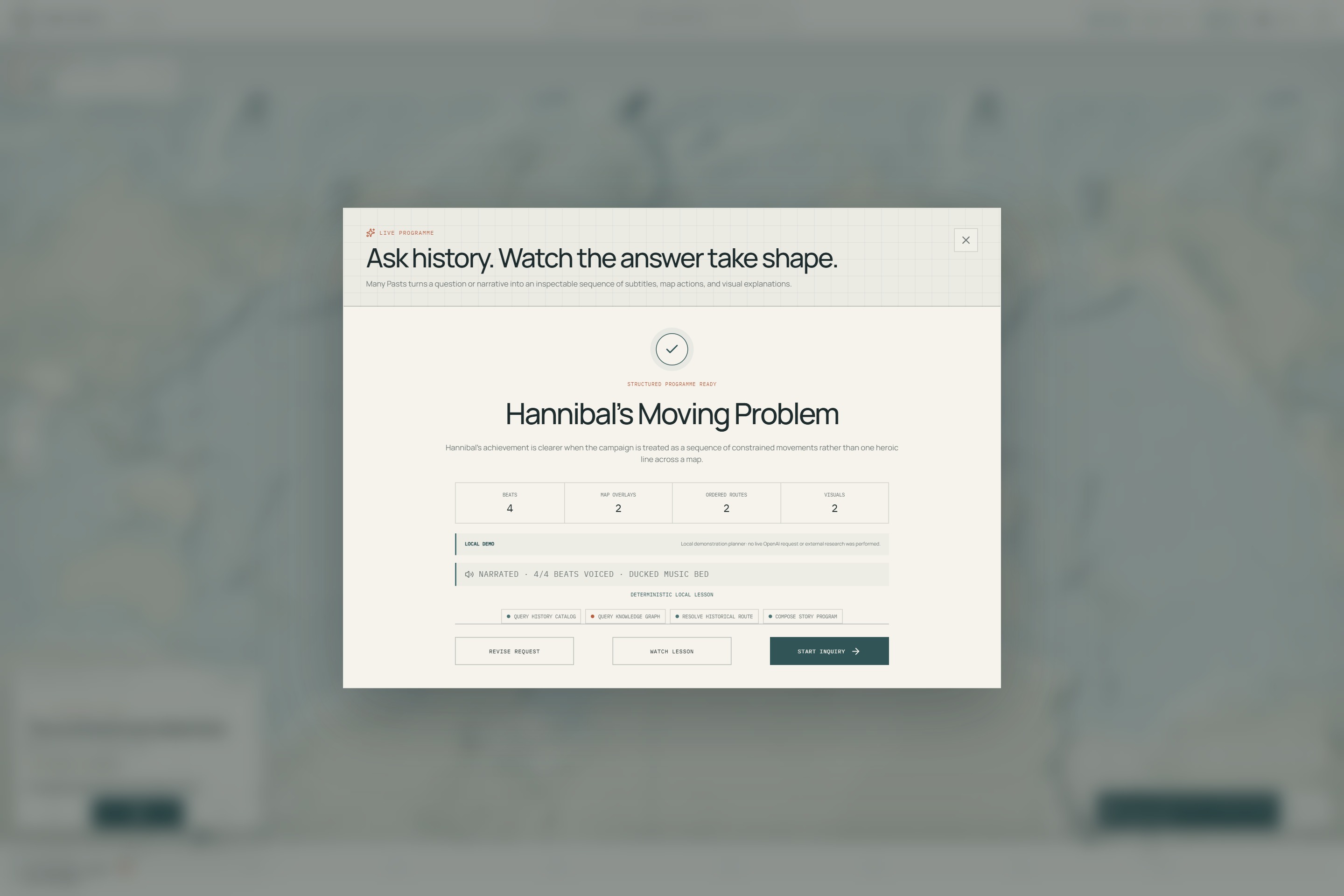
A user can ask a historical question or provide a narrative. GPT-5.6 turns it into a structured visual programme containing narration, subtitles, dates, camera framing, map actions, routes, changing territories, environmental layers, images, diagrams, evidence, and uncertainty labels.
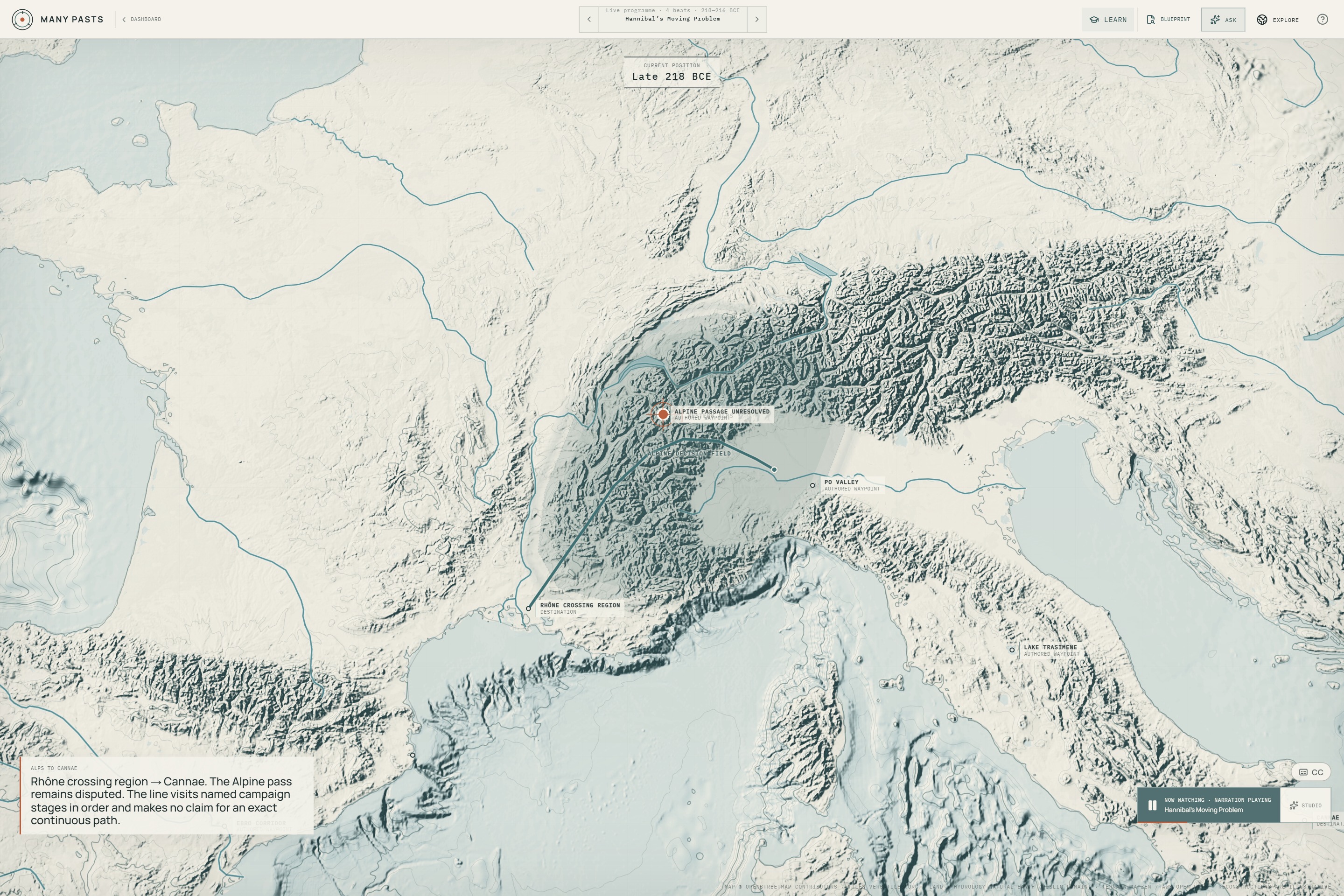
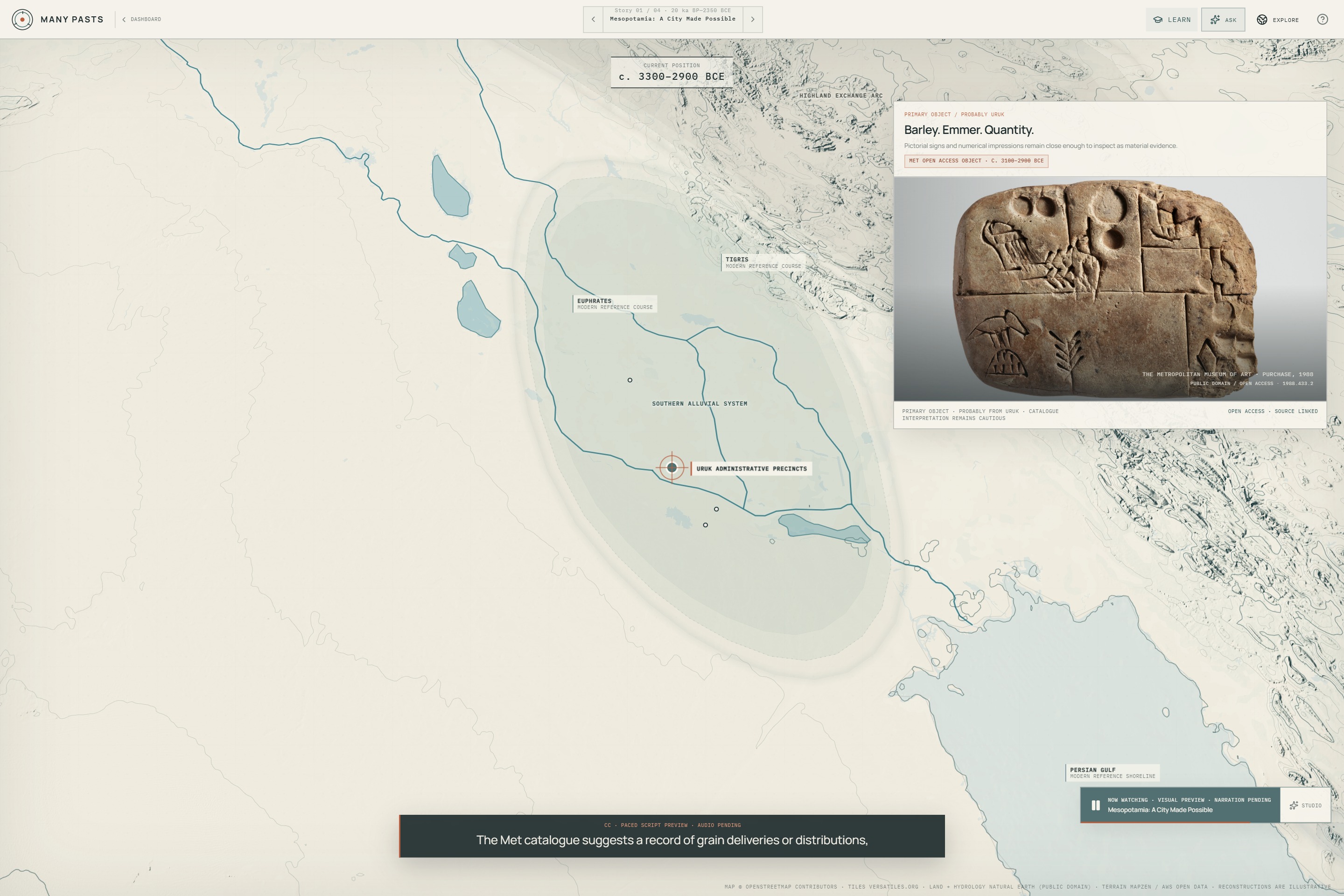
The result plays inside an interactive Viewer rather than returning another block of generated prose. Users can watch the explanation, pause it, move through time, inspect the map, and investigate the evidence.
The same programme can open in a Director timeline, where creators can edit shots, narration, visual cues, camera movement, media, subtitles, music, and sound before producing a video.
How I built it
Many Pasts uses Next.js, React, TypeScript, MapLibre, PostgreSQL, PostGIS, and the OpenAI Responses API.
Its main systems include:
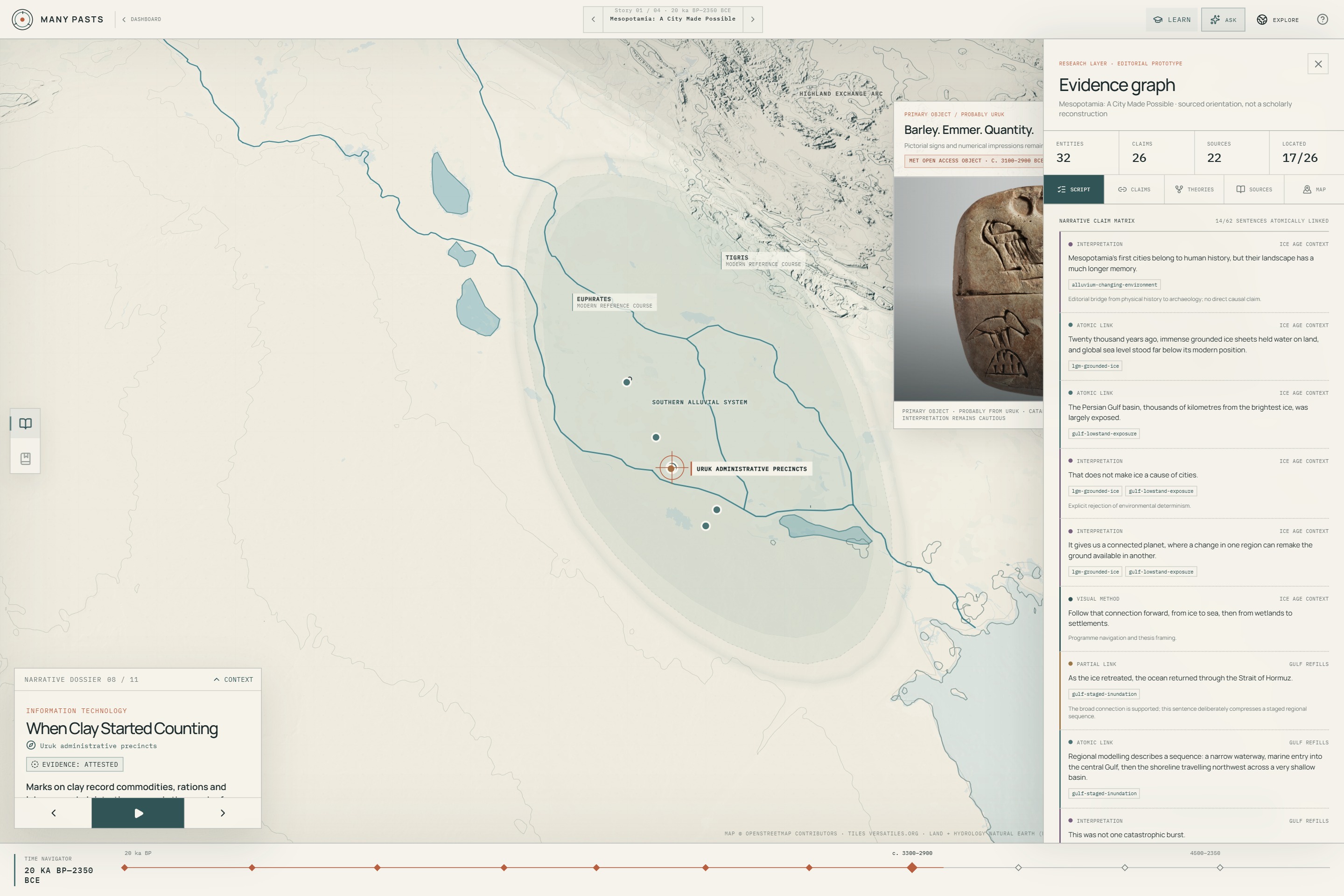
- A historical ontology and evidence-aware knowledge graph
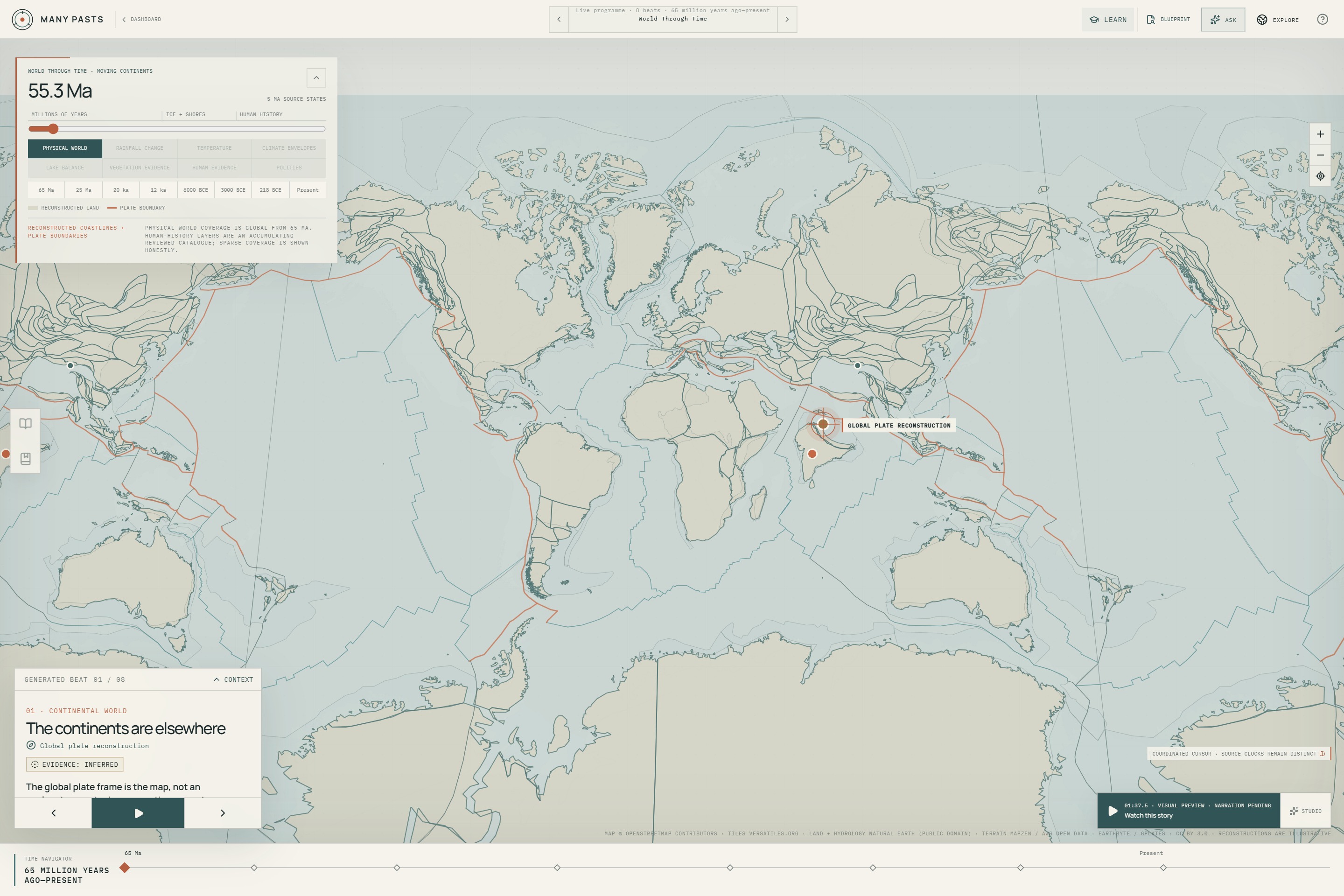
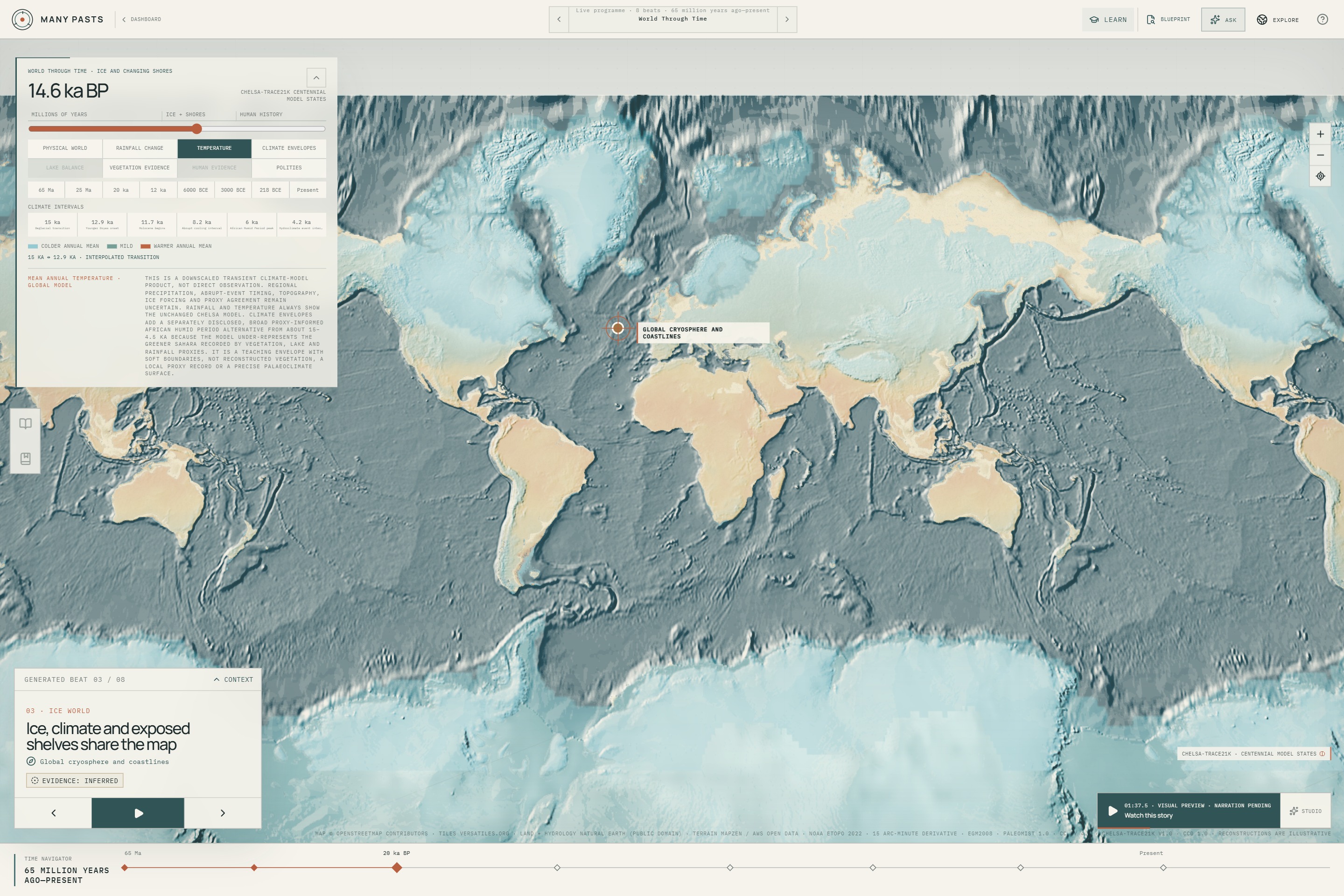
- Temporal map layers for geography, climate, ice, hydrology, civilizations, resources, and movement
- A strict structured format for AI-generated visual lessons
- A shared frame clock synchronizing maps, narration, subtitles, media, and camera movement
- A Viewer for learning and a Director workspace for editing
- A local-first spatial database and data-import pipeline
- Narration, captions, audio editing, and deterministic video rendering
- Explicit distinctions between evidence, inference, dispute, and speculation
The prototype includes a flagship Mesopotamia experience alongside global deep-time, Doggerland, palaeocoastline, climate, tectonic, mythology, linguistics, trade, and military examples.
Building with Codex and GPT-5.6
I acted as product owner, creative director, historical storyteller, and critical first viewer. Codex acted as my implementation partner, translating conversational briefs into working systems and keeping the architecture coherent as the project rapidly expanded.
One major acceleration was generating structured test content. A single timeline can require a large nested JSON configuration containing historical beats, frame timings, narration, camera states, subtitles, routes, layers, media, evidence links, and transitions. Codex generated and revised substantial programmes and edge cases in minutes, allowing me to test far more combinations than I could have authored manually.
I did not accept every result. I repeatedly challenged visuals that did not support the narration, routes that animated incorrectly, overlays that appeared too early, jerky camera movement, cluttered controls, short scene holds, and boundaries that suggested false precision. Codex traced those problems through the relevant systems, implemented revisions, and tested the result.
Special thanks to Tibo for the usage resets that kept this three-day sprint moving.
GPT-5.6 powers the lesson-planning workflow. It can use a closed set of audited tools to inspect the knowledge graph, story catalogue, registered world datasets, routes, and available media. It returns strict structured output, which the application validates before compiling it into the Viewer and Director.
GPT-5.6 cannot execute SQL, generate arbitrary interface code, or write directly into the canonical historical data. The model provides flexible story planning while Many Pasts retains control over evidence, geometry, timing, safety, and presentation.
Challenges
The hardest challenge was presenting uncertain history without making reconstructions look falsely authoritative. Claim confidence and geometry confidence therefore remain separate, while disputed interpretations can coexist.
Synchronizing narration and visuals was another major challenge. Everything needed to respond to one authoritative frame clock so that routes, labels, maps, media, subtitles, and camera motion appeared at the right moment.
The interface also became cluttered as features accumulated. I addressed this by separating a calm, story-first Viewer from the more advanced Director workspace.
Finally, global deep history combines datasets with different projections, resolutions, timescales, and evidence standards. These differences must remain visible rather than being blended into false certainty.
What I learned
I learned that AI works best in a complex creative product when it operates inside strong contracts.
GPT-5.6 is powerful at planning explanations and finding visual opportunities, but the application must remain responsible for validation, provenance, timing, rights, and reproducibility.
I also learned that Codex's value goes beyond generating code quickly. It helped maintain momentum across product design, databases, mapping, animation, historical research, audio, testing, and production tooling within one continuous collaboration.
Most importantly, I learned that visualizing history is not simply putting old events on a modern map. Geography changes, evidence is incomplete, and multiple interpretations may deserve attention. A good historical interface should make that complexity understandable rather than hiding it.
What’s next
The ambition is to build a living visual model of history that can be explored at any scale—from tectonic change and migration to a single person, object, language, myth, or disputed interpretation.
Many Pasts aims to make history connected, explorable, and alive while remaining honest about what we know, what we infer, and what may always remain uncertain.
Built With
- chatterbox-tts
- codex
- docker
- docker-compose
- faster-whisper
- ffmpeg
- geojson
- geotiff
- git-lfs
- gpt-5.6
- html5
- javascript
- maplibre-gl-js
- next.js
- node.js
- openai-api
- openai-responses-api
- playwright
- postgis
- postgresql
- python
- react
- typescript
- webgl


Log in or sign up for Devpost to join the conversation.