-
-
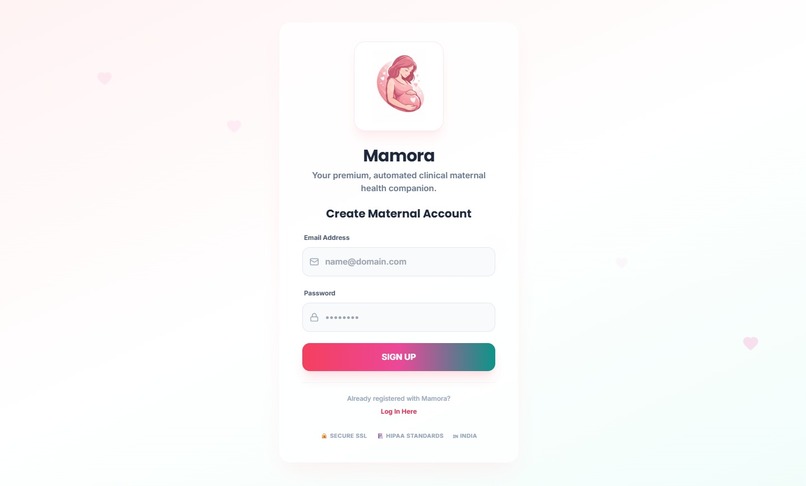
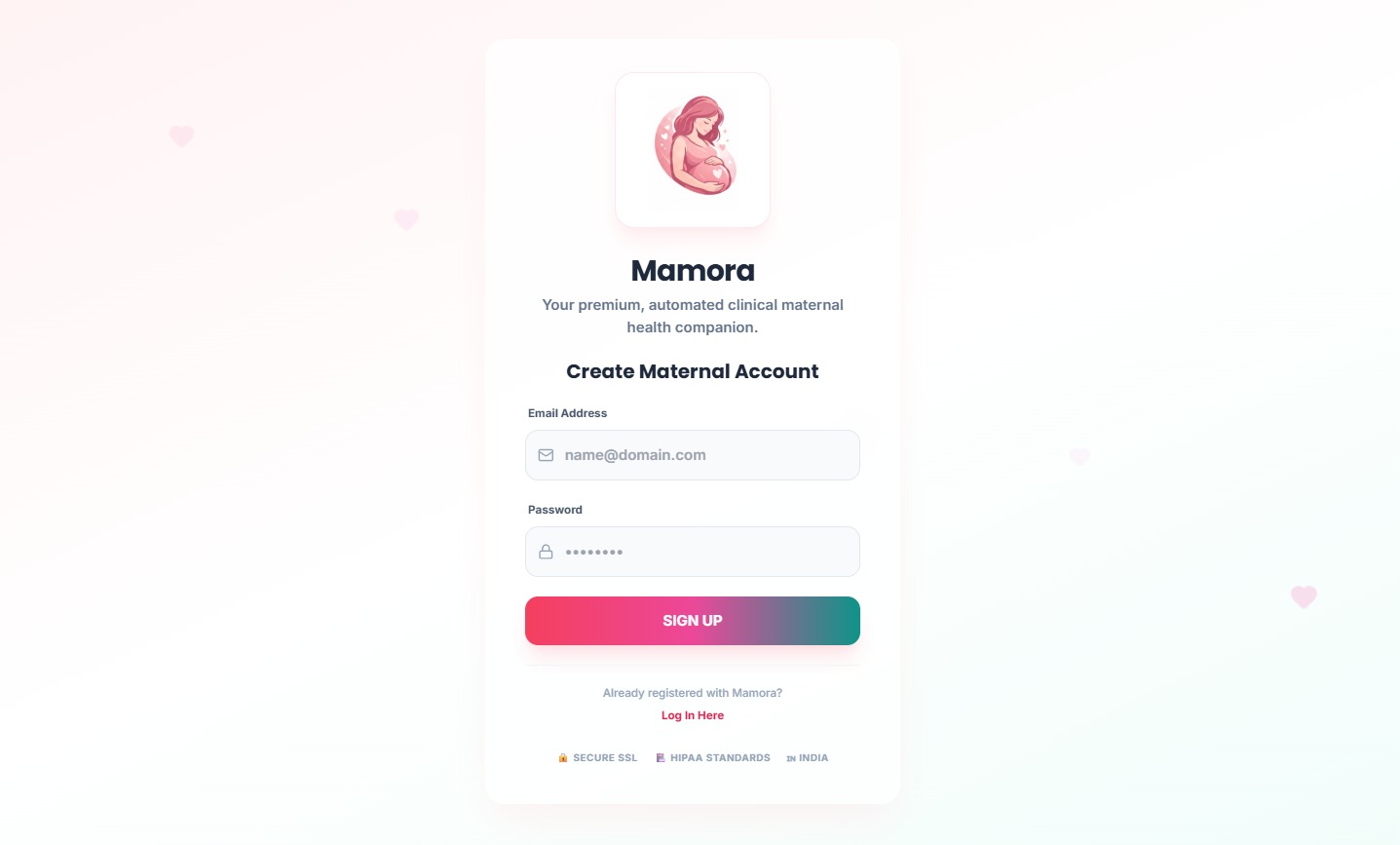
Landing and Sign up
-
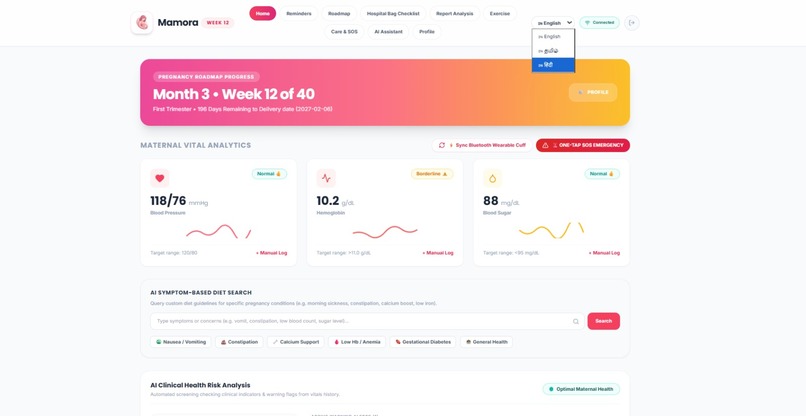
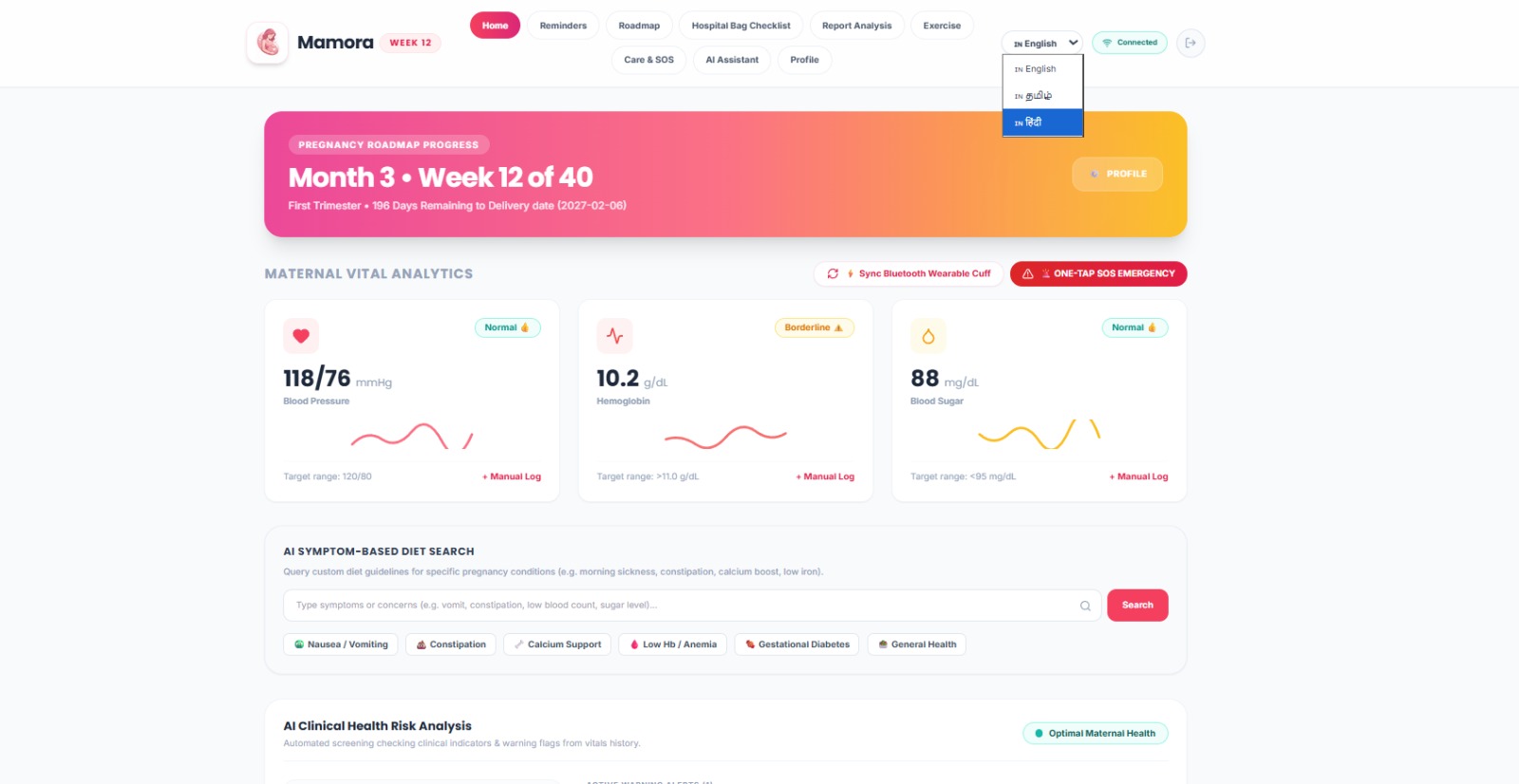
Dashboard and Multilingual Support to set Accross the platrom
-
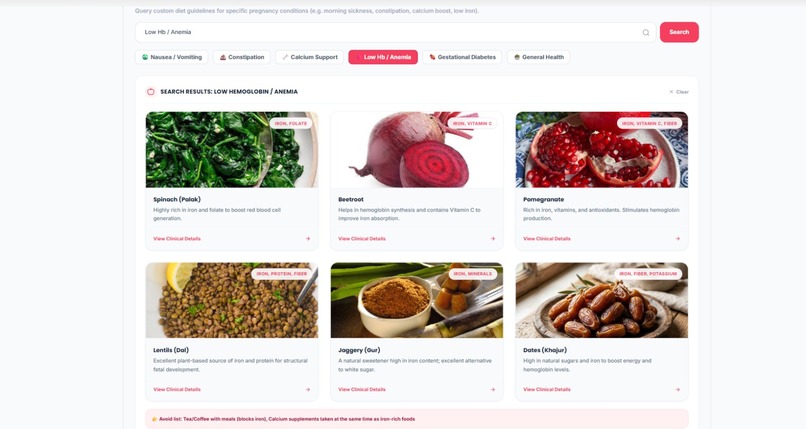
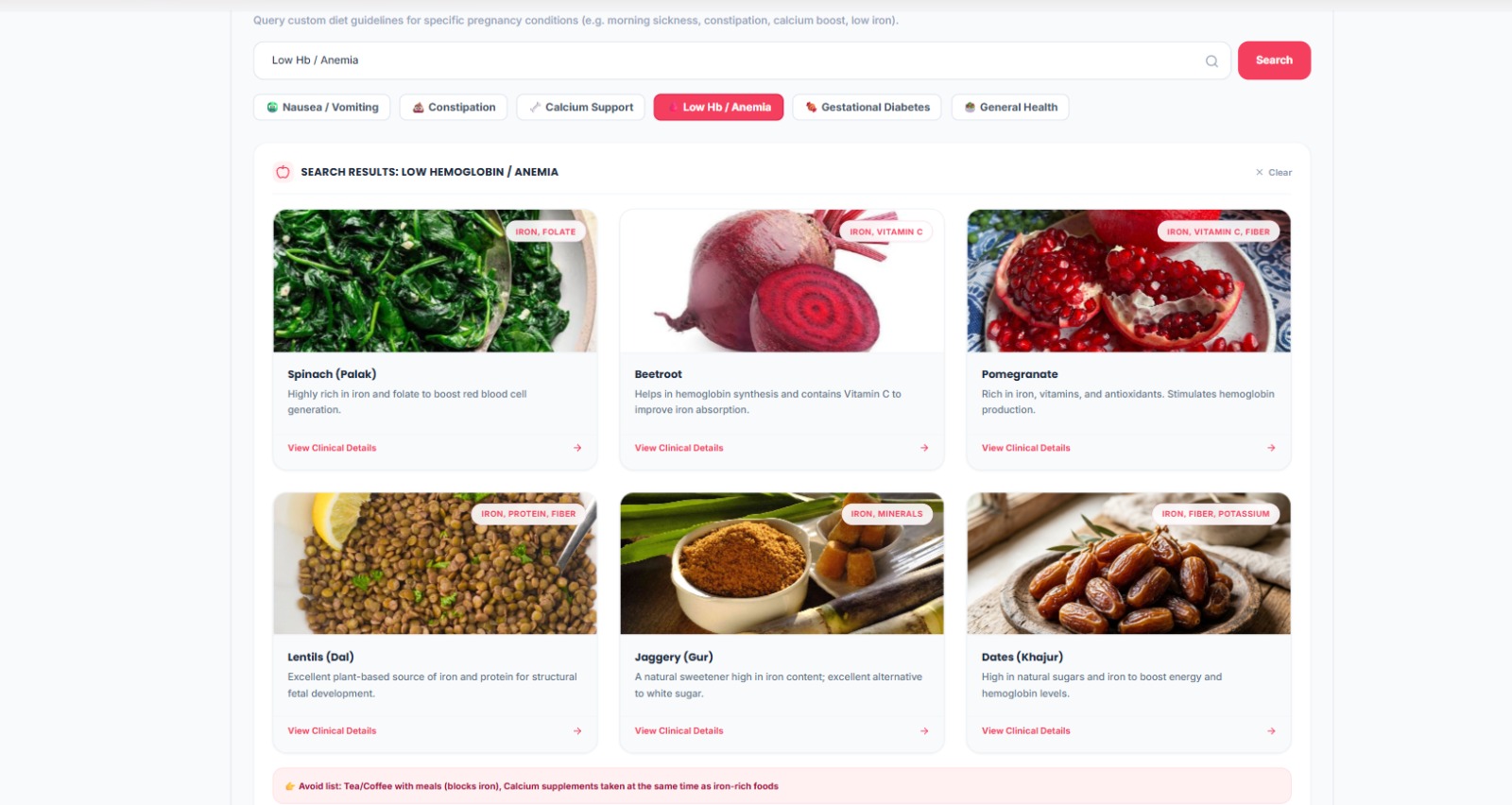
Symptom based diet serach
-
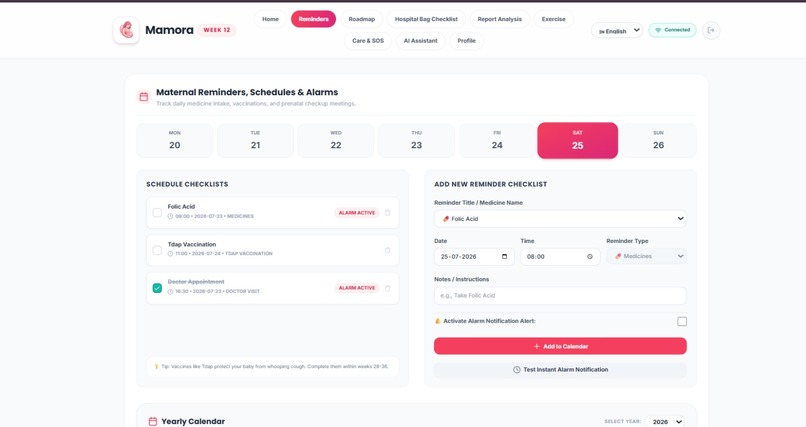
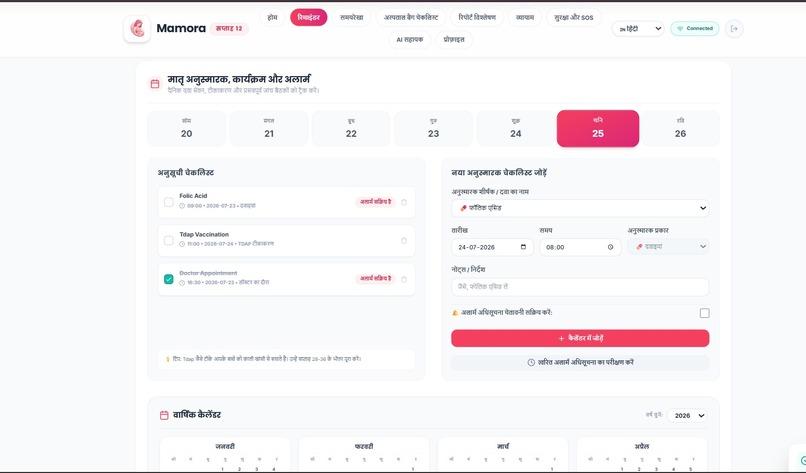
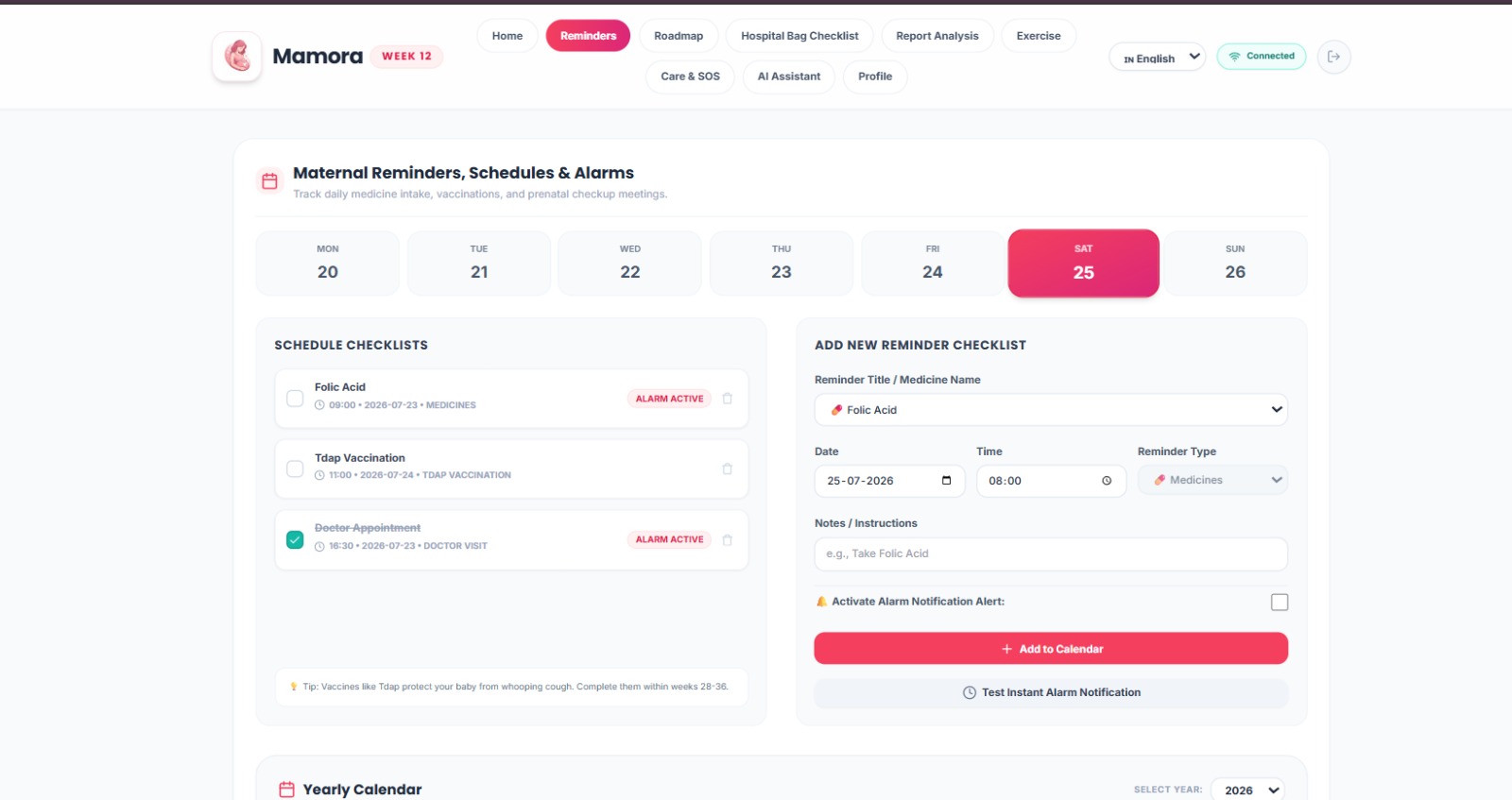
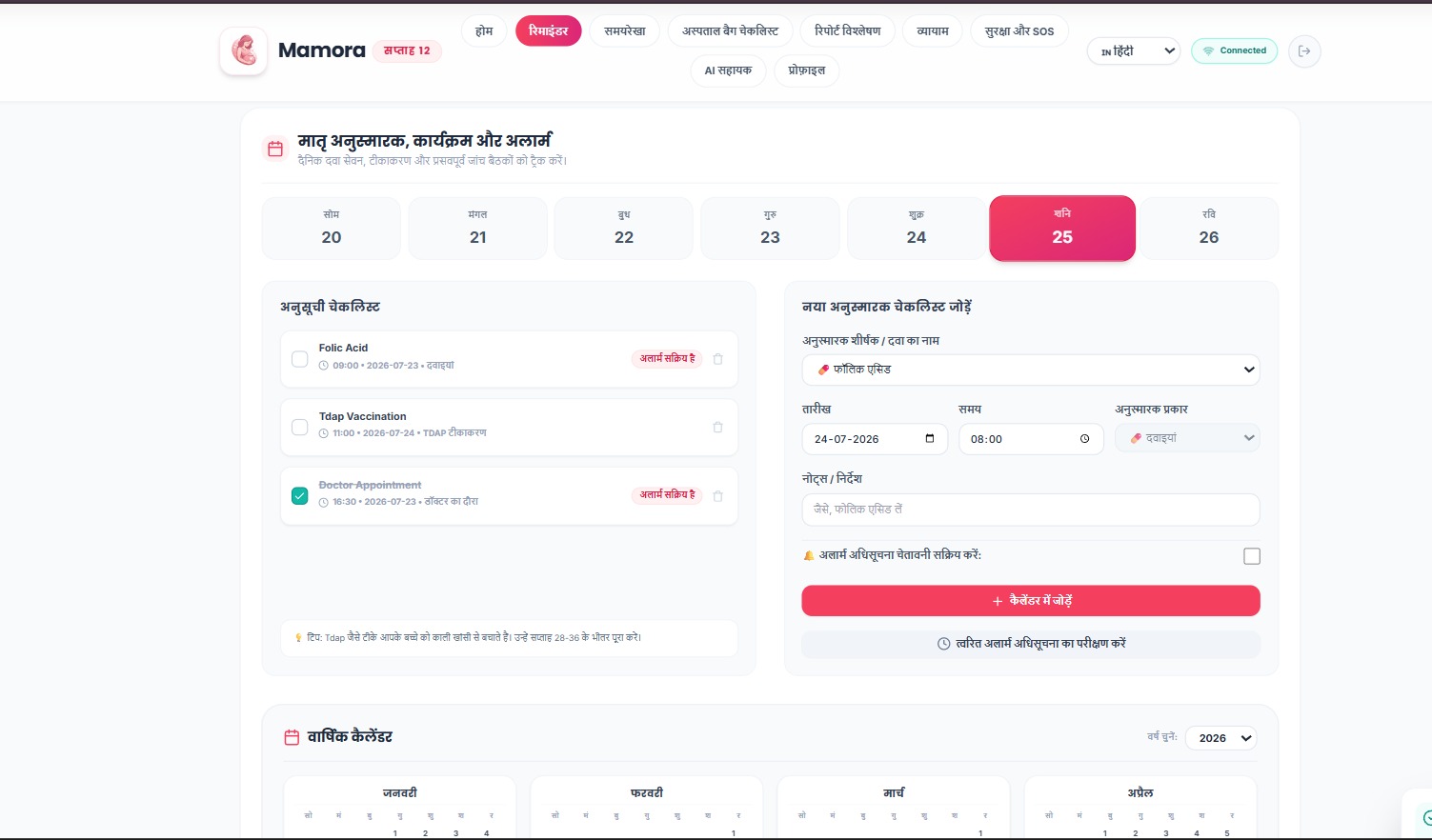
Maternal Reminders, Schedules & Alarms
-
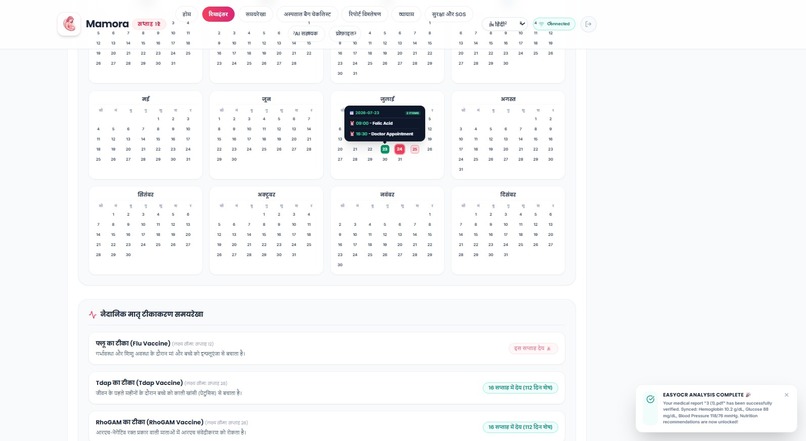
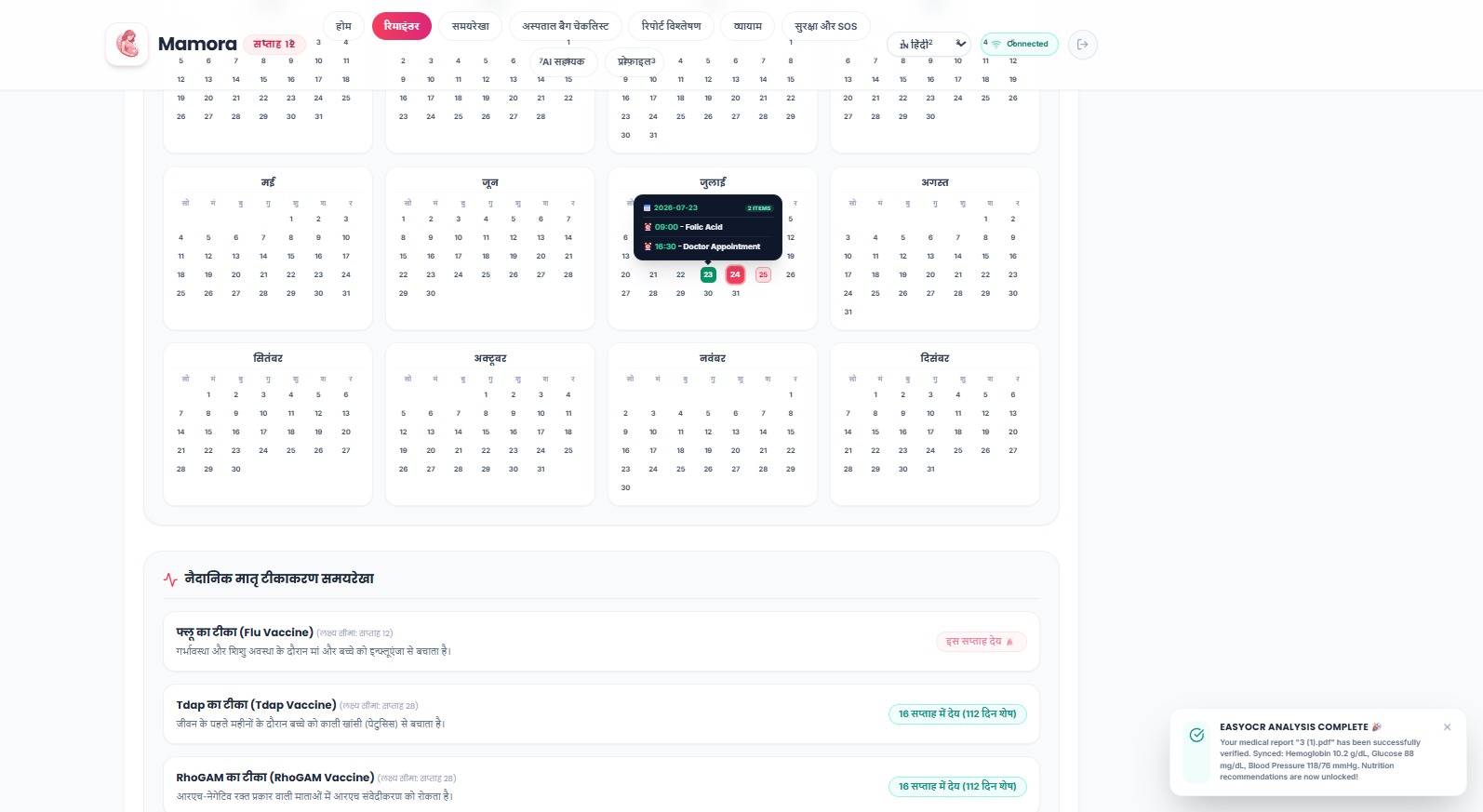
Calender to check Appointments and Remainders and Clinical Maternal Immunization Timeline
-
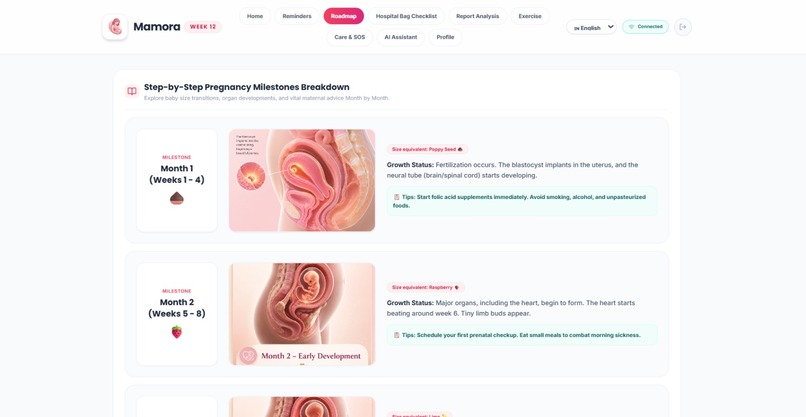
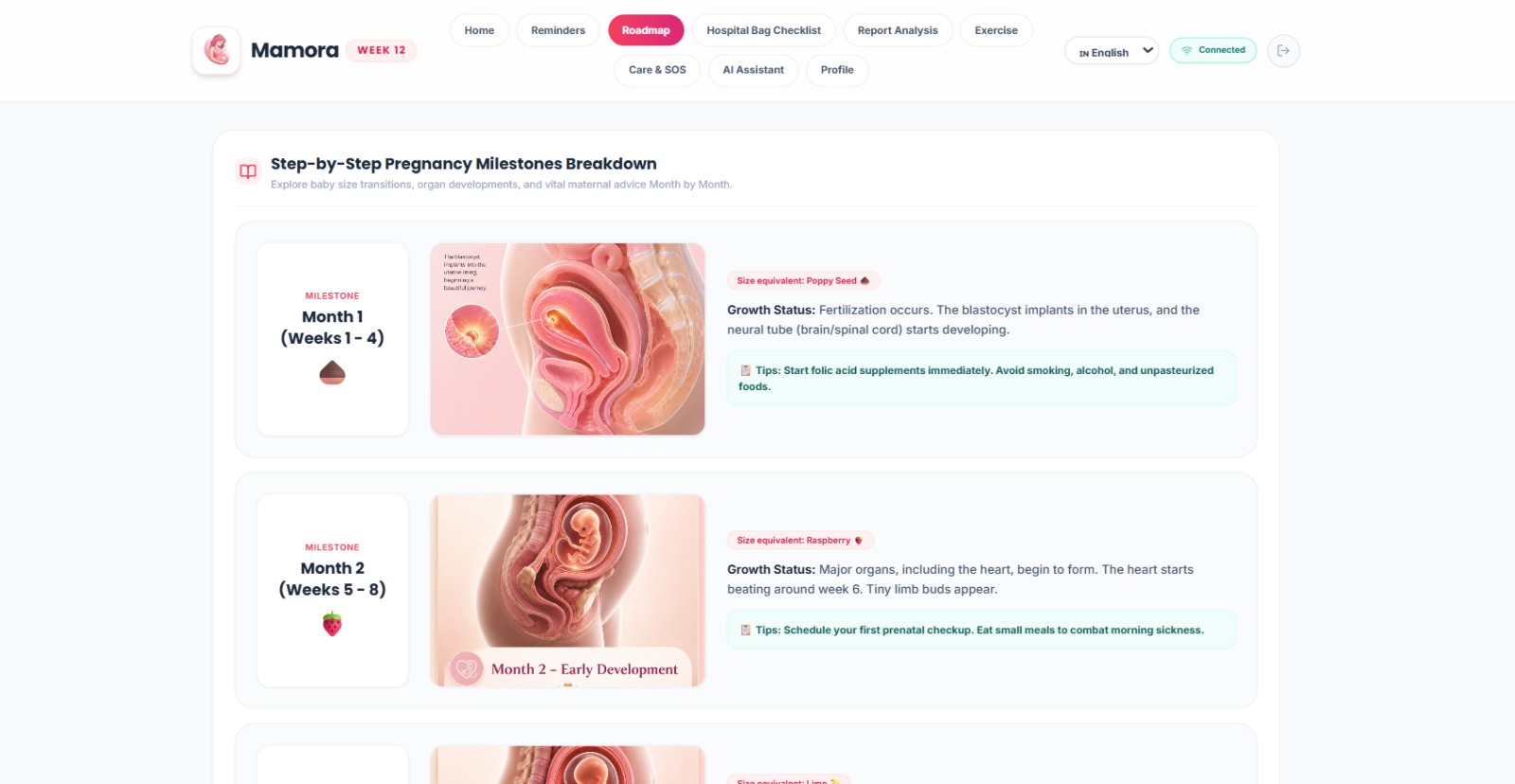
Roadmap of Pregnancy Milestones Breakdown Explore baby size transitions, organ developments, and vital maternal advice Month by Month.
-
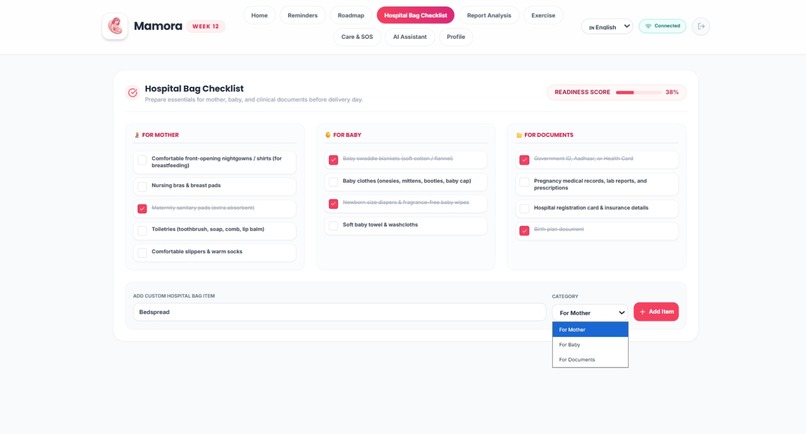
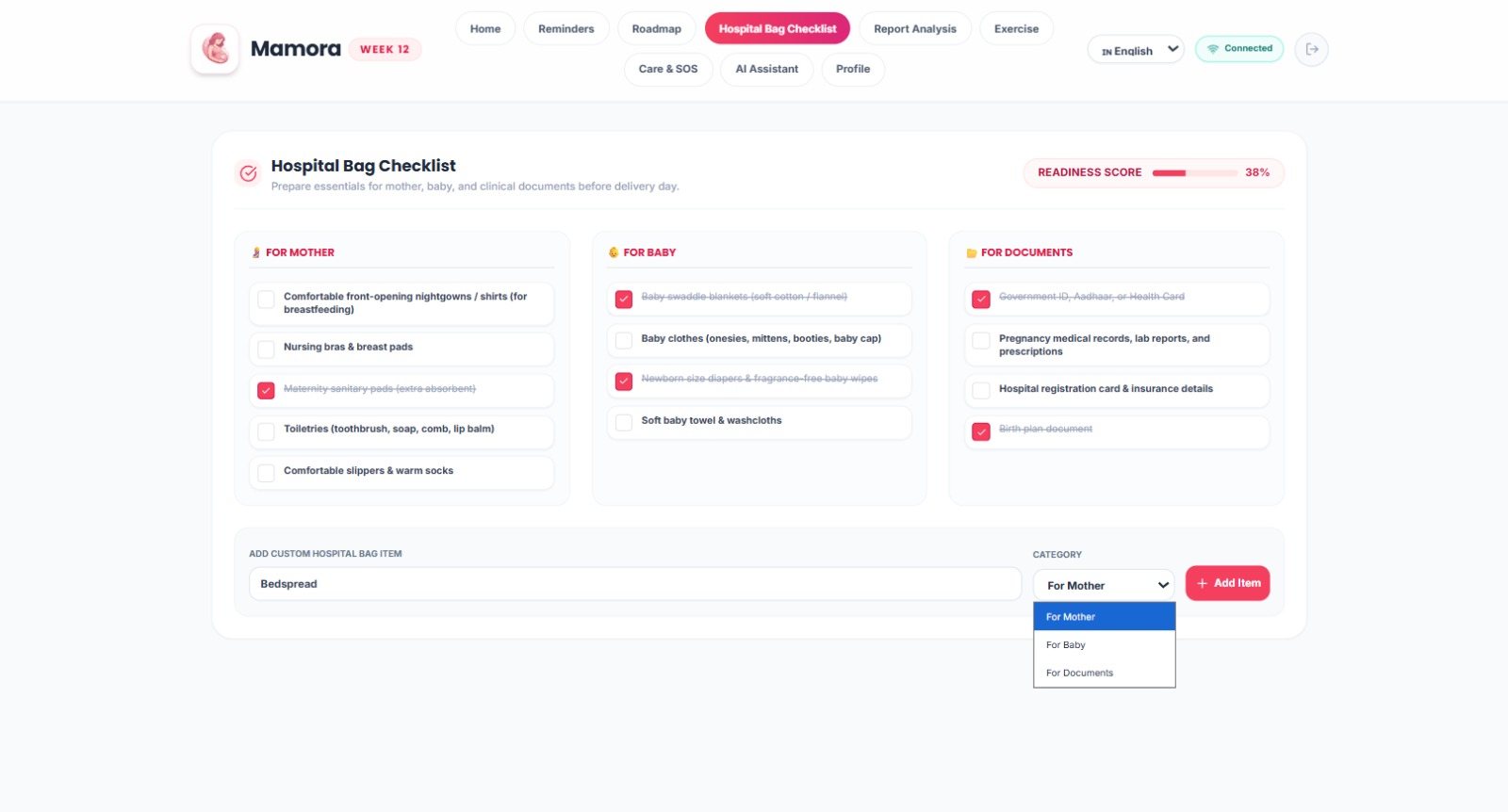
Essential Hospital Bag Checklist
-
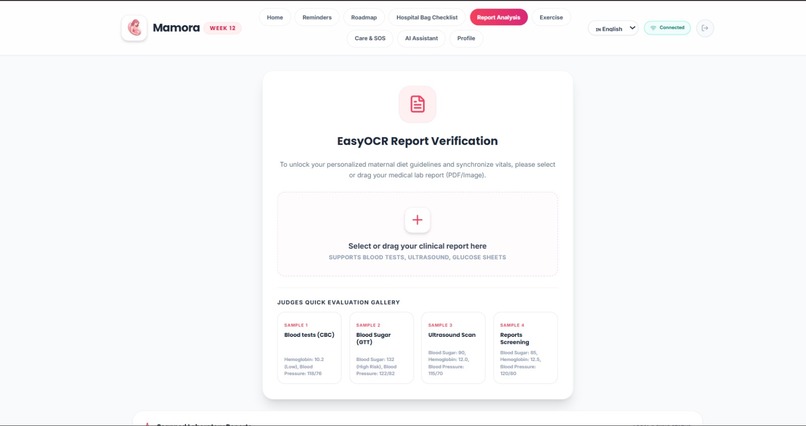
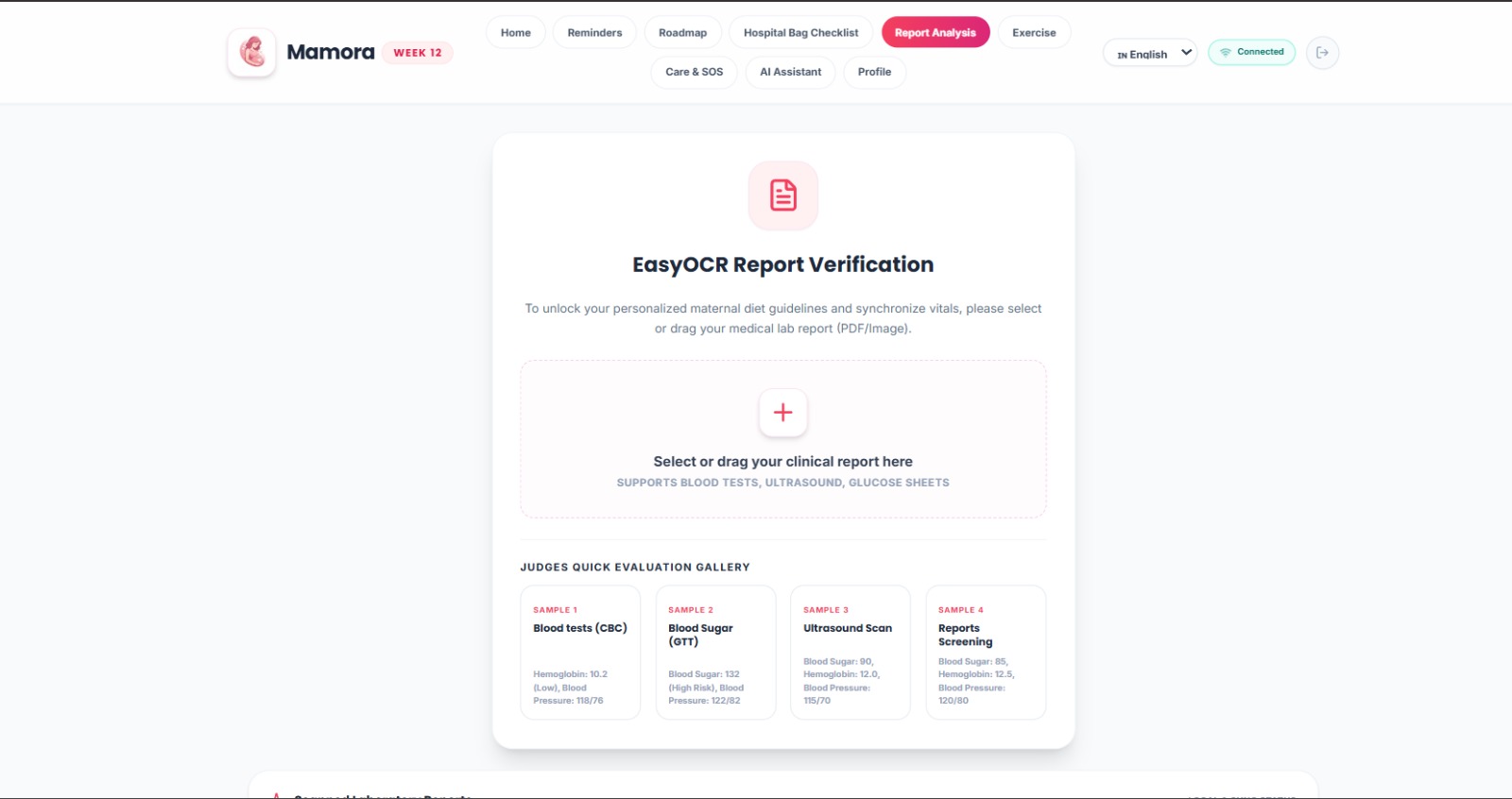
Report Analysis
-
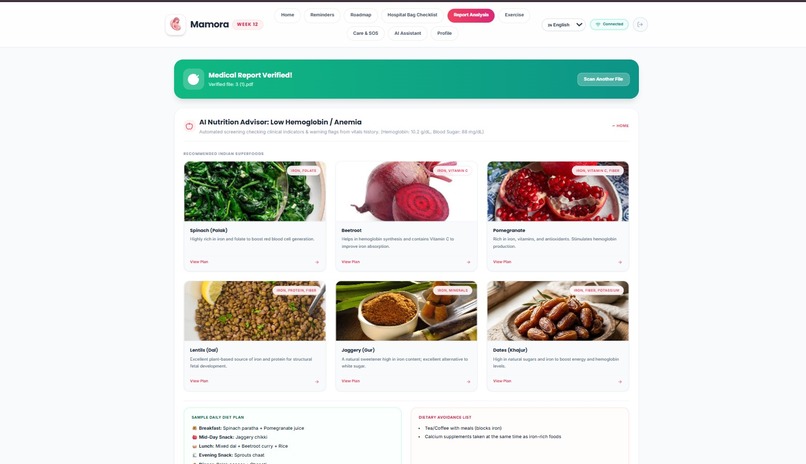
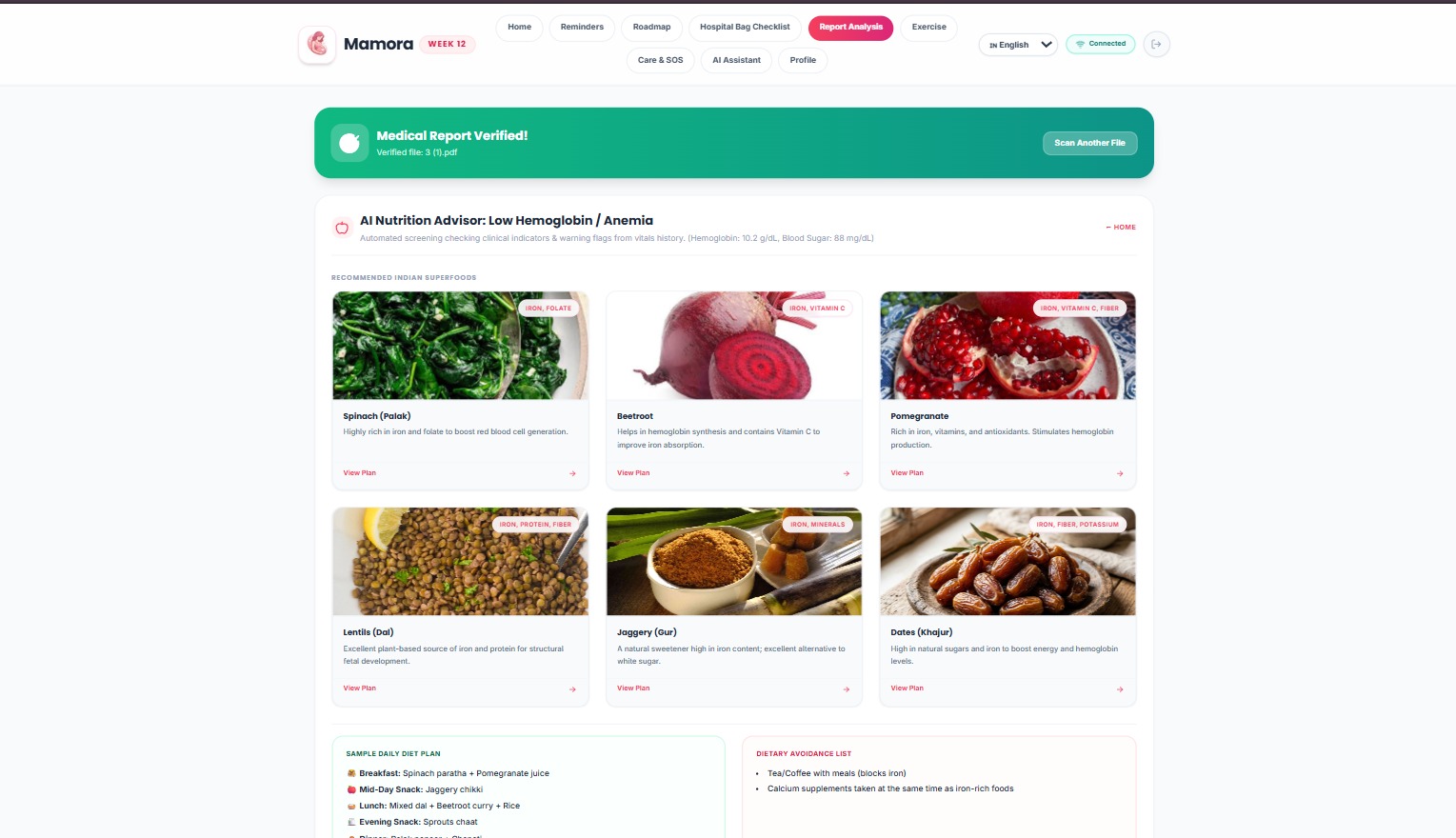
Verified Report
-
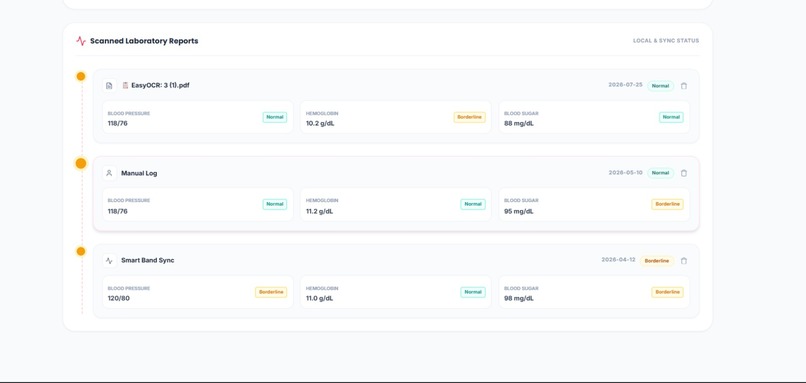
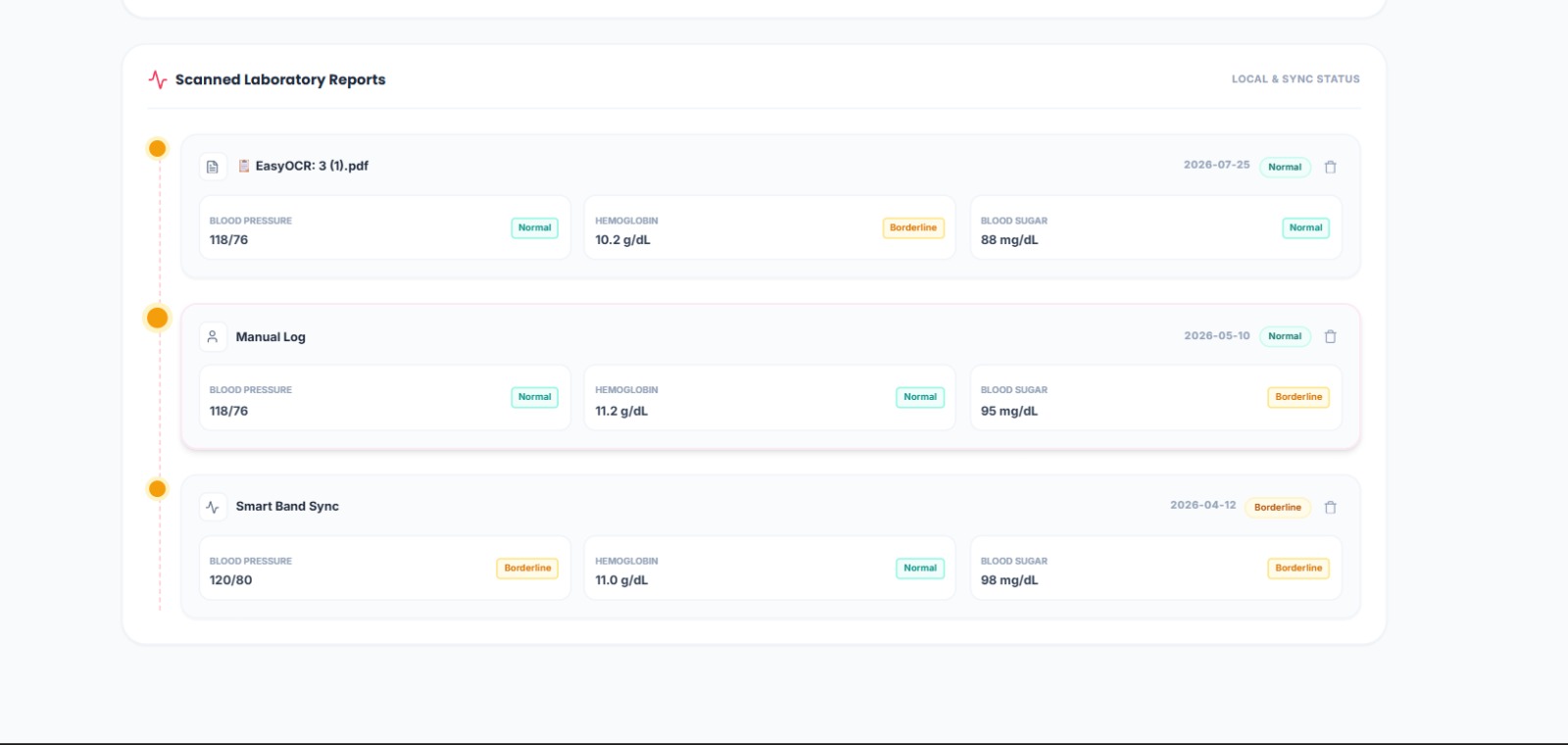
Storing the reports for future purpose
-
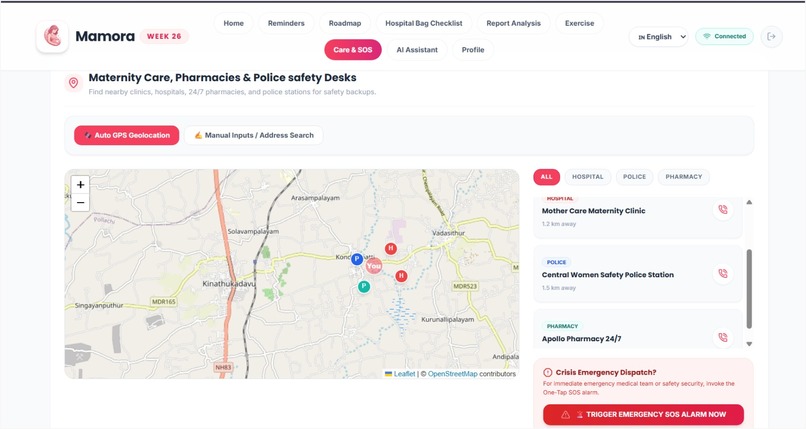
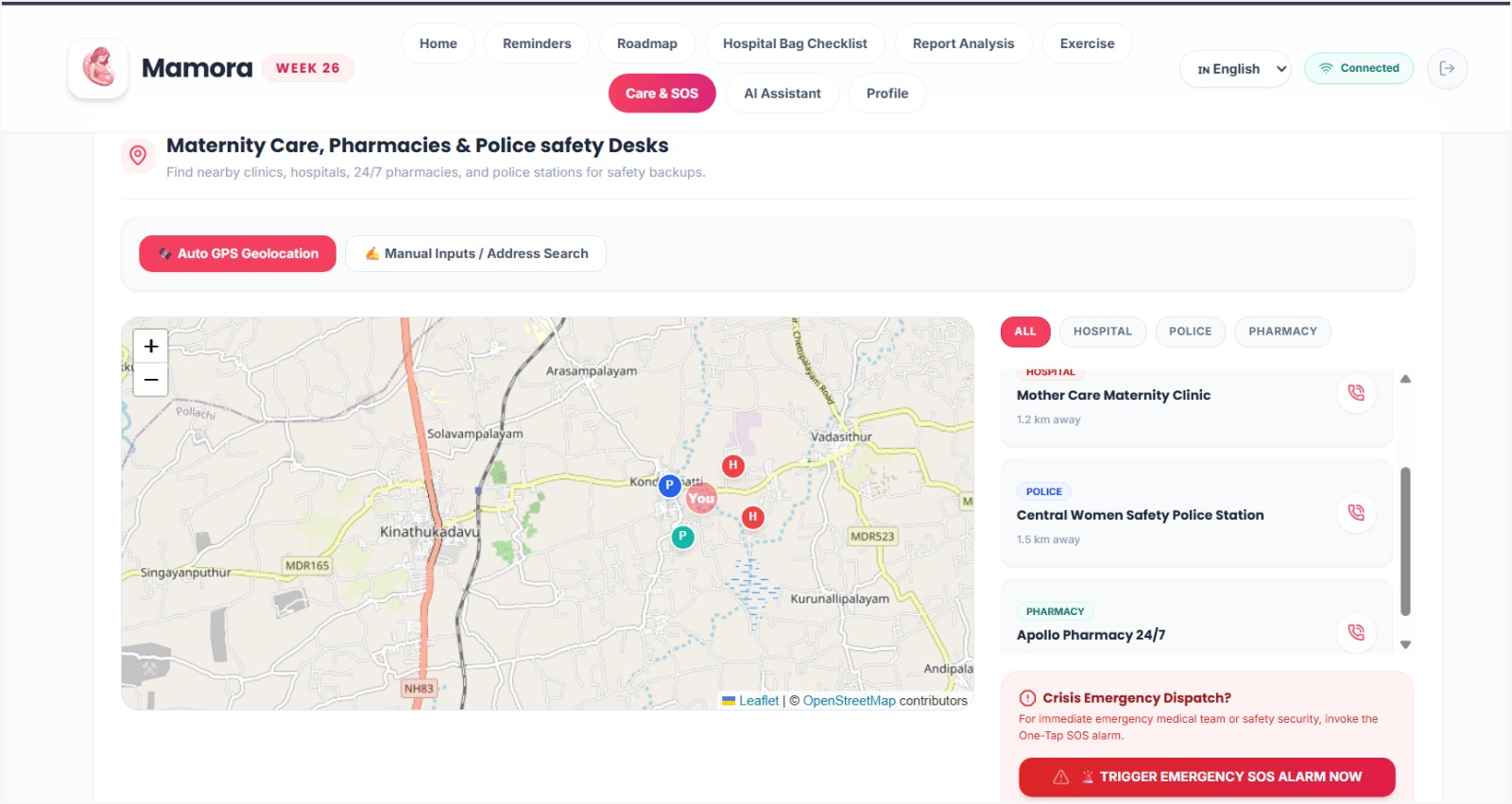
Find nearby clinics, hospitals, 24/7 pharmacies, and police stations for safety backups(Map and SOS)
-
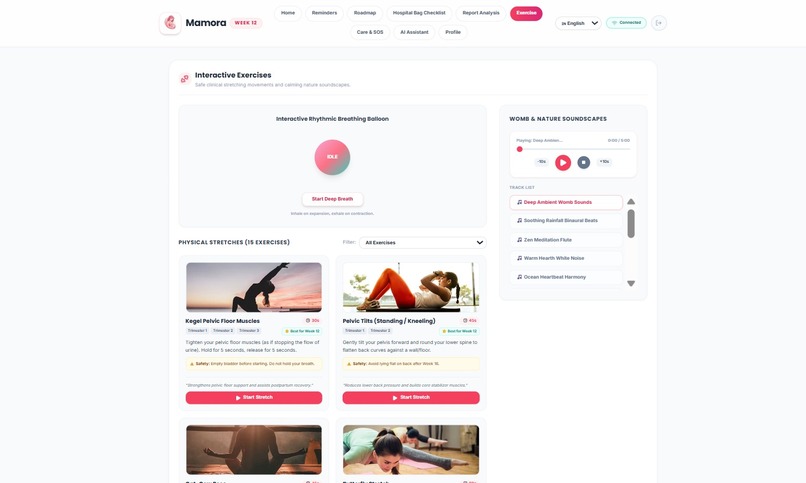
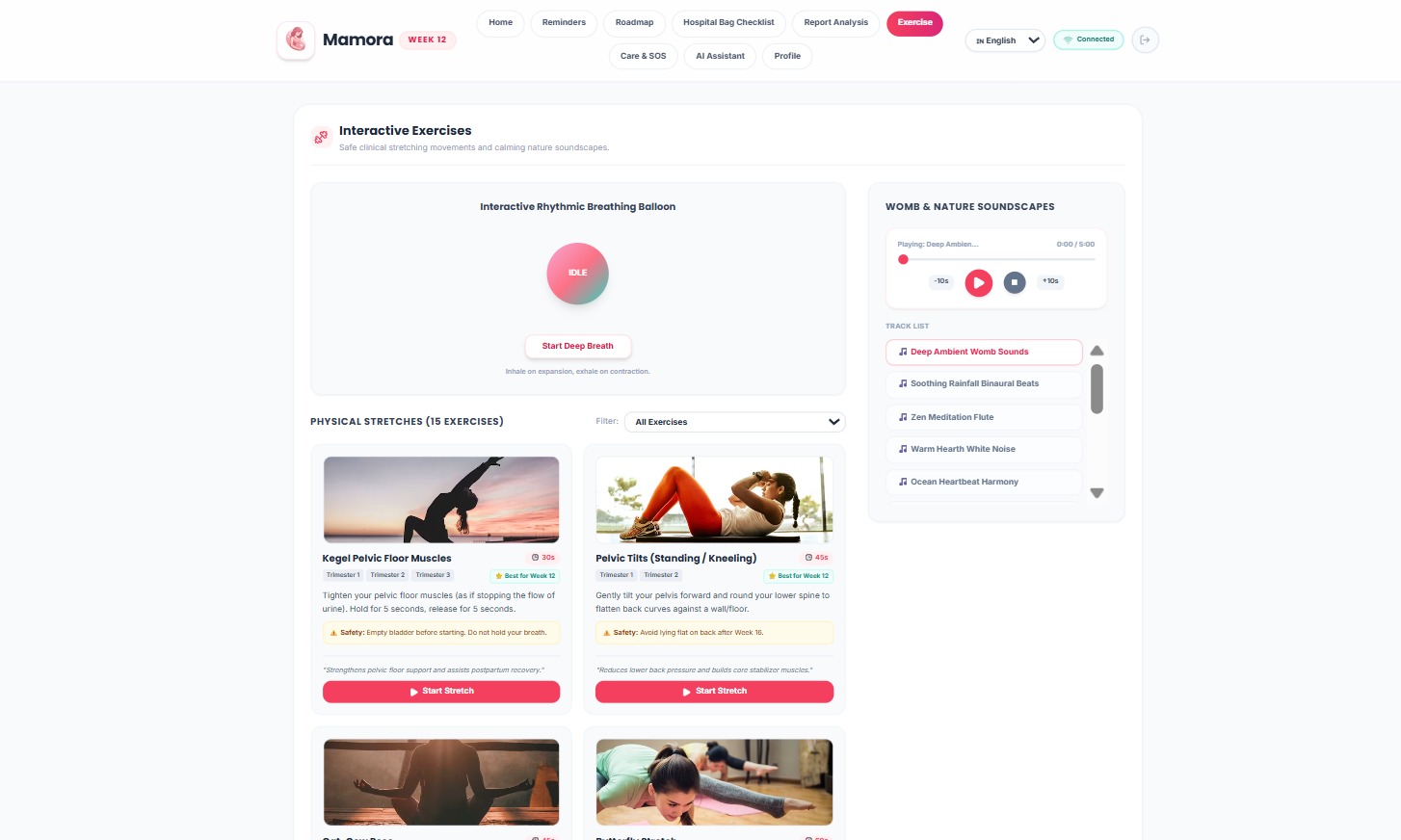
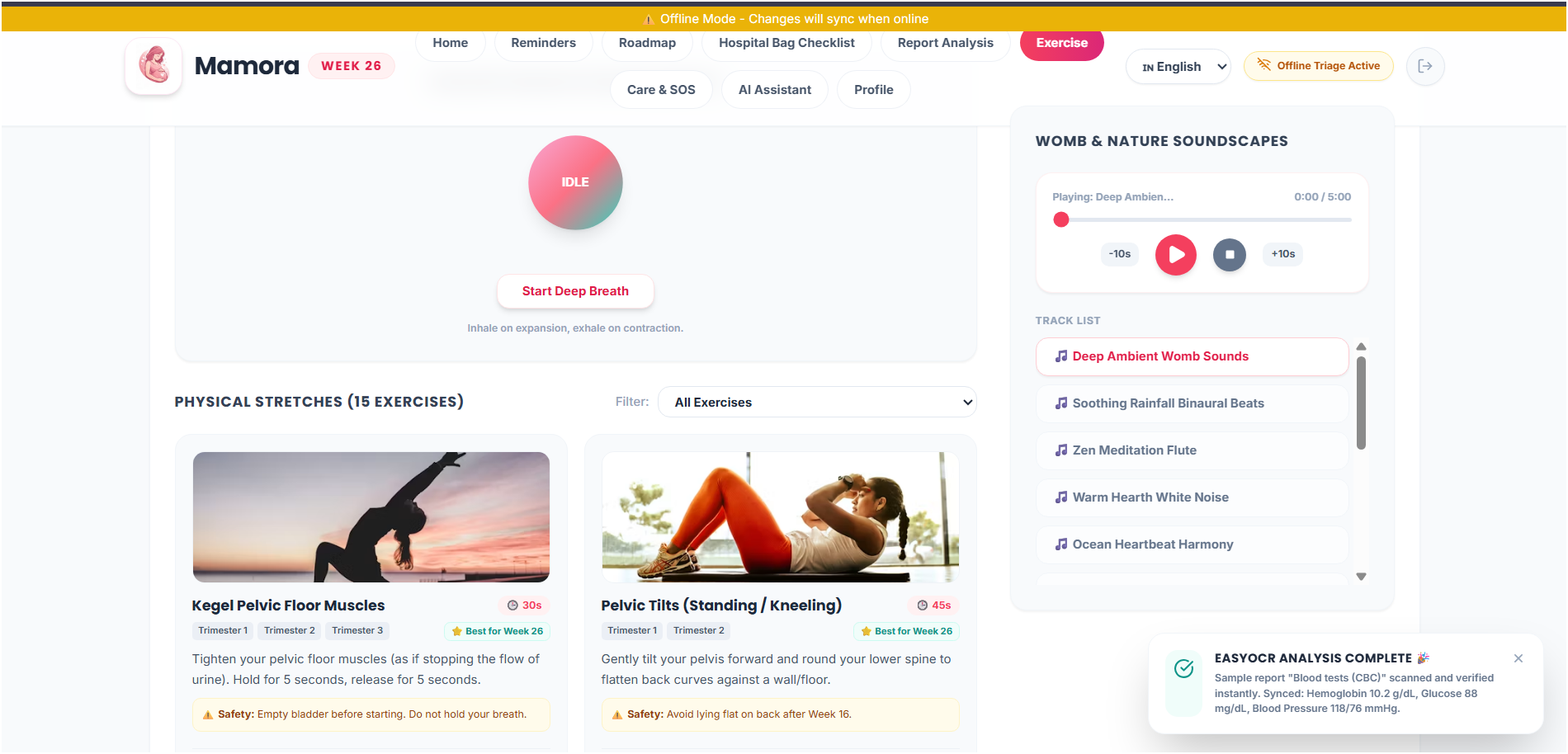
Interactive Exercises
-
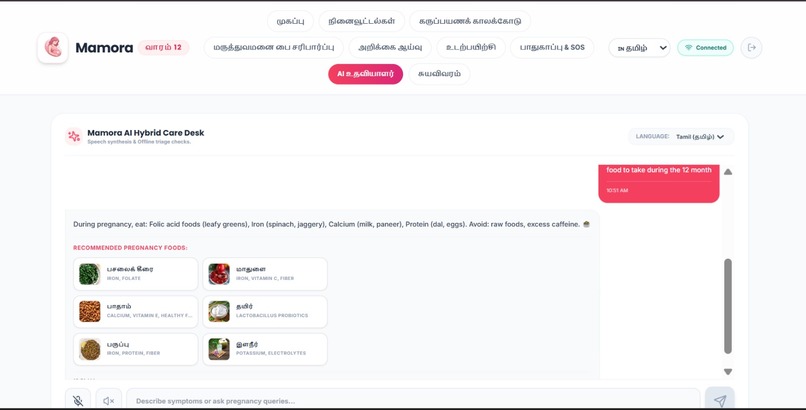
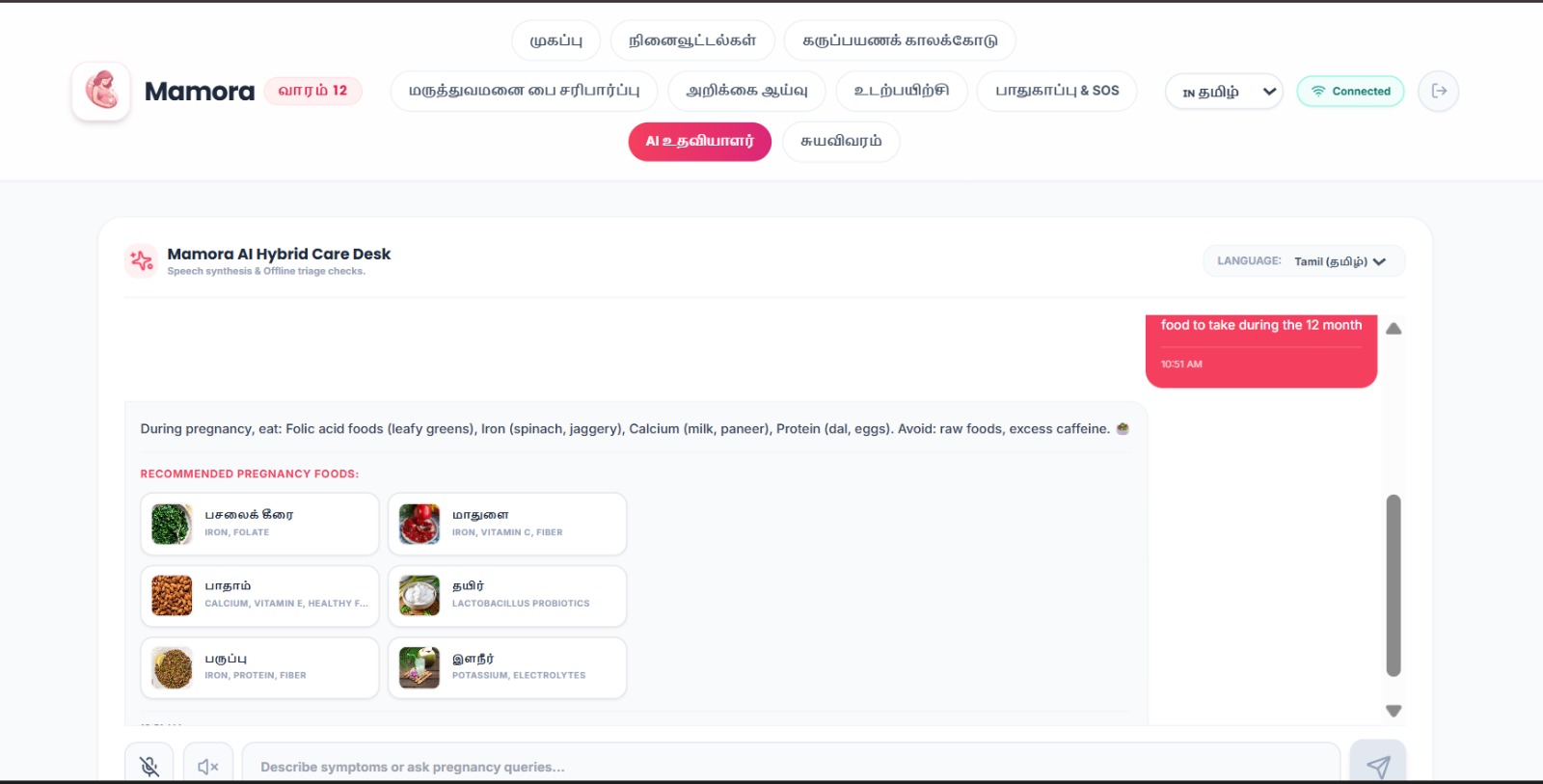
AI Assistant Chatbot with Multilingual Speech, text & Offline triage support.
-
Profile Settings
-
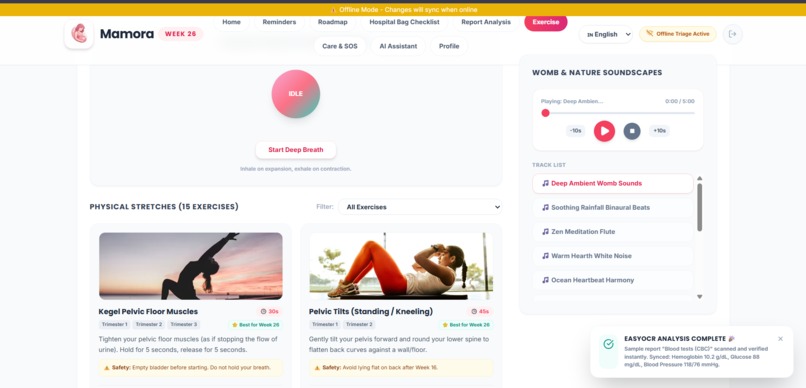
Platform Works in Offline
Inspiration
Every two minutes, a woman dies from a preventable pregnancy-related complication. In India, millions of expecting mothers — particularly in rural and semi-urban areas — have limited access to consistent prenatal care. They visit a doctor once a month at most, leaving weeks of critical health data unmonitored.
We were inspired by a simple but powerful question: What if a mother could carry a clinical companion in her pocket — one that speaks her language, understands her symptoms, and alerts her before a complication becomes a crisis?
That question became Mamora — a name rooted in "Maatru" (mother in Sanskrit), built to be the digital ASHA worker that never sleeps.
What it does
Mamora is an AI-powered maternal health companion that helps pregnant women monitor, understand, and act on their health — in their own language, anytime, anywhere.
Core Features:
🩺 Clinical Vitals Tracker — Logs hemoglobin, blood pressure (systolic/diastolic), and blood glucose (fasting & post-meal). An algorithm instantly computes a Health Score and flags risks like gestational diabetes, anemia, or preeclampsia.
🤖 AI Chat Assistant — Powered by Google Gemini 1.5 Flash, mothers can ask pregnancy-related questions conversationally. A rule-based fallback ensures responses are always clinically safe.
🌐 3-Language Support — Full runtime localization across English, Tamil, and Hindi — switching languages live across the entire dashboard, charts, chatbot, and voice output.
🗣️ Voice Assistant — Uses the Web Speech API for hands-free, speech-to-text input and text-to-speech responses — critical for semi-literate users.
🥗 Symptom-Based Nutrition Advisor — Matches symptoms like morning sickness, constipation, or low hemoglobin to traditional Indian superfoods (ragi, jaggery, beetroot) with clinical dietary tips.
🗺️ Hospital Finder — Leaflet.js-powered map locates the nearest maternity hospitals and emergency services using the device's GPS.
🚨 Emergency SOS Dispatcher — One-tap button instantly captures GPS coordinates, packages patient details, and fires an emergency cloud alert signal.
📶 Offline Sync Engine — Vitals logged without internet are queued locally and batch-uploaded automatically once connectivity is restored.
How we built it
We designed Mamora as a decoupled, production-grade client-server system:
Frontend
- React.js (v18) — SPA architecture with component-based UI design
- Framer Motion — Smooth micro-animations and gesture-based transitions
- Lottie-React — SVG-based animated illustrations for the onboarding flow
- Leaflet.js — Interactive map rendering with OpenStreetMap tiles
- Axios — Dynamic API client with environment-aware base URL configuration
- Web Speech API — Native browser TTS and STT for voice interactions
- Context API — Global language state manager for live localization switching
Backend
- Python + FastAPI — High-performance async REST API layer
- Pydantic v2 — Strict data validation and schema enforcement
- Uvicorn — ASGI server for production-grade async request handling
- Rule-based ML Logic — Deterministic clinical risk engine for vitals analysis
Cloud & DevOps
- Vercel — Frontend CDN hosting with Git-triggered CI/CD
- Render — Backend Python Web Service (Python 3.11.8 runtime)
- GitHub — Version control with branch protection and push protection for secrets
External APIs
- Google Gemini 1.5 Flash — Contextual, multilingual LLM responses
- OpenStreetMap — Free, open-source map tiles for hospital locator
Challenges we ran into
🔒 API Key Security — GitHub's Push Protection blocked our first commit because a Gemini API key was accidentally hardcoded. We rewrote the entire git history using
git filter-branchand migrated to.envfiles.⚙️ Dependency Conflicts —
react-scriptsrequires TypeScript^4.x, but the project initially had TypeScript^6.0.2in devDependencies, causingERESOLVEfailures on Vercel's clean install. We resolved this by downgrading and regenerating the lockfile.🐍 Python Version Hell — Render defaulted to Python 3.14 (pre-release), which broke the
pillowpackage compilation. We pinned the runtime to stable 3.11.8 using a.python-versionfile.🗣️ Speech Duplication Bug — The text-to-speech assistant was reading messages twice due to a React state re-render cycle. We resolved it using a
speechBaselineRefto track the last spoken message.🌐 Multilingual Accuracy — Ensuring clinical terms translated correctly across Tamil and Hindi without losing medical precision required iterative refinement of translation keys in the localization context.
Accomplishments that we're proud of
- ✅ Fully deployed, production-grade application — live on Vercel + Render with automatic CI/CD pipelines.
- ✅ Three-language real-time localization — seamless runtime switching with zero page reloads, across every component.
- ✅ Hybrid AI safety model — combining the flexibility of Gemini LLM with hard clinical guardrails from the deterministic rule engine, preventing dangerous AI hallucinations on medical topics.
- ✅ Offline-first architecture — vitals are never lost, even without internet access.
- ✅ Zero-cost infrastructure — the entire platform runs on free-tier services, making it instantly replicable by NGOs or government health programs.
What we learned
- Security-first development matters from Day 1 — secrets in source code can cause irreversible reputation and compliance damage.
- LLMs need guardrails in healthcare — never let a generative model make unconstrained clinical decisions; always pair it with deterministic validation.
- Accessibility is not optional — designing for semi-literate, rural users forced us to rethink every UI choice, from button sizes to voice-first interaction flows.
- Offline capability is a feature, not an afterthought — in target regions, intermittent connectivity is the norm, not the exception.
What's next for Mamora
- 👩⚕️ Live Teleconsultation — Direct video calls with certified ASHA workers and OB/GYN specialists
- ⌚ Wearable Device Integration — Bluetooth sync with affordable IoT BP monitors and pulse oximeters
- 🧠 ML-Powered Risk Prediction — Replace the rule engine with a trained model on real maternal health datasets for higher diagnostic accuracy
- 🗄️ Persistent Database — Migrate from in-memory storage to PostgreSQL with secure JWT-authenticated user accounts
- 🔔 Push Notifications — Medication reminders, missed appointment alerts, and weekly fetal milestone updates
- 🌏 Expanded Languages — Telugu, Kannada, Malayalam, and Bengali localization
- 🏥 EHR Integration — HL7 FHIR API connection to hospital Electronic Health Records
Built With
- api
- axios
- css3
- fastapi
- framer
- gemini
- git
- html5
- javascript
- leaflet.js
- motion
- openstreetmap
- pydantic
- python
- react.js
- render
- speech
- uvicorn
- vercel
- web


Log in or sign up for Devpost to join the conversation.