-
-
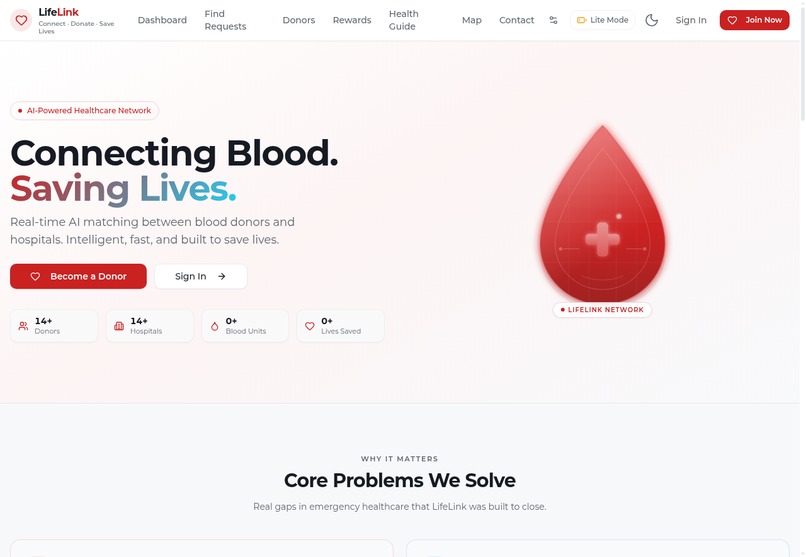
Homepage Light mode
-
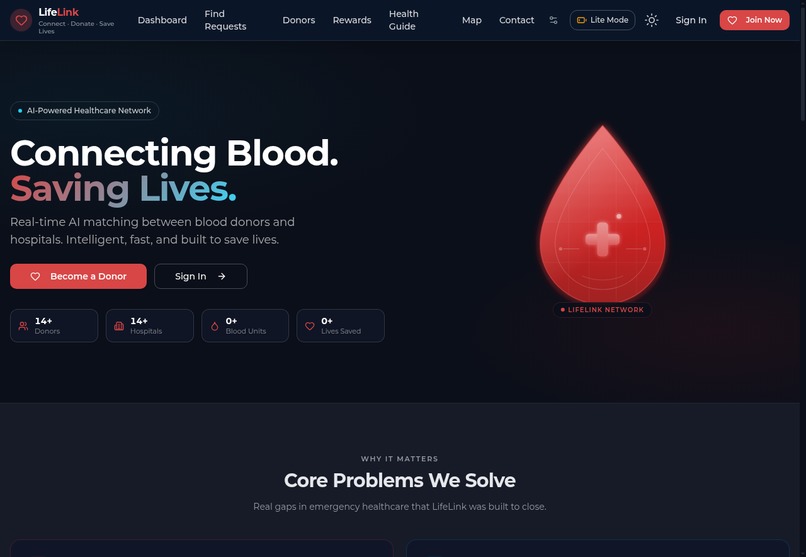
Homepage dark mode
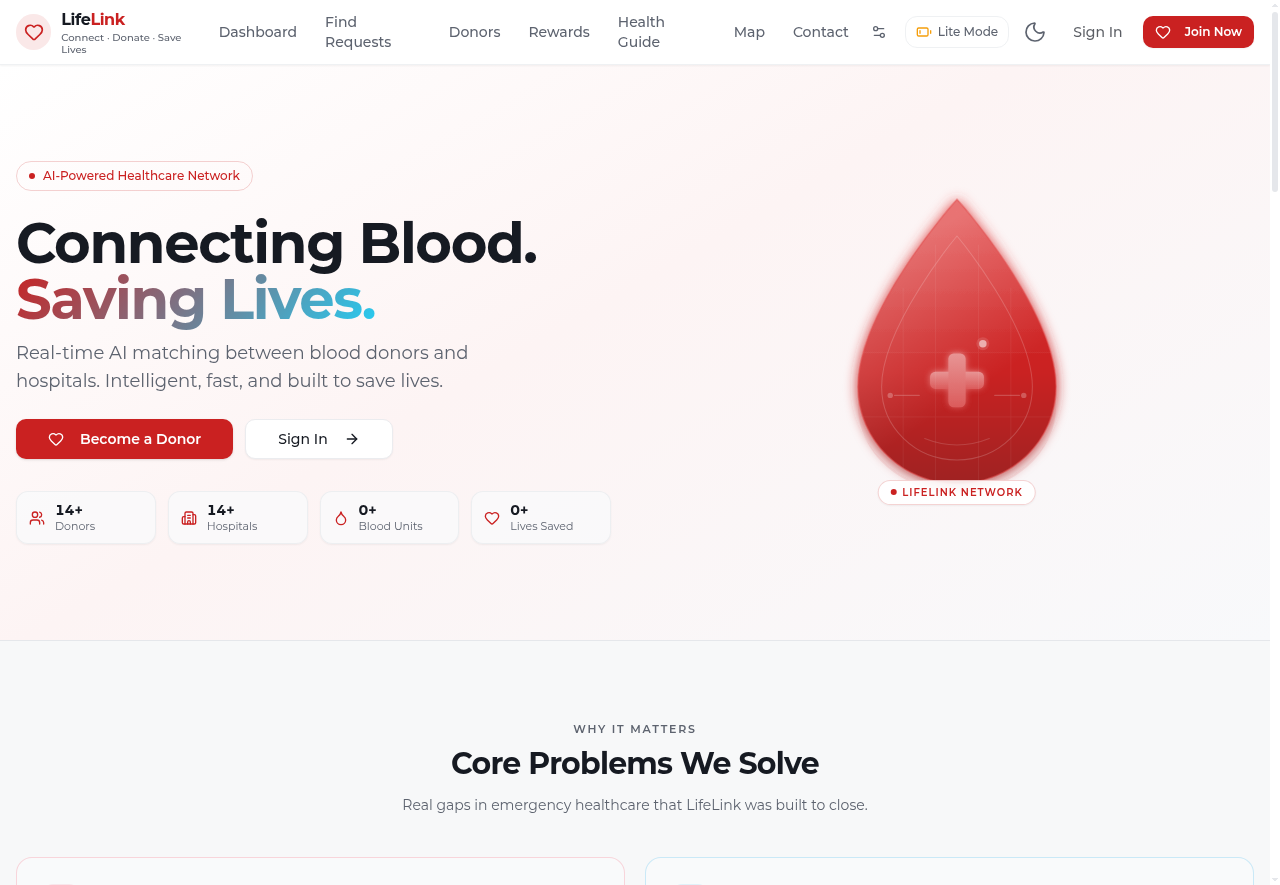
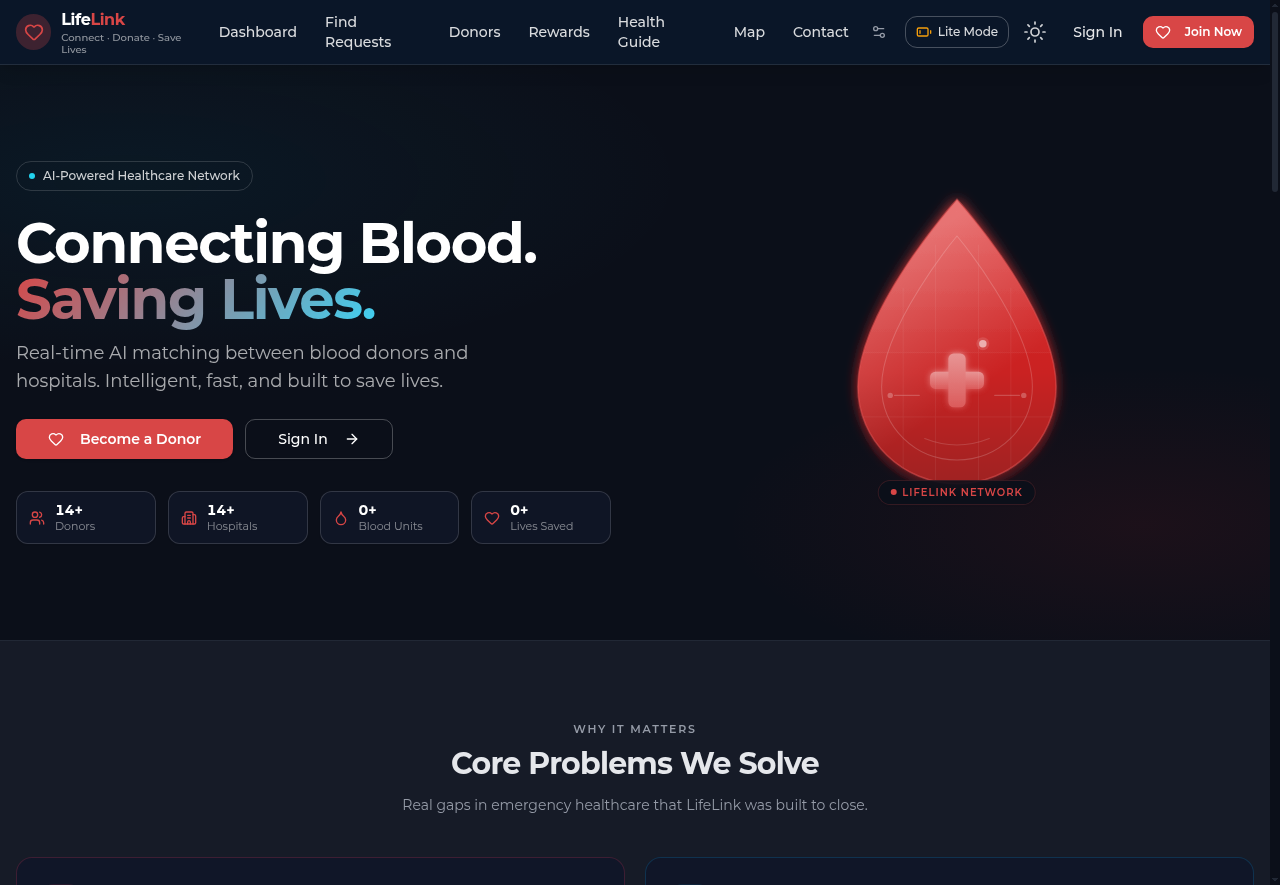
LifeLink — Give Life. In Real Time.
Inspiration
LifeLink was inspired by a simple but painful reality: many people lose their lives during medical emergencies not because blood does not exist, but because the right donor cannot be connected to the right hospital quickly enough.
In many regions, especially in developing healthcare systems, blood donation coordination is still largely manual, fragmented, and reactive. Hospitals often struggle to locate compatible donors during emergencies, while willing donors rarely remain actively connected after donating once.
We wanted to build something beyond a traditional blood donation website. The goal was to create a connected healthcare ecosystem capable of intelligently coordinating donors, hospitals, emergency requests, wellness tracking, and realtime communication within a single platform.
That vision became LifeLink.
What LifeLink Does
LifeLink is an AI-powered realtime blood donation and donor wellness ecosystem designed to improve:
- Emergency blood response coordination
- Donor-hospital matching
- Blood accessibility
- Donor retention
- Wellness engagement after donation
- Realtime healthcare logistics
The platform allows:
- Hospitals to locate compatible nearby donors
- Donors to discover emergency blood requests nearby
- Realtime coordination through integrated maps
- Donor wellness tracking and recovery guidance
- AI-assisted engagement systems
- Smart donor readiness monitoring
- Realtime notifications and communication systems
Unlike many blood donation systems that stop engaging users after donation, LifeLink continues supporting donors through wellness monitoring, recovery guidance, streak systems, and gamified engagement experiences.
How We Built It
LifeLink was designed as a modern full-stack healthcare web application optimized for both desktop and mobile devices.
The platform architecture combines:
- Realtime dashboard systems
- Interactive mapping infrastructure
- Role-based donor and hospital authentication
- Realtime coordination interfaces
- AI-assisted wellness systems
- Responsive mobile-first UI design
- Progressive Web App concepts
- Notification and communication systems
We focused heavily on performance optimization and accessibility because many users may access the platform using lower-end mobile devices and unstable internet connections.
The system includes:
- Donor dashboards
- Hospital dashboards
- Realtime coordination maps
- Wellness and recovery systems
- Notification centers
- Messaging infrastructure
- Gamified donor engagement experiences
- Tier and incentive systems
Challenges We Faced
One of the biggest challenges was balancing futuristic UI design with mobile performance stability.
Initially, several advanced animations and layered interface effects caused rendering instability on lower-end mobile devices, especially on Chrome Android browsers. We had to redesign major parts of the interface to reduce GPU overload, simplify compositing layers, and maintain a lightweight but modern healthcare-tech experience.
Another challenge was building a system that felt operational instead of static. We wanted the platform to feel alive — not just like a dashboard, but like a realtime healthcare coordination ecosystem where donors, hospitals, notifications, wellness systems, and emergency logistics all interact seamlessly.
Authentication and session management also required significant refinement to ensure donor and hospital experiences remained secure, responsive, and role-specific.
Designing the donor wellness ecosystem was another unique challenge. Most blood donation systems focus only on blood collection, but we wanted to improve donor retention by making recovery, wellness, and engagement part of the experience itself.
What We Learned
This project taught us a lot about:
- Realtime healthcare coordination systems
- Scalable dashboard architecture
- Responsive healthcare UX design
- Mobile performance optimization
- Realtime mapping systems
- Donor engagement psychology
- Operational healthcare workflows
- Balancing innovation with usability
We also learned that building healthcare technology is not only about functionality — it is about trust, clarity, accessibility, and speed during critical moments.
Future Plans
Future versions of LifeLink will include:
- Deeper AI-powered emergency prediction systems
- Smarter donor recommendation algorithms
- Integrated ambulance coordination
- Voice/video emergency communication
- Enhanced wellness analytics
- Wearable health integrations
- Blockchain-based donation verification
- Regional healthcare ecosystem scaling
We also plan to improve predictive donor readiness systems using intelligent matching models such as:
$$ R = \frac{D + W + A}{3} $$
Where:
- \(R\) = donor readiness score
- \(D\) = donation recovery level
- \(W\) = wellness consistency
- \(A\) = activity and engagement level
Conclusion
LifeLink is not just a blood donation platform.
It is a connected AI-powered healthcare coordination ecosystem designed to make blood donation smarter, faster, more connected, and more accessible.
Our mission is simple:
Save more lives by improving how blood, donors, hospitals, and emergency systems connect in realtime.
LifeLink
Give Life. In Real Time.
Built With
- css
- framer
- html
- javascript
- leaflet.js
- motion
- openstreetmap
- react
- supabase
- tailwind
- typescript
- vite


Log in or sign up for Devpost to join the conversation.