-
-
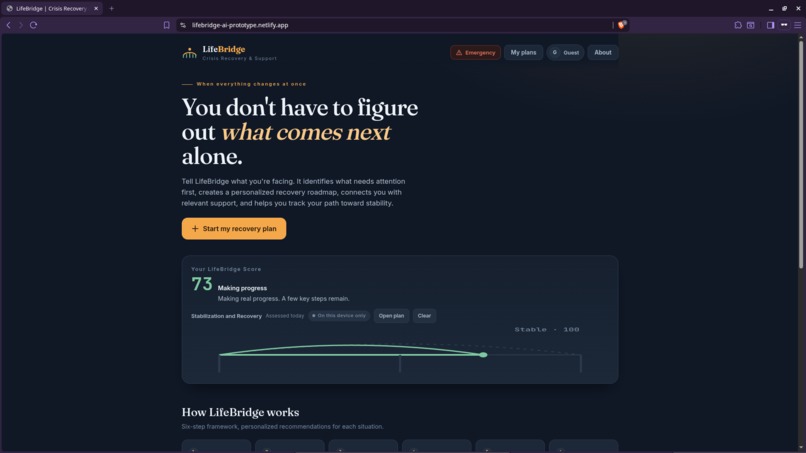
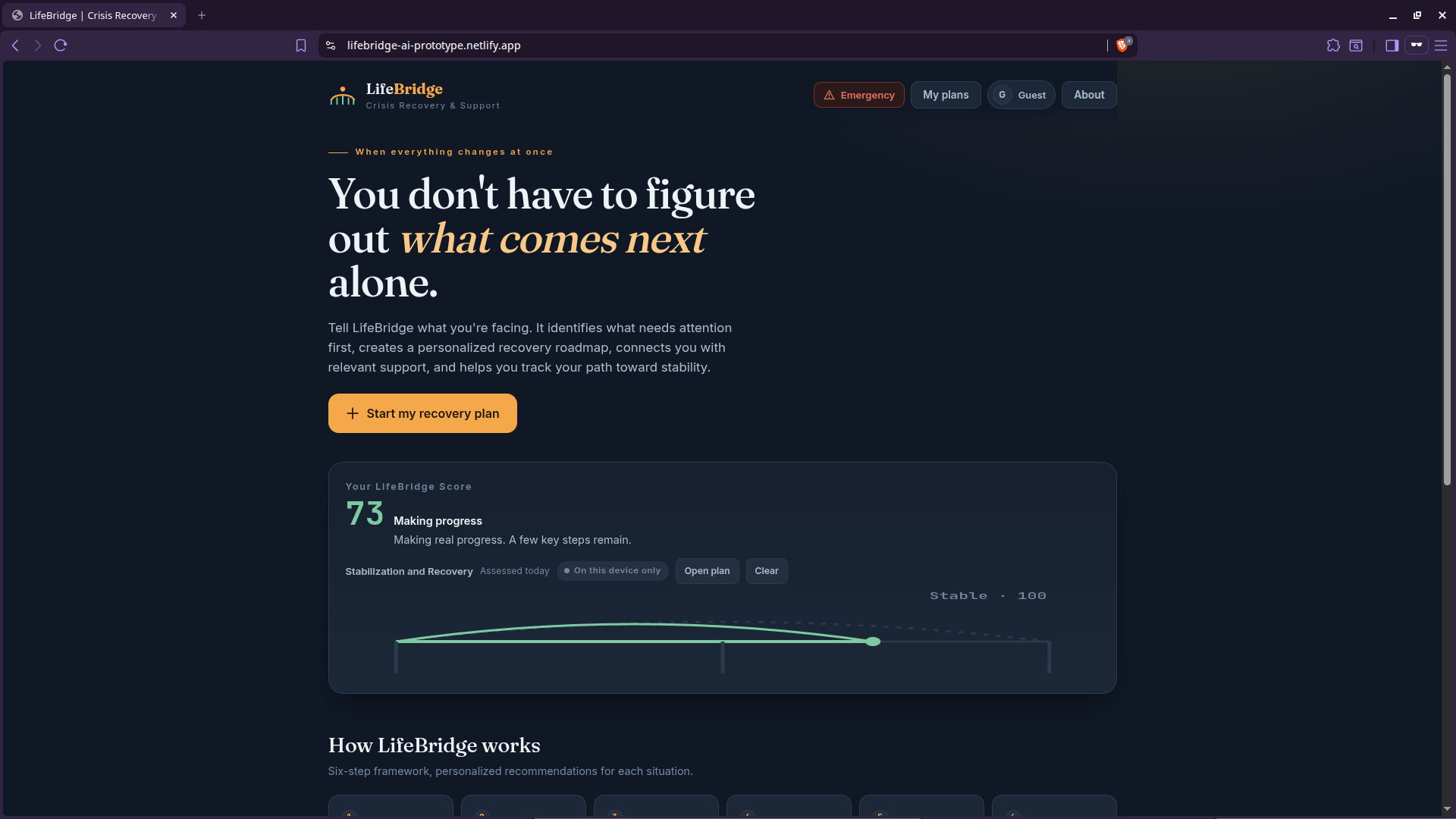
LifeBridge Homepage
-
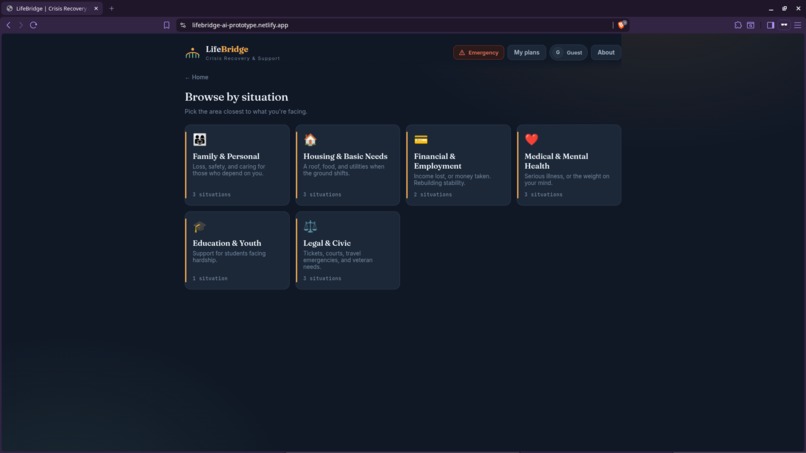
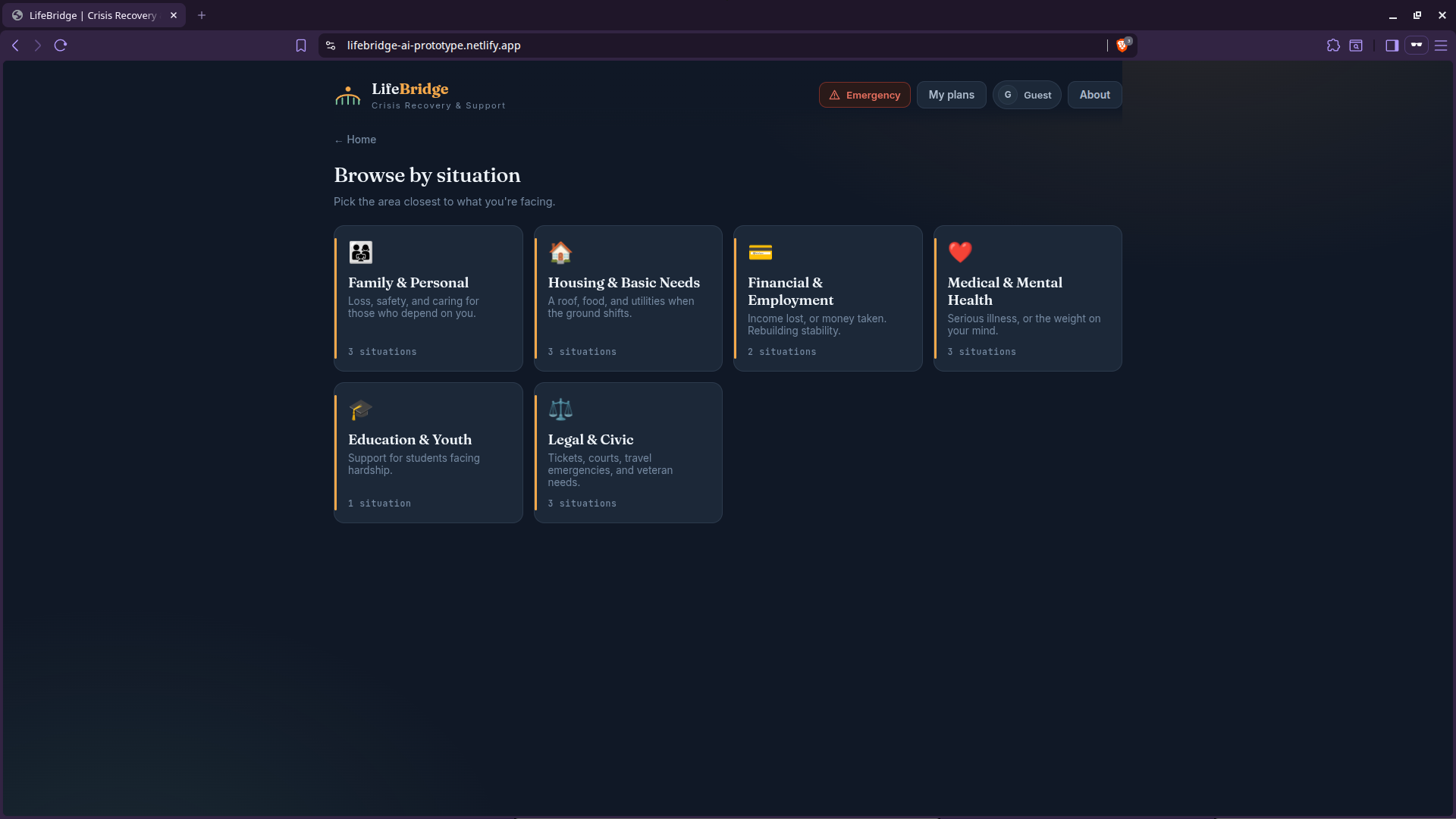
LifeBridge Browse by Situation
-
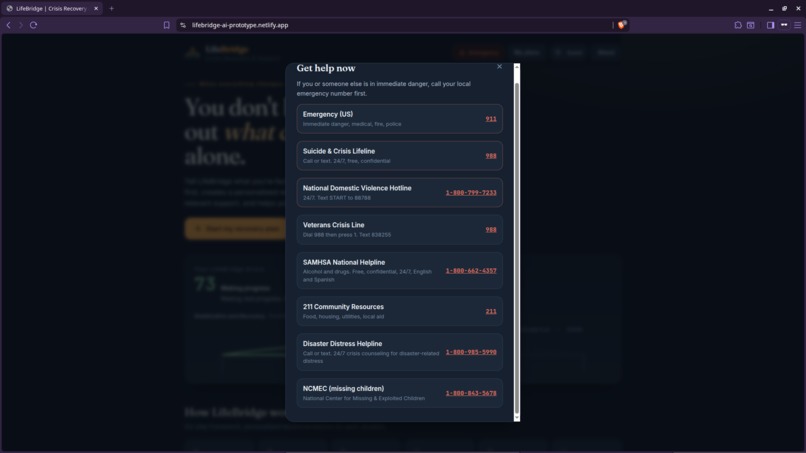
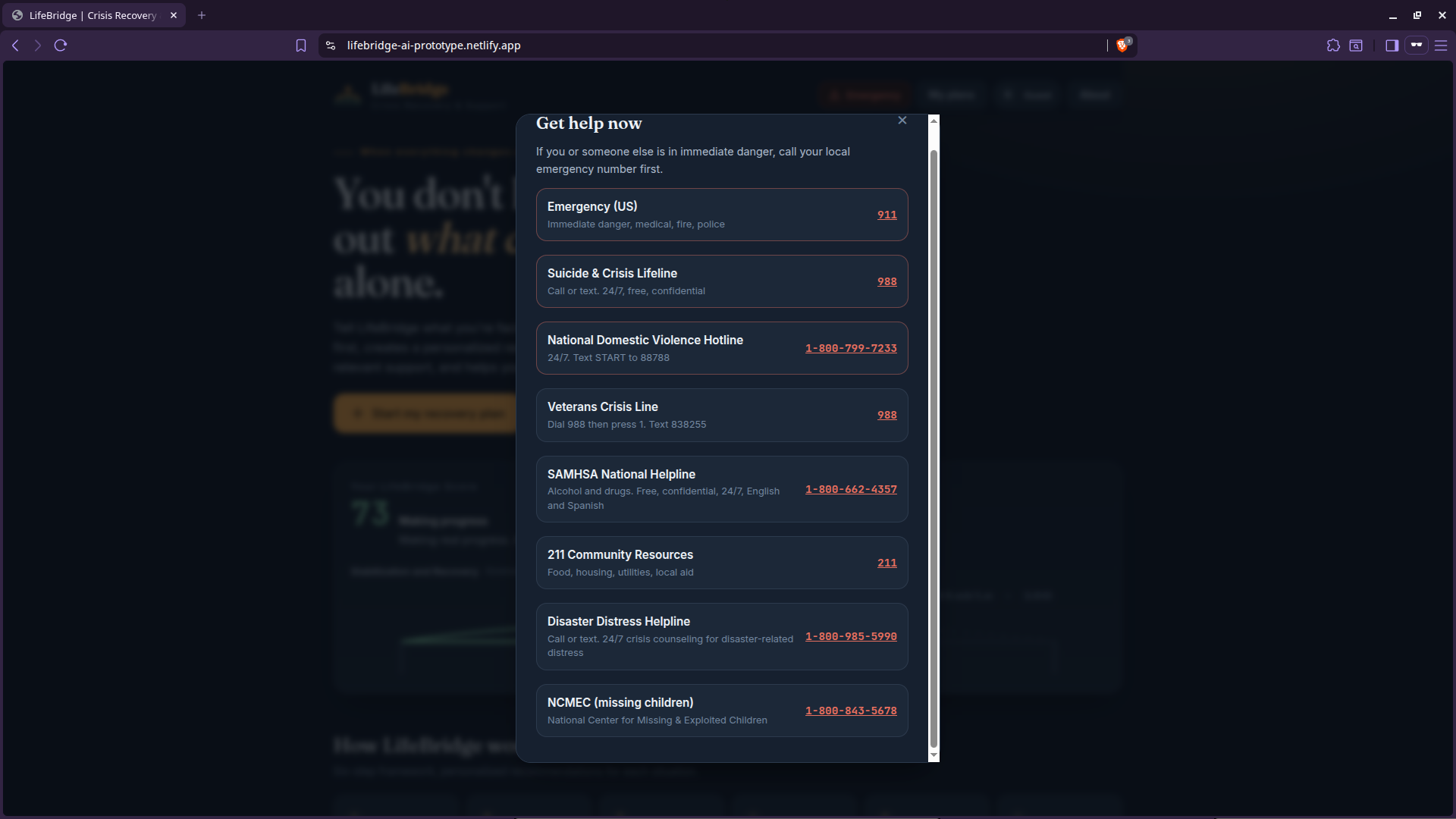
LifeBridge Emergency Hotline
-
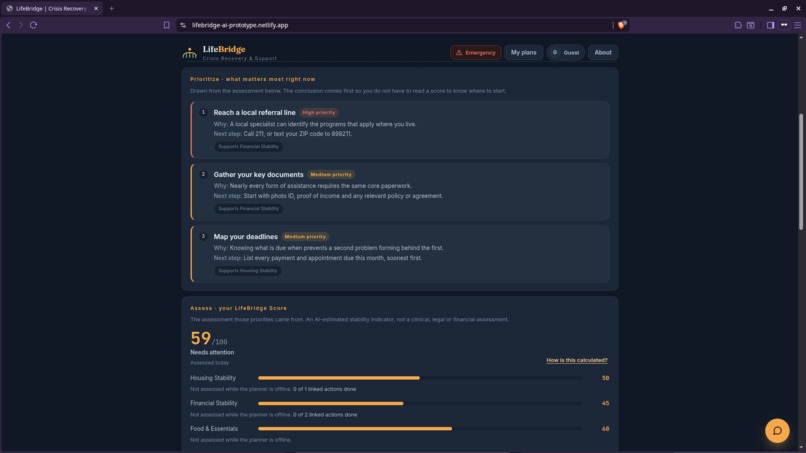
LifeBridge Situation Breakdown
-
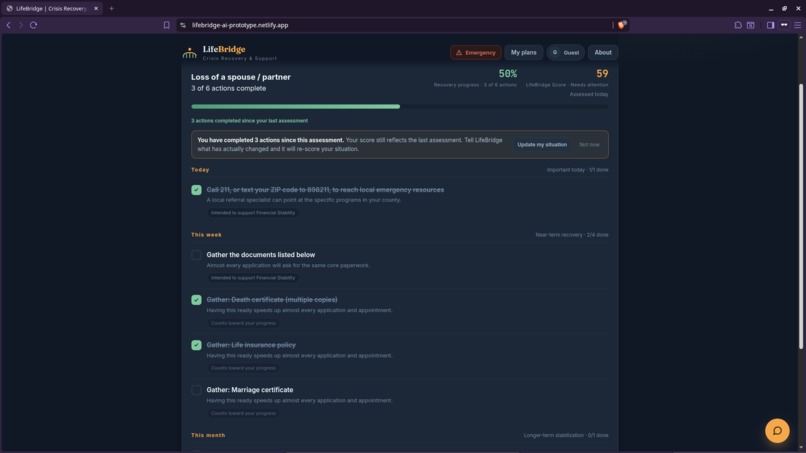
LifeBridge Planner
Inspiration
When something goes badly wrong in a person's life, a spouse dies, a job disappears, a home floods, a scam drains an account, the hardest question is rarely "where is one resource." It is "what do I do now, and in what order." People in crisis are handed phone numbers and PDFs, then left to assemble a plan while overwhelmed. And most tools stop at the first problem, when the damage that breaks a family often comes from the second one: the eviction that follows the job loss, the school disruption that follows a parent's death.
LifeBridge started from a simple idea: build the thing a good case worker does in their head, read the situation, weigh what is most at risk, lay out concrete next steps, point to real help, and warn about what tends to come next, and make it available to anyone, instantly.
What it does
You describe a life-changing event in plain language. LifeBridge:
- Detects the crisis and what is actually at stake.
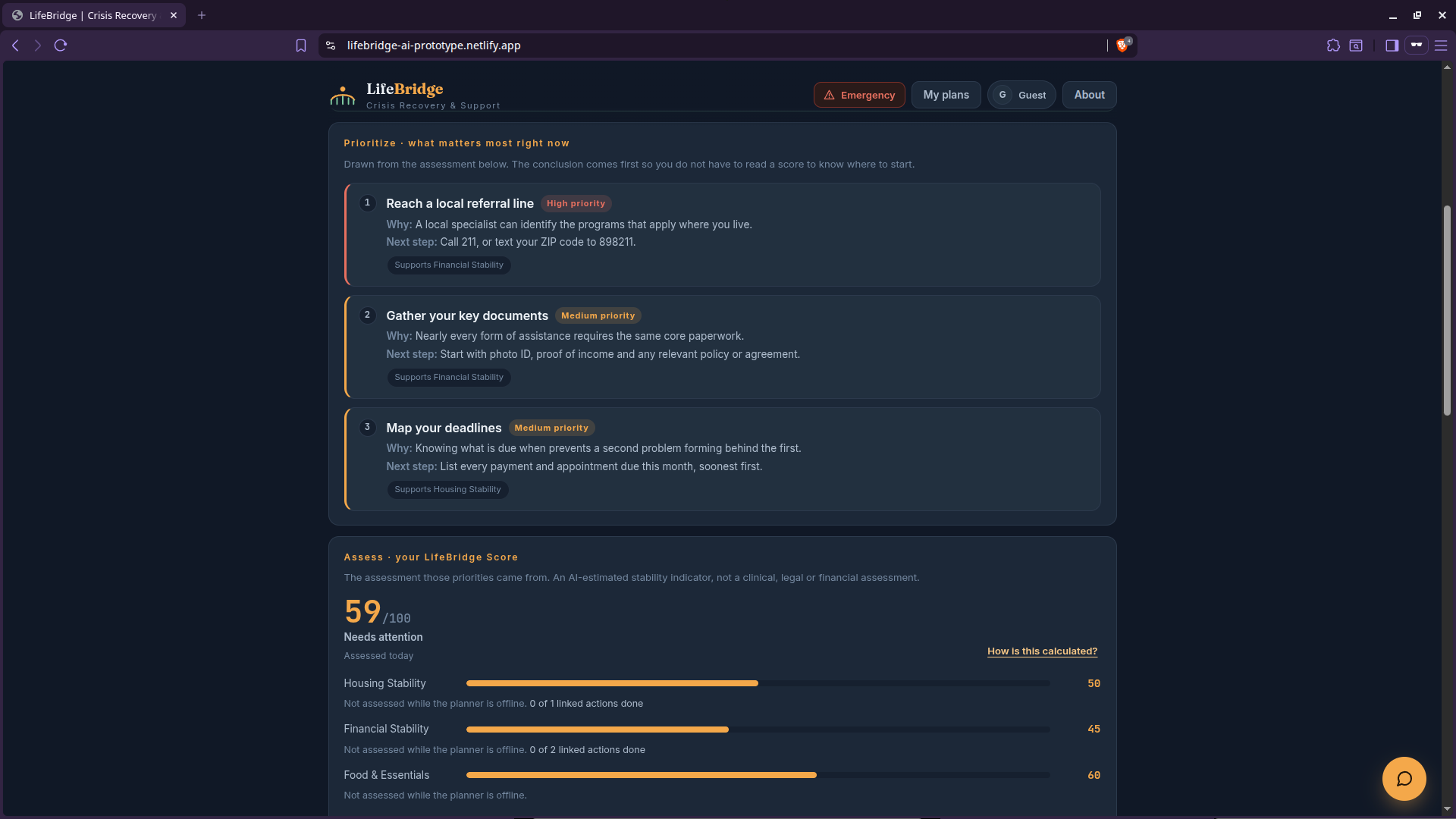
- Assesses stability across six fixed areas (housing, financial, food, health, family/education, safety) instead of one number, and explains what drove each score.
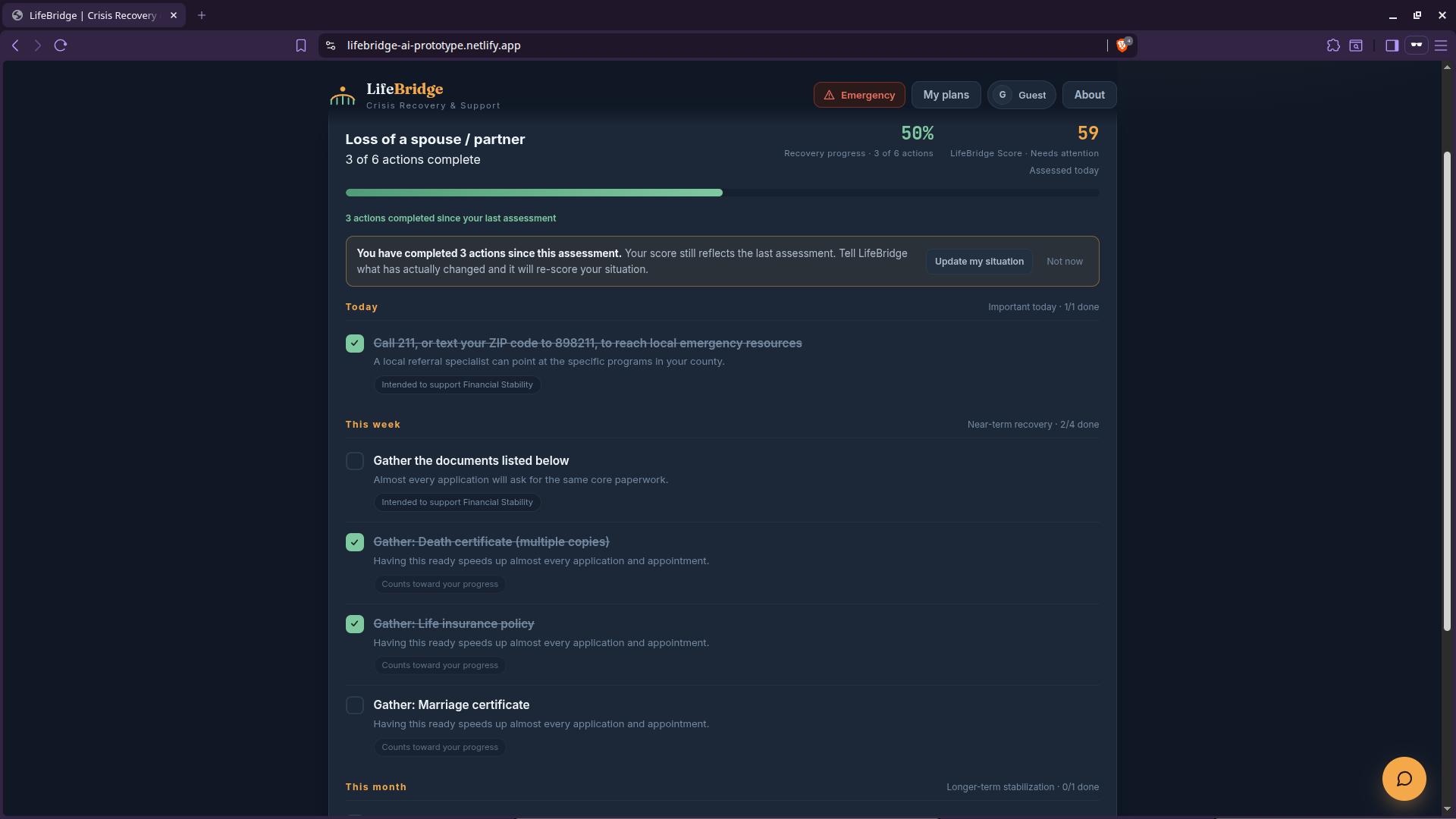
- Builds a personalized recovery plan with today / this week / this month steps, documents to gather, and who can help.
- Names the top three priorities, each with why it matters and a concrete next step.
- Flags risks to watch: the setbacks that tend to follow, worded as possibilities, not predictions.
- Connects to real resources: accurate US crisis hotlines plus nearby social services pulled live from OpenStreetMap.
- Tracks recovery through a roadmap grouped by urgency. Each action is linked to the one stability area it supports, so completing it moves that area rather than inflating the whole score.
- Saves and follows you. One-tap guest sign-in or Google, and plans persist across devices, because recovery takes weeks, not one browser session.
It covers 14 situations across six areas of life, from loss of a spouse to disaster recovery to fraud.
How we built it
- Frontend: plain HTML, CSS, and vanilla JavaScript, no framework. Mobile-responsive, keyboard-accessible, reduced-motion aware.
- AI: Google Gemini behind a Netlify serverless proxy, so the API key never leaves the server. A multi-model fallback chain with retry and backoff keeps the planner reliable under free-tier rate limits, and a rule-based fallback plan means the app never shows a dead end.
- The Recovery Engine: one reasoning core (crisis detection, multi-dimensional scoring, plan generation, secondary-risk prediction) serves every situation, with per-situation content authored as structured data. Scores always mean stability, never risk: higher is always better, everywhere.
- Auth and data: Firebase Anonymous and Google sign-in with Cloud Firestore, loaded as a deferred module so the app works fully without it. Plans live at
users/{uid}/plans/{planId}, and security rules deny everything else, proven by a 23-case emulator test suite. - Resources: OpenStreetMap Overpass API, browser geolocation, and Leaflet for the map.
Challenges we ran into
- Free-tier rate limits made the flagship feature fragile. Live AI planning failed at exactly the moments it mattered. We layered server-side backoff, a model fallback chain, client retry, and lenient JSON repair until the weakest moment became a dependable one.
- Letting the model invent its own scoring axes made results incomparable and unexplainable. We fixed six stability dimensions and forced every plan into them.
- Progress inflation. Checking boxes should not fake recovery, so completing every action tied to a dimension closes at most half the remaining gap: a checkbox is evidence of progress, not proof of stability.
- A login is a barrier at the worst possible moment. We solved it with a sign-in gate that fails open, anonymous guest accounts, and guest-to-Google linking that never loses a plan.
Accomplishments that we're proud of
- A recovery planner that stays honest: scores carry their provenance and their date, fallbacks are labeled, and the score starts as a question mark until you actually build a plan.
- Server-enforced privacy with tests to prove it, not just claims.
- A crisis tool that works offline-first, degrades gracefully at every layer, and keeps 988 one tap away without an account.
What we learned
- Reliability is a feature. A demo only counts if it works when someone else clicks the button.
- Multi-dimensional beats a single score: one number hides which part of a life is on fire.
- Sensitive data changes schema design. Making ownership a property of the storage path means no forgotten query filter can leak across accounts.
- Calm design does real work in a crisis tool. It has to feel safe, not alarming, to someone at their worst moment.
What's next for LifeBridge
- A vetted, human-curated resource directory to complement OpenStreetMap data.
- Localization beyond US hotlines and English.
- Reminders and gentle check-ins tied to the roadmap.
- Partnerships with case workers and community organizations so LifeBridge extends professionals instead of standing in for them.

Log in or sign up for Devpost to join the conversation.