-
-

Leveraging AI
-
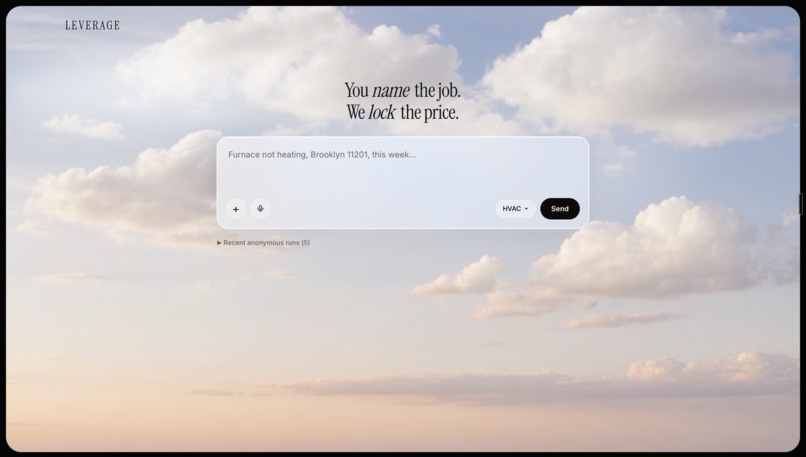
Landing Page
-
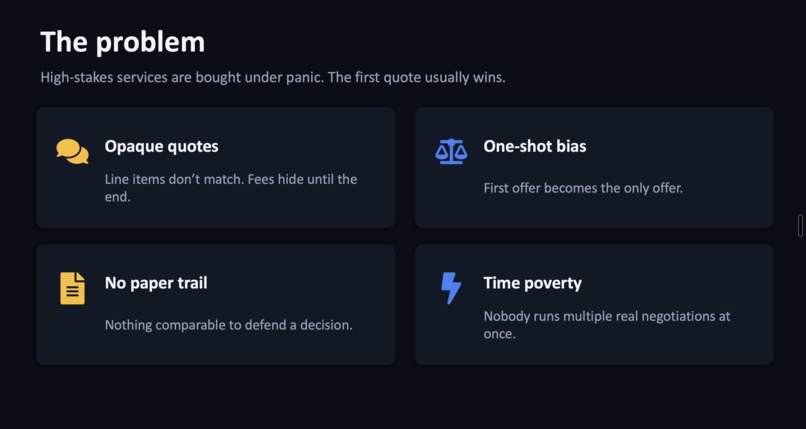
The Problem
-
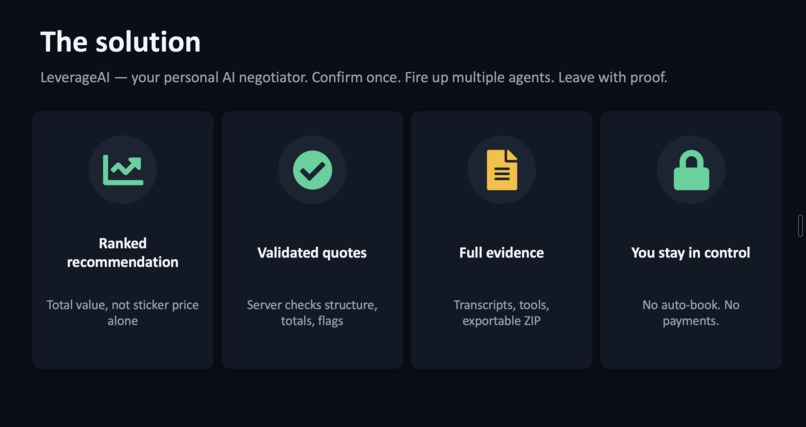
The Solution
-
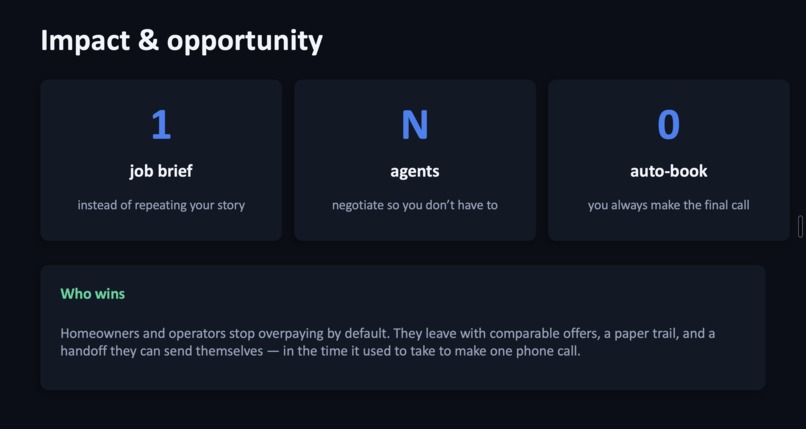
Impact and Opportunity
-
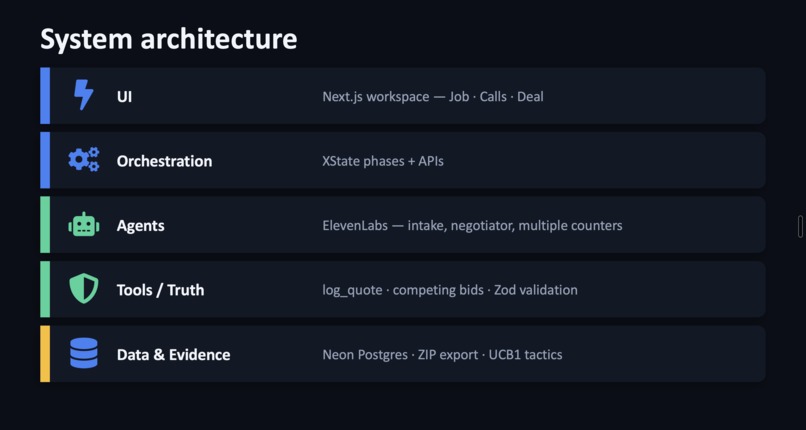
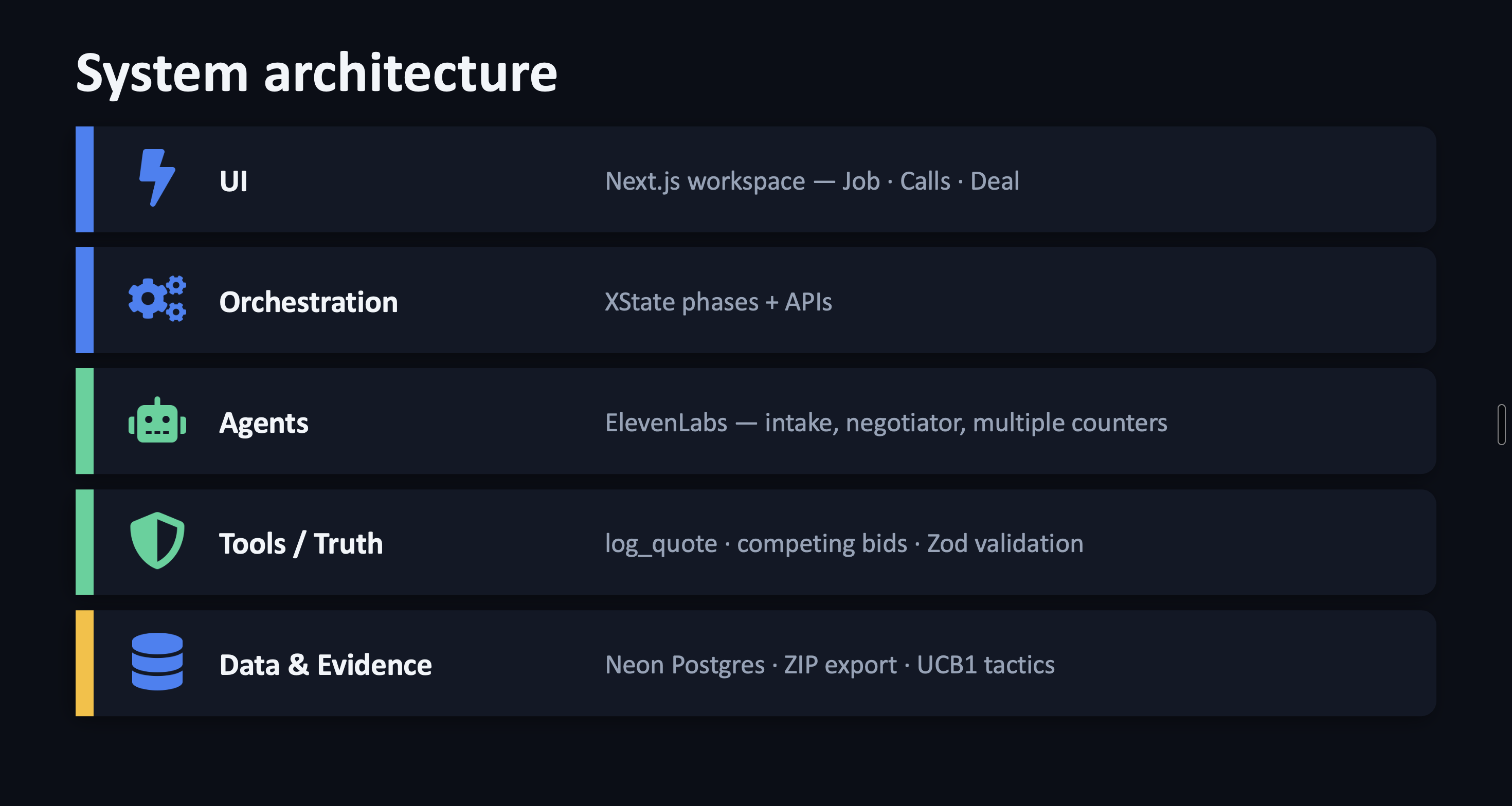
System Architecture
-
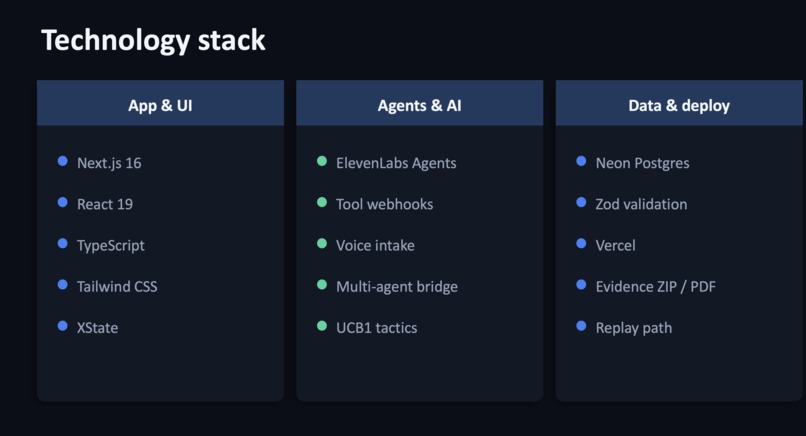
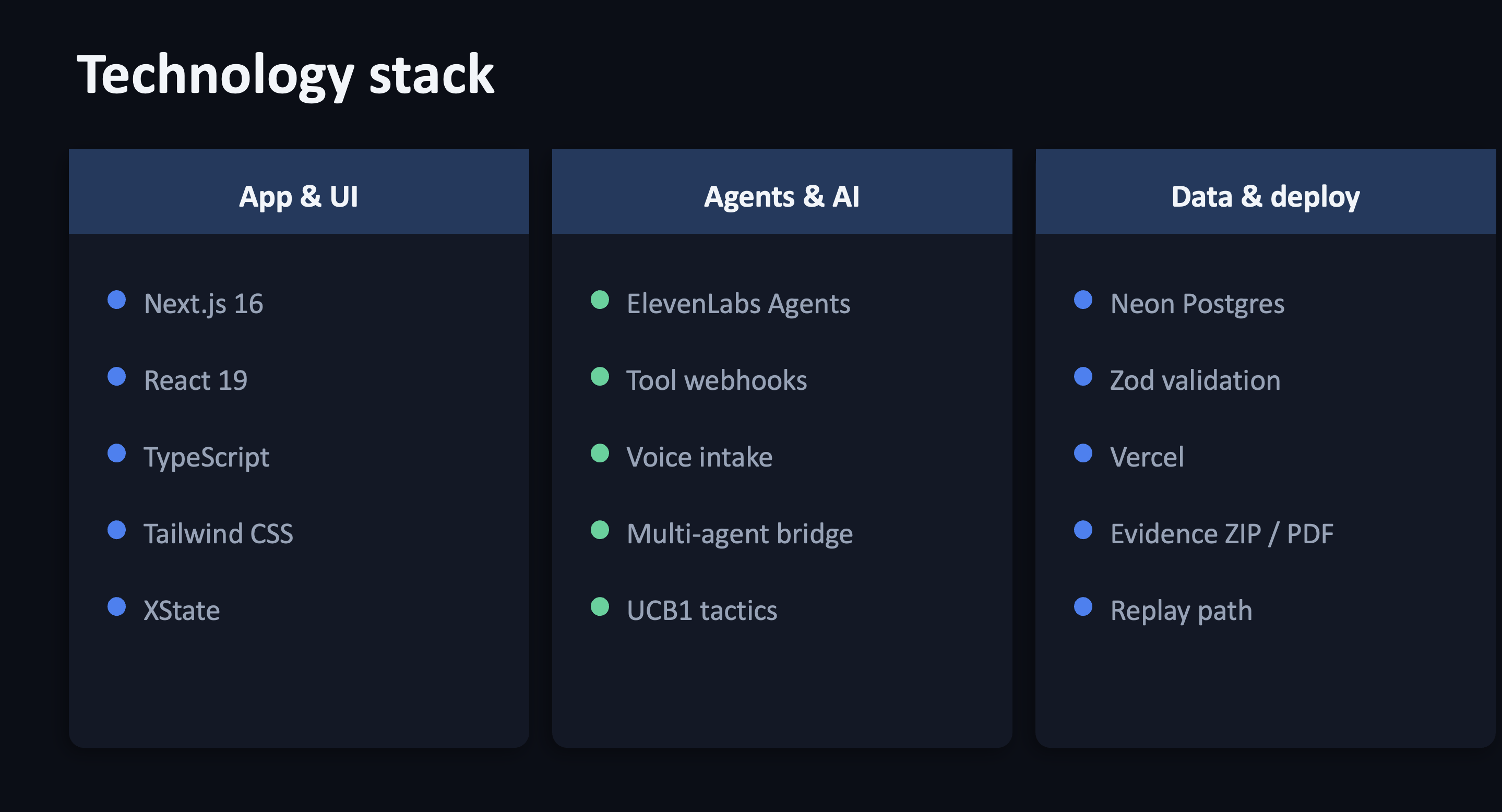
Technology Sack
-
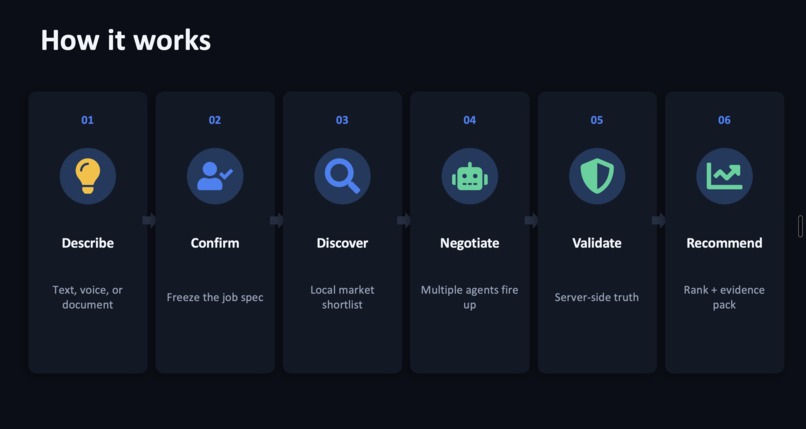
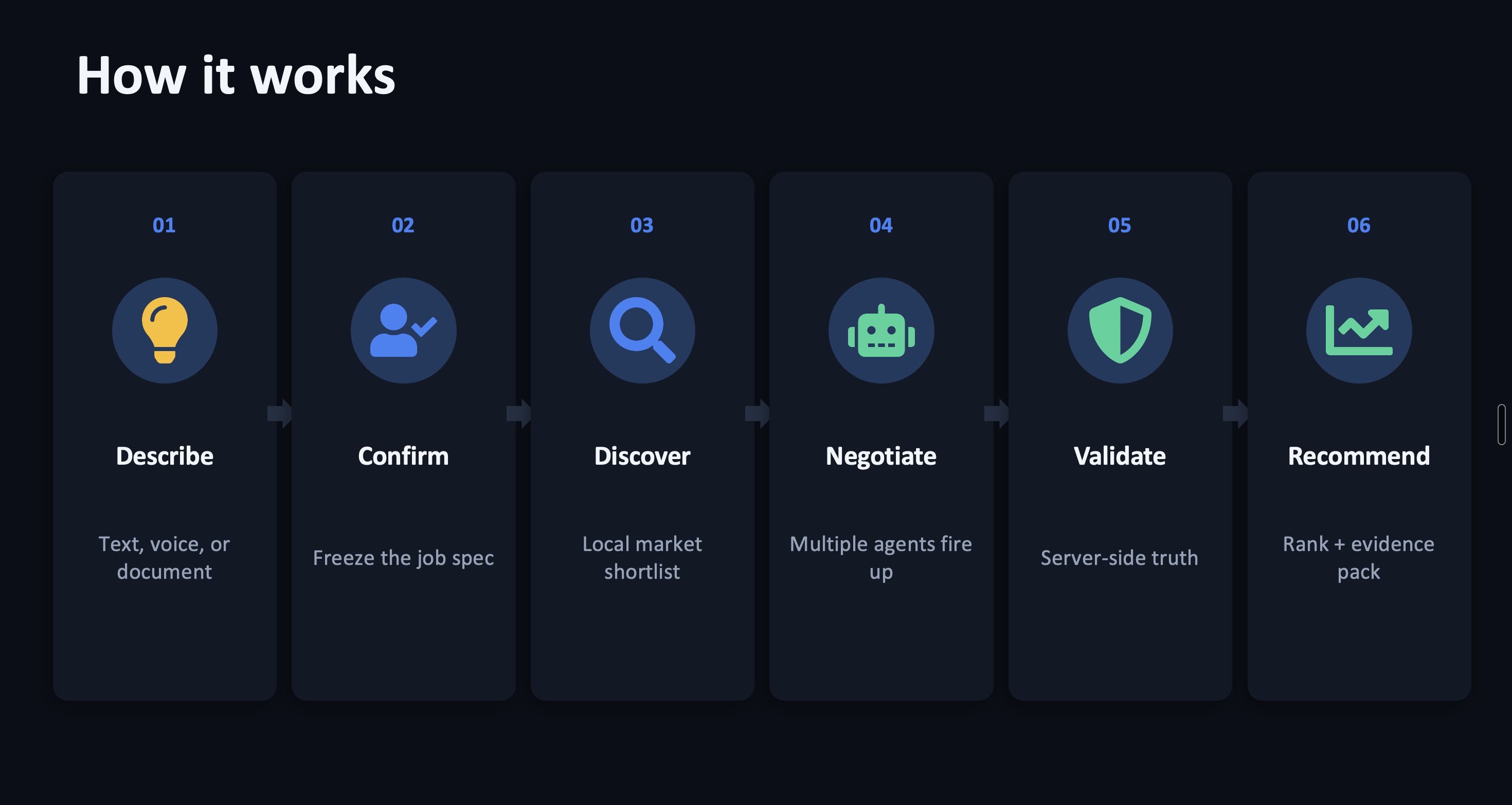
How it Works
-
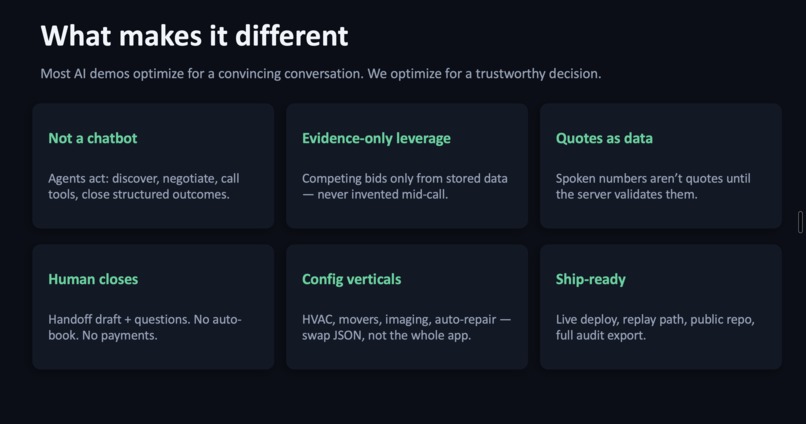
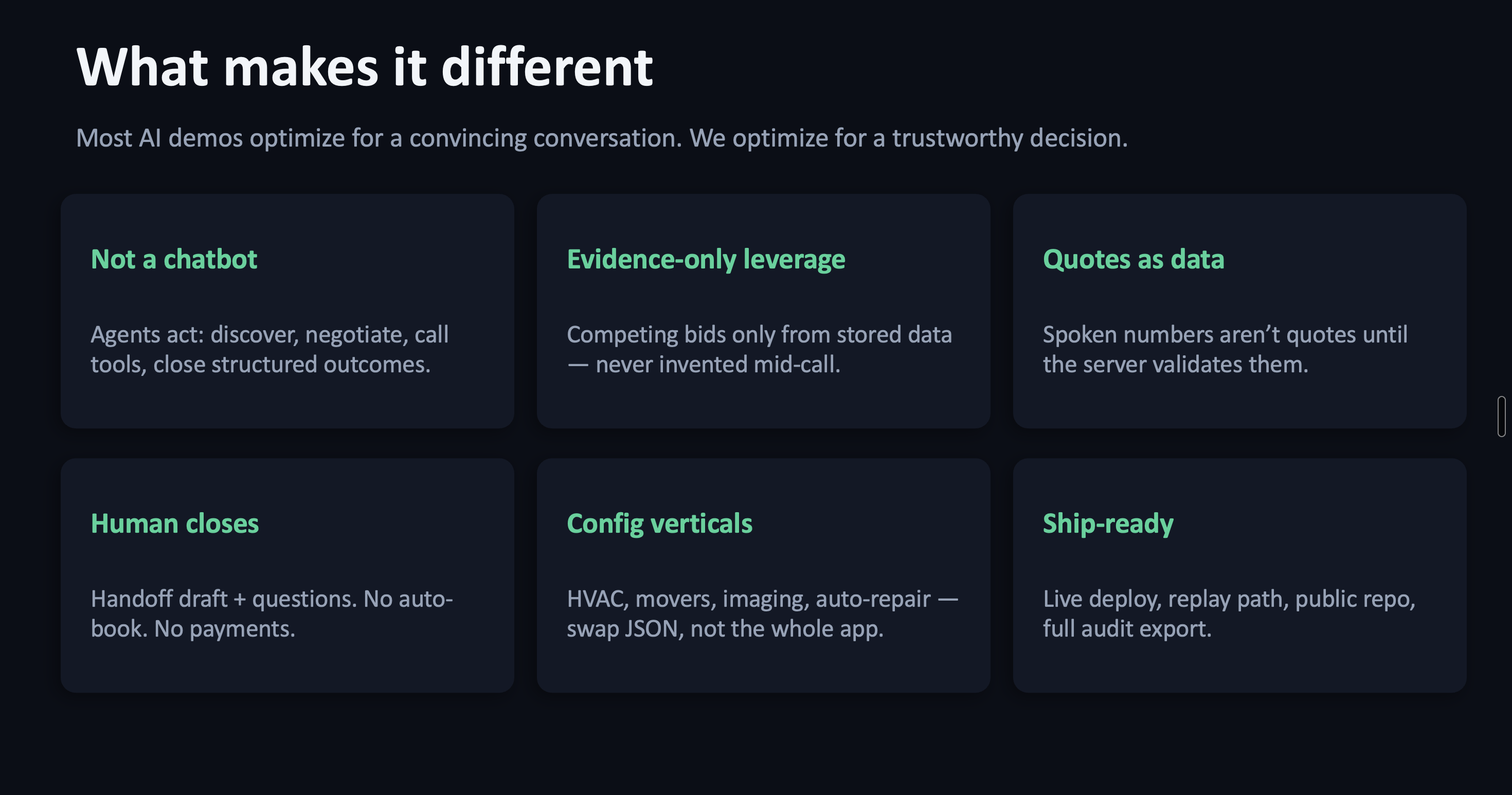
What makes it Different

Inspiration
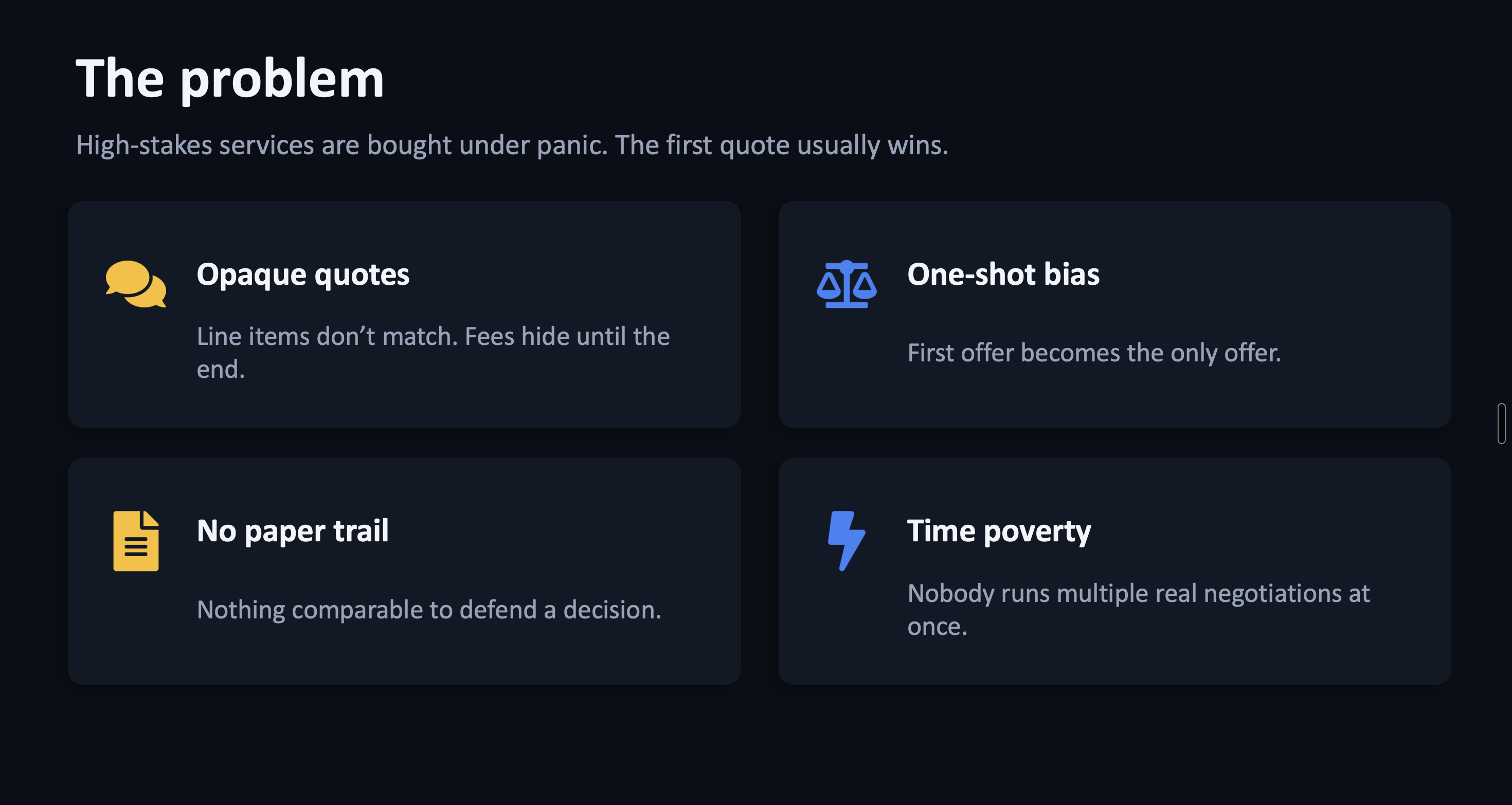
High-stakes services — HVAC emergencies, movers, medical imaging, auto repair — are bought under time pressure. Most people call whoever answers first and take that number. Quotes are opaque. Line items don’t match. Hidden fees show up late. There is almost never a clean paper trail.
We were frustrated by how often “negotiation” just means accepting the first offer. Software is great at structure, parallel work, and memory — exactly what a stressed buyer does not have at 1 AM. That is the inspiration for LeverageAI: give people a personal AI negotiator that works the market for them and returns a decision they can defend, not just a chatty summary.
What it does
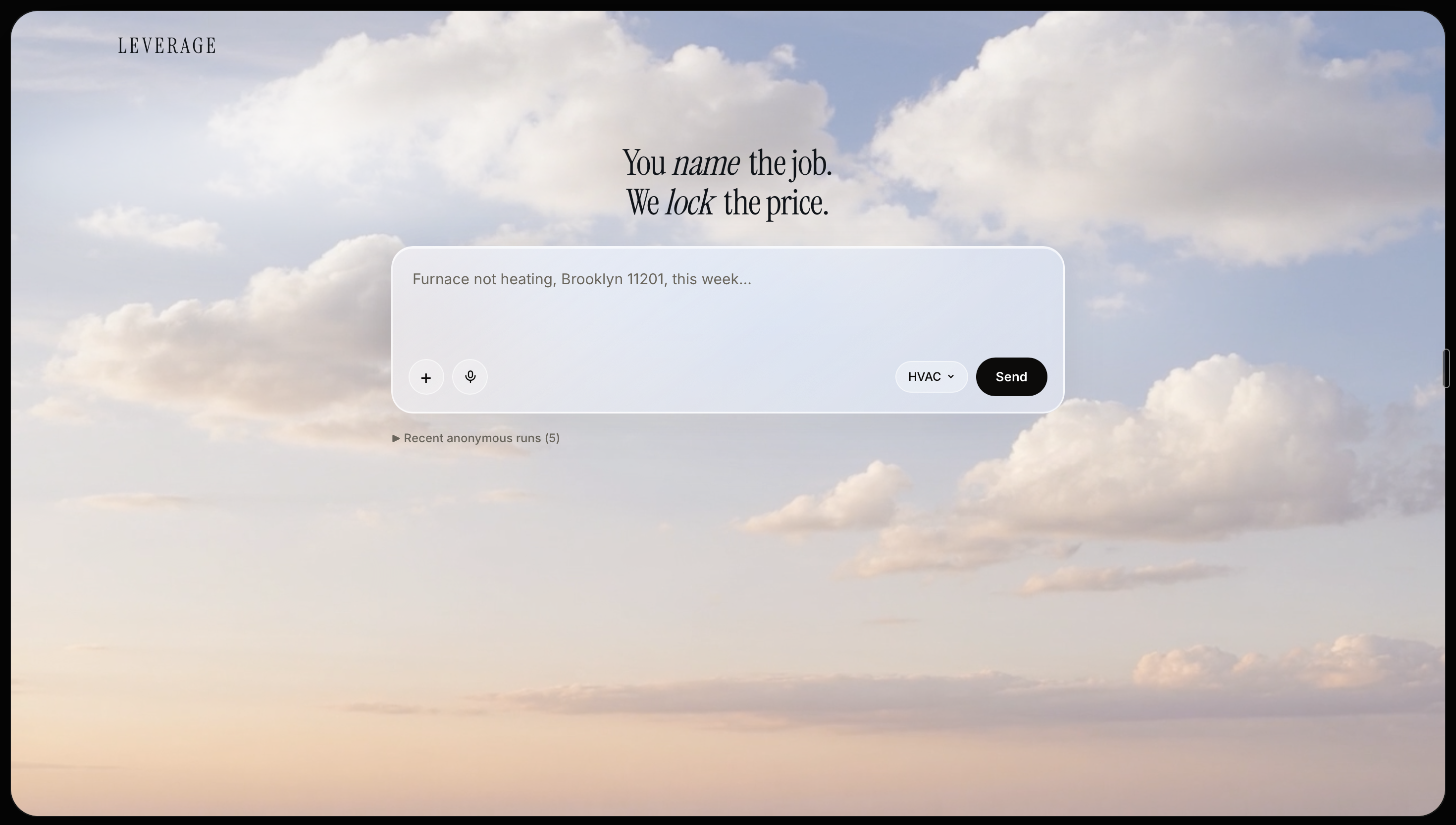
LeverageAI is an evidence-first AI negotiation product for high-stakes services.
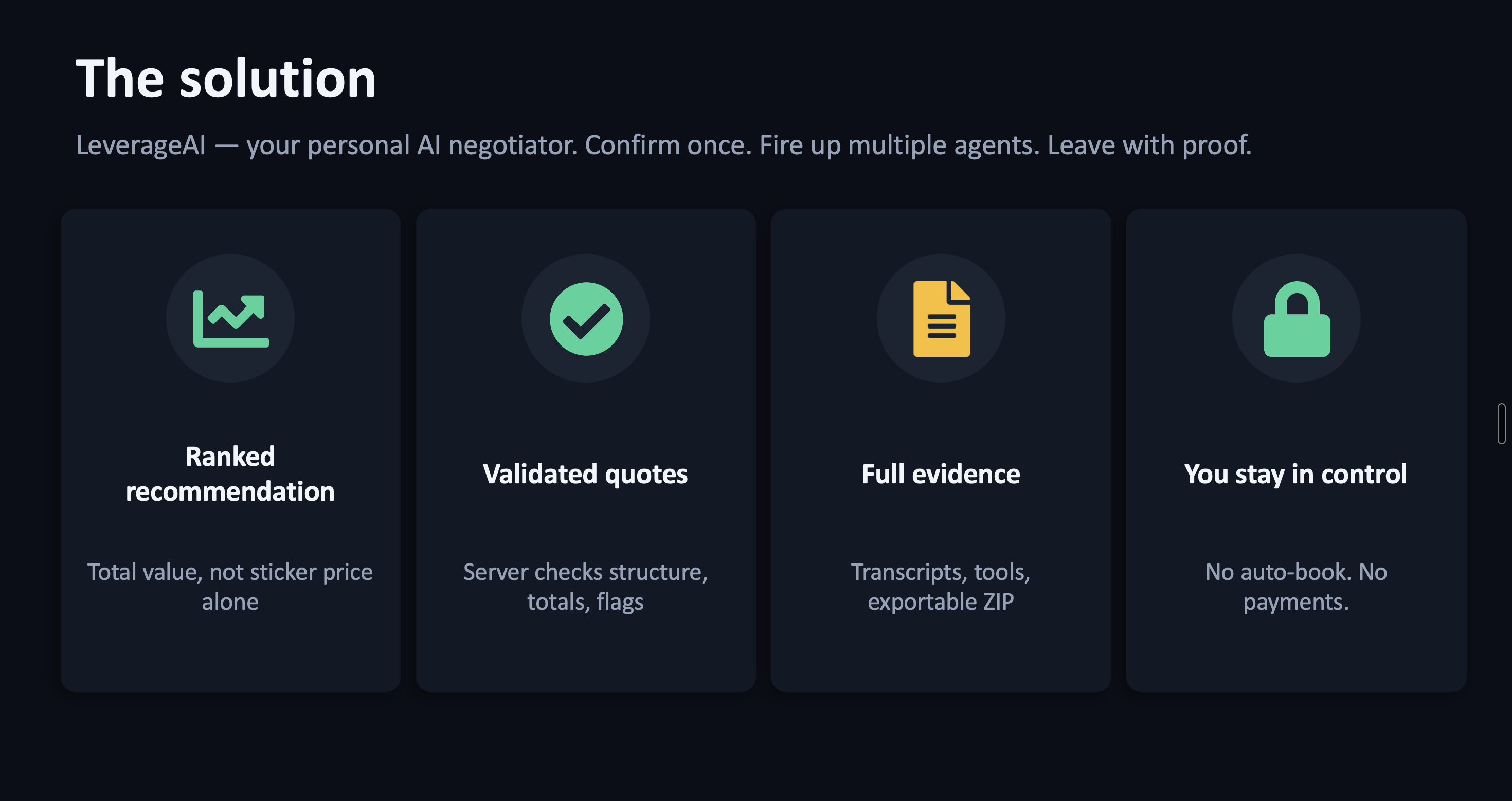
You describe a job once — by text, voice, or document. The system structures it and asks you to confirm before anything runs. After confirmation it discovers relevant local providers, then fires up multiple agents to negotiate on your behalf. When the rounds close, you get:
- a ranked recommendation based on total value, not only the cheapest sticker price
- itemized quotes that only count after server-side validation
- full evidence — transcripts, tool events, quotes, and recordings when available
- a human handoff draft and questions to ask before booking
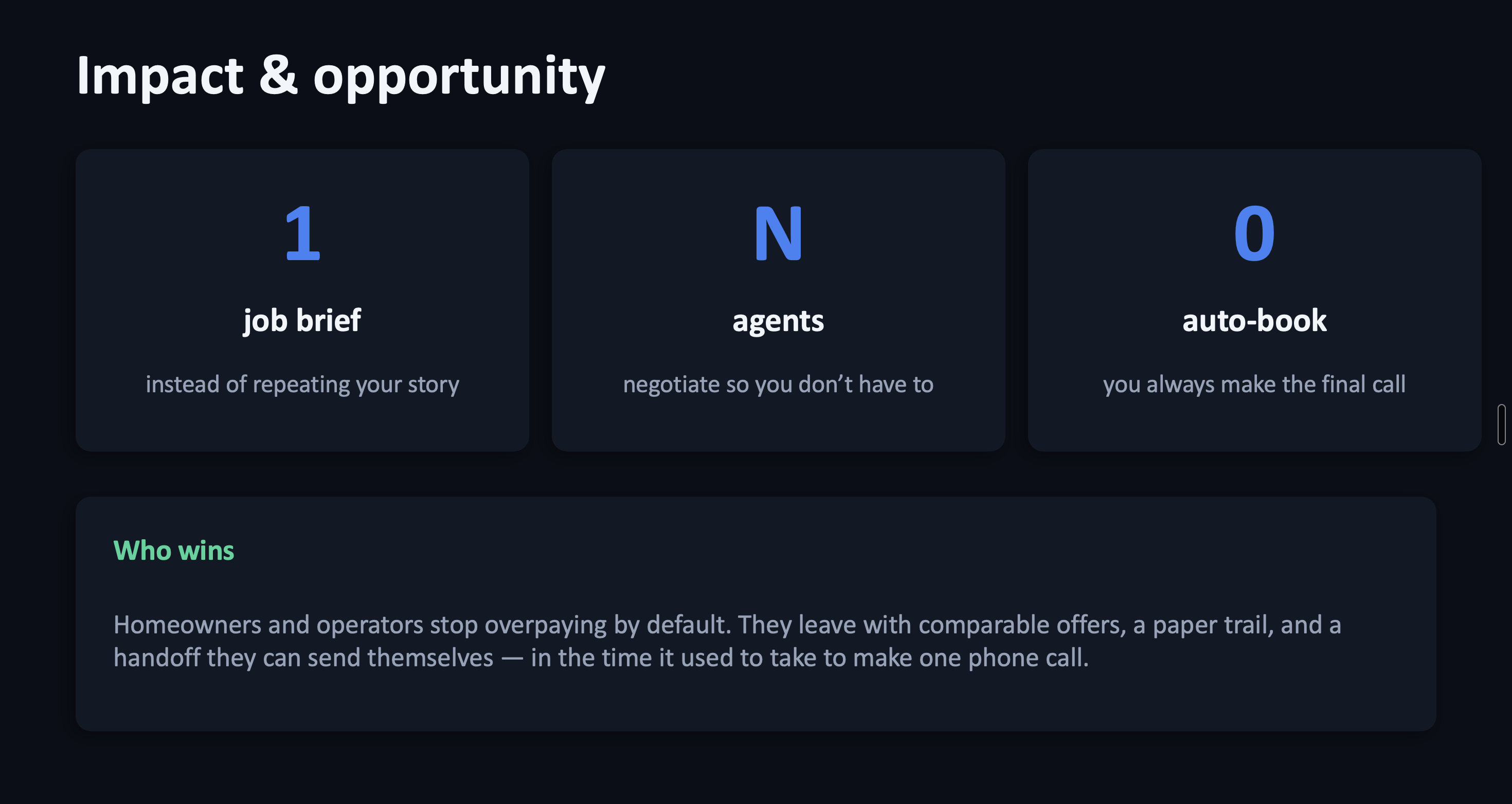
Nothing books. Nothing purchases. You stay in control.
Who it’s for: homeowners, renters, and operators who buy urgent or expensive services and want better outcomes without hours of phone work.
How we built it
| Layer | What we used |
|---|---|
| Product UI | Next.js (App Router), React, TypeScript, Tailwind — single workspace: Job · Calls · Deal |
| Orchestration | XState for explicit job phases (intake → confirm → discovery → negotiate → report) |
| Voice agents | ElevenLabs Agents — intake, negotiator, and multiple counter-party personas |
| Tools | Server webhooks with Zod validation: submit job specs, log quotes, fetch competing bids, benchmarks, close sessions |
| Data | Neon Postgres for jobs, sessions, quotes, and events |
| Evidence | PDF report + ZIP export (transcripts, quotes, tool events, booking draft) |
| Learning | Constrained UCB1 bandit over negotiation tactics — honesty rules stay fixed |
| Deploy | Vercel Functions + optional Blob for recordings |
The hard design choice was not “make agents talk.” It was making them act under rules a human can audit: confirm before action, quotes as validated data (not transcript vibes), leverage only from real stored bids, and a human close every time.
Challenges we ran into
- Trust vs fluency. Voice agents can sound right and still invent prices. We had to treat spoken text as untrusted until server validation accepts a structured quote.
- Real leverage without lying. Competing-bid claims had to come only from the database — never invented mid-call.
- Coordinating multiple agents. Running multi-agent negotiations live is brittle; we needed reliable bridging, turn limits, and a deterministic replay path for demos when live credits or latency fail.
- Multi-vertical without forks. HVAC, movers, imaging, and auto-repair share one codebase; vertical logic lives in config JSON so behavior changes without rewriting the app.
- Demo honesty. Discovery can use real market data while counter-parties stay simulated for cost, legality, and reliability — and the product must not overclaim.
Accomplishments that we're proud of
- A full agentic loop from intake → confirmation → discovery → multi-agent negotiation → validated ranking → evidence export.
- Server-side honesty gates so the product optimizes for a trustworthy decision, not a convincing conversation.
- One-screen live workspace that shows job, calls, and deal together for judges and users.
- Live deployment, public repository, demo video, and a config-driven path to more service verticals.
- A safe product boundary: recommend and prepare the handoff — never auto-book or take payment.
What we learned
- For money decisions, constraints and evidence matter as much as model quality.
- Autonomy without an audit trail is a demo, not a product people will trust.
- Firing up multiple agents only helps if their outcomes are comparable, structured, and ranked on total value.
- A deterministic replay path is not a compromise — it is how you keep demos and judging fair.
- Human-in-the-loop close is a feature for high-stakes services, not a missing automation.
What's next for LeverageAI
- Optional real carrier / PSTN calling when unit economics and compliance allow.
- More verticals via configuration and stronger “savings vs first quote” analytics for users.
- Multi-user accounts and light procurement workflows for small businesses.
- Deeper evaluation harnesses for tool honesty under failure.
- Packaging the core as a venture-grade product beyond hackathon demos — same thesis: negotiate with proof, not hope.
Built With
- ai
- elevenlabs
- javascript
- neon
- next.js
- node.js
- openstreetmap
- postgresql
- react
- rest
- serverless
- tailwind
- typescript
- vercel
- websocket
- xstate
- zod


Log in or sign up for Devpost to join the conversation.