-
-
Hera
-
Home Page
-
Recommendations
-
Safe route live map
-
Connecting MyChart
Inspiration
Pregnancy can be overwhelming enough without having to navigate a complicated healthcare system at the same time. For pregnant women in rural Wisconsin, finding the right specialist can be even more difficult because of distance, limited provider availability, insurance constraints, and the complexity of referrals.
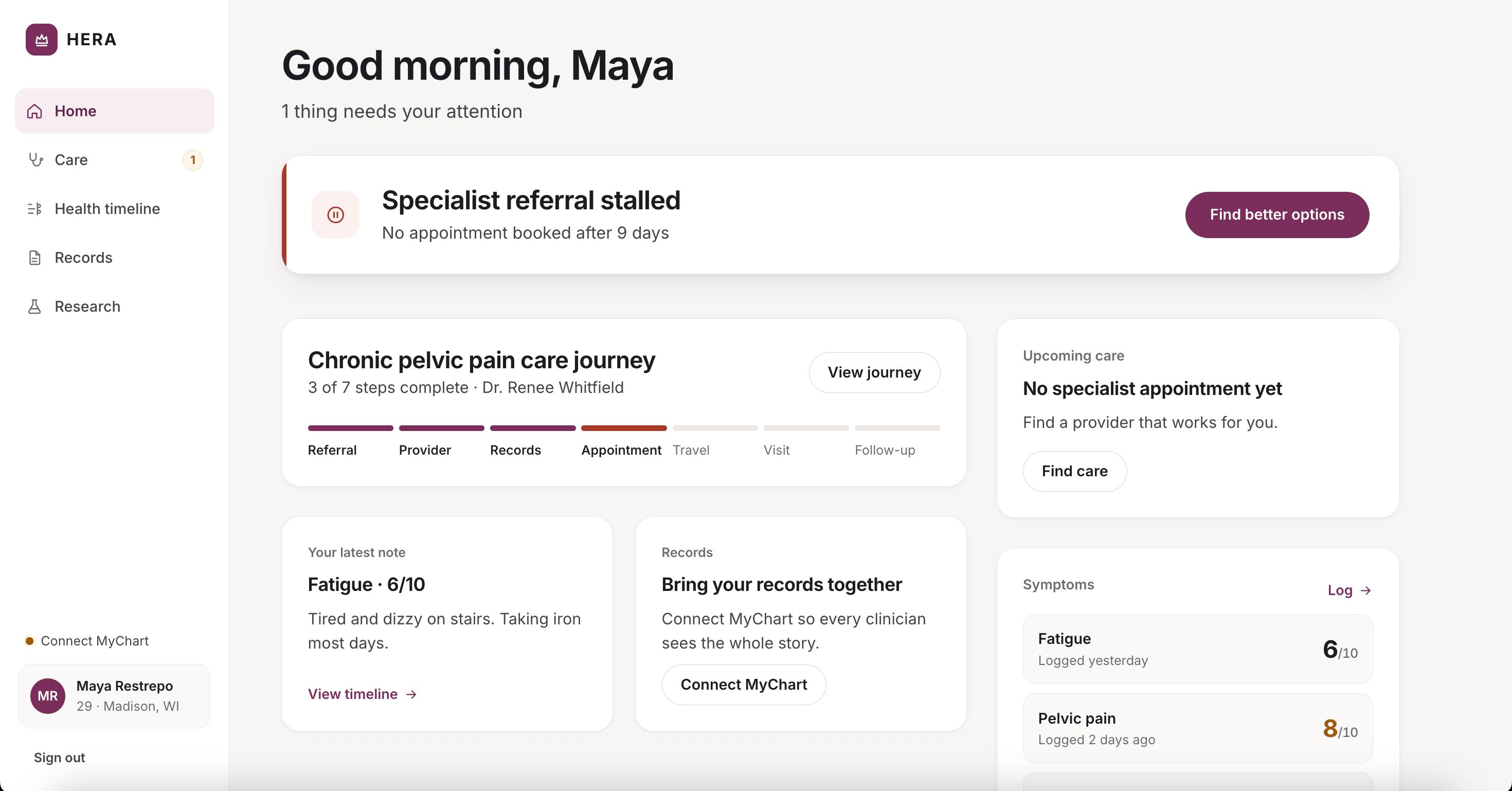
We wanted to understand what happens when a doctor refers a patient to a specialist—and what happens when that referral doesn't actually lead to care. A referral might not work because of insurance, cost, availability, distance, or a lack of specialists nearby.
That became HERA: a platform designed specifically for pregnant women in rural Wisconsin to navigate care from finding a specialist, to getting there safely, to keeping track of what happens afterward.
What it does
HERA supports the pregnancy care journey in three stages:
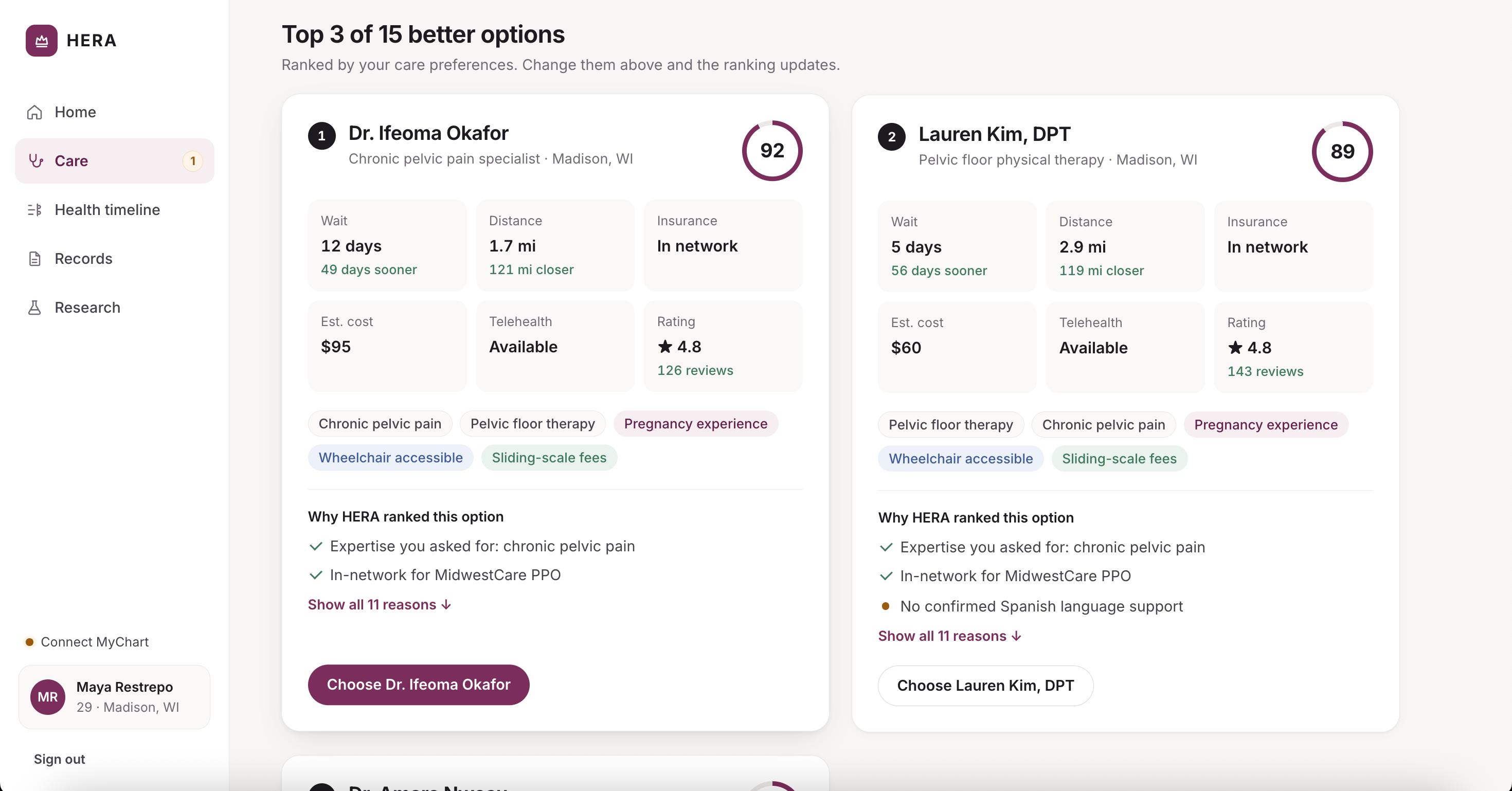
1. Find the right specialist.
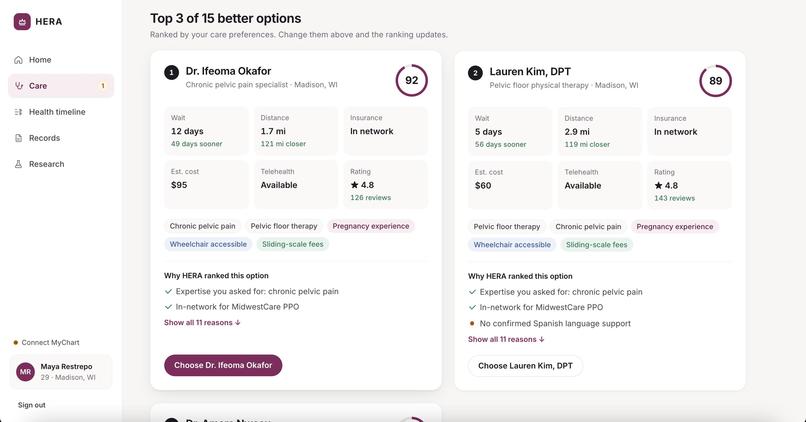
HERA matches pregnant women with specialists based on their individual circumstances, including insurance coverage, financial constraints, location, and healthcare needs. Rather than simply accepting a referral, HERA helps identify specialists who are actually accessible to the patient.
2. Get there safely.
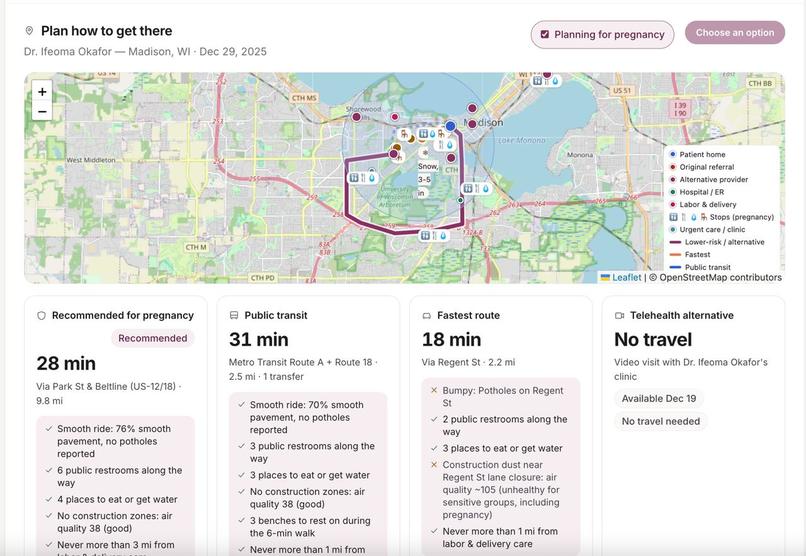
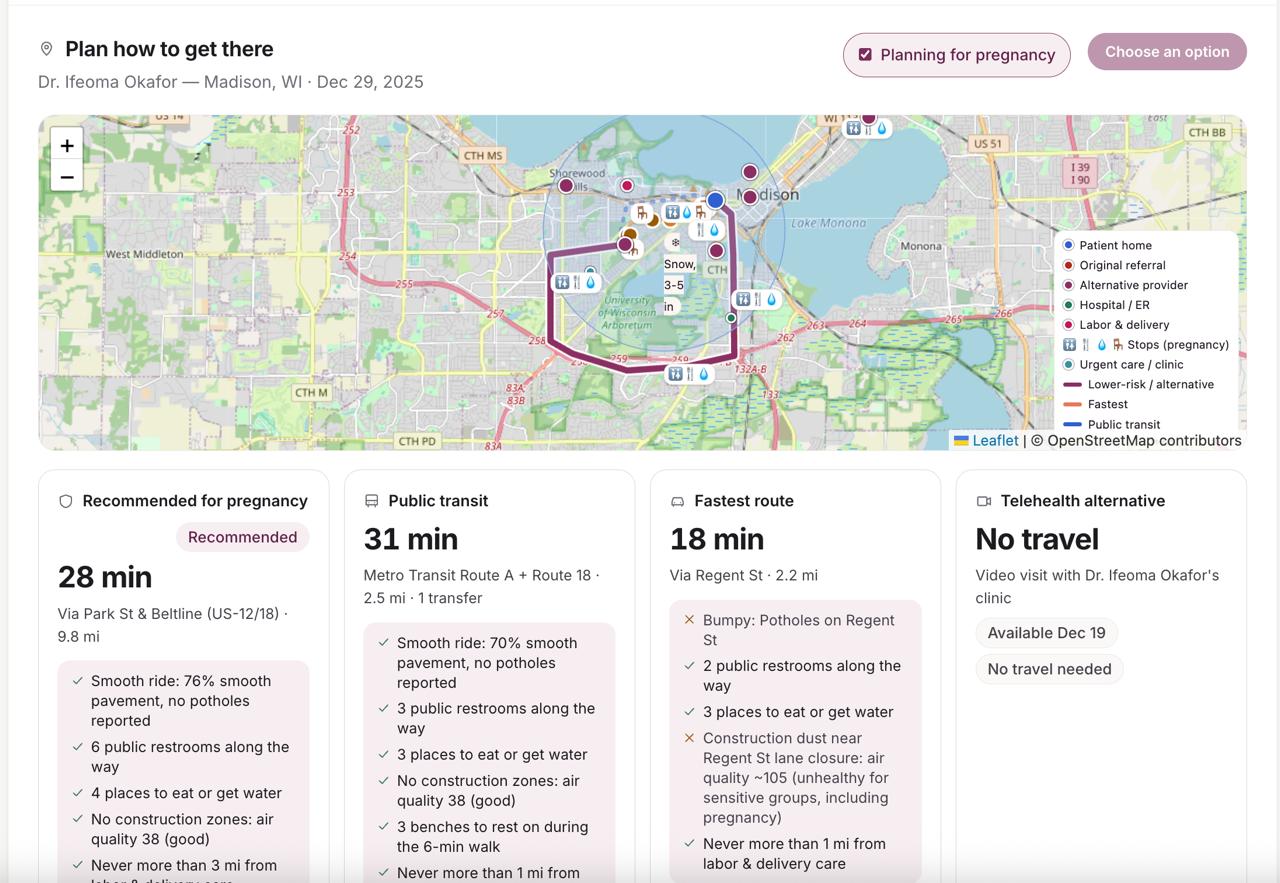
Once an appointment is selected, HERA provides a live map with a route optimized around needs that are particularly relevant during pregnancy. Instead of simply finding the fastest route, HERA considers practical resources such as public bathrooms and water access along the way.
3. Keep everything together.
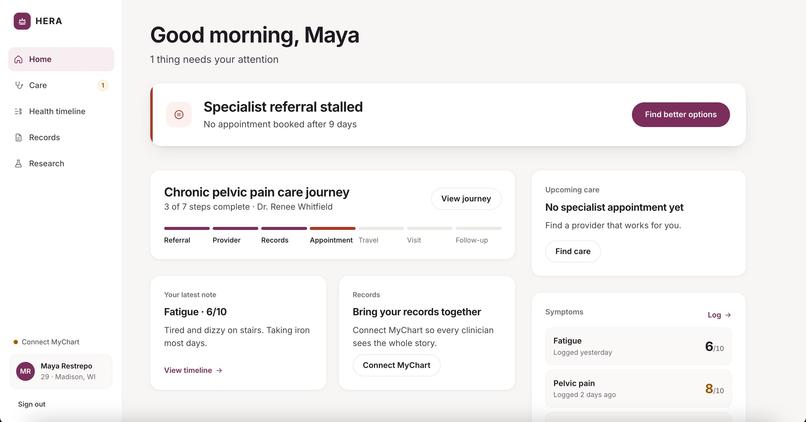
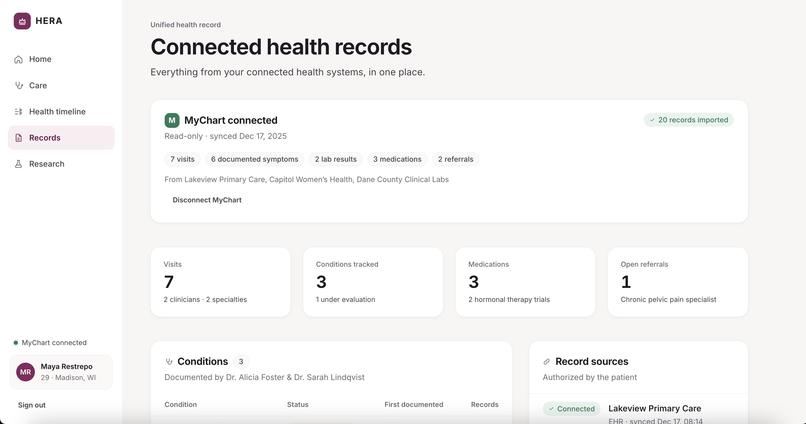
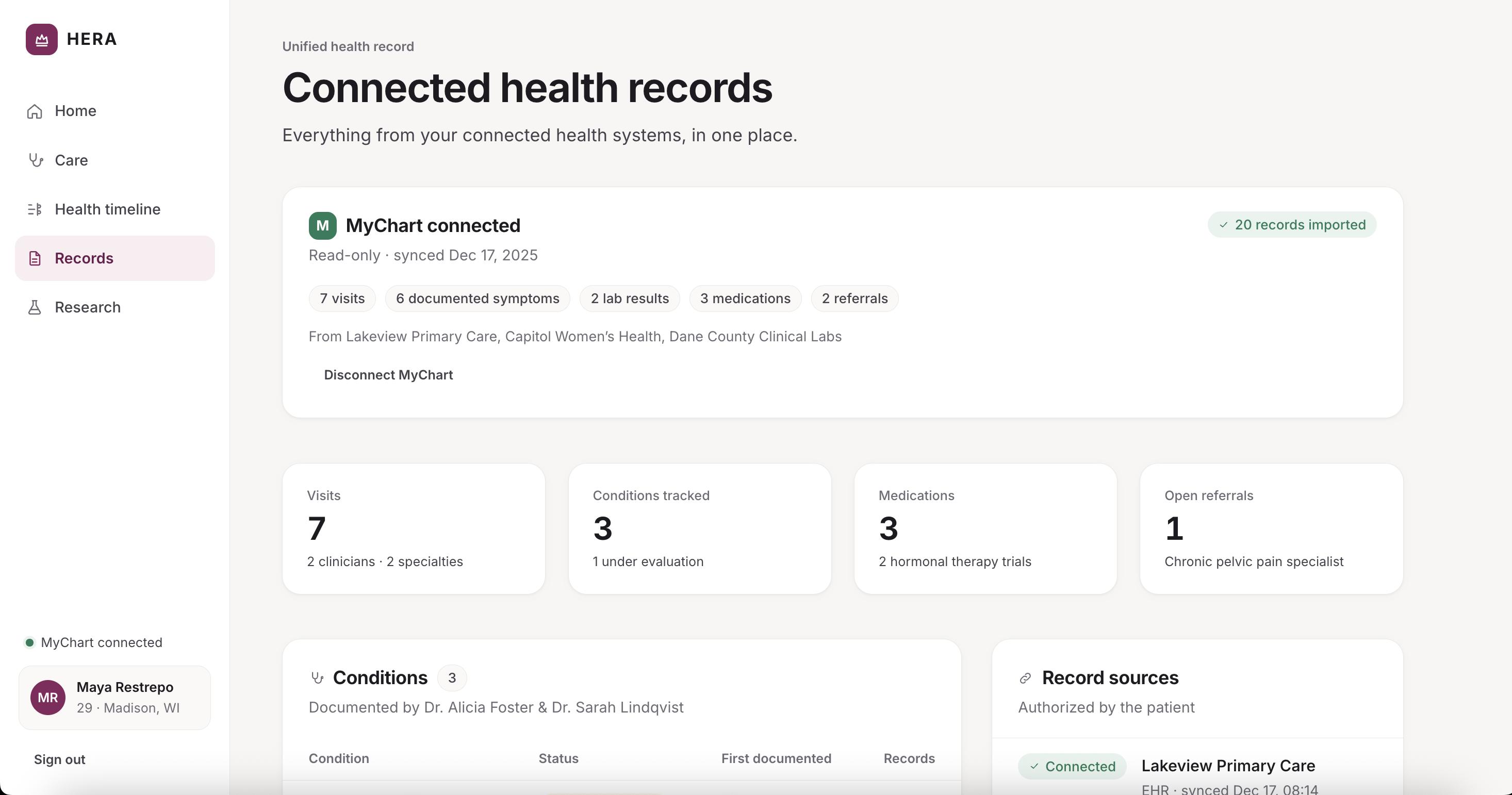
After the appointment, users can keep their healthcare information consolidated in one place and log symptoms over time, giving them a continuous record rather than disconnected pieces of information across different appointments and providers.
How we built it
We built HERA as a full-stack application combining a user-facing interface with backend logic for specialist matching, healthcare information, routing, and symptom tracking.
Our matching system considers multiple constraints simultaneously—such as insurance, cost, location, and personal needs—to identify specialists who are realistically accessible to each patient.
We integrated live mapping and routing while tailoring the experience to pregnancy-specific needs, including access to bathrooms and water along the journey.
HERA is also designed around a B2B2C model: patients receive the care-navigation experience, while healthcare organizations, Medicaid, and insurance providers can support and ultimately fund access to the platform.
Challenges we ran into
One of our biggest challenges was understanding the U.S. healthcare system well enough to build something that actually fits into it.
We had to research how doctor-to-specialist referrals typically work, when referrals fail to result in an appointment, why patients may need to look outside their initial referral network, and how these challenges become more complicated in rural areas where specialists may be much farther away or less available.
We also had to think about how to turn all of those constraints—insurance, cost, distance, availability, and individual circumstances—into a matching experience that is simple for a patient to use.
Another challenge was rethinking what "safe navigation" means for a pregnant woman. A conventional map can get someone from point A to point B, but it doesn't necessarily account for needs like bathroom or water access.
Accomplishments that we're proud of
We're proud that HERA addresses the entire pregnancy care journey, rather than solving just one part of healthcare.
We're especially proud of building around the realities of rural healthcare access. HERA doesn't assume that the closest specialist or the specialist a patient was initially referred to is necessarily the most accessible option.
We also developed HERA with a B2B2C model, creating a path for Medicaid and insurance companies to support the cost of care navigation while keeping the patient at the center of the experience.
What we learned
Our biggest learning was how much more complicated the U.S. healthcare system is once you look beyond simply finding a doctor.
We had to learn how specialist referrals actually move through the healthcare system, why referrals may not work out, when patients are referred outside their initial network, and how rural healthcare changes those dynamics when specialists and healthcare facilities can be significantly farther away.
We also learned that building for healthcare means understanding both sides of the system. HERA isn't just a patient-facing product—we had to think about how Medicaid and insurance companies could participate in the ecosystem, which led us to our B2B2C model.
Most importantly, we learned to design around the actual journey of a patient rather than assuming that healthcare access ends when a referral is made.
What's next for HERA
Our six-month plan is focused on moving HERA from a hackathon prototype toward a validated healthcare product:
Month 1 — Establish credibility:
Validate our assumptions with healthcare professionals and stakeholders.
Month 2 — Beta test:
Test HERA with users and gather feedback on the specialist-matching and care-navigation experience.
Month 3 — Research:
Conduct deeper market and healthcare-system research, particularly around rural Wisconsin and referral pathways.
Month 4 — Pilot:
Pilot HERA with a targeted group of users and healthcare partners.
Months 5–6 — Insurance pitch:
Use the pilot results to develop our Medicaid and insurance partnership strategy, with the goal of establishing HERA as a B2B2C healthcare-navigation platform.
Our long-term goal is to make specialist access during pregnancy more navigable for women in rural communities, while creating a sustainable model for the healthcare organizations and insurers supporting that care.
Built With
- fastapi
- leaflet.js
- openstreetmap
- python
- react
- restapi
- typescript
- uvicorn
- vite

Log in or sign up for Devpost to join the conversation.