Inspiration
I am a Lahori, and that makes the problem behind this project deeply personal. Waste management is not an abstract urban challenge that I encountered in a dataset—it is something I have personally witnessed across the city and communities around me.
But this project is driven by something larger than personal frustration. As a Pakistani, I want to contribute to solving problems that affect the country I live in. Pakistan’s rapidly growing cities face increasingly complex challenges, and I believe technology should not merely reproduce solutions built for other countries; it should be deliberately engineered around our own realities.
The idea behind the Lahore Waste Intelligence System emerged from a simple observation:
Cities already generate enormous amounts of information—but information only becomes valuable when it can be transformed into actionable intelligence.
Instead of building another platform where citizens submit complaints that simply disappear into a database, I wanted to explore what would happen if waste reports, geographic information, real-world datasets, and AI could be brought together into a unified system capable of identifying patterns and helping prioritize intervention.
The ambition is therefore much bigger than creating a reporting website.
It is about demonstrating how Lahore could move from reactive waste management toward intelligent, data-informed urban decision-making.
What it does
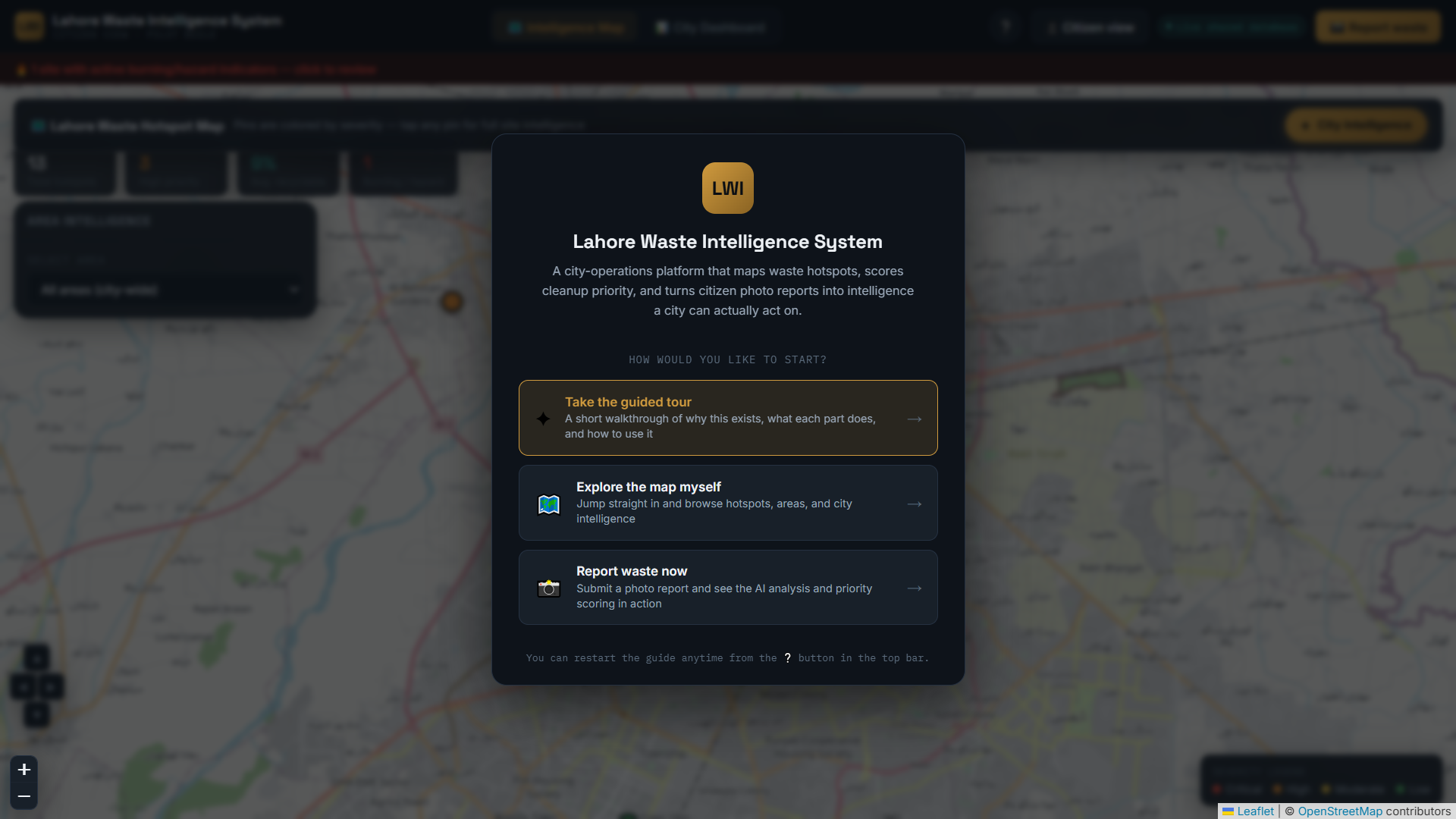
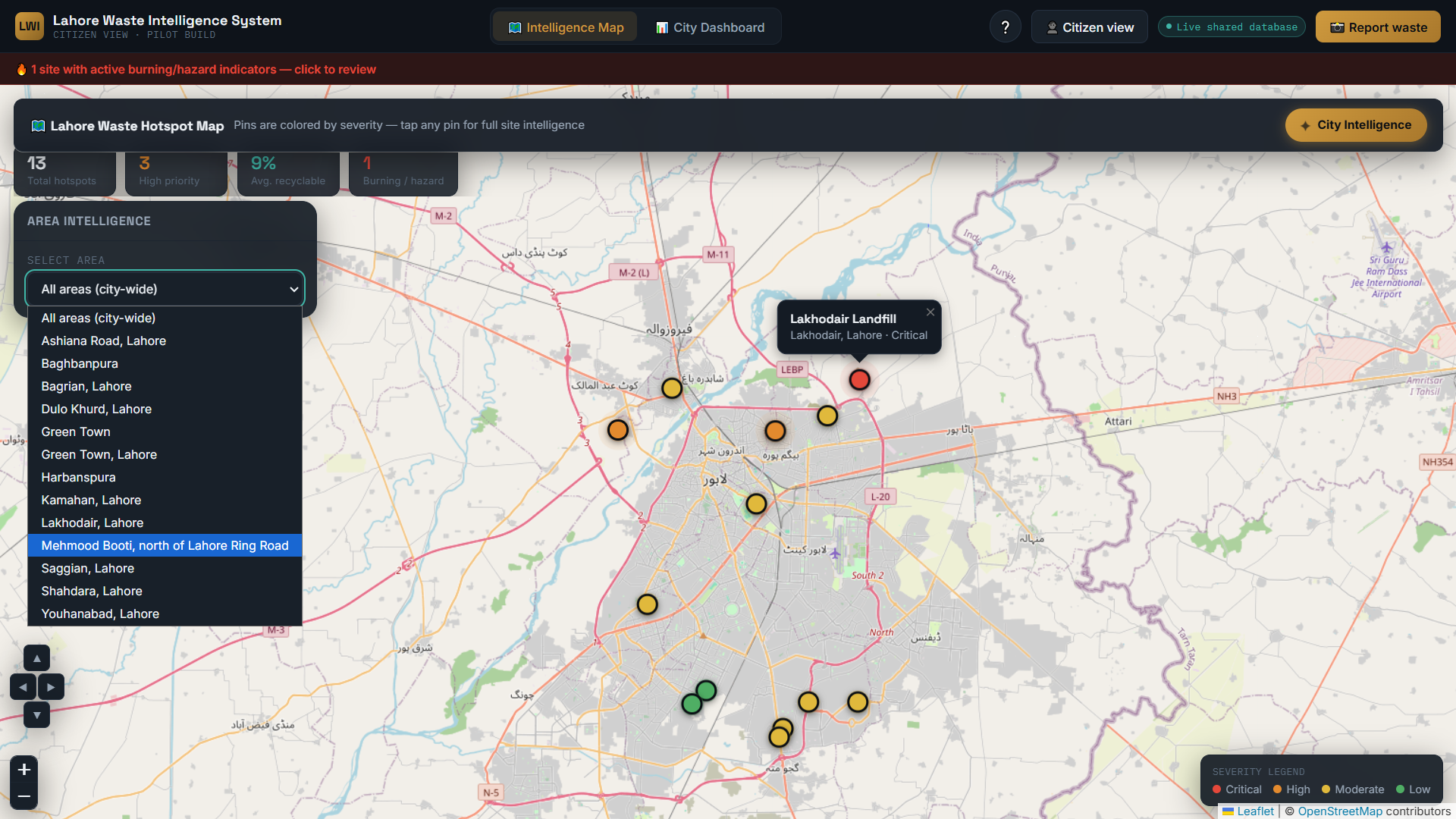
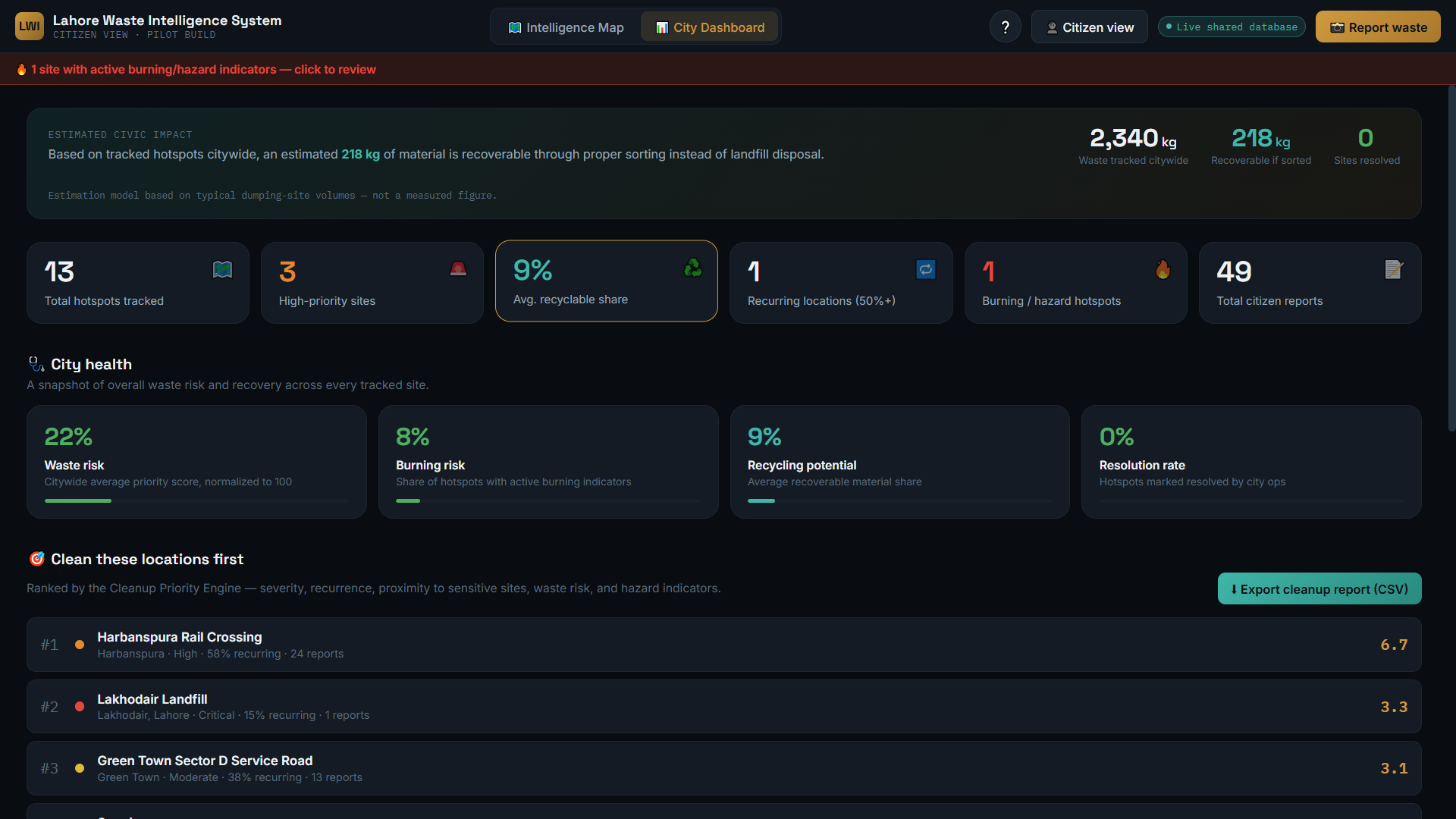
The Lahore Waste Intelligence System is an AI-powered urban intelligence platform designed to help understand, visualize, and prioritize waste-related problems across Lahore.
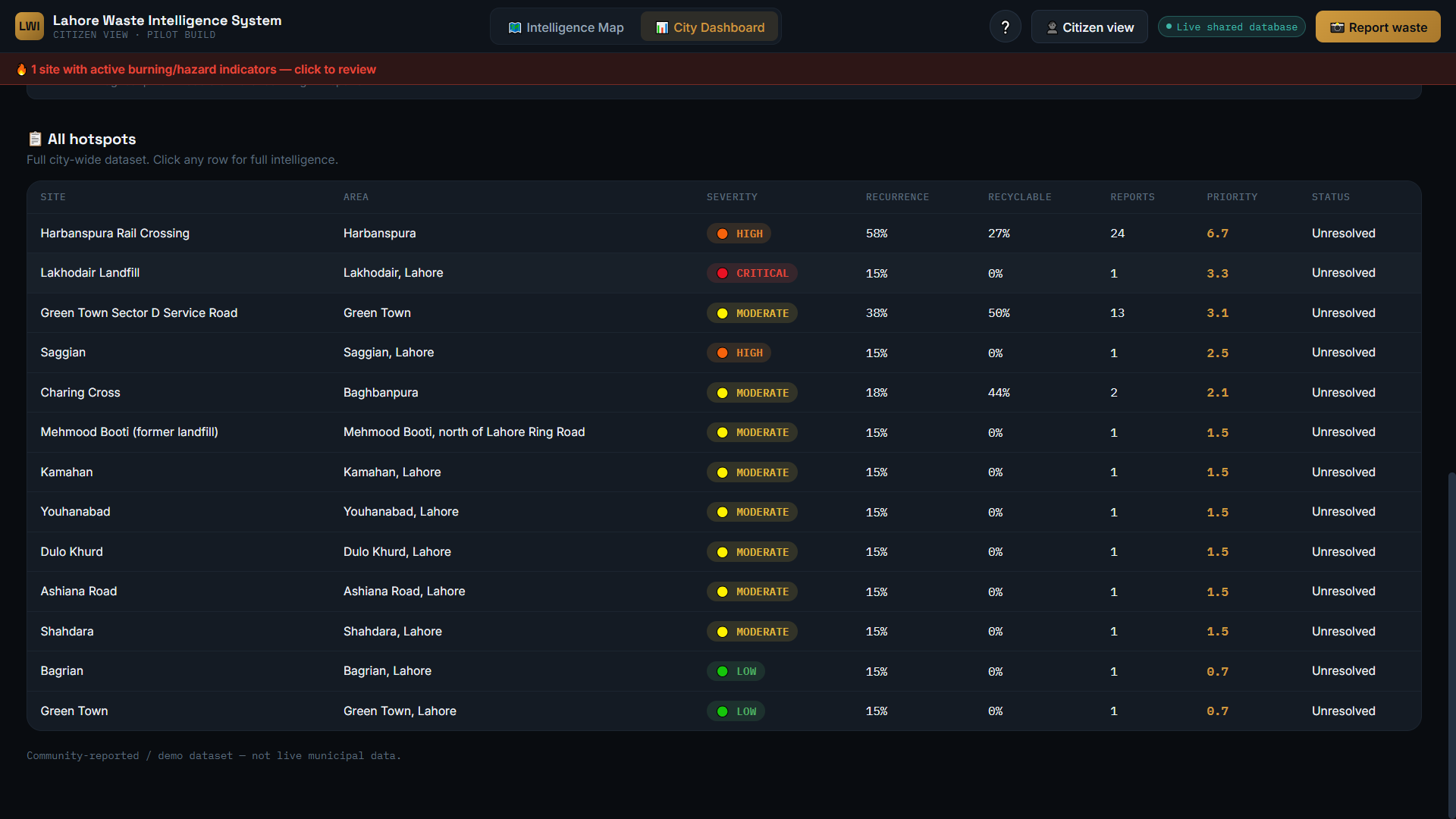
The system combines real-world data, structured SQL storage, geographic intelligence, AI-assisted analysis, and citizen-generated reports into a unified interface.
Its core capabilities include:
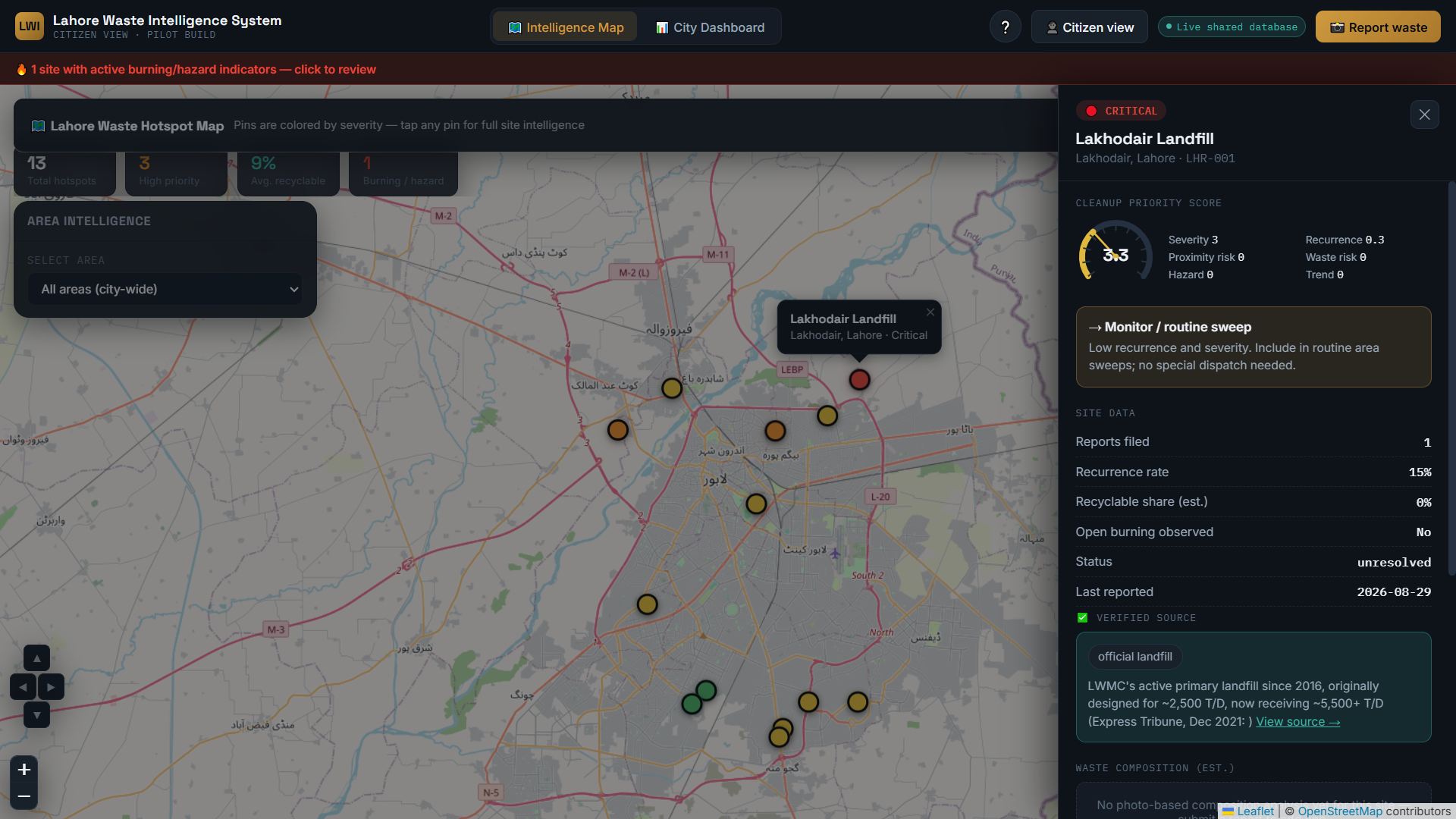
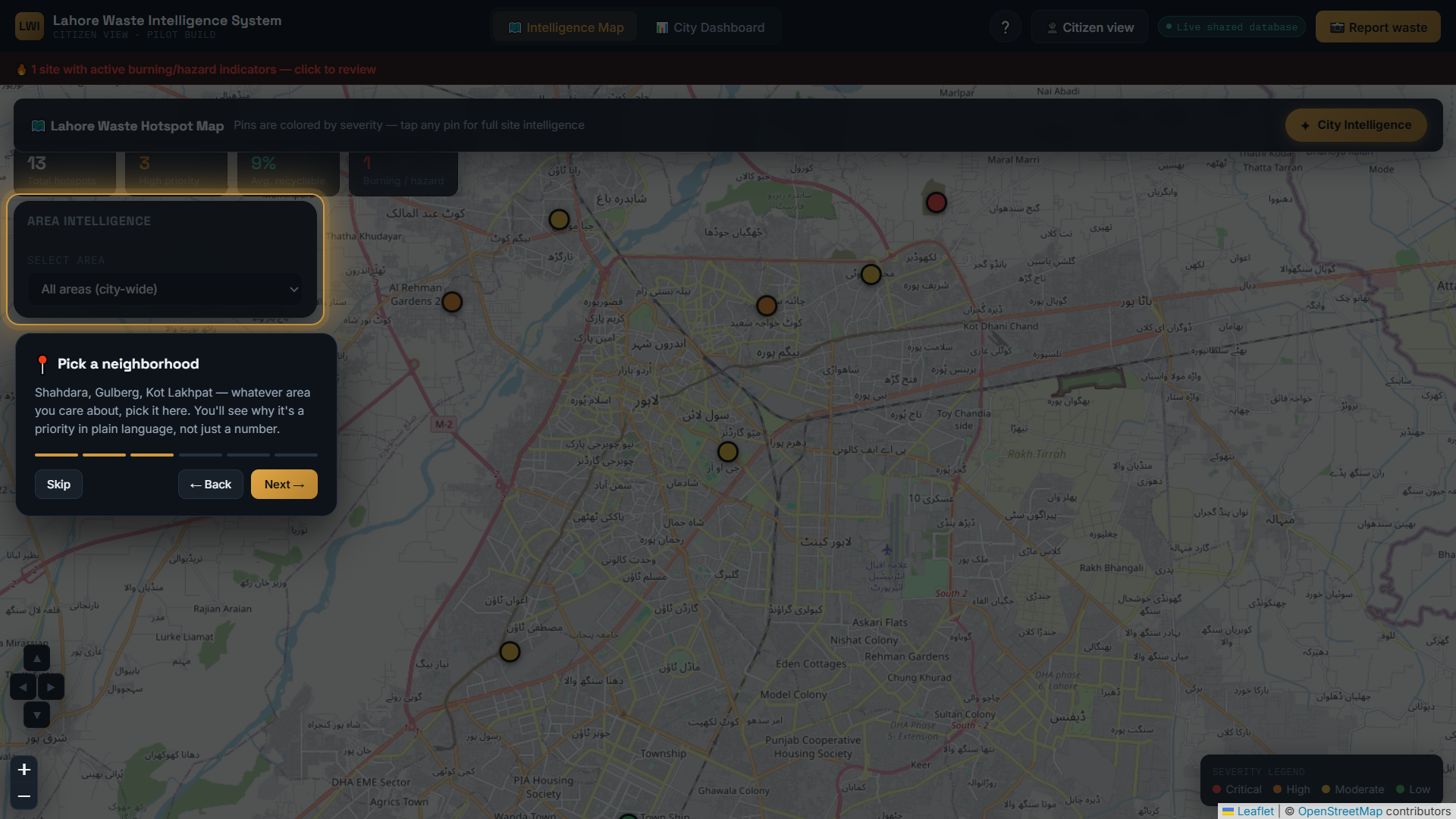
- Lahore Intelligence Map — visualizes waste-related conditions and hotspots geographically.
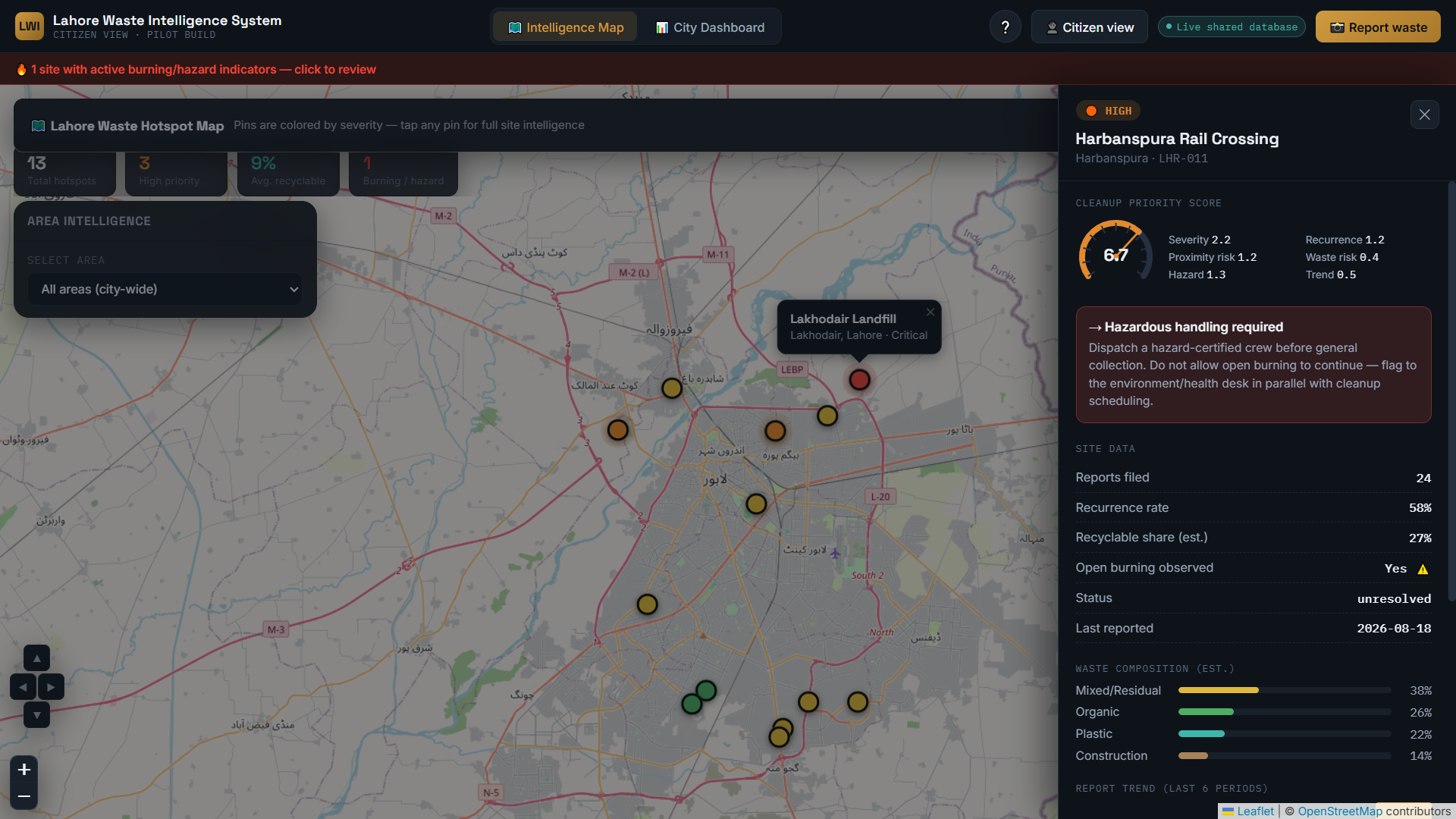
- Area Intelligence — enables users to examine waste conditions at an area level rather than relying solely on city-wide averages.
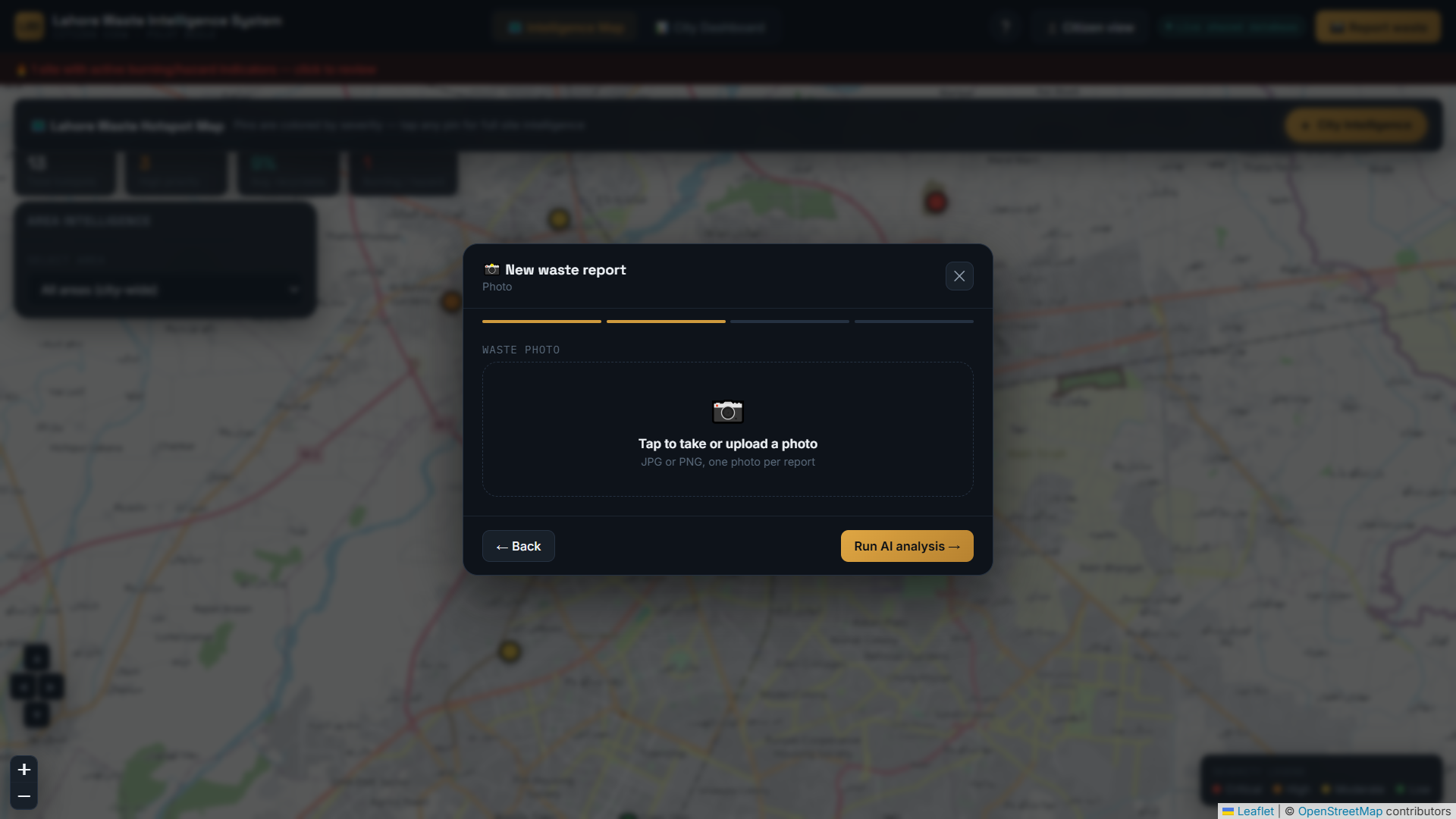
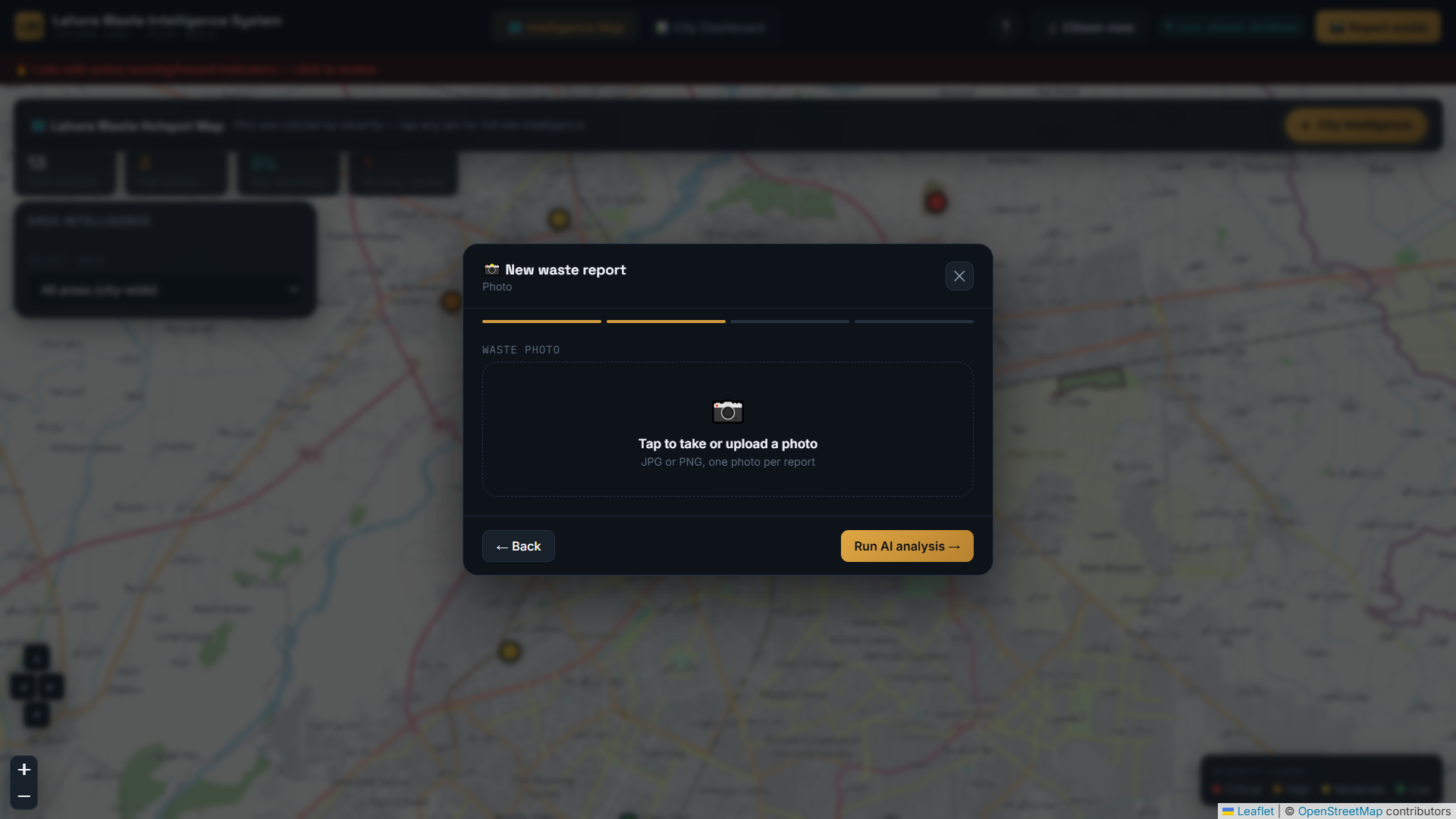
- Citizen Reporting — allows residents to submit waste-related reports, including photographic evidence.
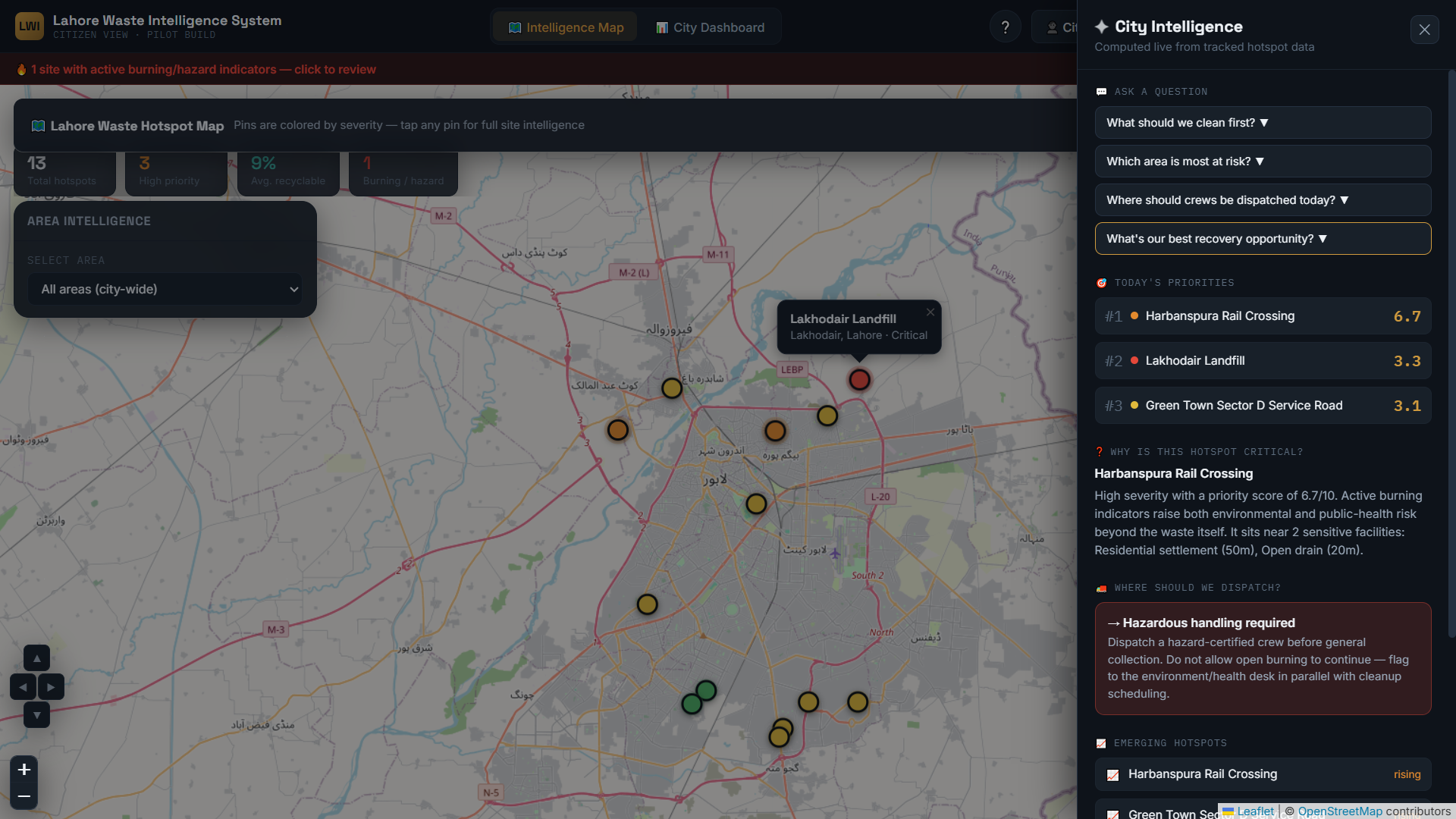
- AI-assisted Waste Analysis — interprets submitted images and information to identify relevant waste characteristics.
- Action Recommendations — converts detected problems into suggested responses rather than merely recording complaints.
- SQL-backed Data Infrastructure — provides a structured foundation for querying, analysis, and future scalability.
- Report Management — submitted reports become structured intelligence that can contribute to understanding recurring and geographically concentrated problems.
The central philosophy is:
Report → Analyze → Understand → Prioritize → Act
Rather than treating every complaint as an isolated event, the system is designed to transform individual observations into a broader intelligence picture of the city.
How we built it
The project was developed as a full-stack web prototype combining a modern user interface with structured data infrastructure and AI-powered analysis.
A significant part of the development process involved incorporating real Lahore-relevant data rather than relying exclusively on fabricated demonstration values. This allowed the platform’s visualizations and intelligence layer to be grounded in information relevant to the actual urban environment the system is intended to address.
The underlying data architecture was upgraded to SQL, allowing information to be stored, queried, and managed systematically rather than being treated as static frontend content.
The platform also contains a functional reporting workflow. Citizens can submit waste-related reports, including photographs, creating a mechanism through which the system can continuously receive new observations from the environment it is attempting to understand.
At the intelligence layer, AI assists in interpreting submitted waste information and converting unstructured observations into information that can contribute to prioritization.
The architecture is built around one principle:
A smart-city platform should not simply display data—it should establish a pipeline through which data becomes decisions.
Data → Intelligence → Prioritization → Action
Challenges we ran into
The most significant challenge was data authenticity and availability.
It is relatively easy to create an impressive-looking dashboard using arbitrary numbers. It is considerably harder to build a credible civic-technology prototype when the objective is to represent a real city with real constraints.
Lahore is a complex urban environment, and obtaining sufficiently granular, standardized, continuously updated waste-management data is a substantial challenge. Rather than concealing that limitation, I treated it as part of the engineering problem itself.
This required distinguishing between verified/publicly available information, citizen-generated observations, and future data sources that could be integrated through partnerships with municipal authorities.
Another challenge was designing a system that could evolve beyond a demonstration. Moving the underlying architecture to SQL was an important step in that direction, because a serious city-scale intelligence platform cannot depend indefinitely on hardcoded or static information.
The final challenge was converting information into something operationally meaningful.
A map full of red markers may look impressive, but it does not necessarily solve a problem.
The more important question became:
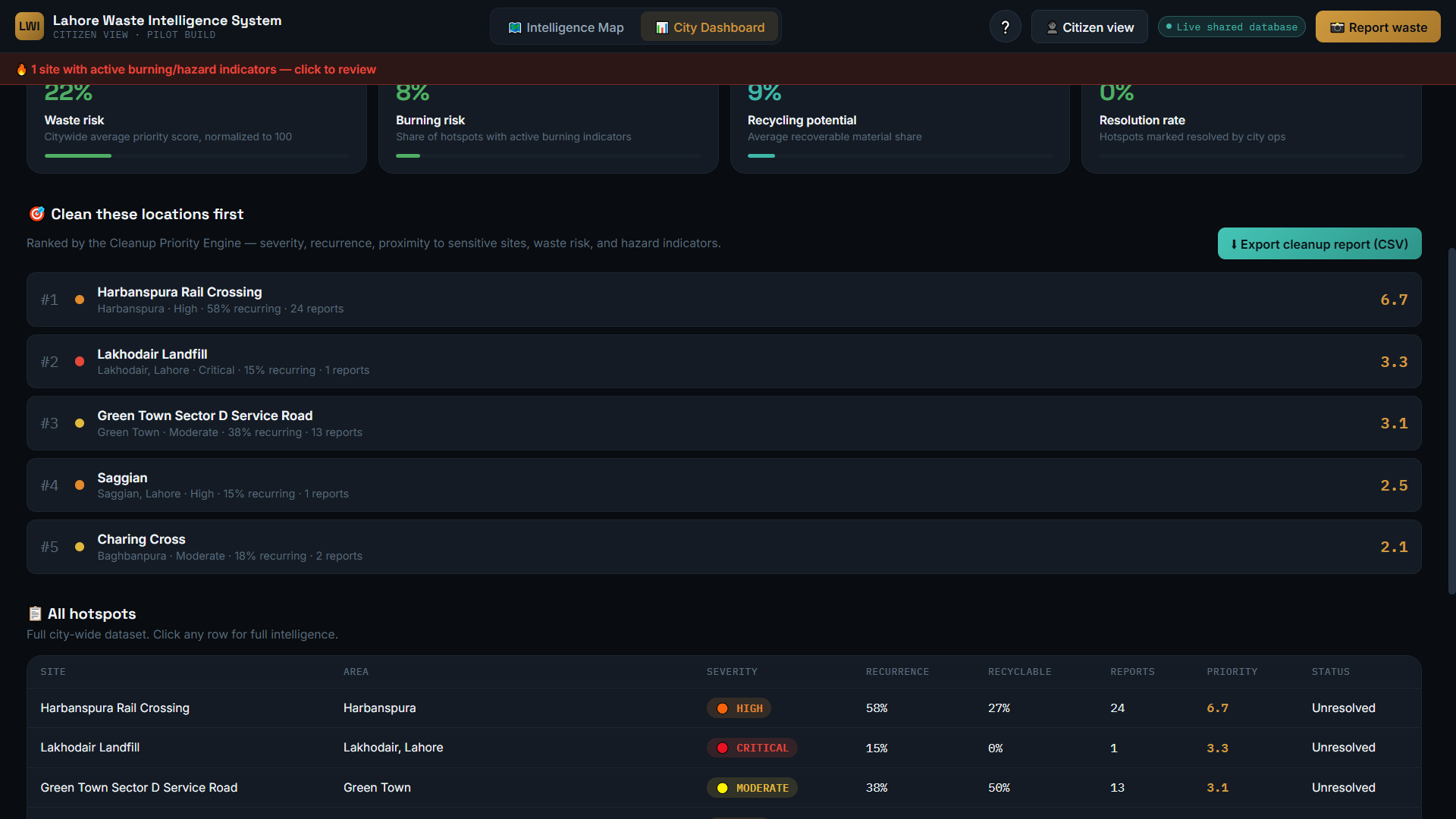
Which problem deserves attention first—and why?
That question influenced the system’s emphasis on area intelligence, reporting, analysis, and prioritization.
Accomplishments that we're proud of
I am proud that this project progressed beyond a conceptual smart-city idea into a functional, data-backed prototype.
We incorporated real Lahore-relevant data, implemented SQL-based data management, developed a working reporting workflow, and connected these components through a unified intelligence interface.
More importantly, the project represents a deliberate attempt to solve the problem at a systems level.
A conventional waste application might allow someone to report an overflowing bin.
The Lahore Waste Intelligence System asks a fundamentally different question:
What can we learn when thousands of observations are treated collectively as intelligence about the city?
That distinction is what I consider the project's most important accomplishment.
I am also proud that the project was built with a specifically Pakistani context in mind. Rather than taking a generic smart-city concept and simply changing the city name, the system is being shaped around Lahore’s actual environment, data constraints, and civic realities.
What we learned
The project taught us that AI is not the solution by itself.
AI becomes genuinely useful when it is embedded within a reliable information pipeline containing meaningful data, structured storage, contextual interpretation, and a mechanism for turning insights into action.
We also learned that civic technology carries a different standard of responsibility from a conventional consumer application. When a system is intended to influence decisions affecting real communities, it becomes essential to distinguish between what the data demonstrates, what the system estimates, and what still requires human verification.
Technically, moving toward SQL fundamentally changed how we approached scalability and data architecture.
Conceptually, however, the most important lesson was simpler:
A smart city is not created by putting more information on a screen. It is created by helping people make better decisions with information.
What’s next for Lahore Waste Intelligence System
The long-term vision extends far beyond the current prototype.
The next stage would involve establishing stronger integrations with official municipal and government datasets, continuously incorporating verified citizen observations, and developing a more sophisticated intelligence layer capable of identifying temporal and geographic patterns.
Future iterations could introduce:
- Real-time waste hotspot monitoring
- Historical trend analysis
- Predictive hotspot forecasting
- Waste collection route optimization
- Ward-level performance intelligence
- Automated severity and priority scoring
- Advanced computer-vision-based waste classification
- Duplicate and unreliable report detection
- Before-and-after verification of reported issues
- Municipal workflow integration
- City-wide analytics and decision-support tools
The ultimate objective is to create a closed-loop civic intelligence system:
Detect → Analyze → Prioritize → Dispatch → Verify → Learn
In that model, every resolved problem can become additional intelligence for improving future decisions.
My ambition is not simply to win a hackathon with a compelling interface.
I want this project to demonstrate that young Pakistani builders can use modern AI and data infrastructure to address problems that matter at home.
Lahore is only the starting point.
If this model can be developed, validated, and eventually deployed effectively in Lahore, the underlying approach could be adapted to other Pakistani cities facing similar urban-management challenges.
I built this because I am a Lahori and a proud Pakistani.
But the ambition behind it is broader: to build technology that contributes something meaningful to Pakistan.
Built With
- api
- data
- functions
- geospatial
- groq
- javascript
- leaflet.js
- llama
- nominatim
- openstreetmap
- pbs
- postgresql
- punjab
- react
- react-leaflet
- rest
- scout
- serverless
- supabase
- unit
- urban
- vercel
- vision
- vite

Log in or sign up for Devpost to join the conversation.