Inspiration
Cities are layered, messy, and full of tradeoffs. Planning work often means jumping between maps, 3D tools, spreadsheets, and scattered feedback.
AI can generate ideas quickly, but a nice-looking idea is not automatically trustworthy.
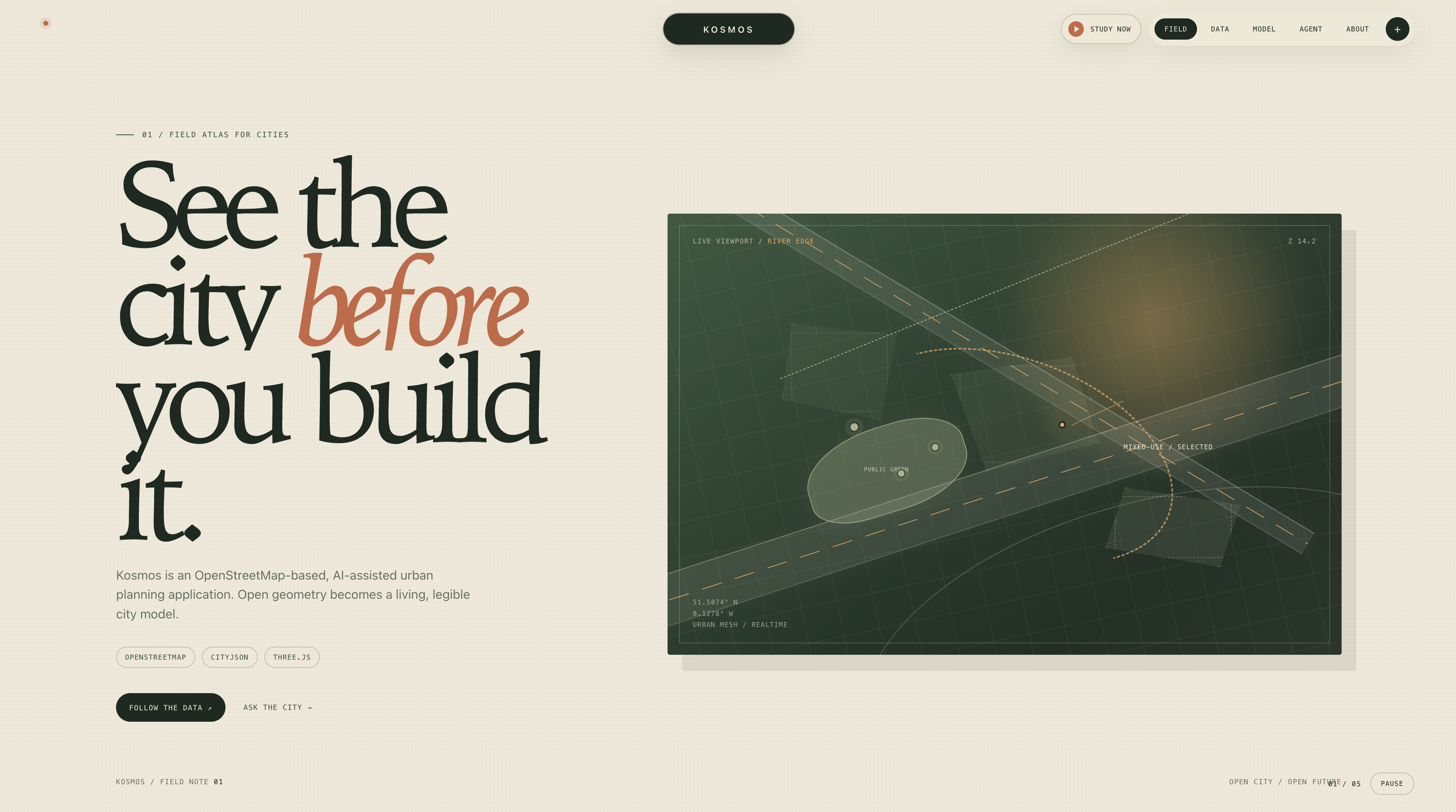
Kosmos is the missing middle: a place where AI can help imagine better cities while people can inspect the evidence, question assumptions, approve changes, and undo decisions.
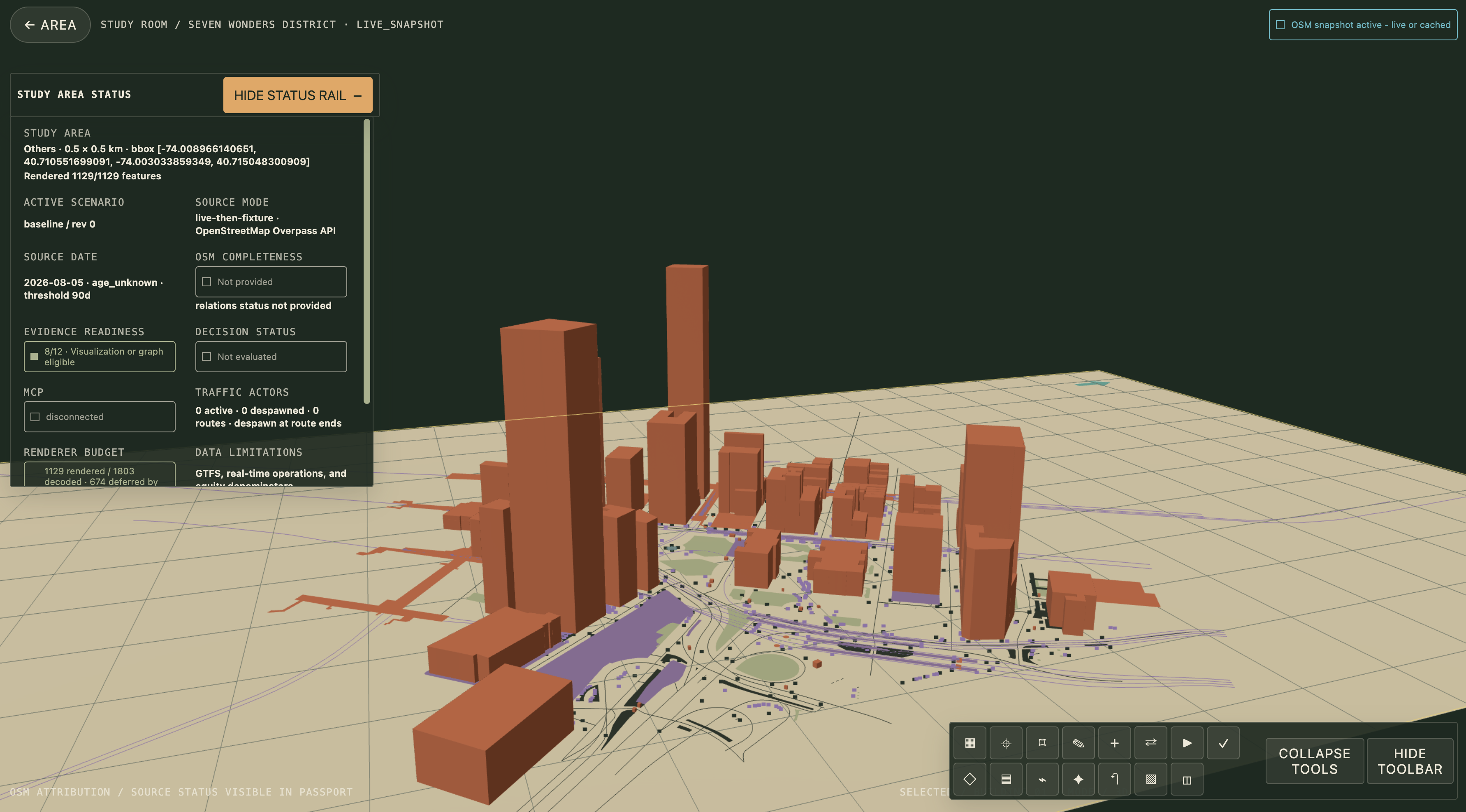
For the demo, we created the Seven Wonders District, transforming a city snapshot into a landmark, public garden, planted streets, pedestrian links, and transit-oriented spaces.
What it does
Kosmos turns a bounded city area into an interactive 2D and 3D urban study room.
Users can:
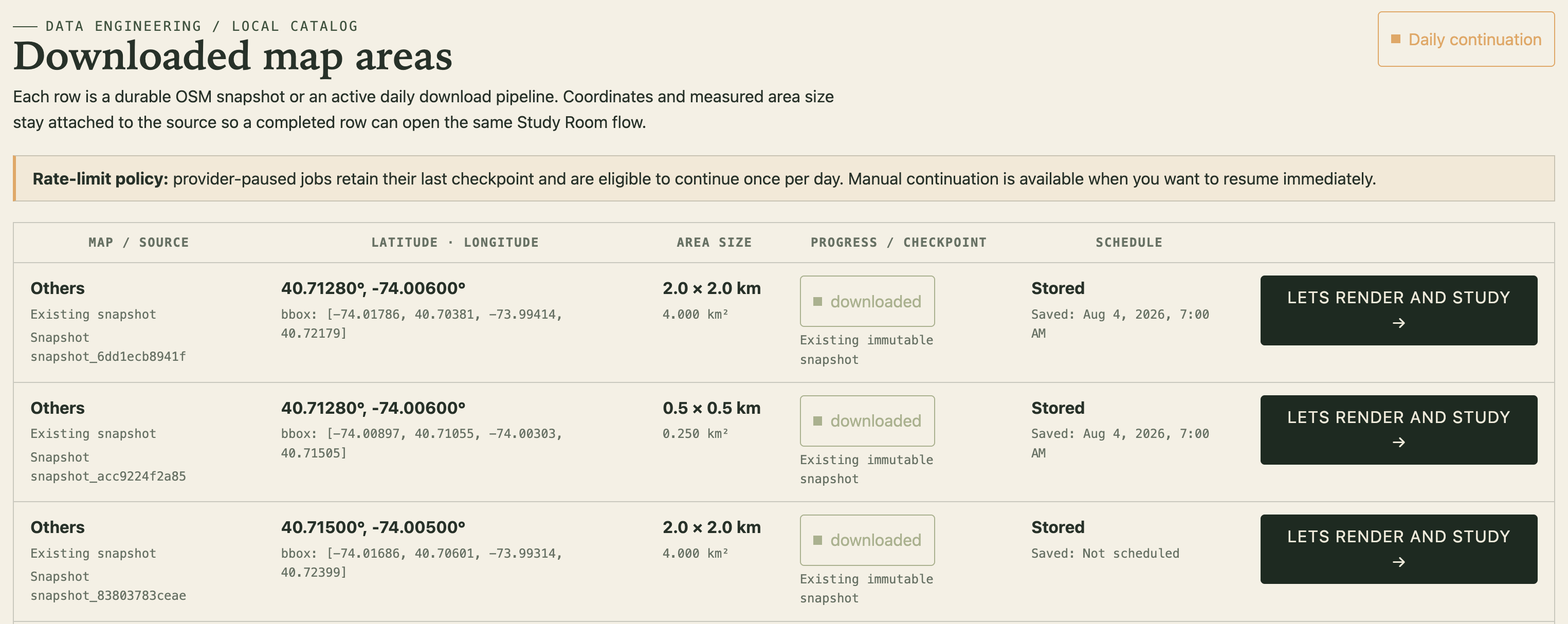
- Choose live OpenStreetMap data or a demo fixture.
- Explore buildings, roads, parks, water, transit, and crossings.
- Inspect where each object came from.
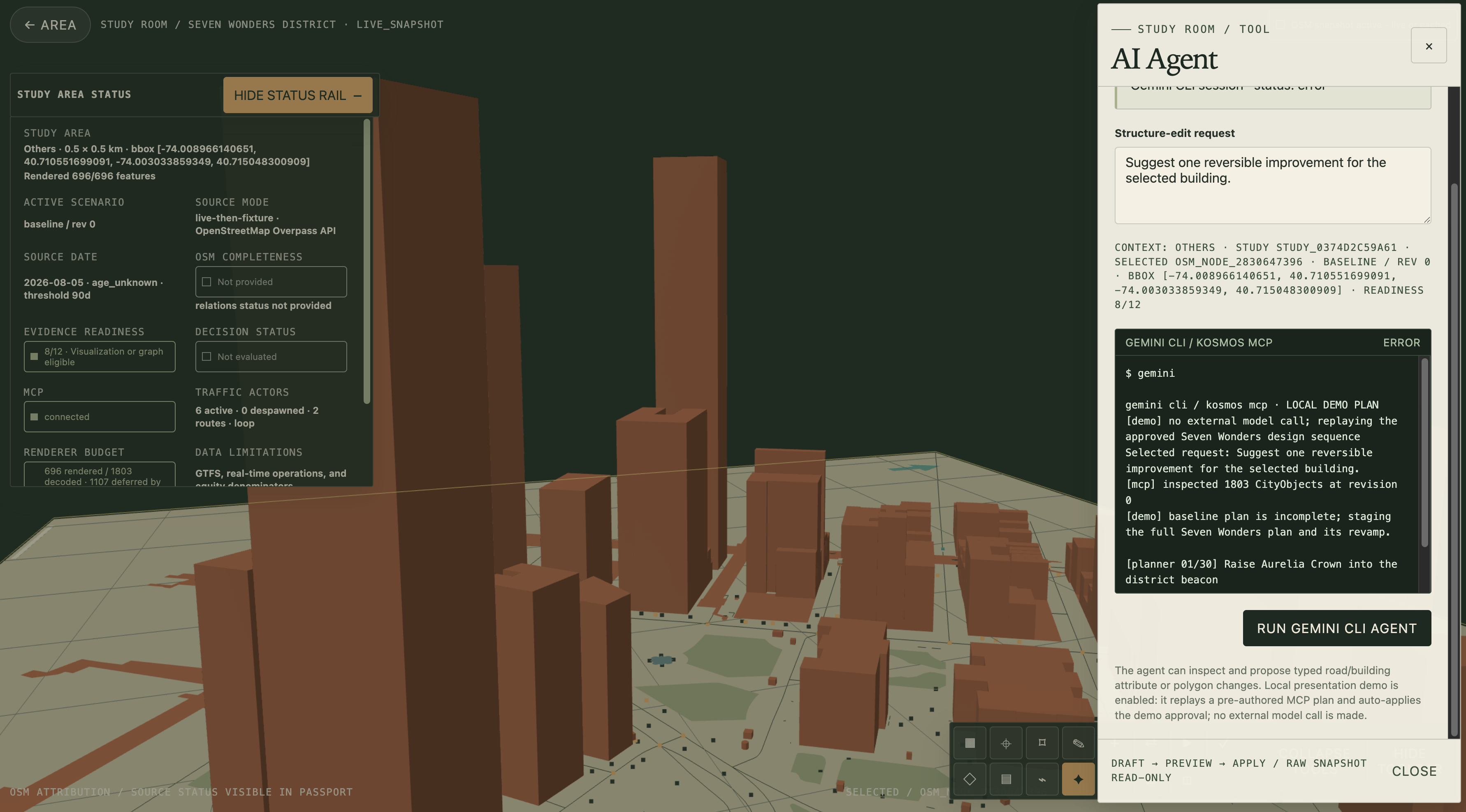
- Ask an AI/MCP agent for typed planning changes.
- Preview, approve, reject, undo, and compare changes.
- Export a Passport containing sources, approvals, versions, and limitations.
Kosmos makes cities editable without making them mysterious. Traffic and evaluation features are clearly labeled as planning proxies, not live digital twin predictions.
How we built it
- Python backend for bounded ingestion, OpenStreetMap data, CityJSON, scenarios, readiness, and evaluation.
- React, TypeScript, Vite, and Three.js frontend.
- Shared feature IDs between 2D and 3D views.
- Typed MCP adapter for AI suggestions and previews.
- Human approval before changes enter scenario history.
- Deterministic fixtures for ready, blocked, missing-data, and failure states.
- Optional Gemini/OpenRouter support, with a reliable local replay for the demo.
We also verified the project with backend tests, frontend typechecking, compilation checks, and a production build.
Challenges we ran into
Real city data is messy. OpenStreetMap relations can be incomplete, multipolygons need careful handling, and providers can fail.
We chose to preserve source IDs, show missing evidence, and fail visibly instead of inventing certainty.
AI also needed boundaries. That is why Kosmos uses typed previews, approval, rejection, undo/redo, scenario history, and exportable provenance.
Accomplishments that we're proud of
We built a complete path from city data to semantic model, interactive design, AI-assisted changes, human review, and export.
We are especially proud that:
- 2D and 3D views share the same city state.
- AI changes are reviewable and reversible.
- Missing evidence and failure states are visible.
- The Seven Wonders transformation is easy to understand in seconds.
- The demo is exciting, repeatable, and honest about what is simulated.
What we learned
Trust is not a footnote. It is part of the product.
A useful AI planning idea needs a source, an explanation, a preview, approval, and a way back.
We also learned that “evidence missing” is better than a confident-looking number built on weak assumptions.
What's next for Kosmos
Next, we want to connect Kosmos to deeper evidence such as traffic demand, transit performance, pedestrian accessibility, population data, equity metrics, and research-backed scenario models.
Today, Kosmos gives urban teams a better next draft: one they can see, question, approve, revisit, and carry forward.
Built With
- cityjson
- openstreetmap
- python
- react
- tanstack

Log in or sign up for Devpost to join the conversation.